Wednesday, December 28, 2016

Bald Eagle relieves Lake Erie of a fish!

I journeyed to one of my favorite Lake Erie haunts today, the city of Huron, in Erie County. The lakefront here features the mouth of the Huron River, and it is nearly always birdy. Even today, when the lake was placid, the skies were mostly blue, and winds were calm. Bad weather makes good birding, along Lake Erie.

After spending an hour or so at the far end of the municipal pier without seeing much in the way of avian diversity, I started the long plod back to the mainland. As I did, I began to hear the calls of Snow Buntings passing overhead. As nearby Nickel Plate Beach is often a good bunting locale, I figured some of the birds might have put down there, so it was off to the beach.
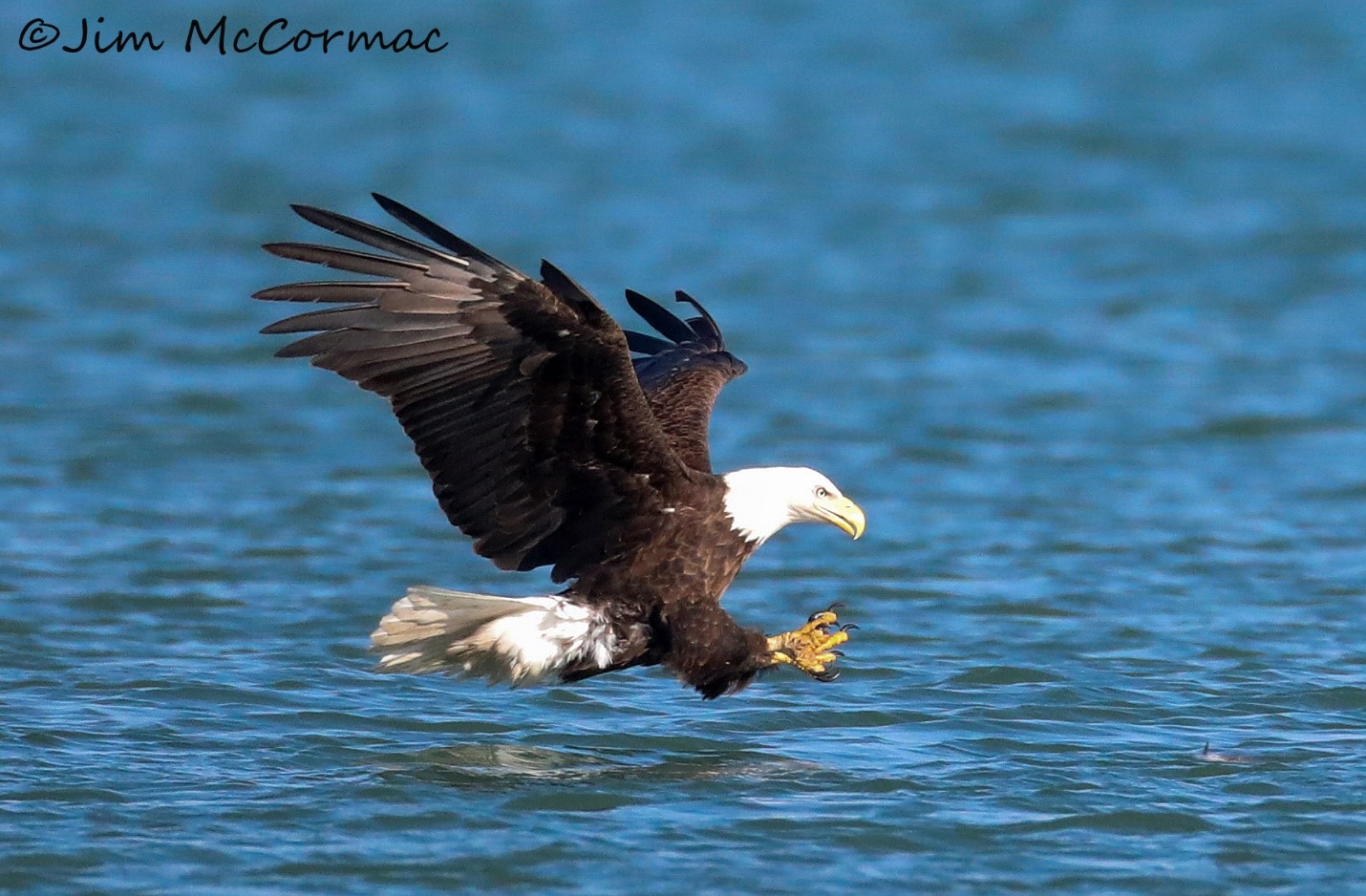
An adult Bald Eagle prepares to snatch a fish from the waters of Lake Erie. As always, click the photo to enlarge, and you'll see the victim swimming in the bottom right hand corner of the image. A millisecond after this photo was made, the eagle snatched the scaly treat.

All morning, Bald Eagles had been soaring about, occasionally putting up clouds of resting gulls. Both adults and juvenile eagles were around, and rarely was one not in sight. As I was stalking the sands of Nickel Plate Beach seeking buntings, I noticed an adult eagle coming near the beach. Just as I glanced over at it, the bird made a sudden careening dive for the surface, but missed the fish. Figuring he/she would try again, I got ready, and sure enough, in came the bird and this time it was not to be deprived its fish.

This image was two shots after the one above, and my camera's burst rate is about seven shots a second. The fish never knew what hit it.

Bald Eagles sometimes get a rap for being vulturelike and frequently noshing on carrion and other easy - dead - pickings. But they are highly adept fishermen, and I've seen scenes like this play out many times. I'm just not usually fortunate enough to be able to capture them with my camera.

Tuesday, December 27, 2016

Giant Leopard Moth cats on the prowl!

The caterpillar of the Giant Leopard Moth, Hypercompe scribonia, a bit sluggish but decidedly active at a temperature of 41 F. I saw four of these large caterpillars today in Hocking County, all crossing roads. I took the liberty of helping this one across the road, and temporarily posed him on some branches for a photo.

Giant Leopard Moth caterpillars overwinter in the larval stage, and on sunny days when the temperature rises somewhat above freezing, some will become active and commence wandering about. This one had a bit of mud caked on its bristles; it had undoubtedly been under leaves or wood. Because of the GLM cats' predilection for late season and winter wandering, they are often confused with the Woolly-bear by the larvally illiterate. The Woolly-bear, as you know, is the caterpillar of the Isabella Tiger Moth, Pyrrharctia isabella, and is fabled for its alleged ability to predict winter's severity, or lack thereof.

So, people seeing roaming GLM cats may presume it to be a very dark Woolly-bear, and thus predict an exceptionally harsh winter (the darker the Woolly-bear the more severe the winter). On the lighter side, another late fall/early winter wandering caterpillar is that of the Virginian Tiger Moth, Spilosoma virginica, the Yellow Bear. This larva is also similar to the Woolly-bear but is quite pale. Misidentifications of this animal result in predictions of a mild winter.

As the Woolly-bear as winter predictor is a demonstrably false myth, none of these larval identification challenges much matters.

I've written in more detail about Woolly-bears and larval forecasting RIGHT HERE.

Monday, December 26, 2016

Intricate ice patterns

Intricate ice patterns formed in a frozen pond, Alley Park, Fairfield County, Ohio. Christmas Day. Much of the surface of this several acre pond was etched in ornate patterns; the effect was quite striking. Photographically, one hardly knew what to focus on as the potential compositions were endless. I finally settled on this piece, for this post.

Thursday, December 22, 2016

The Merlins of Union Cemetery

The open, savanna-like habitat of Union Cemetery, with its wide open spaces punctuated by scattered large trees. This cemetery, in Columbus, Ohio, straddles Olentangy River Road just south of Riverside Hospital, and is only a ten minute drive from my house.

Union Cemetery is also excellent habitat for wintering Merlins, and one or two have taken up residence here for several years. I had seen numerous reports and photos of the tough little falcons, and finally had a run at them a few days ago.

Upon entering the cemetery (the section on the east side of Olentangy River Road), it took all of a minute or so to spot one of the burly little falcons. Merlins have little of fear of anything, from what I have seen, and are prone to perching on conspicuous limbs as this animal is doing.

For a moment, she deigned to glance my way. This was about all the attention I received. If you are not food, or a threat, you are utterly inconsequential to the Merlin. To be fair, a person could and would flush the bird if too close of an approach is made, but Merlins are quite tolerant of observers, even at fairly close range.

One of my goals on this day was testing the new Canon 5D IV, and thus far I am very pleased with the results. While the improvements over its predecessor, the 5D III, are evolutionary rather than revolutionary, they are substantial. Canon bumped up the burst rate about two shots a second, and seemed to make big improvements in focus acquisition. It also has a much larger 30 megapixel sensor. I look forward to more work with this camera. This Merlin was the first bird that I've shot with the 5D IV, but there will be many more I hope.

After a rest period, she took to the air. Merlins in flight are amazing, especially when they are hot on the trail of a songbird, their main prey. Speedy and bulletlike, the muscular falcons are astonishingly agile, and capable of fantastic burst of acceleration.

I was a bit worried about this Red-breasted Nuthatch, and his mate. The two were working large spruce trees in the immediate vicinity of the resting Merlin, and (in my opinion) foolishly kept flying between trees. Each time they did, the Merlin locked its laser-like eyes on them and followed every move. The slow little nuthatches would seemingly be easy prey for the falcon as they crossed open airspace, but it never made a move on them.

Maybe the Merlin ignored the nuthatches because it was preparing to wage war against the local Blue Jays. The jays did not like the Merlins (another was present) and scolded them, often flying near to make their protestations better heard. A jay would be wise to take these raptors seriously. In this shot, the Merlin has just barreled around the top of a spruce, and nearly whacked the jay, which can be seen at the bottom right of the image fleeing for all its worth. The jays were the recipients of many a chase while I was there, but all came out with feather intact. That's not always the case, though.

Merlins are great photographic subjects, because of their approachability, and penchant for stretching and various gymnastics. If one is patient, a resting Merlin is eventually sure to strike an interesting posture like this.

Populations of this falcon are on the upswing, and we are seeing more of them each year wintering in Ohio. They are fixtures in many of our large urban cemeteries, and there have even been two modern nesting records. I suspect more nesters are to follow, and some of them will likely utilize cemeteries such as this one.

Monday, December 19, 2016

Ubiquitous gray squirrel an acrobat - and a thief

A hungry gray squirrel dines in a box-elder/Jim McCormac

December 18, 2016

NATURE
Jim McCormac

One of the most widespread, familiar mammals in Ohio is the gray squirrel.

They occur in the wildest woodlands and the most urban parklands, the common denominator being trees.

Gray squirrels are a fixture of suburbia, and many bird lovers have waged war against the wily seed-stealers. Keeping gluttonous squirrels off backyard feeders involves both a battle of wits and superior engineering. Homeowners often lose.

It sometimes seems as if the animals have Velcro paw pads. A squirrel racing through the trees at full tilt makes for a spectacle. Running full-barrel up and down trunks, and racing across spindly limbs, the beasts make wild, death-defying, branch-to-branch leaps that would put any circus performer to shame.

The range of the gray squirrel delineates that of the great eastern deciduous forest, which once stretched from the Atlantic Ocean to the Mississippi River, south to the Gulf of Mexico and north to southern Canada. Before settlement, this was probably the second most numerous squirrel in the East. The secretive, nocturnal southern flying squirrel was likely even more common.

A healthy gray squirrel is a handsome animal. Taping out at nearly a foot in length, a squirrel’s length doubles if the thick, brushlike tail is added. A healthy specimen might tip the scales at a pound and a half.

While the coat normally lives up to the squirrel's name — grayish with a white underbelly — color variants are not uncommon. Occasional albinos sometimes become conspicuous celebrities. In some areas, many or most squirrels are melanistic, or black. The Columbus area has small pockets of black squirrels, but it seems that in places like Kent, most gray squirrels are black.

Rural squirrels tend to be far warier than their citified brethren, and they serve vital ecological roles. They harvest and stash a wide variety of tree fruit, some of which will be forgotten and sprout new trees. While acorns, walnuts and other large woody nuts are favored, squirrel diets are quite varied.

The squirrels themselves often become meals. Large raptors such as great horned owls and red-tailed hawks are fond of squirrel meat. Foxes, bobcats and even big black rat snakes also take them.

Squirrel hunting is popular with some people, too, and many gray squirrels are harvested annually in Ohio. Partly because of reasonable bag limits, hunting doesn’t affect populations of this prolific breeder, but that wasn’t always the case. The earliest settlers often had crops ravaged by large numbers of raiding squirrels. One squirrel reduction hunt in 1822 killed nearly 20,000 animals.

Now that the leaves have fallen, basketball-sized leafy clusters high in trees become conspicuous. They are dreys, or squirrel nests. The animals use these botanical forts to raise young and as shelter during cold winter days and nights. Sometimes, multiple animals live in a drey, and their collective body heat can raise the internal temperature far beyond that outside.

Naturalist Jim McCormac writes a column for The Dispatch on the first, third and fifth Sundays of the month. He also writes about nature at www.jimmccormac.blogspot.com.

Tuesday, December 13, 2016

Gargantuan Sycamore, in ghostly light

While exploring the artwork of the Chinese Lantern Festival photo-documented in the previous post, I was struck by the more natural beauty of some of the massive Sycamores, Platanus occidentalis. These trees predate the natural resources park where they grow, and I would imagine also the Ohio State Fairgrounds upon which they are located. I could not resist making a few images of one tree in particular.

Lights from the various lantern displays below cast a strange luminescence on the upper boughs of this huge Sycamore. I would have loved to have created an image of the entire tree, but just below the bottom of the photo, lamp posts, the edge of a building, and other manmade intrusions lurked.

The moon, partially obscured by hazy clouds, framed by the upper limbs of the Sycamore.

Sycamores rank high among our most valuable trees, and I can't believe I've never written about this species, either here, or in my Columbus Dispatch newspaper column. I'll have to do something more detailed about the wonders of this super tree.

Monday, December 12, 2016

And now, for something completely different: Chinese Lantern Festival!

Going off the reservation a bit with this post, to be sure. If you're looking for something totally different, visit the Chinese Lantern Festival at the Ohio State Fairgrounds in Columbus. Despite thinking that it sounded hokey, a friend and I went down there Saturday night. Fortunately, I had a lot of camera gear with me, as we'd been doing some shooting outdoors earlier in the day. It was great fun, and offered photo subjects of a very different sort (than what I usually shoot).

All the festival details can be found RIGHT HERE.

The event fills the Natural Resources Park at the southeast corner of the fairgrounds, and this massive dragon greets visitors soon after entering the park.

A group of pandas was popular with onlookers. There are hundreds, if not thousands, of intricately crafted and artfully illuminated lantern effigies scattered throughout the park.

A giant peacock struts near some magical mushrooms.

A trip of cheetahs gallops past a giraffe.

An especially colorful butterfly.

Interesting acts take the stage at regular intervals. This man was impossibly acrobatic with that massive urn; he played it better than a Harlem Globetrotter does tricks with a basketball.

A school of fish swims by.

A few trellis-framed walkways were adorned with showy hanging lanterns.

Pearls sit in an oyster.

A flowery walkway.

A frog sits among water-lilies.

Back to regularly scheduled programming soon!