
Showing posts with label leucistic. Show all posts
Showing posts with label leucistic. Show all posts
Monday, April 8, 2024
A white Eastern Gray Squirrel


Monday, May 30, 2022
Nature: Patchwork-patterned piebald robin with mostly white head an astonishing creature
%20copy.jpg)
A piebald male American robin/Jim McCormac
Nature: Patchwork-patterned piebald robin with mostly white head an astonishing creature
Columbus Dispatch
May 29, 2022
May 29, 2022
NATURE
Jim McCormac
Jim McCormac
The American robin is widespread and ubiquitous, the most common native bird in Ohio. Other than in winter —and sometimes even then! — it is likely to be one of the first birds encountered when stepping outside.
Male robins deliver a rich warbling carol that is a pervasive part of the avian soundscape. Everywhere one goes — urban park, backyard, the wilds of Shawnee State Forest, Lake Erie islands — there are robins. Over 4 million of them in Ohio. Nationwide, there are 370 million robins.
Birds as abundant as the robin can quickly become background blur. We get bored with them, another humdrum robin hopping on the lawn. That’s a shame, as the American robin is one of our handsomest songbirds. Were they great rarities, birders would drop everything and come running if one made a showing.
Even I — an avowed fan of the burly extroverted thrush — must admit to ignoring robins on occasion. However, I did quite the opposite when the odd robin that is this column’s protagonist came to light.
In early May, I was in southern West Virginia helping to lead trips as part of the New River Birding & Nature Festival. This region is awash in interesting and uncommon birds — broad-winged hawks, yellow-billed cuckoos, over 30 warbler species including rare cerulean and Swainson’s warblers, scarlet tanagers, rose-breasted grosbeaks and many more.
Even the palette of thrushes, including Swainson's, gray-cheeked, and wood thrushes, and veery, out-exotic their familiar stablemate, the robin.
However, when longtime festival attendees Don and Karen Stose of Clayton, Ohio, showed me a photo they had taken of a very unusual robin I was all ears. The bird had appeared the day before at their campground near Fayetteville. I asked them to call or text if it appeared again, and I’d try to get there ASAP.
Don rang the following day proclaiming, “It’s here!” Fortunately, we were just back from a field trip, and I made it to the campground in 10 minutes. The first bird I saw upon entering the facility was the gorgeous variegated bird, which promptly flew into a woodlot and out of photo range.
I sat with Don and Karen to wait him out. The allure of nearby turf grass was irresistible and the robin soon appeared on the lawn, posing like a supermodel.
The robin's aberrant coloration is caused by a genetic condition known as leucism (loo-siz-em). Defects in pigment cells cause afflicted animals to become whitish, or more commonly, a mix of whitened zones along with normally pigmented areas. The latter are often referred to as "piebald," although the patchwork pattern is formally known as hypopigmentation. White-tailed deer are perhaps best-known in this region for producing piebald offspring.
Leucism should not be confused with albinism, a different genetic anomaly in which the eyes become pink. Leucistic animals retain normally colored eyes.
The leucistic robin was a stunning creature with its mostly white head and upper breast dappled with charcoal scalloping. Scattered white patches adorned other parts of its body. Even the most jaded robin-watcher would drop his or her jaw in amazement at this bird.
Manifestation of leucism is a numbers game. The more individuals in a species, the more likely it will manifest. Thus, leucistic robins, red-winged blackbirds, white-tailed deer and other abundant species appear with some regularity.
Other than possibly making the robin more noticeable to would-be predators, leucism probably doesn’t affect its well-being. Here’s hoping this robin survives, thrives and astonishes other observers.
Naturalist Jim McCormac writes a column for The Dispatch on the first, third and fifth Sundays of the month. He also writes about nature at www.jimmccormac.blogspot.com.
Monday, May 9, 2022
A piebald robin

As always, click the photo to enlarge
A striking leucistic American Robin. The animal has a genetic condition that suppresses melanic pigments, creating a "piebald" effect. Karen and Don Stose, attendees at the New River Birding & Nature Festival, found this bird and tipped me to it. It was but ten minutes from where I'm staying, so off I went for a look. And I'm glad that I did, even though more exotic fare such as Swainson's Warbler was close at hand. Fayetteville, West Virginia, last Friday.
Friday, February 14, 2020
A pair of dashing cardinals, and Albert the white-headed jay, in snow
Yesterday dawned cold and snowy. It was one of very few snowfalls in central Ohio this winter, and perhaps the best to date. I was stuck at home, working on a book project, but what is life without birds and photography? So, as soon as it was light enough, I took some snaps while the snow still clung to the branches. Albert, the gorgeous white-headed blue jay, was my main quarry but lots of other subjects presented themselves, including these cardinals.

Because this is such a common songbird, it's possible to become jaded to cardinals. Never let that happen. It hardly seems possible that such a gorgeous, exotic-looking animal could be in our midst.

Here's the crimson fellow's mate. She looks fabulous too. Just in a more understated way. The lengthening days have stimulated cardinals to increase their singing. It's a beautiful whistled song often described as "cheery". And that it is. If you have the time to look, it's always worth glancing around to locate the singer. I constantly do this, with all singing birds, as it's a great way to keep honing your ability to rapidly find birds. But there's another possible reward for finding singing cardinals. It might be the female that is singing! They don't sing as often as males, but when they do it's every bit as melodic and artful as the male.

And here he is, Albert, "my" amazing blue jay! He's looking at me as if to say, "what have you done!", in reference to the snow. As he was born last year, this is his (I don't really know if it's a him or her, but with a name like Albert, I'll go with him :-)) first winter. And first exposures to snow.
Albert remains a fixture, bombarding the feeders for unshelled peanuts and other seed every day, especially in the morning. The morning that I made this image, I replenished the feeders shortly after daybreak, and Albert was out there berating me for moving too slowly. He's quite bold, as jays are, and freely speaks his mind. I have been pleased to see that he does not allow the "normie" jays to push him about.
This special white-headed jay has been here for over a month now, and it'll be interesting to see how long he remains.
Wednesday, February 5, 2020
Albert the white-headed blue jay appears in video

A short video of Albert feeding his face. Albert excels at feeding his face. Shot this morning near the backyard feeders. Worthington, Ohio.
Monday, February 3, 2020
Nature: Genetics play role in blue jay's lack of blue

An unusual white-headed blue jay prepares to visit the writer's feeders/Jim McCormac
NATURE: Genetics play role in blue jay's lack of blue
February 2, 2020
NATURE
Jim McCormac
In my last column, I wrote about an unusual melanistic fox squirrel. Although the average fox squirrel is dashing in tones of rufous and brown, this one is black. Dark forms of the eastern gray squirrel are well-known in Ohio, including Columbus, but melanin-enriched fox squirrels are far scarcer.
The dark fox squirrel turned up in my Worthington backyard on Jan. 9. Three days later, I glanced out the back windows and did a double-take. A blue jay with a white head was wolfing down seeds at the feeder.
I’m writing this column on Jan. 26, and both of these odd critters are still frequenting the yard. Sometimes at the same time, which makes for interesting wildlife-watching.
The squirrel looks as he/she does because of an excess of melanin, or dark pigment. It’s the opposite with the jay. He or she — it’s tough to impossible to determine sex in the field — lacks dark pigments only in the head and neck area.
Animals with localized patches of white often are referred to as piebald. Commonly seen examples include white-tailed deer and American robins. These animals can be splotched throughout with white, have pale heads or other localized concentrations, or occasionally are nearly all white. The latter examples differ from true albinos in lacking pink eyes, and normally aren’t as bright white.
The genetic condition that typically causes piebaldness is leucism, and splotchy animals are said to be partially leucistic (loo-sis-tic). When I first saw the unusual blue jay, that’s what I thought it to be — a partially leucistic specimen.
Leucism is a genetic condition that inhibits normal melanin deposition, causing dark areas to become washed out. But genetics that cause color anomalies are complex and imperfectly understood. One can get bogged down in complicated and perhaps unverifiable explanations for various pigment anomalies. Other factors might be at work with this jay.
Suffice it to say, this blue jay is an extraordinary avian no matter the explanation for its unusual coloration.
Odd color genetics is largely a numbers game. The more common the species, the more likely that leucism will manifest itself. That’s why deer, robins and other common animals are the most commonly seen species expressing color mutations.
There are an estimated 15 million blue jays in the U.S., so it’s not surprising that leucism would rear its head in this species on occasion. A quick internet search will reveal numerous examples, but few of them possess the showiness of “my” jay (in my biased opinion).
Naturalist Jim McCormac writes a column for The Dispatch on the first, third and fifth Sundays of the month. He also writes about nature at www.jimmccormac.blogspot.com.
Wednesday, January 22, 2020
White-headed jay continues on

He's got a pretty good deal going here, with plenty of unshelled peanuts and other seedy fare. I hope he sticks around for some time. It's a gorgeous specimen, and really stands out from the typically pigmented jays, of which there are many to keep Albert company.
Perhaps the biggest threat is a good-sized (female, probably) Cooper's hawk that raids the yard daily. She's mostly after the house sparrows and smaller birds, but is more than capable of dispatching a jay. These hawks are incredibly aggressive and so cool to watch. Today, she ran into a dense forsythia shrub on foot in an attempt to rout the house sparrows lurking within. Hope she catches them all.
Sunday, January 12, 2020
And now, a (partially) white blue jay!

NOTE: I am referring to the animal as partially leucistic, even if that's being a bit general. One can get extremely bogged down in what seems to be largely unverifiable explanations for various conditions of pigment anomalies. For a good general discussion about anomalies in pigmentation, with a key to place birds into six general categories of color aberrations, CLICK HERE.


Monday, March 31, 2014
A "white" hawk
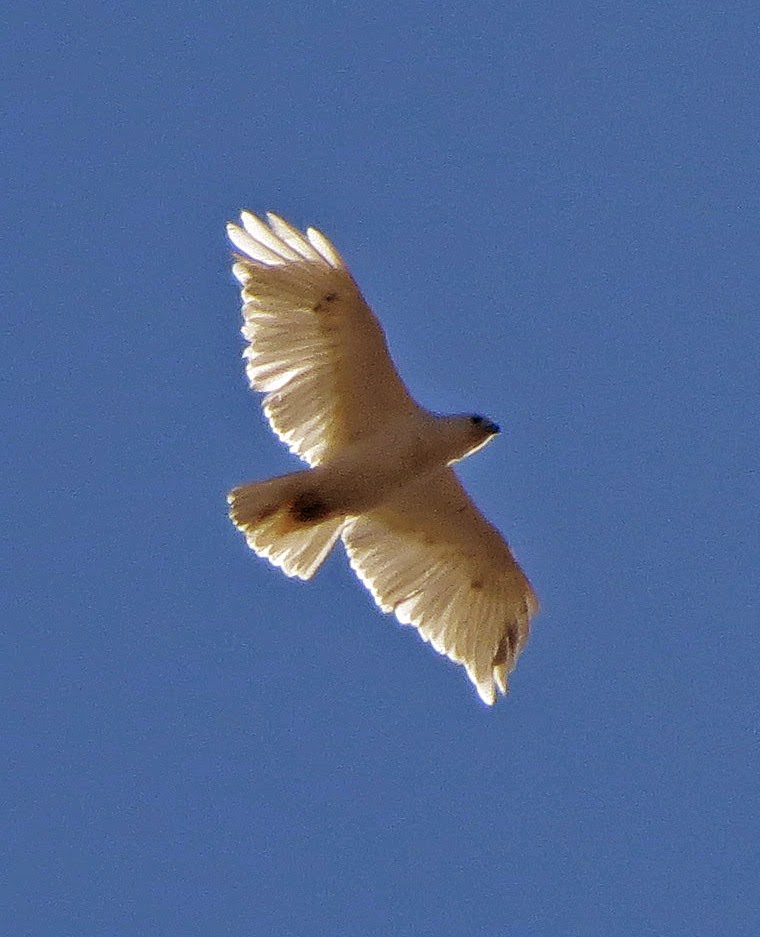
Photo: Kathy Mock
One can only imagine Kathy Mock's surprise when she glanced out the window of her Akron home, and saw a snow-white raptor winging by. In this winter/spring especially, thoughts of Snowy Owl would come right to mind.

Photo: Kathy Mock
Kathy was laboring at the computer when she caught a glimpse of this thing cruising by about two blocks away. She didn't tarry, rushing to grab optics and camera, and took off outside to track the ivory bird down. That she did, and obtained these distant but nice images.
Snow White turns out to be a gorgeous, highly leucistic Red-tailed Hawk. Vestiges of red tail feathers can be seen bleeding through, as can some dark pigment under the wings. This bird would make even a nonbirder whirl around and do a double-take.
Leucism is a pigment anomaly that causes normally dark pigments to become washed out and pale. I've written about this condition in more detail in other posts, such as HERE, and HERE.
Thanks to Kathy for sharing her interesting find!
Tuesday, February 11, 2014
A ghostly goldfinch

Photo: Ian Adams
These excellent images come courtesy of Ian Adams, celebrated landscape and nature photographer, and I appreciate him allowing me to share them. Shortly after Ian put out feeders at his Cuyahoga Falls, Ohio residence, he attracted this oddity to the tubed up thistle seeds. That's a male American Goldfinch up top, still largely in its somber winter colors. It won't be too much longer, and it'll shed those bland feathers and explode into the brilliant lemony hues of a wild canary.
The lower bird is not as clearcut an identification, and could be a stumper if it were seen by itself. The fact that it consorts with goldfinches helps on two counts: guilt by association, and the fact that we can readily compare it to other normally clad members of its species.

Photo: Ian Adams
We beam in on the ghostbird, and can easily see the trademark characters of a male American Goldfinch bleeding through. This individual is leucistic (loo-kis-tik), leucism referring to a genetic anomaly that causes dark melanin pigments to become washed out and pale. I've written about leucistic birds plenty of times, and THIS ACCOUNT gives a more in-depth explanation of the phenomenon. Leucistic animals are sometimes confused with albinos, but the latter would have pink eyes and most likely be snow-white. Truly albino birds generally don't fare well, either, at least in the wild. Their feather shafts and other supporting structures tend to be weakened, and their vision can be impaired, none of which aids survival.
The prevalence of leucism is probably essentially an odds game. The more individuals in a species' population, the more likely a leucistic individual will show up. That's why "piebald" (as leucistic animals patchily blotched with white are often known) are commonly reported in abundant species such as American Robins, Red-tailed Hawks, and White-tailed Deer.
Thanks to Ian for sharing his images. I hope this goldfinch sticks around so that we can see what if anything changes as it progresses through its molt into alternate plumage. If you're in the Cuyahoga Falls area and are interested in seeing/photographing this ghostly goldfinch, flip me an email and I'll pass along Ian's contact info.
Subscribe to:
Posts (Atom)