Showing posts with label mothapalooza. Show all posts

Saturday, May 25, 2024

Mothapalooza 2024: July 19 - 21

The quirky but infinitely fun and thoroughly educational Mothapalooza rolls around in less than two months and it's time to register. And register you should. This is a great event in one of the most scenic biological hotspots in Ohio, and Mothapalooza is populated by extremely knowledgeable connoisseurs of Nature and natural lore who love to share knowledge.

I only say that Mothapalooza is "quirky" because of the primary subject matter, and the hours of some of the field trips. It goes without saying that moths are the primary quarry and stars of the show. Butterflies have mostly always gotten the Lepidopteran limelight, and the creation of Mothapalooza, with the inaugural conference in 2013, showed that moths too could attract attention. And there are FAR more moths to ogle than butterflies. Something like 140 butterfly species have been recorded in Ohio. While no one knows anything close to an exact tally for moths, it's probably 20x higher, or more. Sure, the field trip hours tilt towards the late side, but it's well worth it. There will also be excellent diurnal field trips, and topnotch speakers each night at the historic Paxton Theater in nearby Bainbridge (home of the Dental Museum).

Mothapalooza was held at Shawnee State Park lodge in the early years, capitalizing on the adjacent 70,000-acre Shawnee State Forest and the nearby Edge of Appalachia Preserve. A few years ago, it shifted to the Highlands Nature Sanctuary in Highland County (Ohio), which is among numerous gems owned and managed by the Arc of Appalachia. This'll be the third Mothapalooza at this site, and the mothing is extraordinary.

Following are a few moth photos from events past, but first, to register for Mothapalooza, CLICK HERE. Hope to see you there!

Ornate Compacta Moth (Compacta capitalis), a rarity but we usually get some notable species such as this.

Harris's Three-spot (Harrisimemna trisignata), another oddity but one that we usually find in small numbers.

An Io Moth (Automeris io), one of the more frequent silk moths. The silk moths are always crowd-pleasers and we got lots of them, of many species.

Smaller Parasa (Parasa chloris). This is one of the slug moths, and they are some of the more interesting moths in appearance and coloration.

Yellow-based Tussock Moth (Dasychira basiflava). One element of mothing that is great fun is the photography of these creatures. Whether you use an iPhone or Canon R5 or Nikon Z8, it's easy to make interesting imagery of creatures that are seldom seen, thus seldom photographed. I and others are always glad to offer tips on technique.

Wednesday, May 10, 2023

Mothapalooza! July 14-16, 2023


Pandorus Sphinx artwork by Ann Geise

Between travels and the general busyness of spring, I have been remiss in posting about the upcoming Mothapalooza. It takes place from July 14 thru the 16, at the gorgeous Highlands Nature Sanctuary in Highland County, Ohio. As last year, it is hosted by the Arc of Appalachia. The mothing in this region is superb, and participants can expect to see scores of interesting species including a number of crowd-pleasing giant silk moths. Daytime field trips will produce much in the way of interesting flora and fauna. Photographers are sure to net scads of interesting images.

Doug Tallamy will be returning, as will the incomparable Sam Jaffe and his caterpillar lab. There will be many knowledgeable guides to help lead you through the labyrinth of moths and their identities. For complete details and registration information, CLICK HERE. Hope to see you there!

Monday, June 28, 2021

A few moths, from two nights of fabulous mothing

A bizarrely shaped Brown Scoopwing moth, Calledapteryx dryopterata. It looks like some predator took a bite out of each wing.

Sorry for the lack of posts over the past week. Deadlines called, in addition to other STUFF. I haven't been making many photos of late, either, and was grateful for the opportunity to get back behind the lens this weekend. A wonderful group of people convened at the Highlands Nature Sanctuary in Highland County, Ohio, and we mothed into the wee hours both Friday and Saturday nights. I stumbled to bed around 2:30 am on Saturday morning, and drove home after mothing on Saturday night, arriving back to Worthington around 3:30 am. This is stuff for night owls, but the rewards are worth the odd hours.

We were essentially scouting for the upcoming Mothapalooza. The Arc of Appalachia, which owns Highlands Nature Sanctuary and an ever expanding portfolio of other excellent sites, agreed to take over the management of Mothapalooza. This epic event was launched in 2013, and thanks especially to the wonderful organizational skills of Mary Ann Barnett, a team of dedicated volunteers was able to keep Mothapalooza going for nearly a decade. We would quickly fill the event - about 175 people, all told - every year. It was a mountain of work, and changes in the lives of some of the organizers necessitated a change in management.

Enter the Arc of Appalachia. For the inaugural Arc Mothapalooza, we have kept it to 50 attendees, and it filled up fast. The event takes place in July, which is normally a very good time of year for moth numbers and diversity. Barring unforeseen pandemics, we plan to scale back up to about 150 attendees for 2022. By then, we will also have a really good idea about how to run the event in our new surroundings. One thing that I can assure you of, there will be moths galore.

So keep an eye out for Mothapalooza 2022 dates - I'll plug it here - and try and make it. We have a great time, learn lots, and see some amazing creatures. 

A jumbo female Cecropia Moth, Hyalaophora cecropia. We have done targeted mothing at Highlands Nature Sanctuary several times now, and are always wowed with many silk moths such as this cecropia. Its wingspan can stretch to seven inches.

Moth photography is always fun and rewarding, and as we might lure 100 or more species each night, interesting subjects abound. This is a Dot-lined White, Artace cribarius.

We were pleased to see this elegant Pink-Striped Oakworm Moth, Anisota virginiensis, which is a species that we don't see that frequently.

I took scores of other moth photos over the two nights, and plenty of others during the Saturday diurnal field trip to the always productive Lynx Prairie in Adams County. I'll try to slap some of those up later. 

Monday, July 15, 2019

Mothapalooza 2019

The sixth Mothapalooza is in the books and it was a smashing good time! Thanks to all of the organizers and volunteers, of which there are too many to name. I'll single one out: Mary Ann Barnett, who acts as conference CEO and is the glue that holds the whole complicated affair together.

Mothapalooza was hatched in an Adams County, Ohio roadside ditch some years ago, where a few of us saw a really cool moth (can't even remember what it was). I remarked something to the effect of "if we could show this to everyone, they'd all become moth fans". Now we have Mothapalooza as a vehicle to help do just that.

The first four conferences were annual, but the rigors of orchestrating such a large complex affair with a completely volunteer crew took its toll and we've backed off to an every other year strategy. As all but one Mothapaloozas have been, this year's event was based at Shawnee State Park and its lodge in the thick of the 65,000 acre Shawnee State Forest. Native plant diversity is staggering, and thus so is moth diversity. Couldn't be a better place to host this affair, at least in this neck of the woods.

To our initial great surprise, all Mothapaloozas have filled to a capacity crowd and quite rapidly after the opening of registration. This year, counting everyone involved, we had just north of 200 participants representing 20 states and one other country, Canada. As an important aside, Mothapalooza has generated several hundred thousand dollars in gross revenue for our hosting venues and in ancillary local expenditures. Mothing ecotourism writ large.

Field trips are strange, with 10 pm departures and many participants not returning to the lodge until 3 or 4 am. Mothing sheets are scattered throughout the hinterlands of the vast dark forest, with one or two in the biological riches of adjacent Adams County. We are fortunate to be able to attract the best of the best in terms of entomological experts and biologists, and the opportunities for learning are vast. We're recalibrating how we approach these nocturnal forays in the future, and think some excellent improvements will be coming that will make it even easier for everyone, and result in yet more moths (and caterpillars!).

The next Mothapalooza will take place in 2021, dates to be decided. We'll have it sorted out soon, and the venue should once again be at Shawnee.

For now, here's a few photos from Mothapalooza 2019. I've got scads, and am nowhere near getting through all of them, so I may post additional stuff later.

Samantha Marcone of Sam Jaffe's Caterpillar Lab provides scale to an enormous female black witch, Ascalapha odorata. This tropical stray to these latitudes turned up last Friday over the front door of Don Tumblin's daughter's house in Columbus. Her husband Matt spotted it, Lacey texted Don, who was at Mothapalooza, and Lacey chauffeured the giant moth down to Mothapalooza the next day. Thus, a few hundred people got their first look at this fantastic moth. Such a cool entanglement of circumstances, and better yet the moth dropped 75 eggs in its cage on the way down. Sam has them and will attempt to farm a crop of black witches and document the complete life cycle. The moth was later released to venture wherever it may.

We have diurnal field trips as well (not starting too early!), and hot weather and sunny skies produced scads of butterflies this year. Red-spotted purples, Limenitis arthemis, were quite common and wowed everyone with their extraordinary showiness.

A botanical treat was a huge sprawling mass of leather-flower, Clematis viorna. Scads of the interesting flowers adorned the vines, and this site turned out to be a major biological hotspot. Indeed, our Saturday field trip began here and we never made it anywhere else. The stroll along this sparsely traveled lane produced blizzards of interesting STUFF, from this plant to zebra swallowtail caterpillars to gnat-ogres to yellow-billed cuckoo and much more.

A saddleback caterpillar moth, Acharea stimulea, stares menacingly at the photographer. Its larval form is stunning, looking like a little tubular pony draped with a Day-Glo green horse blanket. The moth is incredibly spider-like from certain angles. This one was one of many that appeared at the moth sheets.

A white flannel moth, Norape ovina, seemingly having a bad hair day. Moths are a photographer's dream, and the subjects warrant attention from all angles.

A quite interesting little fellow, this one. It is a tiny moth in the genus Calioptilia, and perhaps part of a complex in which there are species awaiting description. No one could pin a name to this one. It's only about 5-6mm in length. Calioptilia (cal-ee-op-tee-lee-ah) moths are sometimes called "push-up moths". 

More to follow...

Wednesday, August 10, 2016

Mothapalooza 2016 a big success!

Last weekend saw the 4th annual iteration of Mothapalooza, an event that has developed a strong following amongst natural history enthusiasts in its few years of existence. Over 160 attendees were present, and we filled the entire Shawnee State Park lodge - all 50 rooms and 25 cabins for the entire weekend. Mothing ecotourism, imagine that.

This year we had people from eleven states, and Canada. The attendees who came the furthest hailed from Mission, Texas - over 1,200 miles as the moth flies (and not many can fly that far). A star-studded cast of luminaries of the entomological world were with us, including Doug Tallamy and some of his students. Seabrooke Leckie, coauthor of the 2012 Peterson Field Guide to Moths of Northeastern North America was in the house, and new for this year was the inimitable Sam Jaffe, founder of the Caterpillar Lab in Keene, New Hampshire. Steve Gettle, one of North America's leading natural history photographers, was also there. Entomologists of top caliber, such as Dave Horn, Dave McShaffrey, Diane Brooks, Mike Gilligan, Derek Hennen, Rachel Shoop, Greg Raterman, Linda Romine, and Candace Talbot provided expertise in the field.

Mothapalooza has much help from sponsors, including the Ohio Division of Wildlife, Cedar Bog Association, Midwest Native Plant Society, Cincinnati Museum, Flora-Quest, Wild Ones, National Wildlife Federation, Ohio Prairie Nursery, Crane Hollow Preserve, Ohio Lepidopterists, Monarch Pathways, Ohio Chapter of The Nature Conservancy, and National Moth Week.

The cast of volunteers is huge, and this lot includes many experts in the field of lepidoptera who generously donate their time. Logistics at this event are rather bizarre, with field trips departing on Friday and Saturday nights around 9:45 and often the last groups roll in around 2:30-3:00 am. Coordinating the complexities with precision is Mary Ann Barnett, our conference CEO. She puts in TONS of work to see that Mothapalooza sails smoothly. Following is the list of people who serve as invaluable volunteers and I hope I don't miss anyone!

Kyle Bailey, Kim Banks, Mary Ann Barnett, Chris Bedel, Craig Biegler, Maria Bon, Natalie Boydston, Deb Bradley, Diane Brooks, Kay Clark, Jim Davidson, Jen Dennison, Nate Donat, Judy & Francis Ganance, Ann Geise, Steve Gettle, Mike Gilligan, Derek Hennen, Scott Hogsten, Dave Horn & Roz Horn, John Howard, Sam Jaffe, Olivia Kittle, Amanda Kriner, Jason Larson and his crew, Seabrooke Leckie, Bethany Linert, Katie Lloyd, Martin McAllister, Rich McCarty, Jim McCormac, Kathy McDonald, Dave McShaffrey, Gina & Tom Patt, Greg Raterman, Linda Romine, Elisabeth Rothschild, Marcey Shafer, Colleen Sharkey, Rachel Shoop, MaLisa Spring, Candace Talbot, Doug Tallamy, Brad Von Blon, Robyn Wright-Strauss, and Mark Zloba.

I don't take all that many photos at Mothapalooza, being burdened with various duties, but I do manage to click off some documentary shots and a sampling of those follows...

The bread and butter of Mothapalooza is the mothing stations, which are placed in the wildlands of the sprawling Shawnee State Forest and adjacent Edge of Appalachia Preserve. By illuminating sheets with specialized lights, moths are drawn in, sometimes in large numbers. This is a station high on a Shawnee ridge known as Copperhead Lookout. Via a sophisticated transportation system of shuttles coordinated by Elisabeth Rothschild, participants are ferried between stations.

As nearly everyone who attends Mothapalooza has some sort of camera, there must be many thousands of moth photos taken over the weekend. Moths are wonderful subjects. This is a Tuliptree Beauty, Epimecis hortaria.

Blackberry Looper,  Chlorochlamys chloroleucaria, which is about as large as your thumbnail.

Cherry Scallop Shell, Hydria prunivorata, with its intricate pattern of wavy lines.

Head on with an Isabella Tiger Moth, Pyrrharctia isabella. It's caterpillar is far better known than the moth - the Woolly-bear.

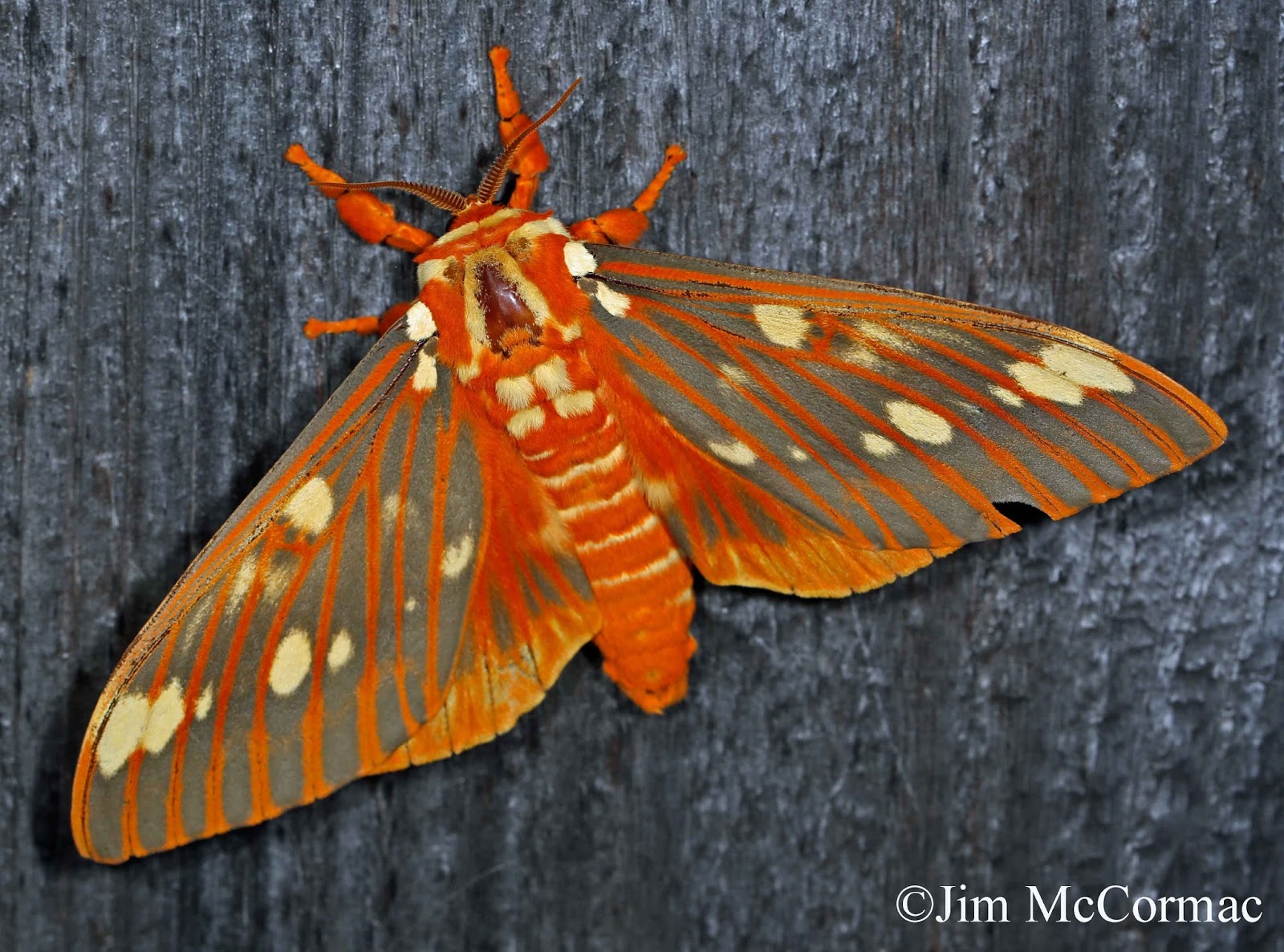
The giant silkmoths always are crowd-pleasers, and this Regal Moth, Citheronia regalis, is among the largest of this crowd.

Luna Moths, Actias luna, are always popular. Sharp-eyed Dan Kenney found this one in the darkened forest while exploring near one of the mothing sheets. It is a female, as evidenced by the skinny antennae.

Another giant silkmoth, this one called the Tuliptree Silkmoth, Callosamia angulifera. It is a male, as easily told by its giant fernlike antennae.

Sphinx moths are always a highlight of the mothing sheets, and we get nice numbers and diversity of sphinxes. This one is a Laurel Sphinx, Sphinx kalmiae.

All moths are intricately beautiful upon close inspection, but some are exceptional. This is a Pink-bordered Yellow, Phytometra rhodarialis.

The caterpillar of this species, the Funerary Dagger Moth, Acronicta funeralis, is one of the Holy Grails, the Paddle Caterpillar. I've written about this cat HERE.

The Hebrew, Polygrammate hebraeicum. Moths such as this, with incredibly intricate patterning, make for fun macro portraits. You should be able to find a face or two hiding among the lines.

Always popular is the Zebra conchylodes, Conchylodes ovulalis.

I could and should do a specific post on this little beauty, the Sooty-winged Chalcoela, Chalcoela iphitalis. Its caterpillars parasitize the larvae of paper wasps!!

The Crocus Geometer, Xanthotype sospeta, is rather butterfly-like in appearance.

A fabulous bird-dropping mimic, and there are many rivals, is the Schlaeger's Fruitworm Moth, Antaeotricha schlaegeri. From afar, this mating pair resembled a fresh sparrow splat.

Looking like little more than an old piece of dead plant matter is the Coppery Orbexilum Moth, Hystrichophora loricana. It was a target of one of our daytime field trips. This species is very rare, only known from three states I believe, and only where its host plant, Scurf Pea, Orbexilum onobrychis, occurs.

Robberflies have little concern for rare species, and this Efferia aestuans robberfly has taken out and is eating the aforementioned Coppery Orbexilum Moth!

Caterpillars face their own perils. We found this Saddled Prominent, Heterocampa guttivitta, being attacked by Formica integra ants on another daytime field trip.

Everyone loved Sam Jaffe and were dazzled by his knowledge. I was fortunate to spend field time with him on the Thursday before the conference began, and was amazed at how he would find caterpillars from clues left by their feeding habits. He spotted this tiny early instar Red-spotted Purple caterpillar, Limenitis arthemis, a long ways off.

Sam also brought along some wonderful caterpillars to share with the group, including this Northern Thorn, Selenia alciphearia, which is an outstanding stick mimic.

Several of the bizarre Monkey Slug caterpillars turned up on field trips. It morphs into the Hag Moth, Phobetron pithecium.

Looking for caterpillars is nearly as much fun - if not more - than watching the moths at the sheets. This spectacular Io Moth caterpillar, Automeris io, was found by Dan Kenney and his blacklight flashlight near one of the sheets.

We're still sorting out details and dates for Mothapalooza '17, and I'll report on that when all is settled.

Sunday, June 21, 2015

Some more Mothapalooza highlights

A Rosy Maple Moth, Dryocampa rubicunda, glares menacingly at your blogger. Well, as menacingly as a pink and yellow animal can manage.

Our extreme mothing efforts at the recent Mothapalooza conference paid great dividends. Scads of species great and small were seen, and in most cases, photographed. I'll share a smattering of my efforts here.

By the way, dates have been confirmed for Mothapalooza IV. The conference will be back at Shawnee State Park Lodge, August 5 thru 7, 2016. The later date will provide a somewhat different cast of moth characters, and the crop of caterpillars will be much advanced. You won't want to miss it. The link to the Mothapalooza website is RIGHT HERE.

This is one of our largest moths, the Royal Walnut Moth, Citheronia regalis. Its larva IS the biggest caterpillar, the fabled Hickory Horned Devil, which is nearly the size of a small hotdog. I have written about them HERE, and HERE.

The giant silkmoths, such as this, always elicit oohs and aahs. But cool as the jumbo silks are, one soon learns that many of the smaller - often MUCH smaller - moths best them in ornateness.

An extravagant animal indeed, and its beauty is reflected in the name: Glorious Hybrosyne, Habrosyne gloriosa. One never seems to see many of these, but a few made their way to our sheets, generating lots of excitement.

This one looks like an artist took a pen to its wings, and drew crazy op art. It's a Zebra Conchylodes, Conchylodes ovulalis. The subjects of this photo and the last were shot in situ; on the white illuminated sheets to which they were drawn. I refer to such backdrops as "white sheets of death" when it comes to making photographs, and only fire off shots under such conditions when I don't think there's any other way I'll get an image. In my view, it's impossible to get a really stunning photo on such substrates.

We have discovered a nearly infallible rule to handling moths. If they're small and/or smooth, you cannot manipulate them. Touch one like this and its off like a rocket. However, the fuzzier and/or larger the moth, the easier they are to handle and move to better backdrops. Most of the following images' subjects were placed on nearby objects that provided for a much better image than a brightly lit white sheet.

This little moth is truly fuzzy, as is its caterpillar. It's a Black-waved Flannel Moth, Lagoa crispata. The larva looks a bit like a turtle covered in brown shag carpet, and it can deliver a punishing sting via sting hairs.

From a photographer's perspective, moths are fun to explore from different angles. Certain ones, such as this, lend themselves well to head-on views. Black-waved Flannels, like so many of the exceptionally fuzzy species, are usually quite easy to handle and move around.

This Eastern Tent Caterpillar Moth, Malacosoma americanum, looks a bit like a charging bighorn sheep. In its larval stage, this moth is much derided. They're the caterpillars that form the large conspicuous silken nests on cherry trees in the spring.

A Rose Hooktip, Oreta rosea, stunning in colors of lemon and peach. Their caterpillars feed on native viburnums such as Arrowwood, Viburnum dentatum.

Ah! A personal favorite, and a stellar bark mimic if there ever was one (and there are lots)! It's a Common Lytrosis, Lytrosis unitaria, and it looks as if it was artfully carved from wood.

Here we have camouflage taken to the ultimate. The sneakiest turkey hunter clad in the best ghillie suit couldn't hope to match this. It is a White-blotched Heterocampa, Heterocampa umbrata, and even though the moth fills the frame and the image is tack sharp, it is tough to see. Such cryptic coloration and patterning serves these moths well as they hide from birds and other predators during the day.

One that was new to me, the Small Necklace Moth, Hypsoropha hormos. With some 2,500 moth species in Ohio, bagging lifers isn't too hard for most of us. Its caterpillar nosh on persimmon and sassafras.

I had to violate my "white sheet of death" rule to make this image of a moth known as The Chevron, Eulithis testata. Being small and smooth, we would have had little chance of successfully relocating it. However, by getting my camera near the sheet and shooting sideways at the moth's level, it mitigated some of the sheet glare. Note how the moth holds its abdomen arched up and over its head. That's probably disruptive camouflage, helping it to blend in with the twigs and branches it probably hides on during the day.

Many of us reminisced on good memories afield with Dennis Profant whenever we saw slug moths, which were probably his favorite group of Lepidopterans. This one is a Spiny Oak Slug Moth, Euclea delphinii. Its caterpillar is incredible. CLICK HERE for a post that I made on slug moth caterpillars, which includes an image of this species' caterpillar.

Finally, the strange little Yellow-shouldered Slug Moth, Lithacodes fasciola. It and most of its slug moth ilk are small enough to be overlooked among the comparative giants of the moth world. But one of the great pleasures of mothing is learning to pay close attention to the little guys, which often are the showiest animals on the sheet.

Put Mothapalooza on your calendar for next year. If you like natural history in all its varied forms, you'll like Mothapalooza.