Showing posts with label jumping spider. Show all posts

Monday, May 12, 2014

Moth that mimics a spider!

As is nearly always the case, I have a bounty of blog material; more than I can ever get to. But I must interrupt the irregularly scheduled programming to bring you something that is indescribably cool. I was commanding my keyboard this evening, attempting to whittle away at emails that I am hopelessly behind on (sorry if you've messaged and I haven't responded), when the inimitable David and Laura Hughes sent along some of their latest handiwork. I had to drop everything and prepare this post.

Enjoy.

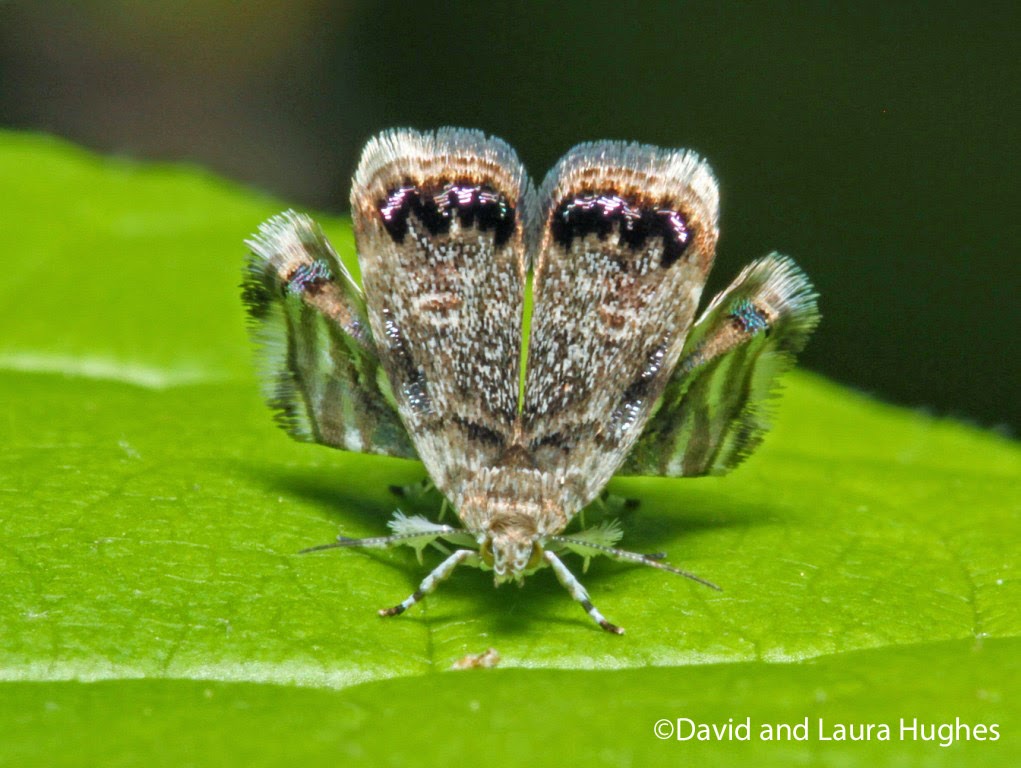
I learned about this moth and its ilk last year, courtesy of caterpillar guru David Wagner. We were light-trapping last June in Adams County, when this moth flew into the lights. It is one of the aquatic crambids, the Canadian petrophila, Petrophila canadensis, I believe. Dave pointed out that it is an apparent jumping spider mimic, as are a number of others in the genus Petrophila.

The evolution of mimicry fascinates me, and I was instantly smitten. Note the moth's gemlike markings lining the top of the hindwings. Those are the faux spider eyes. Unfortunately, being nighttime, the moth didn't do anything but sit motionless, but they certainly can animate themselves as we shall see.

This is a real jumping spider in the family Salticidae (for "saltatorial", which means "leaping" or "jumping"). You've probably seen these small spiders. They are about as cute as spiders can get, and ambulate with astonishingly fast jerky little leaps.

The Hughes, while exploring an area of Athens County recently, encountered this small moth at rest on an ash leaf. It too is a Petrophila moth, but I am unsure of the species. Note its fake eyespots, just as in the moth in the first photo.

A side view. The moth is on alert, knowing that potential danger lurks. It hunches forward and elevates its wings, much as a jumping spider rises high on its forelegs when ready to pounce.

The hind view is extraordinary. If you were a small beast on the same level as the moth, you'd probably take pause when confronted with this creature, even if you were predatory.

While these photos are cool, and build a case for the jumping spider mimic theory, the proof is in the locomotion. Exceptional videographers that they are, the Hughes managed an incredible video of the moth in motion on the leaf's surface. Check it out below:


Video: David and Laura Hughes

The quick jerky movements of the moth are amazingly similar to that of a jumping spider. So much so that even an experienced observer of natural history could easily be temporarily fooled. Resembling a fiercely predatory spider is good insurance against attack by would-be predators who might think twice about lunging at an animal that might turn the tables on them. The evolutionary fits and spurts that lead to such fabulous mimicry over eons of time is endlessly fascinating.

Thanks as always to Dave and Laura for sharing their work.


Tuesday, July 23, 2013

Jumping Spider!

Not long ago, I came back to my car, and this little guy darted out from between two body panels. Yes! A jumping spider (species unknown)! He ran over to look at me, and I stared back just as intently. After telling it to wait a sec, I bolted the macro lens onto the Canon, and took a shot.

If ever a spider could be called "cute", it would be a jumping spider. After the shoot, I coaxed him onto my finger and liberated the spider into some vegetation. Hopefully it is still out there wreaking havoc on the lesser beasts.

Friday, October 30, 2009

Amazing jumping spiders!

I don’t often use other people’s photos on this blog, but I just had to share some of the coolest macro-work being done, anywhere. Following are some utterly amazing shots courtesy of Thomas Shahan of Oklahoma.

I came into contact with Thomas early this summer, in the course of working on a spider project. After seeing his work, I contacted him and he was very gracious in agreeing to work with our team. You can see a broad range of his photos RIGHT HERE.

Other people have noticed Thomas’s photography, and this attention led to his recent appearance on the Today Show. Check THIS LINK to see it.

Below are a few of Shahan’s stunning images of jumping spiders, one of his favorite subjects. All of these species are among the 76 species of jumping spiders known to occur in Ohio. Enjoy!

A male Habronattus coecatus (most of these spiders haven’t yet been branded with formal common names). Quite the charmer, this little guy. Looks big, ferocious, and deadly, but at the same time just about as cute as a spider can possibly get. Most jumpers are tiny; a big female of some species might push the tape to 3/8 of an inch, and many males would be measured in millimeters.

They are ferocious predators, albeit on a Lilliputian scale. Good thing for us they aren’t the size of German Shepherds or we’d have a situation straight out of Eight Legged Freaks!

Hentzia mitrata, male, looking like something out of a science fiction movie. Seen on this scale, the eyes of jumping spiders are one of the dominant features. There are eight, but four are typically small and concealed. Jumping spiders see better than any other family of spiders, and use their exceptional vision to sight prey. You can test this yourself. Next time you see a jumper, approach it closely and lean in towards it. The spider will cock its body to better watch you, and turn to keep you in its line of sight. Sometimes they even will approach, and if you are shooting photos, are notorious for jumping right onto the camera lens. My hunch is they see their reflection, and are attacking it.

An incredible closeup of the binocularlike peepers of a female Dimorphic Jumper, Maevia inclemens. In many species, the various sets of eyes are all canted in different directions, allowing the animal to see many different angles simultaneously.

Male Paraphidippus aurantius, sporting walruslike tusks. They are actually the chelicerae, which are grasping mouthparts and are connected to the venom glands. In short, the business end and the above is definitely a view that you’ll want to see if you are a potential meal.

Female Phidippus putnami, and just darned cute for a spider. She looks like a little punk rocker with spiked hair.

Jumping spiders are aptly named. They locomote with incredible springy bounds, and when suitable prey is detected, it'll be leaped upon, often from a good distance away. Some jumpers can reportedly make leaps of up to 80 times the length of their body! To match this feat, a six-foot tall person would have to be able to jump something like 500 feet - from a standing start!

Another amazing thing about jumping spiders is their ability to retain the exact location of prey, even when it isn't in view. This allows the spider to stalk prey, and work into an optimal position for pouncing, without having to constantly keep the victim to be in sight. Jumpers can even leap from a blind spot, and apparently still strike with deadly accuracy.
My personal favorite, a male Phidippus mystaceus. That is just a jaw-dropping photo. As small as this spider is, one would never have any idea of its beautiful complexity without benefit of a photo like this. And photos like this are NOT easy to get. Shahan spends hours with his tiny eight-legged subjects, and no doubt takes many hundreds of shots, most of which are probably not keepers.

Work such as this is not only interesting to look at, and quite artistic, it goes a long ways towards getting people interested in spiders - one of the most maligned groups of animals.

Monday, June 15, 2009

Jumping Spider Jumps!

After a meeting in Dayton last Sunday, several of us paid a visit to the legendary Cedar Bog, near Urbana. There, we saw many interesting and rare things, both plant and animal. And if you've not been to Cedar Bog lately, or at all, GO! The brand spanking new visitor's center is incredible, and you'll be assured of having a good time.

The boardwalk, which winds through an entrance meadow and on into Ohio's only fen - not a bog! - dominated by White Cedar, Thuja occidentalis. At the time the first settlers colonized Champaign County, the cedar fen sprawled over some 7,000 acres. The preserve encompasses about 435 acres - that's all that's left of this fabulous ecosystem.

The marquee plant this time of year is North America's largest orchid, the Showy Lady's-slipper, Cypripedium reginae. Some enormous clumps dot the meadows, such as the old plant above.

Another beautiful albeit much more diminutive orchid was just beginning to flower, the Grass-pink, Calopogon tuberosus. In a week or so they'll dot the fen meadows pink.

Beautiful flora aside, this little spider was among the stars of the show. It is a Woodland Jumping Spider, Thiodina sylvana, and it put on quite a show for us. Jumping spiders are fantastic little creatures, and next time you see one, try and take a few minutes to watch it operate.
Jumpers don't make webs to catch prey; they stalk their subjects and nab them in a spectacular deadly leap. Such is their jumping ability that a six-foot tall person would have to be able to jump over the equivalent of a large building to match the leaps of a jumping spider. They also have the ability to process and temporarily store locational data. Thus, a spider can spot a potential victim, move out of sight and stalk while hidden behind obstructions, then spring with deadly accuracy from a new position without having eyeballed the soon to be dead prey since the initial visual contact.


Jumping spiders are charismatic, and many people who are died in the wool arachnophobes even find them "cute". It's as if the spiders watch you - they do!- and react to your movements. They often wave their forelegs about as if flashing semaphore signals. The spiders will cock their heads and seem to gaze curiously at you, and do not display much fear.
In the above video, the spider makes a wild leap for my camera lens, misses, and self-rescues via the safety line that he had attached to the leaf prior to the launch. Watch closely at the end and you'll see him rapidly climbing the line back to the leaf.

My cohorts thought the spider disliked me, and was attacking. And it's a darn good thing these jumping spiders aren't the size of Woodchucks! Otherwise, the video above would have looked very different. You'd have seen a large furry blob fly forward and block the camera view like an eclipse, hear me screaming crazily and rapid blurred images of spider legs and foliage whirring around as we tussled, the wild roars of my companions as they raced away in horror, followed by a grim stillness.
But they are not big and we have nothing to fear. This was cool, though. I think that the spider, with its incredible vision, probably saw its own reflection in the lens of my camera. Thinking its image to be that of possible prey, it stalked my camera and when the time was right, leapt. You can see it walk across the lens at the end.
Pretty cool stuff.