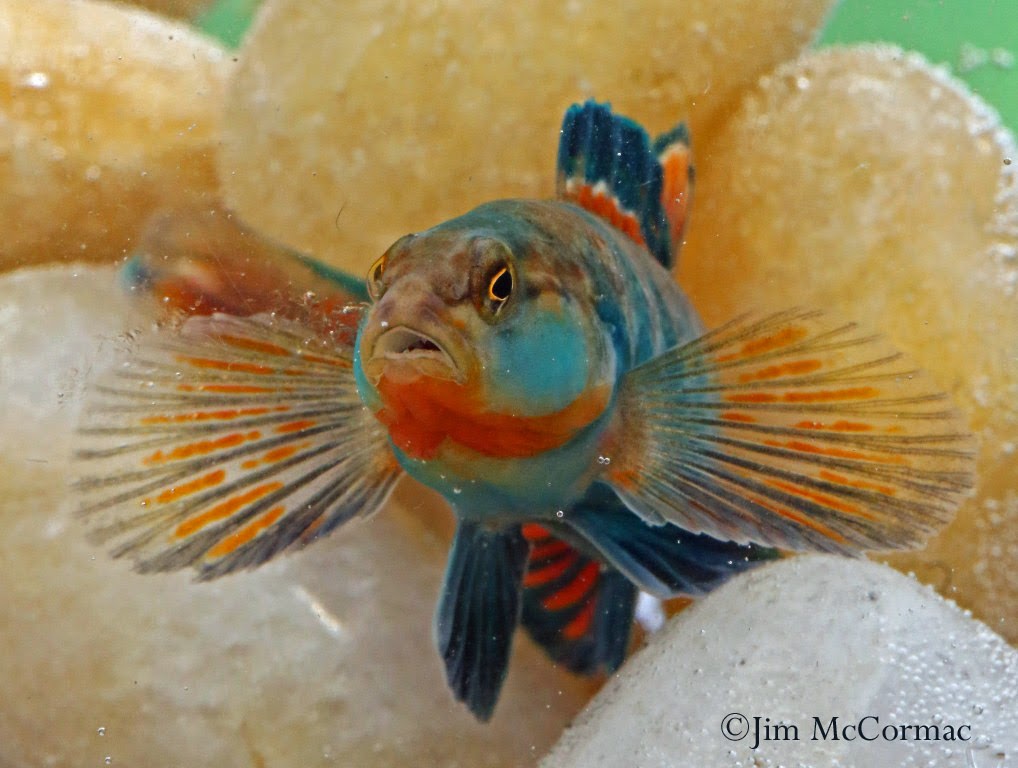
This rainbow darter, Etheostoma caeruleum, is aptly named and would look right at home in a tropical fish tank.
Not long ago, I wrote an account of a recent excursion to Little Darby Creek, which can be seen HERE.I was indeed fortunate to accompany Mac Albin of Franklin County Metroparks, Anthony Sasson of the Ohio Chapter of The Nature Conservancy, and John Tetzloff of the Darby Creek Association. No one knows the fishes of Big and Little Darby creeks like these guys do.
We caught lots of fish, all of which were released back into the waters. We were "fish-watching"; temporarily detaining some of the stream's more colorful denizens so we could study them, and take photos. A pair of brilliant rainbow darters pose in the photo above.
Rainbow darters are common, and occur in streams nearly statewide. Nonetheless, few people have seen one and most might be surprised to know that such a riotously colored animal lurks on our stream bottoms. Although there are a number of rarer darter species in Ohio and in the Darby Creeks, the common rainbow darter is still my favorite. Although most of the other species are finned works of art, too, none of them can top the rainbow in the looks department.
At the very peak of breeding season, when the waters become just the right temperature, male darters shift their colors into overdrive. As many songbirds molt into bright alternate, or breeding, plumage, so do the darters in their own way. Seine up a rainbow darter in the heat of late summer, and it'll be a much muted version of the fish above. At the apex of the breeding season, some rainbow darters become heavily infused with blue, as is the animal in this photo.
It's not only darters that enter a "breeding plumage". A great many other stream fish do the same. This is our largest minnow species, the stoneroller, Campostoma anomalum. It is a very common stream fish throughout the state, and is rather tolerant of pollution and other forms of stream degradation.The curious name stems from their habit of grazing algae from rock cobble in the riffles in which they occur.
This male stoneroller is entering breeding condition, as evidenced by the appearance of warty tubercles on the dorsal surface of its head and back. Before long, it will also develop spectacular black and orange pigments in its dorsal and caudal fins, and the black etchings on its body will become richer and more pronounced. Many plain jane minnows briefly become quite festive in their coloration during breeding season.
Like many stream fish, stonerollers make a nest. The male hollows out a spawning pit near a riffle, and vigorously defends it from other males. An interested female will slink in and deposit her eggs within the spawning pit. In the case of the stoneroller, the male will abandon the nest prior to the eggs hatching, but some species of fish guard their nests right up to the point that the fry emerge.
A healthy stream bottom is its own little world, but one that is out of sight and largely out of mind.
While photographing and closely observing this stoneroller in the holding tank, I noticed something that was news to me. Scroll to the preceding photo, then back to the above image. Note how the fish can roll its eye in its socket. I always assumed fish, or most fish anyway, had their eyes fixed in the sockets. Maybe it was ignorant of me to think that, but then again, how often does one get to closely observe fish?
In the case of the stoneroller, it would make sense that it would evolve an ability to shift its eyes downward, the better to see potential foodstuff on the rocks below.
This is one of my all-time favorite fish, the mottled sculpin, Cottus bairdii. It is a bit more habitat-specific than the preceding two species, preferring smaller streams with cooler water temperatures than are found in larger rivers.
Sculpins lurk in the rocky cobble of riffles, and elsewhere on the stream bottom. They blend with their surroundings quite well, specially when among stones.
If you were a darter, or any other smaller animal, you would not want to glance up and find this face staring at you. Sculpins are predators, and snap up small fish and a variety of other stream animal life. The victims probably have little warning, as the cryptic sculpin would be hard to detect. For the prey, it is probably as if one of the riffle's rocks suddenly exploded to life, and sucked you in with a giant swallow of that proportionately enormous mouth.
Thanks again to Mac, Anthony, and John for an excellent field trip. I hope to do more of these aquatic forays in the future. Kudos too to their respective organizations for all of the work that they do to protect Big and Little Darby Creek. These streams are among the highest quality waterways in the Midwest, and it is imperative that they remain so. Most Ohio streams have not fared nearly as well, and as a result, even common fishes such as those that I've shared in these posts are not nearly as common as they once were.
A romp through the diverse flora and fauna of Ohio. From Timber Rattlesnakes to Prairie Warblers to Lakeside Daisies to Woodchucks, you'll eventually see it here, if it isn't already.
Showing posts with label Stoneroller. Show all posts
Sunday, April 20, 2014
Sunday, March 22, 2009
Warblers of the Underwater World
When I first began my career, I had the good fortune to make many trips afield with Ted Cavender and Dan Rice, two of the top fish guys in Ohio. Once they saw I was truly interested in stream ecology and fish, they let me serve as labor on fields trip far and wide. In the process, I got to see nearly all of Ohio's fish, and learn them pretty well.
But that's been a while, and circumstances haven't let me look for fish in a serious way for a long time. For a few years, though, I've been threatening to make concrete plans with Mac Albin, another true fish guru, to work some riffles in Big Darby Creek. Finally, today was the day, and we couldn't have picked a better one. Warm air temperatures and low water levels made conditions for catching fish just perfect. And we're not talking Smallmouth Bass or Bluegill - oh, no, much more interesting piscine targets than those were our goal.
Our main quarry were darters. These are tiny members of the perch family, and they mostly lack air bladders and thus can't float. So one doesn't often notice darters, and you've pretty much got to make a special effort to find them. And darters truly are the warblers of the depths. At this time of year, males brighten up and their colors rival just about anything one might find in aquaria. Reds, oranges, blues, greens, you name it - darters are a rainbow palette of showiness.
Big Darby Creek, in Battelle-Darby Metropark. This 8,000-acre park protects large swaths of the Big and Little Darby Creeks, one of North America's standout river systems, and one of Ohio's most significant natural resources. More species of fish occur in these waters than any other Ohio stream, including many very rare ones.
For our subjects, we're going to have to go underwater, into rapidly flowing riffles like the one above. You see, most darters are torrent specialists, uniquely equipped to negotiate the unending rush of chutes and rapids. In some places, it is nearly impossible to find purchase and remain erect and holding a seine, so forceful is the sweep of the water. But if you can, there will be darters down there.
Mac Albin, left, aquatic ecologist for Franklin County Metroparks, and Anthony Sasson, freshwater conservation coordinator for The Nature Conservancy. They may be the two most knowledgeable people around whan it comes to the Darby Creeks, and it was a treat to spend time in the water with them. We spent about three hours working just one riffle and some assoicated habitats, and scored big time. In all, we got ten species of darters, most in good numbers. This would be like finding 30 species of warblers in one day in Ohio. For those darter listers among you, we had: Rainbow Darter, Bluebreast Darter, Spotted Darter, Tippecanoe Darter, Greenside Darter, Orangethroat Darter, Banded Darter, Johnny Darter, Variegate Darter, and Logperch.
Of course, a healthy stream has much more than darters. We dredged up this robust hellgrammite, which is the larval form of the dobsonfly. Fishermen love 'em for bait. They've got a decent pair of pinchers, and this one gave Anthony a good nip. Wish I had caught that on film!
Stonerollers, Campostoma anomalum. Fish are not easy to observe, and concerted efforts have to be made to check them out. Thus, most people don't know much about what lurks under water. These Stonerollers are males in their breeding finery. Just like birds, the males of many fish take on brighter colors and a gaudier appearance for a short while during the breeding period, which for many stream species is right now. Stonerollers are bottom-dwelling minnows, and normally don't look like much. But for a few weeks, the male's dorsal fin becomes infused with bright color, bluish-white warts known as tubercles appear on the head, and even the eye color seems to get brighter. In essence, they become real showstoppers.
Darters are aptly named. This is a Rainbow Darter, Etheostoma caeruleum, in habitat. They lack air bladders, and thus don't float. But this serves them well, and helps darters to anchor themselves to the cobble of stream bottoms in swiftly flowing riffles. There, they dart about with quick, abrupt movements, capturing an array of tiny macroinvertebrates and other stream life. Their stiff pectoral fins - fanned out to the sides in the above shot - are used as props, and help to hold the darter in place.
It isn't difficult to see how this species got the name Rainbow Darter. Breeding males are absolutely striking, enriched with bold greens, blues, and reddish-orange.
Although they appear exotic, like something that should be in a saltwater aquarium, Rainbow Darters can be quite common in appropriate habitat. Mac and Anthony seined up about 400 of them today.
Part of a male Variegate Darter, Etheostoma variatum, in breeding condition. The transition to breeding condition is triggered by water temperature. I think Mac told me that Variegates come into color when water temperatures hit about 48 degrees. This is another common species, and one that gets fairly large by Etheostoma darters standards. A whopper might stretch the tape to three or four inches. This is an extremely colorful darter; almost makes you blink and rub your eyes! Variegates are found only in Ohio River drainages in Ohio.
Variegate Darter on stream bottom cobble. Darters are especially sensitive to degradation of stream systems, as they require clear waters and clean substrates. Muck the stream up with too much sediment, and darters will vanish. Big Darby remains fairly pristine, in no small measure due to the hard work of Franklin County Metroparks and The Nature Conservancy. As Columbus and surrounding areas continue to grow, it will be increasingly difficult to protect the Darby, though. Hopefully we are up to it, and decision-makers can recognize the global significance of the stream, and its value to central Ohio.
But that's been a while, and circumstances haven't let me look for fish in a serious way for a long time. For a few years, though, I've been threatening to make concrete plans with Mac Albin, another true fish guru, to work some riffles in Big Darby Creek. Finally, today was the day, and we couldn't have picked a better one. Warm air temperatures and low water levels made conditions for catching fish just perfect. And we're not talking Smallmouth Bass or Bluegill - oh, no, much more interesting piscine targets than those were our goal.
Our main quarry were darters. These are tiny members of the perch family, and they mostly lack air bladders and thus can't float. So one doesn't often notice darters, and you've pretty much got to make a special effort to find them. And darters truly are the warblers of the depths. At this time of year, males brighten up and their colors rival just about anything one might find in aquaria. Reds, oranges, blues, greens, you name it - darters are a rainbow palette of showiness.
I shot off 345 photos today, and a fair number were keepers. I'll share other underwater warblers as the week progresses, including a few of the real rarities.
Subscribe to:
Posts (Atom)