Showing posts with label warblers. Show all posts

Friday, March 18, 2022

Get ready for warblers: Pine Warblers are back on territory


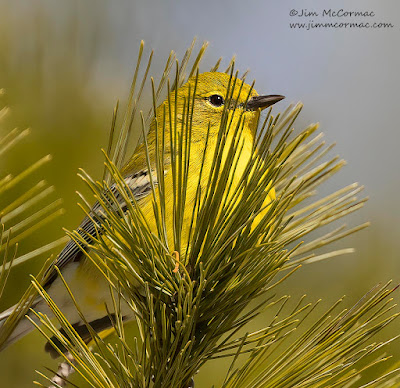
A male Pine Warbler (Setophaga pinus) perches, quite appropriately, on a pinecone. This big White Pine (Pinus strobus) was part of his turf. I photographed this bird last Monday in Hocking County, Ohio, and the warbler was probably newly arrived and busy establishing his territory. While small numbers of Pine Warblers will overwinter in Ohio, I suspect this one wintered further south, as most do.

Pine Warblers are the first to arrive back on territory and commence singing and this one was in fine song. Of our breeding warblers - Yellow-rumped Warbler (Setophaga coronata), which commonly overwinters, is not a nester here), the Pine Warbler leads the spring parade. Before long, Louisiana Waterthrush (Parkesia motacilla) will appear very soon, then Black-and-white Warbler (Mniotilta varia), Black-throated Green Warbler (Setophaga virens), Northern Parula (Setophaga americana), and Yellow-throated Warbler (Setophaga dominica) will soon follow up. Not long after the warbler rush will be on.

I watched this Pine Warbler foraging for some time. Here, he rests among dense fascicles of pine needles. I saw him grab a few small caterpillars but was unable to photo-document them. Quite a few species of moth caterpillars specialize on feeding on pine, and a number mimic the needles to a remarkable degree. Thus, Pine Warblers employ a slow deliberate creeping style of foraging rather than the maniacal rushing about of many other warblers. Even for the sharp-eyed warbler, these pine needle caterpillars are probably pretty tough to spot and require more methodical searching.

Tuesday, September 29, 2020

A few fall warblers

The extreme upper end of Alum Creek Reservoir, in Delaware County, Ohio. The beginnings of fall tinge the foliage with bits of color. This spot will look autumnally fantastic in a few weeks.

I was here last Saturday at the crack of dawn to photograph plants. There are some interesting meadow-like openings atop high shale bluffs along the east side of the reservoir. They support the striking combination of Showy Goldenrod, Solidago speciosa var. speciosa, and Smooth Aster, Symphyotrichum laeve. I use the nominate trinomial for the former, as this goldenrod is carved into several distinct varieties. One of these, var. rigidiuscula, also occurs in Ohio. It is very rare and listed as state-endangered. The variety I saw on this day is not much more common and is listed as state-threatened.

A Bay-breasted Warbler peeks from oak foliage. About the time that I was through photographing plants, the sun was cresting the distant tree line and casting solar energy onto the nearby treetops. And in came the warblers.

A mixed feeding flock that included at least these species: Tennessee, Nashville, Chestnut-sided, Magnolia, Cape May, Yellow-rumped, Black-throated Green, Blackburnian, Bay-breasted, Blackpoll, and Black-and-white warblers. I may have missed one or two, as I became fixated on trying to capture imagery of the small active animals. In any case, dozens of birds comprised the flock.

A Tennessee Warbler pauses briefly to survey its surroundings. Note its very fine, sharply tipped bill.

Fall warblers are subtle, and don't exactly draw one's eye. The still dense foliage masks them, and in many species the plumage is somewhat more muted than in spring. No males are singing, but the birds regularly emit soft chip notes that alerts one to their presence.

A Magnolia Warbler flits through the shadows within an Eastern Red Cedar, Juniperus virginianus. A few small specimens of this conifer were nearby, and I was surprised at the number of warblers foraging among the needles.

The Black-throated Green Warblers were especially smitten with the cedars. Which makes sense, as they are conifer-breeders over most of their range.

A Black-throated Green Warbler hover-gleans cedar foliage. It tugged out what looked like a Juniper Geometer caterpillar, Patalene olyzonaria. This is very common warbler feeding strategy.

Seemingly as quick as the flurry began, it was over. 
 

Wednesday, May 13, 2020

Buckeyes, and birds

Yesterday morning, at nearly the crack of dawn, I went to a local Columbus greenspot known as Duranceaux Park. It sits along the banks of the Scioto River, and that big stream is a thoroughfare for migrant birds. I'd been hearing all manner of reports from there, and the little park has been heavy with warblers and other songbirds. And birders. In this spring of reduced travel and social distancing, scads of local birders are visiting Duranceaux, and issuing interesting reports.

The light was stellar yesterday morning, and as I rolled into the park about the first thing that I noticed was the conspicuous flowering spikes of Ohio buckeye, Aesculus glabra (above). In the short distance to the parking lot I saw a number of flowering buckeyes, and also saw a photographic opportunity.

Once on foot, it didn't take long to see that things were moderately birdy. Most frequent were yellow-rumped warblers. This is the most common of the wood-warblers with a total population of nearly 100 million birds. I'm not jaded to the "butterbutts" though - I mean, look at that male above! A case could be made for this species as the most handsome warbler.

Lots of other migrants were around, including many blue-gray gnatcatchers. I took a photographic swipe at this one, as these high-strung fidgety little songbirds are not particularly easy to shoot well, and my archives are not especially rich in acceptable gnatcatcher photos. The bird finally rewarded my efforts by posing on this grapevine which made for nicely artistic prop.

But the flower spikes of the buckeyes kept 90% of my attention. As soon as I saw the buckeyes I thought about ruby-throated hummingbirds. Buckeye flowers are an important early spring nectar source for hummers, but I'd never managed to document this relationship with a camera.

I didn't have to wait long before I heard the squeaky chirps of a hummingbird, and moments later she raced in to the closest buckeye flower spike. She quickly tapped about half the flowers in this spike, then shot off to parts unknown. Nice.

The mistake, photographically, that I made was not putting my flash rig on the camera, knowing there was probably a pretty decent chance of a hummer-buckeye happening. Hummingbirds definitely pop much better with a puff of light, and it allows for much faster shutter speeds to mostly freeze wing movement. As it was, I shot this at 1/500 - fast enough for everything else I was shooting, but not this little speedster. I'm loathe to use super high shutter speeds if it causes the ISO to go sky high, and in this setting it was already at ISO 640 at f/8. Probably should have opened the lens up to f/5.6, jacked the shutter to 1/1000 or more and just rolled with it. But, whatever - the photo still proves that hummingbirds stick their bills in buckeyes.

Not long after the hummingbird encounter, I noticed a female northern parula showing interest in buckeye blooms. Here, she appears to critically evaluate the flowers.

A second later, she jumped into the flower raceme and began probing her thin bill deep into the flowers. Northern parulas are known to take flower nectar, especially on the (largely tropical) wintering grounds. It's been unseasonably cold around here of late, and on this morning the temperature was in the high 30's F when I arrived. The frosty temps and reduced insect availability might be driving increased nectariferous behavior from birds like this parula.

Finally, a short while later I noticed this Nashville warbler flit over to yet some other buckeye flowers. Same old story - into the flowers she went, working them over. This is a well-known nectar feeder, and was the second most common warbler on this day at this site. I'm sure I could have seen more Nashville nectar feeding had I paid closer attention.

I hope to have another crack at this phenomenon before the buckeyes go out of bloom. There are several goals: flash-assisted hummingbird shots, and capturing Cape May warbler, and Baltimore and orchard orioles in the act of plumbing these flowers.

Tuesday, May 17, 2016

A warbler extravaganza at Magee Marsh Wildlife Area!

I spent the weekend up in the marshland region of western Lake Erie, and am darn glad that I did. Saturday was excellent, with many notable bird observations, but none to rival the amazing Curlew Sandpiper that Steve Jones found. The bird was in its breeding finery, and wowed hundreds of birders. Kudos to Steve for producing the 6th Ohio record of this Eurasian vagrant. I've got plenty of photos of the bird, and will try and post some of them here eventually.

Sunday dawned COLD - a nippy 35 F at sunrise. Brisk winds didn't make things feel any warmer. As the fabled Bird Trail at Magee Marsh Wildlife Area had seen an influx of birds on Friday evening, I figured that they'd all still be around, augmented by any new arrivals on Saturday night. The migrants would be resting and refueling, building fat deposits and energy for the flight across Lake and on to points north.

No one who was at Magee on Sunday morning was disappointed. The birds were absolutely incredible. I've been going to Magee since before there was a boardwalk, and have seen years of bounty and bust. This was BOUNTY with a capital B. Of the myriad birders present that day, I'm sure there were plenty of greenhorns, and they must have been blown away by the spectacle. I know I was.

Following is a montage of warblers (I saw MUCH more than warblers!) that I photographed along the boardwalk on Sunday morning. The only camera that I used was the Canon 7D II, coupled to Canon's incredible 100-400 II lens, and handheld. I've probably said it before but I'll say it again - this is one of the best rigs for handheld shooting. A plus is that this lens will focus down to 3.5 feet. Believe it or not, there were times when birds were too close for other photogs to focus on, but my setup allowed me to.

SHAMELESS PLUG: If you're interested in learning more about photographic techniques, for birds and many other subjects, David FitzSimmons, Art Weber and I will be teaching a photo workshop at beautiful Lakeside, Ohio on September 20-22. We've got all kinds of cool stuff to show attendees, and plenty of birds will be passing through in their fall transit. Details and registration are RIGHT HERE.

Chestnut-sided Warbler

Tennessee Warbler

Bay-breasted Warbler

Cape May Warbler

Cape May Warbler, female

Yellow Warbler

Another Yellow Warbler (because they're cool)

Blackpoll Warbler

Magnolia Warbler

Yellow-rumped Warbler

Black-throated Green Warbler

Black-and-white Warbler

Nashville Warbler

Palm Warbler

Northern Parula

Prothonotary Warbler

Blackburnian Warbler

Monday, May 28, 2012

Warblers!

Everyone loves a warbler. These colorful sprites are, to many, the avian highlight of spring. I am not impervious to their charms, and one of the great things about visiting northern Michigan's Presque Isle County is the numbers and diversity of warblers. During the nine days I was there, my groups and I tallied 25 species, nearly all of them breeders.

Following are a few shots that I managed to click off, all with my new Nikon Coolpix P5100. When leading groups or otherwise engaged, I like having a higher end "bridge" point and shoot around my neck. Toting the SLR and its accouterments just isn't practical in such situations. The P5100, by the way, is AWESOME! It has an incredible 42x zoom that actually holds up well at its higher ranges, and the camera does well with macro, landscapes, and video. Hard to beat if you're looking for a versatile non-SLR camera (no connections with Nikon, me!).

An adult American Redstart, in a rare moment of repose. These animals are feathered bulls in leafy china shops, engaging in a shock and awe foraging strategy. They rage through the vegetation, flicking and fanning those brilliant orange wing and tail spots, literally spooking the insects from the foliage. Fleeing bugs are snatched in flight, and the redstart is aided in aerial captures by stiff rictal bristles that line its mouth, thus effectively increasing the bird's gape.

Perhaps the most common breeding warbler in Presque Isle County is the Nashville Warbler. This species is quite facultative - a generalist - in its habitat requirements. They can be found in nearly every forest type, in most successional stages of woods.

I would be loathe to cast a vote for the most beautiful warbler, but if my hand was forced my ballot might go to the Chestnut-sided Warbler. This species prefers young scrubby growth, such as shrubby thickets, woodland margins, and regenerating clearcuts. It is quite common in Presque Isle County.

The classic Chestnut-sided Warbler song ends with an emphatic "swee-swee-CHU!" Such typical songs are easily recognized, but these warblers also deliver soft jumbled whisper songs that can be impossible to separate from alternate Yellow Warbler songs.

Peeking coyly from a tuft of white pine needles is a truly shocking bird, the male Blackburnian Warbler. Their songs are very high in pitch, and I think that certain renditions travel so high up the scale that even the best of ears cannot hear the entire melody.

A Mourning Warbler, always a crowd-pleaser. They aren't especially common, and are adept at skulking in dense cover. Their quick husky songs can easily be lost among the chorus of neighboring singers, but song is the best way to find them. I had heard this bird some ways off, and was able to array the entire group in a good viewing spot. We eventually managed good looks, and this bird became nearly everyone's life Mourning Warbler.

One of my favorites of the Presque Isle breeding warblers is the Golden-winged Warbler. They aren't especially early returnees, and males are still showing up on territory while I am up there. The male resembles a chickadee with a yellow cap and gold ingot stamped on its wings. This species is closely related to the more southerly Blue-winged Warbler, and hybrids are frequent. When I hear a Golden-winged singing its buzzy ZEE zee-zee-zee or some variation thereof, I always try and run down the singer. Once, a hybrid Brewster's Warbler popped out of the thicket, and I'm sure the hybrids are not all that rare up there. Note how this bird has a yellowish wash below its bib - normal variation or evidence of backcrossing?

Black-throated Green Warblers are quite common, and their breezy zee-zee-zee-zoo-zee songs are simple to learn. If the singer is announcing its territorial boundaries to rivals, it will sing a more aggressive ZEE-ZEE-ZOO-ZOO-ZEE version.

We had an interesting experience with this bird. It was singing and foraging near our group, allowing for great looks and we were enjoying the opportunity to admire the bird at close range. Suddenly it came down low into the boughs of a spruce - 15 feet from the group - and settled in for a nap. For at least five minutes it remained stone still, and shuttered its eyes. When nap time was done, it shook itself awake and resumed activities.

Resplendent in its zebralike finery, a male Black-and-white Warbler poses for the camera. While not colorful, these warblers have a strikingly beautiful pattern, and I notice that they always generate enthusiastic receptions from observers when seen well. The male's high-pitched wispy song is often likened to the sound of a rotating wheel in need of grease: WEET-see, WEET-see,WEET-see.

During this expedition, I "discovered" a massive stand of elfin jack pine forest that was new to me. The Michigan Department of Natural Resources and the U.S. Fish & Wildlife Service manage extensive areas of jack pine to perpetuate habitat for the Kirtland's Warbler. These trees are only about seven years old, and the stand seemingly had a full complement of warblers. This was probably only the second year that warblers occupied the stand. By 20 years of age, the trees are too mature and the Kirtland's Warblers' abandon the habitat - thus, the need for ongoing large-scale jack pine management.

Although sometimes termed jack pine "barrens", these forests are anything but stark. The botanical diversity in the herbaceous layer is great, and includes many interesting plants. The plant diversity, in turn, spawns scores of insects, which become bird food. Other avian species that share the Kirtland's jack pine habitat include Clay-colored and Vesper sparrows; Hermit Thrush; Upland Sandpiper; Nashville Warbler; Brown Thrasher; and others. I was pleased to find a territorial Palm Warbler in the habitat in the photo above. This species is expanding its range into stunted jack pine forests in the northern Lower Peninsula of Michigan.

On my last day in Michigan, after everyone else had left, I made a final stop to spend time in the jack pines. I had figured out the pattern and territorial boundaries of one particular Kirtland's Warbler, and quietly lay on a soft bed of Pennsylvania sedge (Carex pensylvanica) in his turf. As the bird made its rounds, it of course noticed me prostrate on the ground. Singing all the while, it hopped to the base of a nearby jack pine and to within three feet of your narrator. At one point, I was certain that the bird would hop on my leg. Its rich boisterous song is LOUD indeed when delivered a few feet from one's ear! After concluding I was rather boring, apparently, the Kirtland's Warbler continued on its rounds and I slunk off, richer for the experience even if the bird wasn't.

This is not a crowd gathered for an outdoors performance by the Rolling Stones - it is the mob scene that formed following the discovery of a migrant Kirtland's Warbler at Ohio's Magee Marsh Wildlife Area a week or so ago. I've seen this photo several places, and apologize for not being sure of who the photographer is, although I think it may be Gunnar Engblom. Hopefully Gunnar - or whoever took it - will not mind me sharing it here.

There are only 3,600 or so Kirtland's Warblers on earth, and their charisma is evident by this photo. It's as if the bird was a powerful magnet and all of these people had iron in their binoculars. In spite of the horde, the Kirtland's Warbler probably wasn't intimidated in the least, as they are by nature tame and confiding. I'm sure many birders got their life Kirtland's Warbler here, and I'm glad for that.

Still, I'd much rather savor the birds in the lonely jack pines, with no one else around.