As always, no shortage of material as I prepare this, my 1,708th blog entry since beginning this blog almost exactly ten years ago. Mothapalooza was held last weekend and it was a smashing success. I want to put up some pics and commentary about that soon, but for now, an adventure from yesterday.
Word has been circulating about great shorebird habitat developing in the easternmost big impoundment at Big Island Wildlife Area in Marion County, so I finally made it there late yesterday to check things out. The reports were not exaggerated; plenty of mudflats and shallow water bode well for waders. We're early in the fall migration for shorebirds - yes, fall migration in mid-July! - and there weren't a lot of birds. Killdeer were most common, probably mostly birds that bred somewhere in the general region. Others included Lesser Yellowlegs, Pectoral Sandpiper, Least and Semipalmated sandpipers, and Solitary and Stilt sandpipers. Most of these birds have already been to the Arctic to nest, but probably experienced nest failure. The brief Arctic summer does not always allow for a second attempt, so the birds head south and begin to appear at our latitude in July.
I took the photo gear, but conditions were not great for photography, so I mostly just watched the birds, and life in the marsh. I've always enjoyed watching groups of shorebirds, and their feeding dynamics. For birds that seemingly always have their bills buried in the mire, they don't miss a trick. Several juvenile Bald Eagles were making regular forays into this impoundment for fish, and if they got too near the shorebirds would often rise en masse before settling back in. Always pay heed to their behavior - they'll tip you to an incoming Peregrine Falcon or other predator long before you'll see it.
At one point, I decided I wanted another piece of gear from the Jeep, about a third mile from my hiding hole, so I trotted back for it. As I neared the parking area, I saw the grass moving and a brief flash of brown. Juvenile Muskrats! After spending some more time with the shorebirds, I stealthily crept up on the muskrat ditch. That's it, above, after I had settled in with camera, tripod, and camo chair. You can see a culvert at the far end of the ditch - it connects with the big marsh which is about 30 feet or so to the left. Most of the photographic action on this day centered around that pipe.
Immediately upon peeking into the ditch, I saw an adult Muskrat grazing on plants. I'm not sure how well these rodents see, or if she just wasn't bothered by me, but she remained in the open for a bit while I made images. Nice as she looks, it wasn't the photographic plum that I sought.
This is the photographic plum that I sought - baby Muskrat! Not long after I settled into the vegetation, this little fellow dropped out of the drain pipe and clambered up onto the adjacent bank. Here, he scratches an itch, while a large bullfrog looks on. The little mammal was not a lot larger than the frog! There was another juvenile 'skrat, and I was hoping to get images of both together - maybe even interacting - but no cigar.
For most of the time that the youngsters were out and about, an adult Muskrat - female, presumably - was around although sometimes hard to spot. Here, she keeps a watch from the entrance to one of her burrows. Muskrats are prolific burrowers, and thus draw the ire of marsh managers as their tunneling can greatly undermine the dikes that hem in many managed wetlands. But we've pretty much invited them into our all too often highly managed world, so what would we expect, especially seeing how we've destroyed most of their natural world. Ohio has lost an estimated 90% of its pre-settlement wetlands.
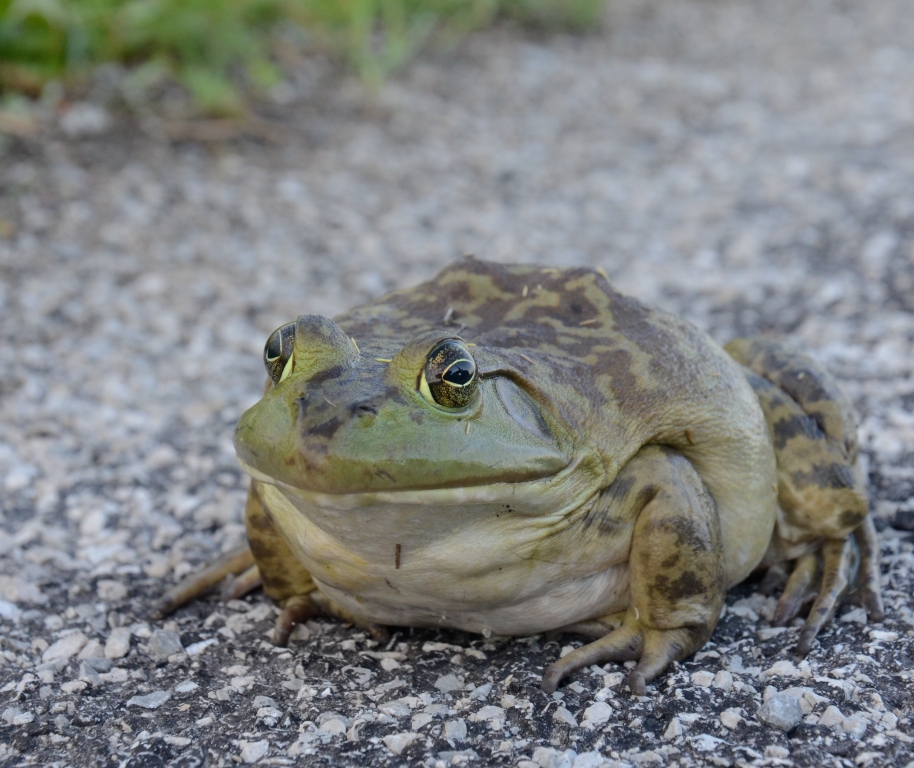
After the Muskrat family retreated back into the drain pipe and probably into the big marsh on the other side, I turned my camera's attention to the large Bullfrogs by the culvert's mouth. Here, a lunker stares inscrutably at the camera. I once saw a huge Bullfrog sitting just like this, with a much smaller Green Frog's head poking out of its mouth. I didn't have a camera then, but would have loved to photographed that scene.
As I was photographing the frogs, I noticed a roiling from within the culvert pipe, with noticeable waves coming from within. I thought that perhaps the Muskrats were in there, but the wave action seemed to extreme. A few seconds later, this absolutely monstrous Snapping Turtle emerged!
As I was above and behind the pipe when the turtle exited, it didn't see me and I ran around to the other side to get this shot. At that point, he/she did spot me and froze, allowing for some close up portraiture work of a beast that totally looks the part of its several hundred million years of evolutionary history.
I would not want to get my finger nipped by this brute. A turtle this size could and would do some serious damage if mishandled, and snappers are not known for their friendly temperament. They can live a long time - 50 years or more - and I suspect this one would have to be at least a few decades old. Note the numerous mosquitoes biting its head, and the leech on its shell. Maybe that's why they're ill-tempered.
Photo tip: A perfectly still subject such as this turtle allows for employment of techniques not often possible with animals. I had my camera on a tripod, and moved the rig in as close as possible. Then I used live view on the back of the camera, which keeps the mirror locked up, eliminating even the very slight "slap" caused by mirror motion. Using the two second timer allowed the camera to be totally still when the shot fired. This allowed me to use a very long exposure at a small aperture. Settings for this image were ISO 100, f/16, and a very slow one-third second exposure.
A romp through the diverse flora and fauna of Ohio. From Timber Rattlesnakes to Prairie Warblers to Lakeside Daisies to Woodchucks, you'll eventually see it here, if it isn't already.
Showing posts with label bullfrog. Show all posts
Thursday, July 13, 2017
Tuesday, July 7, 2015
Snake attacks frog!
A Blue Dasher, Pachydiplax longipennis, poses for the camera. While casing out sites for Mothapalooza field trips a few weeks back, I came across a beautiful pond in the depths of Shawnee State Forest. Its marshy verges were filled with dragonflies, and my attention was diverted to shooting images of the spectacular beasts. Blue Dashers are often about the most common dragonfly in such habitats, but I never tire of shooting them. The animal in the photo is "obelisking" - pointing the tip of its abdomen towards the sun to minimize heat absorption. Sometimes, on very hot days with the sun overhead, they'll stick their abdomen up until nearly vertical.
SNAKE ALERT: If you don't like serpents, AND somehow missed the title of this post, be aware. Snake photos to follow.
While shooting the dragons, I noticed that several interesting birds were close at hand, including a singing Yellow-throated Warbler. Wanting photos, I switched camera gear over to the 500mm lens, and put the whole affair on the tripod. As I stalked the warbler, I began to hear a strange call from the small creek that fed the pond. Certain it was an amphibian, but unsure as to what species, I wandered over to find the singer.
Well! Small wonder I didn't recognize the sound! A large Bullfrog had been seized by this Northern Watersnake, and was issuing soft plaintive bleats quite unlike its typical calls. I pivoted the big lens to this drama, and began snapping away.
The snake seemed to have a firm grip on its prey, but the frog was large and powerful enough to occasionally drag the snake about as it tried to escape. After about ten minutes of this (I'm not one to interfere in such affairs), the frog appeared to be tiring. Birds forgotten, I was determined to photo-document this tale to its end, whatever that might be. Although some snakes, apparently including this species, can dislocate their jaw and thus open the mouth to incredible proportions, I didn't see how the snake would ever manage to swallow such a large prey.
I never got the chance to find out. Finally, the frog lunged forward in a mighty burst, and shook free of its tormentor. It was gone in the blink of an eye, leaving behind a presumably hungry and frustrated snake. NOTE: When we came back to this spot the next day on the formal field trip, this snake (I would suppose) was in the same spot, hiding under streamside vegetation. It occasionally thrust out into the clear waters and grabbed minnows, so fear not, it wasn't going hungry.
Here's a short video of the frog-snake encounter. Turn up your audio and you'll hear the curious bleating sound given by the seemingly doomed frog.
SNAKE ALERT: If you don't like serpents, AND somehow missed the title of this post, be aware. Snake photos to follow.
While shooting the dragons, I noticed that several interesting birds were close at hand, including a singing Yellow-throated Warbler. Wanting photos, I switched camera gear over to the 500mm lens, and put the whole affair on the tripod. As I stalked the warbler, I began to hear a strange call from the small creek that fed the pond. Certain it was an amphibian, but unsure as to what species, I wandered over to find the singer.

The snake seemed to have a firm grip on its prey, but the frog was large and powerful enough to occasionally drag the snake about as it tried to escape. After about ten minutes of this (I'm not one to interfere in such affairs), the frog appeared to be tiring. Birds forgotten, I was determined to photo-document this tale to its end, whatever that might be. Although some snakes, apparently including this species, can dislocate their jaw and thus open the mouth to incredible proportions, I didn't see how the snake would ever manage to swallow such a large prey.
I never got the chance to find out. Finally, the frog lunged forward in a mighty burst, and shook free of its tormentor. It was gone in the blink of an eye, leaving behind a presumably hungry and frustrated snake. NOTE: When we came back to this spot the next day on the formal field trip, this snake (I would suppose) was in the same spot, hiding under streamside vegetation. It occasionally thrust out into the clear waters and grabbed minnows, so fear not, it wasn't going hungry.
Saturday, July 2, 2011
One Big Bullfrog
A while back, I was cruising a rural lane enjoying the sights when an enormous lump on the road caught my eye. As I moved nearer, wondering what the unidentified mass might be - bear scat, horse apple, osage-orange fruit?! - the pile transformed into a bullfrog. Possibly the largest bullfrog that I've ever seen, and if I as yet have nothing more to point to in my life, I can honestly say that I've seen a lot of bullfrogs.
A note on the bullfrog's name: some authorities have made the case that this species and others should be placed in the much harder to pronounce genus Lithobates (Rana - Ray-nah; Lithobates - Lih-tho-bat-ees). The jury seems out on this proposal so I stick with the long-used name and the one that will be employed in all of your field guides. Whatever the case, the scientific epithet catesbeiana refers to the brilliant and productive English naturalist Mark Catesby (1692-1749). Among his many talents, Catesby was a skilled artist. Check out his rendering of his namesake bullfrog HERE.
Anyway, it turns out I had no worries about the bullfrog fleeing. The thing was not even in the slightest intimidated of me, or my 3,200 lb. car. It just sat there, regarding me with a Yoda-like inscrutability. It's likely that, if the frog had any thoughts at all regarding me, it was lament that I was probably too large to enwrap with its long viscous tongue, by which I could then be pulled into its expandable mouth and swallowed whole.
So I got out of my auto and lay on the pavement with the frog; always, always, working my hardest to bring you the best angles of creatures great and small. Even this intrusion failed to faze her. Now, from a much closer distance, she continued to inspect me with an unblinking stare. Not one millimeter did she move, and if this frog has anything to be grateful for, it is that I am not a frog-legger. There was a meal to be had here, and they say bullfrog gams taste like chicken.
Oh, I called her a "her". The way to tell bullfrog sexes apart is by the "ear", which is more appropriately referred to as the tympanic membrane. This is that drumskinlike round organ just behind the eye. In girls, the typanic membrane is about the same size as the eye; in males it is considerably larger.
I'd say this frog's body - just the body - was about six inches in length, maybe a bit more. Throw in the outstretched legs and you'd use up about all of the real estate on a foot-long ruler measuring her if she was dangled from her toes.
Such a massive predatory amphibian can catch prey we don't normally think of as meeting their demise at the hands (tongues?) of frogs. Big bullfrogs are known to snap up songbirds, small turtles, snakes, and nearly anything else that it is capable of overpowering and stuffing down its gullet. In a fabulous case of forever lamenting NOT having the camera close at hand, I once was walking a marsh's edge and observed numerous massive bullfrogs sitting in the shallows. One looked a bit odd, and after glassing it with the binocs, I saw a somewhat smaller frog, its head still jutting from its captor's mouth.
Bullfrogs create one of the classic summertime sounds, their loud growling roars echoing from ponds and wetlands. And I'm sure that the female starring in this blog has produced her share of little green monsters.
Subscribe to:
Posts (Atom)