Showing posts with label lygodium palmatum. Show all posts

Tuesday, December 30, 2025

Climbing Fern


Last Saturday, Shauna and I participated in the Beaver Christmas Bird Count. Our area of the count covers a very remote area of Jackson County, Ohio, and it was quite birdy, at least in regard to species diversity. Overall numbers were not great. Highlights included five Hermit Thrushes and two Eastern Phoebes. In all, we found 43 species. And reconfirmed the existence of this population of Climbing Fern (Lygodium palmatum).

ASIDE: Hermit Thrushes are undoubtedly far more common in wintertime southern Ohio than is generally imagined. One key to finding them is getting an eye for suitable habitat, which is hardly rocket science. They favor early successional habitats with plenty of fruiting sumac (genus Rhus) and most commonly from my experience, Staghorn Sumac (Rhus typhina). The copious and long-persistent sumac fruit is a staple of their wintertime diet. Once in a while, one will hear the easily recognized low chuck call note of a thrush and find it that way, but mostly, the birds remain silent in dense cover and are easily overlooked. But judicious playing of the thrush's call note - not the song - will usually elicit a response, quickly. Had I not done that, we probably wouldn't have found any on this excursion. Had we had more time to just work Hermit Thrushes, we may well have doubled that number.

Back to the fern. The above photo shows Climbing Fern's scrambling growth habit. It isn't hard to spot a colony, but colonies tend to be fairly rare and local and widely scattered. At one time, it was on the Ohio Department of Natural Resources' official list of rare plants but was rightly removed long ago as it isn't rare enough to merit listing.

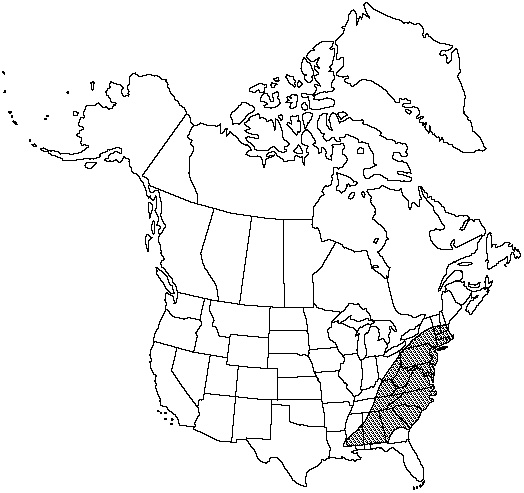
Map courtesy of the Flora North America

This is the only member of the largely tropical fern family Lygodiaceae that occurs entirely within the Unites States, and by far the most northerly species. Two others, Asian species and both in the genus Lygodium, have been introduced. One of them, Japanese Climbing Fern (L. japonicum) is widely established across the southeastern states but has not yet managed to make it as far north as Ohio. The other is Climbing Maidenhair (L. microphyllum) which thus far is confined to Florida but seems to be rapidly spreading.

Aptly named, Climbing Fern is adept at scrambling up supporting vegetation, and can climb to several feet in height via its spaghetti-like orangish stems. The green conspicuous fronds are the sterile leaves that are long-persistent. The fertile spore-bearing leaves are short-lived and quite different in appearance. Remnants of these can be seen at the bottom one-third of the plant in the image above. They are the lacy brown extensions from the stems.

The fern's specific epithet, "palmatum" essentially means "hand-like" and the fronds certainly suggest hands. In the fern world (Pteridophytes), which encompasses about 80 species in Ohio, Climbing Fern is among our most distinctive species.

I first saw this Climbing Fern colony over 20 years ago, and it's always rewarding to revisit it each year. The general area in which it occurs has a large silica mine that is still operational and has laid waste to lots of interesting and valuable habitats since it started. Hopefully this fern colony and its vicinity will be spared, especially as there are several other rare plant species nearby, including some that are truly endangered.

Tuesday, October 6, 2015

Climbing Fern, Lygodium palmatum

Way back on August 13, I made a visit to Vinton County in southeastern Ohio, to visit my friend Ray Showman and his wife, Carol. The primary mission was to deliver a presentation to Carol's garden club, and that task was dealt with. But there was time for a field excursion into Vinton County's wildlands, and Ray and I hit some of the local hotspots.

One organism that I really wanted to revisit was a strange plant known as Climbing Fern, Lygodium palmatum. For as long as I can remember there has been a large station of this plant in a scruffy cutover woods not far outside of McArthur. Ray and I made our way there, and lo and behold - there was the fern. Vegetation succession has eliminated much of it - back when I first became acquainted with this spot the fern clambered over vast expanses, and suggested an out-of-control growth of Japanese Honeysuckle from afar. But the odd tangle of the odd fern persisted here and there.

In the photo above, we see the finely cleft fertile leaves of Climbing Fern, near the summit of the filamentous vining stems that scramble over other plants. Its support plant - at least one of them - is the noxious Japanese Honeysuckle, and supporting this beautiful fern is one of the better uses that I've seen for that invasive species.

This is what the ground below looked like. A vegetative tsunami of interesting hand-shaped leaves; the sterile foliage of the Climbing Fern. Their shape provides the plant's scientific name's specific epithet: palmatum (hand-like).

Here are both leaves together on an aerial stem. The narrowly lobed fertile leaves, which bear the indusia or spore cases, adorn the upper part of the twining stem. A few of the larger sterile leaves are below. All in all, a very showy climber well worthy of our attention and respect. It would seemingly make an excellent garden plant, but may be tough to grow, and it seems virtually unknown in the nursery trade.

Up until recently, Climbing Fern was a member of the strangely named Curly-grass family of ferns (Schizaeacaea. It has since been segregated into the Lygodiaceae). Only two species in these groups make it this far north: Climbing Fern (map), and the strange little Schizaea pusilla of the east coast and northeastern maritime regions. Ohio is on the edge of the Climbing Fern's range, and although it can be locally common, generally the fern occurs sparingly and locally in a handful of southeastern counties. The rest of the 35 or so species are tropical, and occur far to our south.