Showing posts with label indiana. Show all posts

Thursday, December 2, 2021

Dancing cranes


I recently spent a few days in northwestern Indiana, at and in the vicinity of Jasper-Pulaski Fish & Wildlife Area. This area is legendary for the numbers of Sandhill Cranes (Antigone canadensis) that gather here in late fall and early winter. They are southbound from northern nesting areas. During my time there in the last week of November, crane numbers were reaching their peak. About 30,000 birds were estimated to be in the area.

The photo above shows typical land use in the regions around the wildlife area. Agriculture on an epic scale, and streams transformed to deep ditches. The Kankakee River drains much of northern Indiana, including this area. At the time of European settlement, there were about a half million acres of wetlands and prairies along the river's corridor. By the early 1920's, agriculturalists had managed to drain nearly all the wetlands and destroy nearly all of the prairies and savannas. The destruction of the "Grand Marsh" is one of the greatest and saddest tales of large-scale land conversion in North America. Mountains of biodiversity was lost, and the Kankakee itself was channelized into a linear ditch over its entire length in Indiana.

But the cranes still come to this ancestral staging area. The big birds are far more resilient than, say, Greater Prairie-Chickens, which were thoroughly vanquished from the state. A hard and inescapable fact in nature is that there are always winners and losers resulting from our actions. Specialists such as prairie-chickens, Regal Fritillary butterflies, and Prairie Fringed Orchids tend to be the losers when people more or less successfully bend nature to their will. Facultative opportunistic species such as Canada Geese, Butterweed (Packera glabella) and Coyotes are winners, adapting well to massive change. And, to a degree, the cranes are winners.

The cranes spend their nights in big marshes within the wildlife area and radiate out into agricultural fields during the day. There, they feed on spilled grain and whatever morsels these omnivorous opportunists can find. In certain areas, the fields are full of cranes. At one point, I was watching and photographing a group of them when something put up thousands of birds about a mile away. The din created by all those bugling cranes was easily audible from my position, and they created a semblance of low scudding clouds on the horizon.

A pair of Sandhill Cranes picks through the stubble. It would be interesting to know how old they are, and how long they have been paired. The oldest known wild Sandhill Crane (from a western population) was forty (40!) years old. Sadly, we know that because it was shot by a hunter. An ignominious ending for such a regal elder. But as the bird was banded, we did glean something of value from the unfortunate episode.

Cranes are thought to often mate for life, and one way in which they reinforce bonds is by "dancing". If you visit Jasper-Pulaski at peak crane season, you will see this behavior. To me, it is one of the most interesting things about crane-watching. Much of the dancing occurs beyond the range of my lens, and I just enjoy it through binoculars. Sometimes, a pair's dancing sparks more dancing by other birds, and before you know it it's like a feathered flash mob erupts, dancing to some primal beat.

I had a feeling the pair featured here was going to do something, and they were close enough that I could work my camera. Sure enough, the dance soon commenced. The bird on the left has tossed plant debris aloft - you can see it in the air over its head. Object tossing typically accompanies these displays. We can assume the other bird is impressed.

Dancing cranes offer showy wing flourishes, polite bows, and frequently hop vertically several feet into the air, like pogo-sticks.

This synchronized, energetic bird ballet is impressive. It'll usually last for a minute or few, then it's back to gleaning seeds from the stubble as if nothing happened.

If you've not been to Jasper-Pulaski, I highly recommend a visit. The incredible Kankakee Sands prairie restoration is less than an hour west and should be included on the itinerary. I'll write more about Kankakee later.

Wednesday, March 16, 2016

Goose Pond, Indiana: Part II

As mentioned in the previous post, I spent the weekend past at the amazing Goose Pond in Indiana. You can read why, and see other photos from that foray, RIGHT HERE.

Two particular challenges face the photographer at Goose Pond, at least during our weekend. One is distance. This is a huge wide-open space, and waterfowl and other wild birds are not dummies. Getting within good range for tack-sharp photos can be tough. The other challenge was weather-related. Skies were heavy and gray the entire time, often delivering a wet mist or spitting rain. As much of photography is about light, such conditions are distinctly suboptimal, especially when shooting birds where fast shutter speeds are often a necessity. But as noted in the prior post, we probably learned more by having to work in these conditions.

Following are a few more photos from the Goose Pond weekend.

Hundreds of American White Pelicans mass in the distance. There were over 1,000 birds present; so many that the large roosts looked like distant snowbanks.

Occasionally small pelican squadrons would pass by on the wing near enough to shoot fairly well. Note the large "horn" or flattened tubercle atop their bills. American White Pelicans develop these odd bumps during the breeding season.

By FAR the most common waterbird in the marshes was the American Coot. Thousands of them were everywhere. They did make for good wingshooting practice.

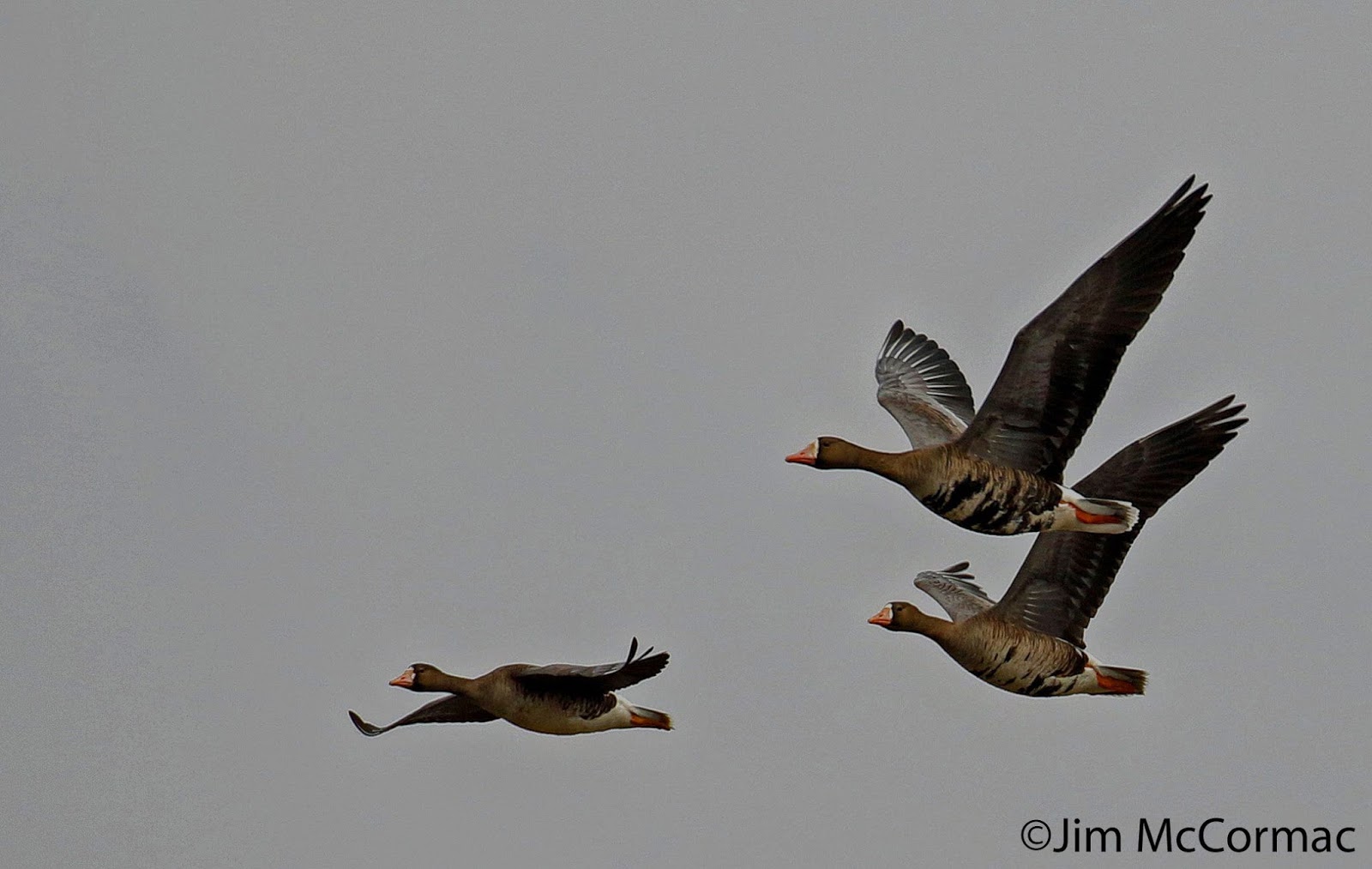
A trio of Greater White-fronted Geese passes over. Hundreds were present. It was neat to see so many of these birds, which occur largely west of Ohio. The semi-musical piping squeaks of flocks filled the air on occasion.

In the previous post, I discussed the challenges of exposing birds in flight that are backdropped by a colorless leaden sky. To make this image, I cranked the exposure compensation two stops or so to the right (positive) to try and get a decent exposure. The end effect can be rather painterly.

A hen Green-winged Teal rockets by. These tiny ducks are a challenge to capture in flight. This one surprised me as it came from behind as I stood partially hidden amongst some cattails. I was using my Canon 7D Mark II with the superb 100-400 II lens, handheld. This was the first shot I got off, and the only keeper. This camera shoots ten frames a second on burst mode, and I kept the trigger down. But the bird saw me just about the time that I took this photo, and quickly veered off.

This one was luck, at least in part, depending upon your viewpoint. I shot it from the same cattail blind as the previous image, and was smoothly panning this flock of Redheads as they passed by my position. When I later evaluated the images, I saw that one of the birds was caught in the act of releasing a flume of fecal effluvia.

Several interesting questions are raised by this, on which I suspect there has been little to no research. Ducks in flight are fast, and these Redheads were probably doing 40 mph or faster. It would be distinctly disadvantageous to be a duck that was closely following a bird when it forcefully expelled. Have waterfowl evolved a staggered flight formation to avoid such mishaps? Do birds that must "go" when on the wing drop to the back of the pack as a matter of etiquette? Do they prank their comrades with an expected blast?

Goose Pond has become an important resting and refueling area for Whooping Cranes in the recently established population that winters in Florida, and migrates to Wisconsin. At least seven were present this weekend. While the giant white birds can be seen a mile away, and they're fun to watch, most of the time the cranes were too distant for photos. While the bird and its companion were fairly far off, they were close enough to get fairly clear images. I was using the equivalent of an 1120 mm lens, and even then much cropping was necessary. Note all the bands adorning its legs, and there was even a leg transmitter for radio telemetry monitoring.

We figured the meadows and marshlands of Goose Pond were harboring Short-eared Owls, and sure enough, we saw about five of the charismatic raptors at dusk on the first night. As is often the case with these largely crepuscular owls, they didn't emerge until it was too dark for decent photography. The camera's ISO was 6400 when I made this image - far too high for a crisp shot. But the photo does show the general ambiance of the scene, and we greatly enjoyed watching the owls' antics.

I look forward to a return visit to Goose Pond, someday.

Monday, March 14, 2016

Goose Pond, Indiana: Part I

David FitzSimmons and I co-led a photography workshop over the weekend, at an amazing place known as Goose Pond, in south-central Indiana. Read more about this site RIGHT HERE. Dave is one of the best photographers that I know, and I was flattered that he would have me along. Ben and Anna Warner also were leaders and their bird-spotting and overall trove of natural lore was indispensable. Roberts Camera of Indianapolis organized the affair and Walt Kuhn did his usual topnotch logistical work.

Back to David for a second. He's created a brilliant series of books dubbed "Curious Critters", and you can learn all about those at his website, HERE. But there's more. Dave just released another book entitled Salamander Dance, and it's great. CLICK HERE to learn about that. These books are exceptionally effective at interesting kids in nature. Think about getting some for the kids in your sphere.

We have great fun at these workshops, and everyone learns a lot. Should you be interested, Dave, myself, and Art Weber are conducting another on September 20-22, at Lakeside Chautauqua on the shores of Lake Erie on Ohio's Marblehead Peninsula. It'll be a blast, with scads of interesting photographic subjects. DETAILS HERE.

There's no predicting Midwestern weather, and  our groups were challenged much of the time by spitting rain and leaden skies. These are not ideal conditions for bird photography - which was our focus - but one should strive to make lemonade from lemons. We actually probably learned more from shooting in such weather, as good photos can still be made, but one must work harder for them.

A male Red-winged Blackbird is not deterred in the least by the rain wetting his feathers. Red-wings, needless to say, abounded in Goose Pond's nearly 8,000 acres of marshland, and they made wonderful subjects.

We were pleased to see that many Eastern Phoebes had returned, and were setting up shop under bridges. These tough little flycatchers are the first of their family to return in spring.

This female Red-winged Blackbird posed beautifully for our group, allowing everyone to practice composition, and exposure in gloomy light. We had discussed optimal head positions and postures for interesting photos, and it was cool to hear the flurry of clicks from the cameras when the red-wing canted her head to a pleasing angle.

We focused (pun intended) a lot on flying birds. This represents a real challenge to proper exposure when the bird is backdropped by the "white sky of photographic death." Without really ratcheting up the positive exposure compensation, you'll end up with a black silhouette. It's often not intuitive for people to intentionally overexpose their cameras on a subject, but that's what must be done in such situations. This light morph Rough-legged Hawk gave me a few close passes. I shot it with the Canon 7D Mark II and the 100-400 f/4.5-5.6 II, handheld. Settings were 400mm, f/5.6, ISO 320, and 1/600. Smooth panning of the subject with the camera and the lens' brilliant image stabilization makes getting a sharp shot fairly easy. The key, though, was cranking the exposure up one and two-thirds stop.

It wasn't all birds. The warm rainy weather pulled out turtles galore, and many Painted Turtles were marching overland. Turtles do not require the blisteringly fast shutter speeds that birds often do, I have found.

At one point, a bunch of us had our big rigs mounted on tripods and focused on a group of distant American White Pelicans. These pelicans are feathered jumbos indeed: weight about 16-17 lbs, with a wingspan of nine (9!!) feet! They're not too tough to locate in the camera's viewfinder. While we were shooting those, I noticed a tiny dime-sized Spring Azure butterfly flit by and land on some nearby grasses. Many of us turned our rigs to the butterfly and it was amusing to see a bunch of 500 and 600mm lens - complete overkill! - trying to focus on the tiny insect. I suspect millions of azures could fit in a pelican's pouch. But it was a great exercise in locating tough to see objects with a large lens. This image was shot with the Canon 7D Mark II, 500mm f/4 II, and 1.4x extender - a focal length equivalent to 1120mm. I was standing about 15 feet away from the butterfly.

I had never been to Goose Pond prior to this excursion, so I spent Friday scouting before the first group arrived. At one spot I saw a thick stand of cattails in the shallows of a marsh, and waded out to hide in them, camera in hand. Sort of a makeshift blind, if you will. It worked, and I got some neat images of various waterfowl. But the highlight of this locale was some curious Muskrats. Apparently I had chosen an area important to them, and they either did not appreciate my presence, or didn't know what I was and were curious. They approached closely several times, and would swim around within two feet of me, emitting soft little squeaky whistles.

Next up I'll post some interesting waterfowl photos, and other waterbirds.

Thursday, November 19, 2015

Sandhill Cranes over Indiana

I made a whirlwind trip to the state next door last weekend, Indiana. The Indiana Native Plant and Wildflower Society was holding its annual meeting, which is a big affair. In this photo, which I made with my iPhone from the balcony of the conference room at Indiana University - Purdue University Indianapolis, Doug Tallamy orates to the group. It was a packed house - about 350 attendees. They take their flora seriously in the Hoosier State. I was flattered to be asked back (3rd or 4th time!) to speak, especially given the otherwise star-studded lineup: Doug, Rick Darke, Mike Homoya, and Kevin Tungesvick. It was a great time, and fun to catch up with lots of people and hear some great talks. Kudos to all of the conference organizers and volunteers for the usual bang-up job.

Mid-November in Indiana means crane time, though, as in Sandhill Cranes. And the Mecca for Hoosier State cranes is Jasper-Pulaski Fish & Wildlife Area, which is in only two hours or so northwest of the conference venue. Even though I've made the Jasper crane scene a number of times, at the last moment I decided to stay over there and arrive at the big crane field the following morning before daybreak. This decision was partly based on the weather - it was to be a bright clear day, and every other time I've been, the skies have been leaden-gray. Blue ether would make a better backdrop for photography, of course.

The observation tower casts a long shadow over Goose Pasture as the sun pops over the horizon. This mammoth field serves as the gathering ground for myriad cranes before they begin their day, and again in the evening before they fly off to the marshes to roost for the night.

I prefer being here as the sun rises, for a few reasons. One, the light is to your back. Two, there are generally way fewer people than in the evening. Sometimes the viewing platform is overly packed for the dusk show, but even on this beautiful Sunday morning, just after sunrise, there was plenty of room for everyone and our tripods.

Assembled crane enthusiasts admire assembled cranes in the field beyond. I was told that estimates put the number of cranes at about 8,000 birds, but it didn't seem like that many to me. Nonetheless, there was certainly no shortage of the spectacular animals.

This scene is kind of Disneyesque and I couldn't resist making the shot. A trip of Sandhill Cranes wings by while a White-tailed Deer gallops along, and a loose assemblage of more cranes loiters in the backdrop. Such is Jasper in November.

While there are places where far more cranes gather than here, J-P is still an amazing experience. People come from near and far to drink in the sight of these fabulous giants flying about, wings spanning well over six feet. Cranes are vociferous, and the air resounds with their primitive guttural rattles.

As the sun cleared the horizon, its rays began to cause flying cranes to glow with beautiful golden tones, and the click of cameras accelerated. I met some new friends on the platform, and we had a great time shooting birds, talking photography, and alerting each other to incoming opportunities. Mike Bader was one of them, and some of his stunning work can be seen RIGHT HERE. In general, bird photography is a solo pursuit, but in this case it doesn't matter. The cranes are probably going to act the same whether there was just one person hiding under the platform, or 75 people gabbing away on the deck.

A gorgeous red-capped adult crane wings right over the platform. I shudder to think how many images were clicked off of this bird. It sounded like mini machine guns going off. I shot this one with my Canon 7D Mark II which fires ten frames (rounds) a second, and there was plenty of similar hardware aimed at the bird. There must be millions of (camera) shots fired at cranes at J-P during the peak fall migration.

Sandhill Cranes remain together as family units throughout winter and well into spring. Many of the groups have at least one juvenile in tow. Here, a youngster trails an adult. The juveniles give a distinctive high-pitched whistle in flight, sometimes drowned out by the adults' raucous rattles.

Jasper-Pulaski should be prime for cranes into mid-December, so if you're looking for an interesting avian experience, check it out.