Showing posts with label american alligator. Show all posts

Friday, January 27, 2012

American Alligator

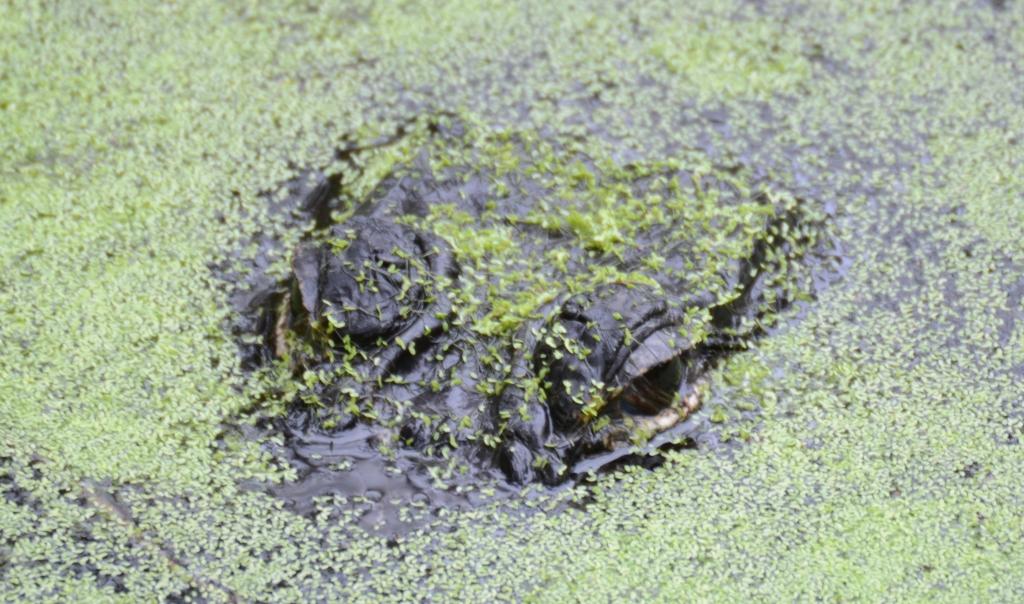
An American Alligator, Alligator mississippiensis, cruises slowly down a blackwater canal in southern Georgia's Okefenokee National Wildlife Refuge.

This post is a bit of a blast from the post - from my November 2011 trip to the Okefenokee. I had intended to share some gator photos shortly after the trip, but a crush of other subjects nearly relegated the giant reptiles to the scrap bin.


There are several thousand alligators in the Okefenokee's 438,000 acres, and if you visit, you're almost sure to see some. This stegosaurus-tailed bruiser was hauled out on a muddy embankment, and gave us his best repilian grin as we slowly cruised by in our swamp boat.


This old boy was in repose along a road, and apparently some fool tossed a pebble on its head. A "sleeping" gator looks dead and still as stone, but only an idiot would closely approach one. While attacks on people are very rare, only Darwin Award candidates test their luck.

An exceptionally massive old male can reach 14 feet in length and weigh half a ton. In spite of their bulk, big gators can move with astonishing speed, and become scaly Esther Williams' when in the water. They'll occasionally attempt to snap perched birds from limbs overhanging the water, and can nearly lunge free of the water. There is a great story of an Okefenokee swampman who was cruising a canal in his motorized johnboat when he rounded a bend only to meet a big gator that was hotfooting it right at his boat. The spooked reptile leapt free of the water and right into the guy's boat! After a wild tussle the boatman managed to lever it over the side with a pole, nearly capsizing in the process. He got a cool story out of that encounter!

Thursday, February 3, 2011

Gators

There's no shortage of American Alligators in south Florida. Nearly everywhere one goes, the toothy lizards are laying about, or poking their snouts ominously from the water. Although not very aggressive and hardly a threat to anyone with half a brain and an ounce of self-preservation, their presence does make one look at the murky swamp waters in a new light.

Probably no other animal in Florida excites the touristos like Alligator mississipiensis does. They're big, primitive, scary, and rise from the primordial ooze. What's not to like?

This big boy was one of the larger ones that I saw on my recent trip, but they can get a lot bigger than that. The males grow larger than the females, and there is at least one claim of a 19+ footer being bagged. That'd be exceptional; normally they'll not stretch more than 14 or 15 feet and such jumbos are rare.

Regardless of their size, you don't want to try and ride one sidesaddle or scratch 'em behind the ears. If it didn't flee, the gator might chomp you and that would hurt. Supposedly, the force of their jaws clamping together is one of the strongest pressures ever measured in an animal. A healthy gator can exert over 9,000 newtons of force with its downward clamp of the jaw. What's that mean? Well, 9,000 newtons is about equivalent to a ton of force. An expert boxer normally wouldn't generate half this force in his strongest blows. Plus, the gator has the added benefit of a lot of teeth with which to secure you, and the ability to keep those jaws shut so tightly you'd need TNT to blast yourself free.
Not something you see everyday - a baby alligator. they're colorfully banded with yellow at this stage, and about as close to "cute" as one of these reptiles ever manages to get. This little fellow was perhaps a bit more than a foot in length.

As cute and unintimidating as Jr. Gator was, it still would have been a bad idea to mess with him. This is Mom, and she was huge and ever so watchful. I detect some hostility and anger issues in her eyes, and it was a strong enough signal to keep everyone well back from her two little charges.

It's good that there are so many gators to see these days. It was only a few decades ago that scientists thought they would never recover to the point of being common. Unrestrained market hunting throughout much of the 1900's nearly eliminated alligators from much of the southern U.S., and in 1967 it was declared an endangered species. Multi-pronged recovery efforts following this designation were successful, and the gator was de-listed in 1987 and is once again a fixture of Florida wetlands.