Showing posts with label ring-necked pheasant. Show all posts

Tuesday, November 10, 2015

Ring-necked Pheasant

A rooster Ring-necked Pheasant skulks through thick brush in north-central Ohio last Saturday. I saw a number of these flashy birds on this day, and many orange-coated hunters trying to bag one. Pheasants are as tasty as they look.

Ring-necked Pheasants are not native here, as I'm sure you know - they hail from Asia, but have been intentionally spread far and wide. Efforts have been made to establish pheasants in nearly 50 countries, with varying degrees of success. The only continent that has been spared the ring-necks is Antarctica, where they'd have no chance at all.

This spectacular bird can fare well in North America, if conditions are right. Indeed, South Dakota has become a Mecca for pheasant hunters, and the Mount Rushmore State even boasts the world's largest piece of pheasant statuary, a behemoth effigy standing 20 feet tall and extending 40 feet from breast to tail tip.

Apparently ring-necks were first released in Ohio in 1896, and while they've had their ups and downs, releases are still widespread and regular. They do fairly well in some areas that still have decent habitat, but are nowhere near as frequent as they were in the early to mid 1900's. The birds that I photographed here were probably very recent releases.
As always, click the photo to enlarge

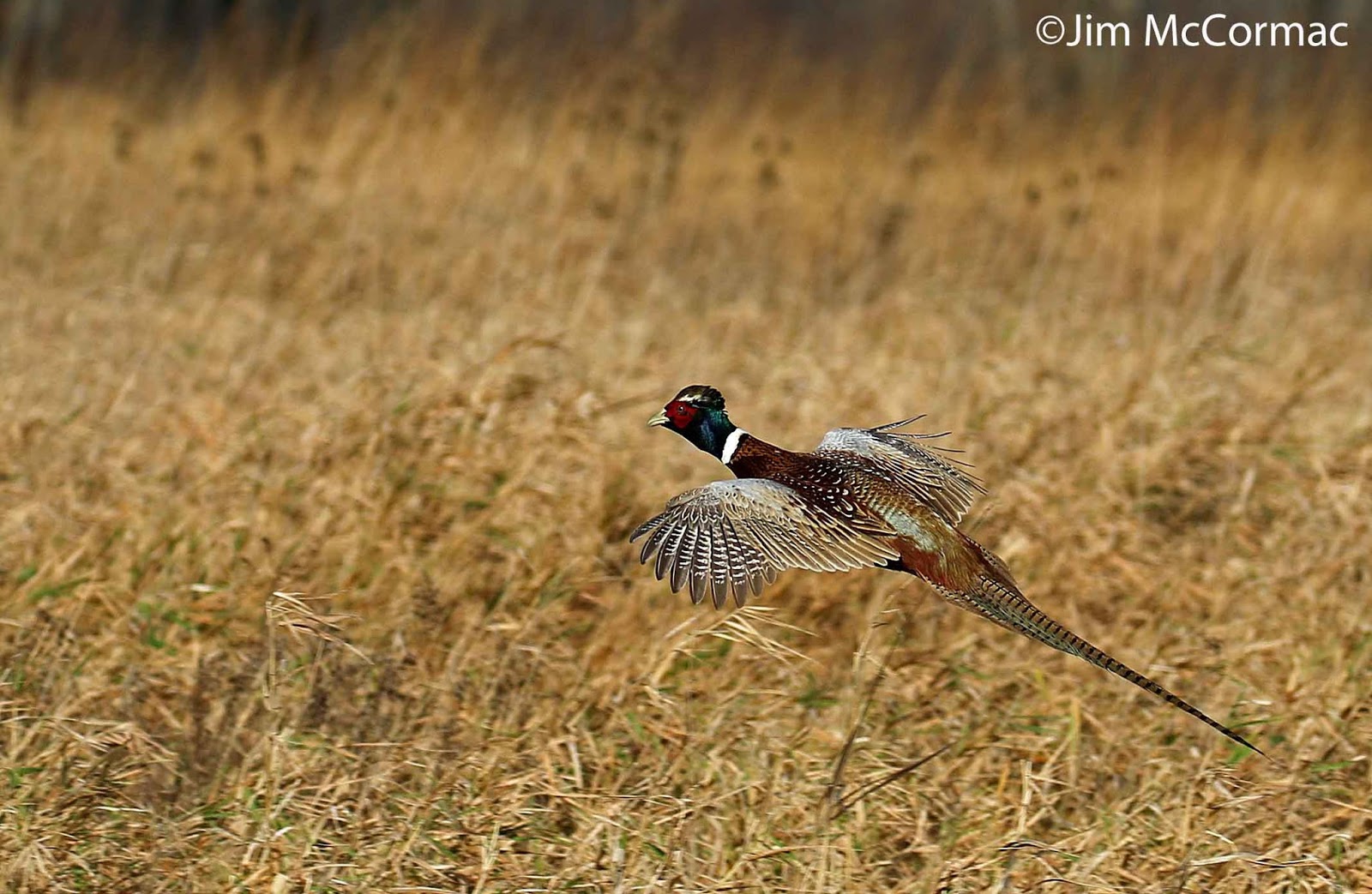
A rooster ring-neck whirring across a late autumn field of browned grasses makes for a pleasant pheasant sighting indeed, and even though I will never put these birds on the same plane as our native species, they do make irresistible eye candy.

I was, as the Boy Scouts say, "[be] prepared", and that's how I got this shot. When cruising interesting country, I like to have the bird camera on the front seat and ready for action. While slowly trolling a backroad, I spotted this bird slinking through the grasses. I stopped the car, camera in hand, and quietly attempted to exit the vehicle. That was too much for the bird, and it took wing, heading for the meadow on the opposite side. It gave me enough time to click off a few shots before it dropped into thick cover.

The image was made with the Canon 7D Mark II and Canon's 100-400 f/4.5-5.6L II lens. This combo is, for sure, one of the best for shooting birds, in flight or otherwise. Settings were f/5, 1/1600, ISO 100, and exposure compensation -2/3rd. I had the camera set on aperture priority and ISO on auto. For the place and conditions, those were good general default settings in case something happened fast and there wasn't time to fiddle about. As always now, I used back button focusing (read Art Morris's nice description HERE). The 7D has 65 focus points, and they are adjustable in many ways. When knowing or suspecting that I'm going to be shooting larger birds, I usually have the center point active as well as the four surrounding points. That was the case here. This gives a nice tight block of five clustered focus points, and if you're tracking the quarry smoothly, you ought to connect with one of them. Of course, the camera was set on high speed burst mode, and in the 7D's case that's 10 shots a second. It's like a photographic machine gun, and such rapid bursts up one's chance of getting a keeper. In spite of this, by the time I acquired the bird in the lens, and hit the shutter, I only got off a partial burst before it vanished into the grasses.

While all or some of this may sound complicated, it really isn't. A little study will break it all down easily enough. The cameras and associated gear grow ever more amazing, and we might as well try and take advantage of what they've got to offer.

Tuesday, April 10, 2012

Ring-necked Pheasant strutting his stuff

I recently wrote about thirteen-lined ground squirrels, HERE. The place were I observed those furry little tunnel-dwelling prairie dogs is a massive Conservation Reserve Program grassland, smack in the middle of the former Pickaway Plains prairie. This site, which sprawls over 1,000+ acres, is just south of Circleville, the county seat of Pickaway County and home of the world famous Circleville Pumpkin Show.

It isn't just ground squirrels that occupy these grassland - there are more Ring-necked Pheasants than you can shake a stick at! I once counted about 55 of them in the same field. I know, I know, this is an introduced bird of Asian origins, and it doesn't really belong here. Doesn't change the fact that pheasants are very cool, and at least in modern times, they've probably done much more good than harm.

This testosterone-filled rooster was really strutting his stuff, and didn't much mind when I stopped my car nearby to make some photos.This is a darn good-looking bird; impressive by any standard.

The cock pheasant's display is a rather sensational affair. Seconds after I made the first image, he launched into his girl-getting routine. The bird sort of rises up on its legs, puffs its chest out, and lets loose with a mighty flapping of the wings. The resultant loud drumming is an explosive flurry of sound reminiscent of a flapping tarpaulin in a hurricane. It carries a long ways.

Here he is nearly done, his wings slowed to a mild sputter. The rooster, of course, is scanning the horizon to see if any hens are responding.

The display done, he is probably saying something to the effect of "alright, you little feathered fillies, bask in my presence, get a ticket, and form a line!"

And if the stud is impressive enough, a hen will indeed come calling.

Although Ring-necked Pheasants were first released in Ohio in 1896, they didn't really take until the 1920's, and reached a peak around 1940 when an estimated 5 million birds roamed our landscape. Some authorities believe that the enormous pheasant population may have been a contributing factor in the demise of the Greater Prairie-Chicken, which once was common in Ohio's largest prairie regions.

Say what you will about pheasants, a lot of sportsmen love them and in 1982 a group known as Pheasants Forever formed. In the intervening 30 years, PF has grown ever more sophisticated ecologically, and although the perpetuation of Ring-necked Pheasants remains a core mission, their work fosters habitat for a great many species of native flora and fauna.

The grasslands where I made these photos is not a Pheasants Forever project, but they've helped create many similar habitats throughout Ohio. PF and CRP grasslands don't just support pheasants. Living among the prairie plants are birds such as Grasshopper and Henslow's Sparrows, Northern Harriers and Short-eared Owls, Bobolinks and Eastern Meadowlarks, Sedge Wrens and Dickcissels, and more.

So, in a way we can thank the fabulous Ring-necked Pheasant for spawning restoration of Ohio's hard hit prairie and grassland ecosystems and all that come with such places.