Showing posts with label yellow-rumped warbler. Show all posts

Tuesday, January 20, 2026

Yellow-rumped Warbler is Ohio's only regular wintering warbler


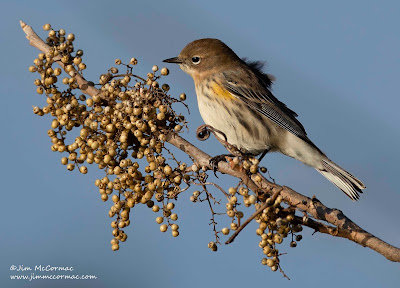
A female yellow-rumped warbler feasts on poison ivy berries/Jim McCormac

NATURE
Jim McCormac

January 19, 2026

Come mid-winter, birders start to experience warbler-deficit disorder. The small, colorful songbirds are favorites among the binocular-toting crowd, and Ohio is a major warbler hotspot.

Forty-one warbler species have occurred in the Buckeye State, and 36 of them occur annually. Many species occur in large numbers, especially during spring and fall migration.

But May – peak of vernal migration – is still months away. That’s a long time for those of thirsting for colorful Blackburnian, Cape May and Magnolia warblers and their dashing brethren. Collectively, our warblers display a palette of hues that would dazzle the most ambitious artist.

However, most of our warblers are currently residing in haunts that should make most of us northerners envious: southern Florida, Colombia, Costa Rica, the Dominican Republic, Mexico. Most species of warblers winter in tropical climes with some species as far south as Argentina and Bolivia.

Take hope, though – we still have the hardy yellow-rumped warbler! This feathered tough bucks the dominant paradigm of its southbound snowbird associates and routinely winters in northerly latitudes such as Ohio.

The yellow-rumped warbler is the most abundant North American warbler with a population estimated at 150 million birds. “Butterbutts,” as they are slangily known, are among our showiest warblers, but people get jaded to them due to their commonness. “Just another butterbutt” is an oft-heard refrain amongst birders poring through the waves of spring and fall migrants.

No yellow-rumped warblers occupy Ohio during the summer months. Their breeding season lies well to our north, where they nest across the length and breadth of the conifer-dominated boreal forest.

Breeding butterbutts can be found from Alaska to Newfoundland, and south to northernmost Michigan. Others breed further south at high elevations in the Appalachian Mountains and the western Rocky Mountains.

While both sexes sport the telltale yellow rump, the male is admittedly flashier. It is clad in showy black and grayish-blue plumage highlighted by a golden throat and flanks. At one time, scientists cleaved this widespread warbler into two species: the eastern “myrtle” warbler and the western “Audubon’s” warbler.

Males of the latter, named for the legendary frontiersman and ornithologist John James Audubon, wear a lemony-colored crown patch and flashy yellow throat. The myrtle warbler – which birds appearing in Ohio are – lack the golden crown and have white throats.

Due to a zone of hybridization, where myrtle and Audubon’s warbler ranges meet, scientists lumped them into one species – the yellow-rumped warbler – in 1973. To this day, many birders still refer to these subspecies as myrtle and Audubon’s warblers.

Breeding yellow-rumped warblers are tightly tied to coniferous trees, including fir, pine and spruce. Away from that habitat, however, they are perhaps the most versatile of all our warblers in habitat use.

I would not be surprised to see a butterbutt in nearly any habitat imaginable and probably have over the years. The warblers are also adept at finding and eating a wide range of food, which, in addition to their vast breeding range, probably plays a big role in their success.

This hardy, versatile warbler also winters further north than any other warbler. While some birds range as far south as the Caribbean and Central America, most winter in the U.S.

I’m in southeastern Texas as I write this column, and yellow-rumped warblers are everywhere. But just a week ago, Shauna and I participated in the Hocking Hills Christmas Bird Count in Ohio and found seven butterbutts in our turf. Yellow-rumped warblers winter commonly north to Ohio and other Midwestern states.

A prime reason that butterbutts can survive northern winters is their ability to include lots of fruit into their diet. And a major source of that fruit is one of the most despised native plants in North America: poison ivy (Toxicodendron radicans).

I suspect that poison ivy is THE primary reason that butterbutts can successfully overwinter in northern climes, while their mostly insect-eating warbler relatives must retreat to more southerly buggy latitudes.

The yellow-rumped warbler in the accompanying photo is scarfing down poison ivy berries, and I made that image on the aforementioned Hocking Hills bird count in subfreezing temperatures.

Poison ivy fruit fuels many species of wintering birds, not just butterbutts. In many ways, the rash-inducing vine is one of our most important wildlife plants. That’s a hard case to make to most people, but the yellow-rumped warblers sure appreciate poison ivy.

Naturalist Jim McCormac writes a column for The Dispatch on the first and third Sundays of the month. He also writes about nature at jimmccormac.blogspot.com.

Saturday, January 3, 2026

Yellow-rumped Warbler eating poison ivy berries


A female Yellow-rumped Warbler (Setophaga coronata) noshes on the fruit of poison ivy (Toxicodendron radicans). Shauna and I found this bird on today's Hocking Hills Christmas Bird Count in Hocking County, Ohio. It was one of 11 "butter-butts" that we located.

Poison Ivy is an important source of wintertime sustenance for this hardy warbler - the only warbler species that winters in numbers at northerly latitudes such as Ohio. The much reviled (by people, not other animals) native vine is relished by many other bird species. At one point today, we saw a Carolina Chickadee eating poison ivy fruit, and I have over the years photographed many other species partaking of this fruit.

Saturday, December 25, 2021

Poison Ivy is a major bird attractant


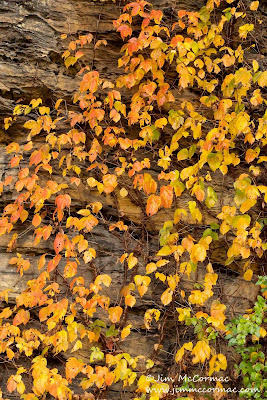
Poison Ivy (Toxicodendron radicans), in autumn color. Just saying its name usually triggers negative reactions. This beautiful native species is among the most despised members of our flora. It does contain urushiol, the active compound that causes blistering dermatitis among those who are allergic to it (and that's most people). 

Ironically, we (people) are the cause for the abundance of this opportunistic winner. Poison Ivy is a successional species, thriving in disturbed habitats. And we've created no shortage of disturbances in which it can thrive. It would be interesting to beam back to pre-settlement North America to see what Poison Ivy's status was then. My hunch: not nearly so common, and mostly confined to areas of natural disturbances.

A Yellow-rumped Warbler (Setophaga coronata) snacks on the yellowish-white berries of Poison Ivy. This hardy warbler winters as far north as the northern states in the eastern U.S. The abundance of Poison Ivy and its copious fruit are a major reason why - maybe THE primary reason. Yellow-rumps become highly frugivorous in late fall and winter, and really go for these berries. Birds, obviously, are not susceptible to urushiol's toxicity. Indeed, I wonder if any non-Homo sapiens animals are.

While exploring a central Ohio park the other day, big camera rig in hand, I was pleased to come across a large mixed foraging flock of birds. I heard the chips of Yellow-rumped Warblers from afar, and saw many American Robins, a few Northern Flickers, and other species. As I slowly moved in, I saw the reason for the flock: a number of trees draped with vines of Poison Ivy heavily laden with fruit.

Awesome! I love coming across such a situation in winter, as - from just a photography perspective - it means the potential for lots of interesting shots. From a bird-watcher's perspective, the ivy-attracted birds mean lots of interesting observations. Sure enough, in the hour or so I stood quietly watching and photographing, a Cooper's Hawk made a pass through, and a young Red-shouldered Hawk did the same. The former cleared everyone out, and it took about fifteen minutes for the situation to rebound. The latter had little impact on the birds' behavior. They know that the comparatively slow and clumsy Buteo has little chance of bagging a small speedy songbird.

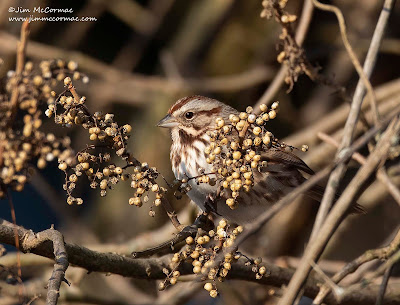
A Song Sparrow (Melospiza melodia) among an ocean of fruit. It plucked and downed many. While Yellow-rumped Warblers are conspicuous, frequently give their distinctive tchek! calls, and often forage higher in the vines, the sparrows typically remain low and feed quietly.

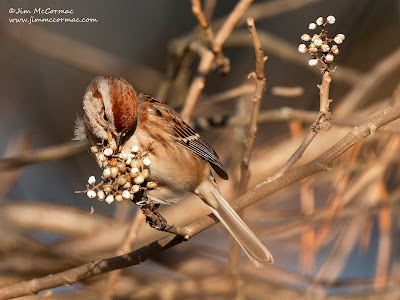
An American Tree Sparrow (Spizelloides arborea) works the ivy. Several of his colleagues were nearby.

I saw a number of other species grabbing Poison Ivy berries, but couldn't get shots. There are dozens of potential candidates that might snack on the fruit. I have even seen giant Pileated Woodpeckers (Dryocopus pileatus) hanging agilely from the vines, pulling off berries.

The sheer number of fruit in this particular Poison Ivy honey hole means that the site should be productive for some time to come, and I look forward to returning, camera in hand.

Wednesday, May 13, 2020

Buckeyes, and birds

Yesterday morning, at nearly the crack of dawn, I went to a local Columbus greenspot known as Duranceaux Park. It sits along the banks of the Scioto River, and that big stream is a thoroughfare for migrant birds. I'd been hearing all manner of reports from there, and the little park has been heavy with warblers and other songbirds. And birders. In this spring of reduced travel and social distancing, scads of local birders are visiting Duranceaux, and issuing interesting reports.

The light was stellar yesterday morning, and as I rolled into the park about the first thing that I noticed was the conspicuous flowering spikes of Ohio buckeye, Aesculus glabra (above). In the short distance to the parking lot I saw a number of flowering buckeyes, and also saw a photographic opportunity.

Once on foot, it didn't take long to see that things were moderately birdy. Most frequent were yellow-rumped warblers. This is the most common of the wood-warblers with a total population of nearly 100 million birds. I'm not jaded to the "butterbutts" though - I mean, look at that male above! A case could be made for this species as the most handsome warbler.

Lots of other migrants were around, including many blue-gray gnatcatchers. I took a photographic swipe at this one, as these high-strung fidgety little songbirds are not particularly easy to shoot well, and my archives are not especially rich in acceptable gnatcatcher photos. The bird finally rewarded my efforts by posing on this grapevine which made for nicely artistic prop.

But the flower spikes of the buckeyes kept 90% of my attention. As soon as I saw the buckeyes I thought about ruby-throated hummingbirds. Buckeye flowers are an important early spring nectar source for hummers, but I'd never managed to document this relationship with a camera.

I didn't have to wait long before I heard the squeaky chirps of a hummingbird, and moments later she raced in to the closest buckeye flower spike. She quickly tapped about half the flowers in this spike, then shot off to parts unknown. Nice.

The mistake, photographically, that I made was not putting my flash rig on the camera, knowing there was probably a pretty decent chance of a hummer-buckeye happening. Hummingbirds definitely pop much better with a puff of light, and it allows for much faster shutter speeds to mostly freeze wing movement. As it was, I shot this at 1/500 - fast enough for everything else I was shooting, but not this little speedster. I'm loathe to use super high shutter speeds if it causes the ISO to go sky high, and in this setting it was already at ISO 640 at f/8. Probably should have opened the lens up to f/5.6, jacked the shutter to 1/1000 or more and just rolled with it. But, whatever - the photo still proves that hummingbirds stick their bills in buckeyes.

Not long after the hummingbird encounter, I noticed a female northern parula showing interest in buckeye blooms. Here, she appears to critically evaluate the flowers.

A second later, she jumped into the flower raceme and began probing her thin bill deep into the flowers. Northern parulas are known to take flower nectar, especially on the (largely tropical) wintering grounds. It's been unseasonably cold around here of late, and on this morning the temperature was in the high 30's F when I arrived. The frosty temps and reduced insect availability might be driving increased nectariferous behavior from birds like this parula.

Finally, a short while later I noticed this Nashville warbler flit over to yet some other buckeye flowers. Same old story - into the flowers she went, working them over. This is a well-known nectar feeder, and was the second most common warbler on this day at this site. I'm sure I could have seen more Nashville nectar feeding had I paid closer attention.

I hope to have another crack at this phenomenon before the buckeyes go out of bloom. There are several goals: flash-assisted hummingbird shots, and capturing Cape May warbler, and Baltimore and orchard orioles in the act of plumbing these flowers.