.JPG) Mud. Thick, gunky, suck the shoes off your feet mud. A superficially worthless and oft-derided substrate that isn't given nearly the due it deserves. If you like birds, especially shorebirds, mud is worth something. And if you are interested in the big, long-term picture of plant distribution and global ecology, mud takes on a whole new meaning.
Mud. Thick, gunky, suck the shoes off your feet mud. A superficially worthless and oft-derided substrate that isn't given nearly the due it deserves. If you like birds, especially shorebirds, mud is worth something. And if you are interested in the big, long-term picture of plant distribution and global ecology, mud takes on a whole new meaning..JPG) Here's a whole lot of mud. I was up at Hoover Reservoir yesterday, which is a large impoundment just north of the city of Columbus, Ohio. Many years, autumnal draw-downs produce acres of mudflats at the upper end of the reservoir, much to the delight of birders. When conditions are as above, Hoover ranks among the best stopover sites in the region for long-haul migrant shorebirds.
Here's a whole lot of mud. I was up at Hoover Reservoir yesterday, which is a large impoundment just north of the city of Columbus, Ohio. Many years, autumnal draw-downs produce acres of mudflats at the upper end of the reservoir, much to the delight of birders. When conditions are as above, Hoover ranks among the best stopover sites in the region for long-haul migrant shorebirds..JPG) At first blush, a big mudflat appears rather two-dimensional: mud, and water. The birder's eye is mostly preoccupied by the above, the interface of water and mud. This is where most of the shorebirds congregate, generally speaking.
At first blush, a big mudflat appears rather two-dimensional: mud, and water. The birder's eye is mostly preoccupied by the above, the interface of water and mud. This is where most of the shorebirds congregate, generally speaking.But this big, open landscape is full of subtle ecotones, and carefully watching the different species of plovers and sandpipers will reveal distinct affinities for different niches. Yellowlegs, Stilt Sandpipers, dowitchers, godwits and other long-billed, long-legged species typically forage in the shallows just offshore from the mud.
Semipalmated Sandpipers and Dunlin often occur right at the mud/water interface. Least Sandpipers and Semipalmated Plovers will frequently forage a bit further back from the water, where conditions are a bit higher and drier.
We saw over a dozen shorebird species at Hoover yesterday, and as always it was fun and instructive to watch their various methodologies for plundering the mire of its tiny invertebrates.
.JPG) But four species that were present really pique my interest: American Golden-Plover, Baird's Sandpiper, Buff-breasted Sandpiper, and Pectoral Sandpiper. These are truly global wanderers, nesting in the North American high arctic tundra, about as far north as one can go, and wintering at the other end of the globe, in southern South America.
But four species that were present really pique my interest: American Golden-Plover, Baird's Sandpiper, Buff-breasted Sandpiper, and Pectoral Sandpiper. These are truly global wanderers, nesting in the North American high arctic tundra, about as far north as one can go, and wintering at the other end of the globe, in southern South America.And all of them share a commonality in habitat preference - they prefer the drier spectrum of the mudflats, where vegetation is starting to reclaim the barren ooze. In the above photo, we are well back from the water, and an elevational rise of just inches has allowed the mud to dry to the point where plants are forming a green carpet.
.JPG) Experienced birders know to look in the vegetated flats for Buff-breasted Sandpipers, and indeed there are two in the shot above. I have often found the beautiful little Baird's Sandpiper foraging in the proximity of the Buff-B's, and golden-plovers and pectorals often utilize this type of situation. That's why the superficially similar but ecologically barren sod farms can briefly play host to this suite of species.
Experienced birders know to look in the vegetated flats for Buff-breasted Sandpipers, and indeed there are two in the shot above. I have often found the beautiful little Baird's Sandpiper foraging in the proximity of the Buff-B's, and golden-plovers and pectorals often utilize this type of situation. That's why the superficially similar but ecologically barren sod farms can briefly play host to this suite of species.The innumerable links between birds and botany are not nearly as well studied as they ought to be, and that's especially true with shorebirds. So, we'll move in and dissect the prime Buff-breasted et al upper mudflat habitat.
.JPG) The Hoover mudflats emerald carpet, that every visiting birder who walks onto the flats traipses through, is dominated by this species: Creeping Lovegrass, Eragrostis hypnoides. A prostrate little annual grass, it is the first plant to begin colonization of the bare mud, and eventually forms coarse meadows covering acres.
The Hoover mudflats emerald carpet, that every visiting birder who walks onto the flats traipses through, is dominated by this species: Creeping Lovegrass, Eragrostis hypnoides. A prostrate little annual grass, it is the first plant to begin colonization of the bare mud, and eventually forms coarse meadows covering acres.
.JPG) A close second fiddle to the grass are sedges, in terms of dominance. Jutting above the rest in this photo is Rusty Umbrella-sedge, Cyperus odoratus, which at perhaps three inches in height is not casting much of a shadow. However, it towers over the Awned Flatsedge, Cyperus squarrosus, which is what nearly everything else in this photo is. And it's the latter that co-dominates with Creeping Lovegrass to form the vast mowed meadow look at Hoover's mudflats, and many other wetlands throughout the Americas.
A close second fiddle to the grass are sedges, in terms of dominance. Jutting above the rest in this photo is Rusty Umbrella-sedge, Cyperus odoratus, which at perhaps three inches in height is not casting much of a shadow. However, it towers over the Awned Flatsedge, Cyperus squarrosus, which is what nearly everything else in this photo is. And it's the latter that co-dominates with Creeping Lovegrass to form the vast mowed meadow look at Hoover's mudflats, and many other wetlands throughout the Americas.
.JPG) A handful of dicotyledonous plants makes the scene as well, and this is one of the more obvious: Tooth-cup, Rotala ramosior. Should you find yourself at Hoover looking for shorebirds, take note of all the little Twizzler-like pink shoots jutting from the mud - they're this.
A handful of dicotyledonous plants makes the scene as well, and this is one of the more obvious: Tooth-cup, Rotala ramosior. Should you find yourself at Hoover looking for shorebirds, take note of all the little Twizzler-like pink shoots jutting from the mud - they're this.
.JPG) If you've got a sharp enough eye to pick out a Western Sandpiper from the Semipalmated Sandpipers, you should be able to pick out this Sessile-fruited Ammannia, Ammannia robusta, from all of the Tooth-cups.
If you've got a sharp enough eye to pick out a Western Sandpiper from the Semipalmated Sandpipers, you should be able to pick out this Sessile-fruited Ammannia, Ammannia robusta, from all of the Tooth-cups.
All of these plants are seed-bankers; species adapted for short-lived, irregularly appearing habitats. Their seeds are capable of decades-long periods of dormancy, entombed in the mud and awaiting the return of conditions favorable to germination and growth.
Tiny and unimportant as these plants may seem, they are actually of extreme importance over the long run. Mudflat seedbankers are frontline ecological pioneers that jump into an unvegetated niche, and begin the all-important process of stabilization. If water levels remain low for long enough, these plants help shore up the substrate enough for bigger, long-lasting plants to invade.
And even if they don't stay long, for the brief period that lovegrasses, sedges, etc. blanket the mudflats, they radically change the animal food supply of the flats. I observed an abundance of tiny insects in the plants, and even numerous jumping spiders, robber flies and other small predators. So, for birds like the Baird's and Buff-breasted Sandpipers, the vegetated upper flats provides a food-rich foraging environment unexploited by the rest of their ilk who remain in the water or fresh mud.

Distribution map of the Buff-breasted Sandpiper, courtesy Cornell Lab of Ornithology. In their global wanderings, migratory sandpipers such as this hit a lot of spots between breeding and wintering grounds. And it stands to reason that over the millenia that these birds have been flying the earth, they've been part of plant migration.
 This is the isotype (dupicate sheet of the actual specimen from which a species was described to science) of a plant known as Ammannia latifolia. It is very similar to the species that I shared above from the Hoover mudflats, Ammannia robusta. However, this species was described to science from material collected in... Argentina!
Both the Creeping Lovegrass and the Awned Flatsedge also occur in Argentina and the wintering grounds of the Buff-breasted Sandpiper and its long-haul brethren that winter in South America. There are numerous other botanical examples of this plant-shorebird connection, too.
I think it is likely that shorebirds such as the ones that I've mentioned are the dispersal agents for moving northern plants species to the other end of the globe, or perhaps vice-versa. The odd seed is certainly going to make the trip from time to time, either in the bird's digestive tract or perhaps stuck to its body. Given enough time - and they've had plenty of that - this should lead to isolation and speciation, as could be the case with the Ammannias and others.
Food for thought, and an angle that perhaps sandpipers and plovers are not given credit for although they might deserve it. Certainly very little study, at least that I'm aware of, has gone into the botanical/shorebird connection.
.JPG) The Hoover mudflats emerald carpet, that every visiting birder who walks onto the flats traipses through, is dominated by this species: Creeping Lovegrass, Eragrostis hypnoides. A prostrate little annual grass, it is the first plant to begin colonization of the bare mud, and eventually forms coarse meadows covering acres.
The Hoover mudflats emerald carpet, that every visiting birder who walks onto the flats traipses through, is dominated by this species: Creeping Lovegrass, Eragrostis hypnoides. A prostrate little annual grass, it is the first plant to begin colonization of the bare mud, and eventually forms coarse meadows covering acres..JPG) A close second fiddle to the grass are sedges, in terms of dominance. Jutting above the rest in this photo is Rusty Umbrella-sedge, Cyperus odoratus, which at perhaps three inches in height is not casting much of a shadow. However, it towers over the Awned Flatsedge, Cyperus squarrosus, which is what nearly everything else in this photo is. And it's the latter that co-dominates with Creeping Lovegrass to form the vast mowed meadow look at Hoover's mudflats, and many other wetlands throughout the Americas.
A close second fiddle to the grass are sedges, in terms of dominance. Jutting above the rest in this photo is Rusty Umbrella-sedge, Cyperus odoratus, which at perhaps three inches in height is not casting much of a shadow. However, it towers over the Awned Flatsedge, Cyperus squarrosus, which is what nearly everything else in this photo is. And it's the latter that co-dominates with Creeping Lovegrass to form the vast mowed meadow look at Hoover's mudflats, and many other wetlands throughout the Americas..JPG) A handful of dicotyledonous plants makes the scene as well, and this is one of the more obvious: Tooth-cup, Rotala ramosior. Should you find yourself at Hoover looking for shorebirds, take note of all the little Twizzler-like pink shoots jutting from the mud - they're this.
A handful of dicotyledonous plants makes the scene as well, and this is one of the more obvious: Tooth-cup, Rotala ramosior. Should you find yourself at Hoover looking for shorebirds, take note of all the little Twizzler-like pink shoots jutting from the mud - they're this..JPG) If you've got a sharp enough eye to pick out a Western Sandpiper from the Semipalmated Sandpipers, you should be able to pick out this Sessile-fruited Ammannia, Ammannia robusta, from all of the Tooth-cups.
If you've got a sharp enough eye to pick out a Western Sandpiper from the Semipalmated Sandpipers, you should be able to pick out this Sessile-fruited Ammannia, Ammannia robusta, from all of the Tooth-cups.All of these plants are seed-bankers; species adapted for short-lived, irregularly appearing habitats. Their seeds are capable of decades-long periods of dormancy, entombed in the mud and awaiting the return of conditions favorable to germination and growth.
Tiny and unimportant as these plants may seem, they are actually of extreme importance over the long run. Mudflat seedbankers are frontline ecological pioneers that jump into an unvegetated niche, and begin the all-important process of stabilization. If water levels remain low for long enough, these plants help shore up the substrate enough for bigger, long-lasting plants to invade.
And even if they don't stay long, for the brief period that lovegrasses, sedges, etc. blanket the mudflats, they radically change the animal food supply of the flats. I observed an abundance of tiny insects in the plants, and even numerous jumping spiders, robber flies and other small predators. So, for birds like the Baird's and Buff-breasted Sandpipers, the vegetated upper flats provides a food-rich foraging environment unexploited by the rest of their ilk who remain in the water or fresh mud.
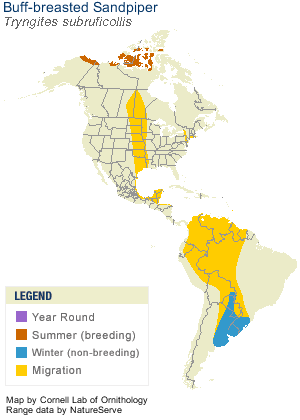
Distribution map of the Buff-breasted Sandpiper, courtesy Cornell Lab of Ornithology. In their global wanderings, migratory sandpipers such as this hit a lot of spots between breeding and wintering grounds. And it stands to reason that over the millenia that these birds have been flying the earth, they've been part of plant migration.
 This is the isotype (dupicate sheet of the actual specimen from which a species was described to science) of a plant known as Ammannia latifolia. It is very similar to the species that I shared above from the Hoover mudflats, Ammannia robusta. However, this species was described to science from material collected in... Argentina!
Both the Creeping Lovegrass and the Awned Flatsedge also occur in Argentina and the wintering grounds of the Buff-breasted Sandpiper and its long-haul brethren that winter in South America. There are numerous other botanical examples of this plant-shorebird connection, too.
I think it is likely that shorebirds such as the ones that I've mentioned are the dispersal agents for moving northern plants species to the other end of the globe, or perhaps vice-versa. The odd seed is certainly going to make the trip from time to time, either in the bird's digestive tract or perhaps stuck to its body. Given enough time - and they've had plenty of that - this should lead to isolation and speciation, as could be the case with the Ammannias and others.
Food for thought, and an angle that perhaps sandpipers and plovers are not given credit for although they might deserve it. Certainly very little study, at least that I'm aware of, has gone into the botanical/shorebird connection.


.JPG)
.JPG)
.JPG)
.JPG)

.JPG)
.JPG)
.JPG)
.JPG)
.JPG)
.JPG)
.JPG)
.JPG)
.JPG)
.JPG)
.JPG)
.JPG)
.JPG)


.JPG)


.JPG)
.JPG)
.JPG)
.JPG)
.JPG)