Saturday, October 23, 2021

The interesting case of the Wall Lizard

A female (I assume) Wall Lizard, Podarcis muralis, on - surprise, surprise - a wall.

I visited Ault Park in Cincinnati on October 21, mostly to see the small colony of Cassius Blue butterflies that appeared there. No problem finding the butterflies, which I am sure did not get there under their own power. I'll hopefully write more about that situation later.

As it turns out, Ault Park hosts a sizeable population of Wall Lizards. It was not hard to find them, in fact, one cannot help but see them if the temperatures are warm enough. Add some sun, and they'll come out in droves and bask on exposed surfaces.

A Wall Lizard peeks from cover. These lizards are astonishingly fast when they need be, and if disturbed shoot under cover. They are almost always around rocks, cement steps and ledges, walls or other structures offering niches into which they can tuck themselves.

Here's a male showing extraordinary colors and patterning. I made this shot in 2011, also in Cincinnati. That was the last time that I had been around these lizards prior to this experience.

Wall Lizards range widely throughout Europe, ranging all the way to Turkey. The lizard is decidedly NOT native here in Ohio. In 1951, a boy named George Rau,  stepson of Fred Lazarus III the department store magnate, released about ten lizards at the Lazarus's family home in Cincinnati. George caught the lizards near Milan, Italy and apparently smuggled them back to the states.

The climate in the Milan region is only marginally warmer than southern Ohio, and the Wall Lizards flourished. They have spread throughout much of the Greater Cincinnati area and somewhat beyond. Densities as high as 1,500 animals an acre have been reported in optimal habitat.

Lizards have managed to get to adjacent areas in Indiana and Kentucky. In 2020, animals were found near Dayton, and in Delaware (Ohio). It will be interesting to see if these lizards are the nucleus of a coming invasion. Wall Lizards have long been established on Vancouver Island, British Columbia, and have occasionally turned up in points south along the west coast.

A big question would be: Do nonnative Wall Lizards wreak ecological havoc by displacing native lizards, and annihilating beneficial native insects and other invertebrates? I've not heard a good answer to that, at least regarding lizards in the Cincinnati area. From my limited experience, the Wall Lizards are often in very urban and unnatural environments - places that it would seem unlikely that native skinks or the Fence Lizard would flourish. The Wall Lizard's strong fidelity to rocky places - or utterly artificial analogs - greatly limit where it can live. Indeed, its scientific epithet muralis means "of walls". A botanical counterpart of the lizard is the Kenilworth Ivy, Cymbalaria muralis, which is indigenous to the same general area as the lizard. It too made its way to North America, but remains confined to rocky places and artificial walls. But maybe I'm all wet on the lizard's impacts, and they do cause damage that I'm unaware of.  

In any event, it is interesting to see scads of lizards racing about in places that you wouldn't expect them. And the story of their introduction illustrates how nonnative species can be introduced, and gain a major foothold. 

Monday, October 18, 2021

The Gadwall: An underappreciated fowl

A drake Gadwall, Anas strepera, poses in a Cape May, New Jersey marsh earlier this month. This is an exquisite and highly detailed duck, and an underappreciated species. Note the intricate scaled pattern on the breast, which fades to ornate vermiculations along the side. A coal black rump sets off the posterior, and when open, the wings display cinnamon, black, and white wing patches. Even the male's "quack" is special: a low nasal croak that suggests a woodcock.

The fabled Federal Duck Stamp program, launched in 1934, features original artwork for each annual stamp. Winning the duck stamp competition is a highly coveted honor, and attracts the best wildlife artists in North American. Amazingly, the Gadwall has been selected only once: in 1951, when Maynard Reece's submission won. That adds evidence to my point: Gadwalls are underappreciated. However, from an artist's perspective, I wonder if they aren't hard to render accurately, with all that incredible plumage detail.

See below for a black and white image of Reece's 1951 stamp.


Saturday, October 16, 2021

Atlantic Ghost Crab: A fascinating decapod

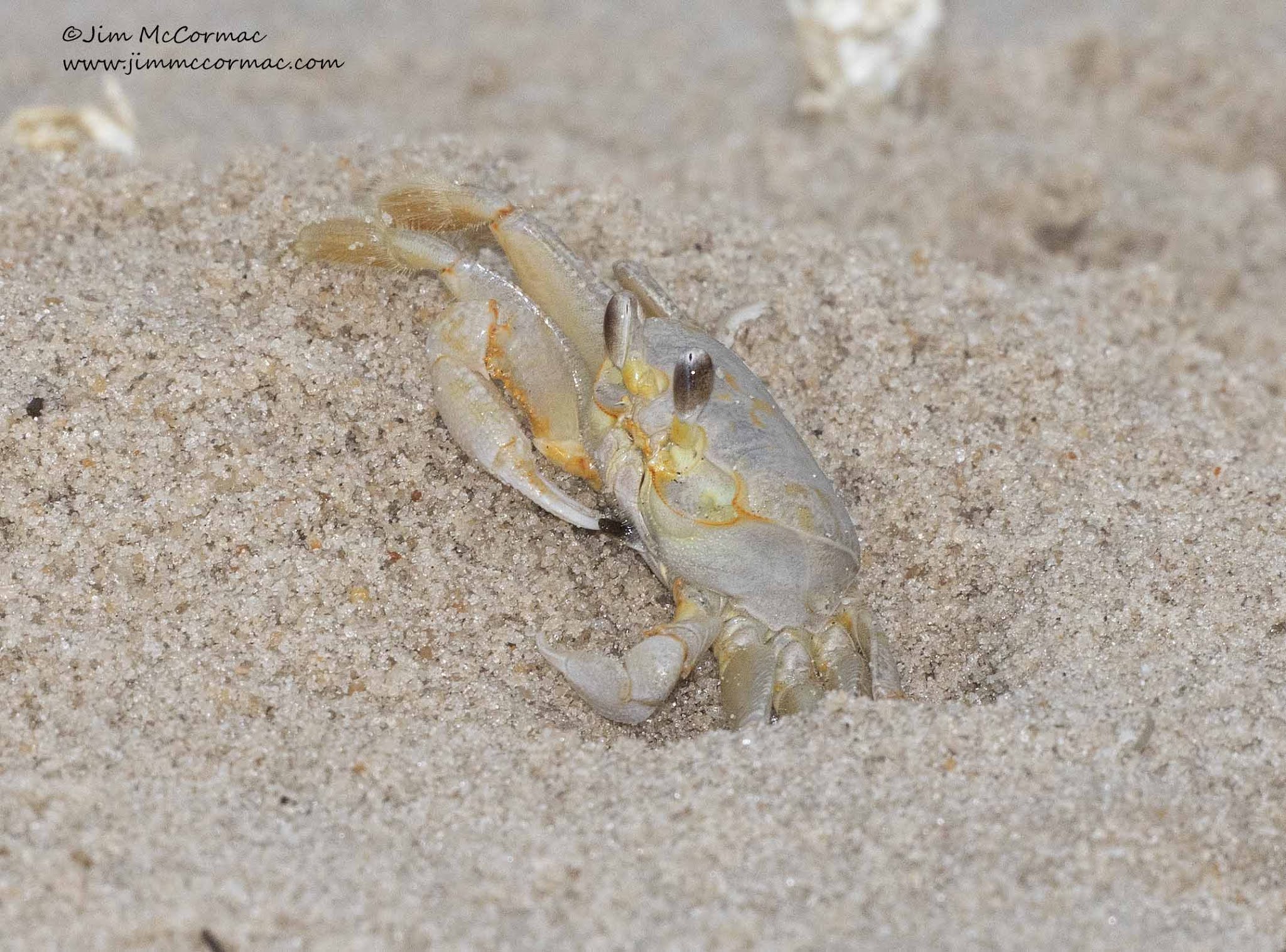
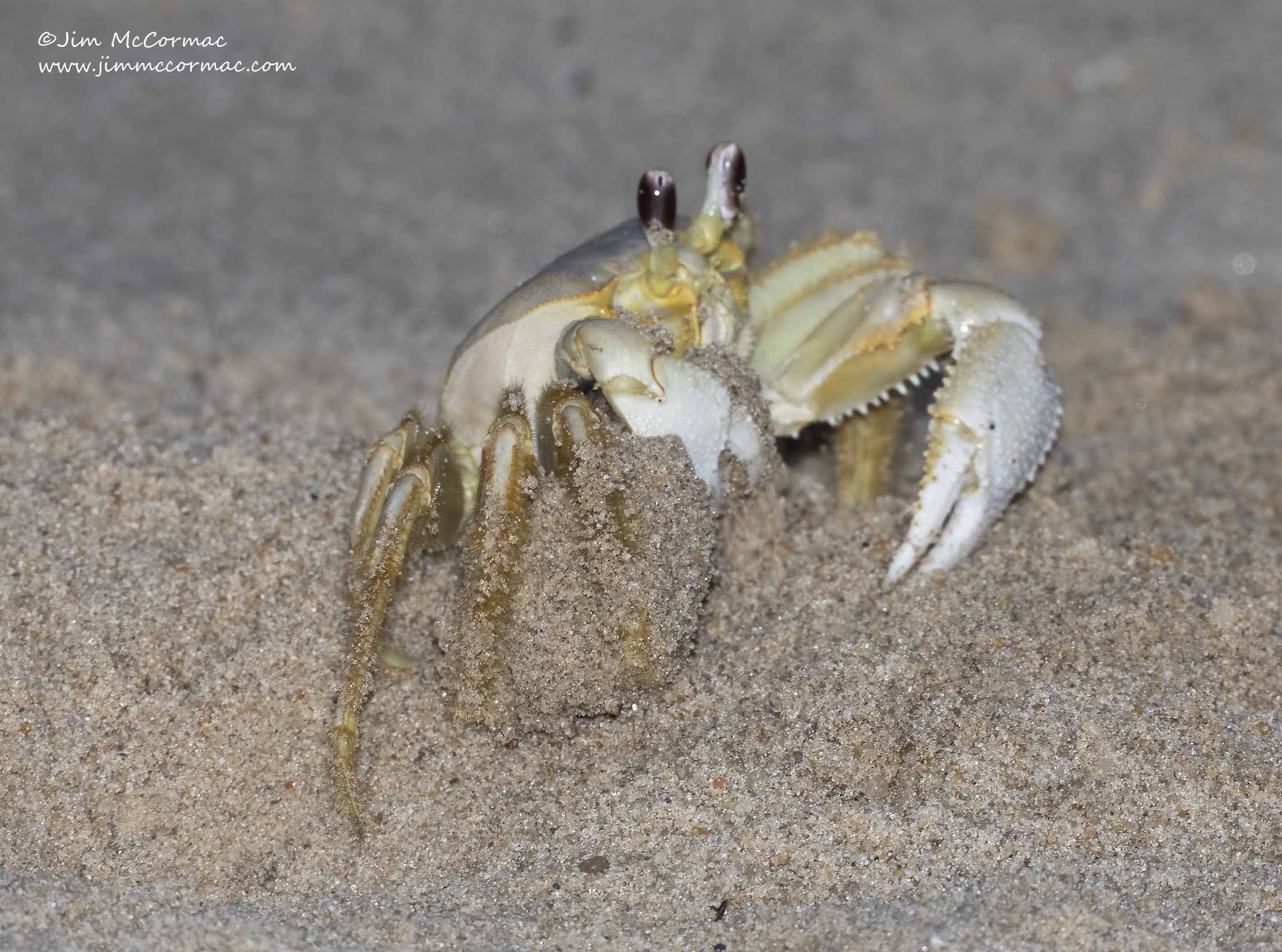
A common but always interesting sight along the beaches of Cape May, New Jersey - and far beyond - is the Atlantic Ghost Crab (Ocypode quadrata). They're well named, as the crab's sandy coloration and fleeting movements, combined with general wariness, makes them wraithlike. People new to them might wonder if they actually saw something and if so, what it was. But with minor perseverance it isn't hard to get good looks at these fascinating decapods (ten-legs).

A crab lurks at the entrance to its burrow. They are accomplished diggers and always seem to maintain burrows to which they can retreat. Some tunnels can apparently be four feet deep. But the excavation is easy in soft beach sands and it does not take them long to mine out a new hole.

A crab in the act of construction. It uses its first two legs and the claw on that side (the claw, or cheliped, is actually part of a highly modified leg) to create a basket in which it scoops sand from the excavation.

Once the subterranean dwelling is complete, it becomes the crab’s home base. They retreat to it in the blink of an eye if threatened or disturbed. When exiting, I noticed that a crab would sometimes pause below the opening, and use its long-stalked periscope-like eyes to check the surroundings before emerging. They can rotate the eye stalks 360 degrees, increasing their efficiency at predator detection. I would imagine that gulls are one of the major threats. Great Black-backed, Herring, Laughing, and Ring-billed gulls are constantly patrolling the shoreline and would snap up a crab in a heartbeat if given a chance.

A crab dines on what appear to be the remains of another crab. They are omnivorous opportunistic scavengers, cleaning the beaches of various edible detritus. The chelipeds are used like hands, and the crabs quite dexterously handle their meals. They also will thump the claws on the sand, apparently to send signals to other crabs, and may use them as semaphores in mating rituals as do some other crabs, but I’m not sure about the latter.

There is also another use for the claws: jousting with rivals. I saw this several times, and finally got an opportunity to photograph a joust. Occasionally a foraging crab would stray far from its burrow, or venture to the sea to wet its gills. On these trips, if it would trespass too closely on another occupied burrow, the offended crab would sometimes pop out and do battle with the interloper. That’s what happened here. The guy on the left owned the burrow, and the intruder on the right was quickly vanquished after a brief locking of the horns. He sidled speedily back to his own burrow.

Atlantic Ghost Crabs take about a year to reach sexual maturity. After mating, the female deposits eggs in the ocean. The larvae develop there, and then head ashore as young crabs. I saw many juveniles on the beaches, but only because I was looking. They can be really tough to spot. The crablets are small, and their camouflage is incredible. If immobile or partially buried in the sand, they are essentially invisible. At this stage, I imagine various shorebirds – plovers, sandpipers, etc. – are major threats. The coloration and patterning of the carapace and upper legs is amazingly sand-like – a textbook example of crypsis.

After my crustacean hiatus, it was back to the business at hand: bird photography, and there was no lack of subjects there.

Monday, October 11, 2021

Mud Fiddler Crab


A male Mud Fiddler Crab, Minuca pugnax, on a saturated tidal mudflat. Males have outrageously asymmetrical chelipeds (claws), and are beautifully tinted with turquoise-blue between the eyes, and on the eye stalks.

On my recent foray to southern New Jersey and the Cape May area, I made a stop at the Wetlands Institute. This is an amazing place that does lots of important research and conservation work, and I highly recommend a visit if you're in the area. I'll write more about that place later.

The main trail at the Wetlands Institute - which is VERY birdy - passes by a rich mudflat, and I happened to be there at low tide. Dozens and dozens of these interesting crabs were swarming the mire, and I had to spend some time observing them.

A pair of Mud Fiddler Crabs lounge at the entrance to a burrow. That's definitely a male on the right. I presume the other is a female. They are smaller, lack the blue on the carapace, and their chelipeds are not so disproportionate in size. Also, they are hanging out together. I saw males come into contact with one another (next photo) and battles commenced immediately.

These burrows are covered during high tides, and the crabs apparently mostly stay in them at such times. Or at least we can't see them if they're foraging under the water. I stopped here the next day, mostly to shoot birds, and the tide was up. The flats were submerged and I only saw a few crabs along the margins - nothing like the number of animals at low tide the previous day.

I saw a few hostile encounters between males, apparently triggered when one would encroach upon another's burrow. Apparently the main purpose of the outsized claw is as an attractant to females. The amorous male waves it around like a semaphore, and presumably the bigger the cheliped the more attractive he is.  But the massive claw clearly has another purpose - to spar with other males. These two mixed it up for maybe a minute, and the interloper was driven off. Crustacean-elk, if you will.

Later I'll share photos of ghost crabs, which are also amazing creatures that took me away from the birds for a while.

Saturday, October 9, 2021

Cape May, New Jersey and vicinity

Just returned from nearly a week in and around New Jersey's southernmost point, Cape May. This area is a birding Mecca, renowned for spectacular migratory showings from many species of birds, and some insects, most notably the Monarch.

I caught up with lots of stuff, but haven't had time to go through photos yet (there were many made). Here are just a few, with probably more to follow.

A Tricolored Heron, Egretta tricolor, in portraiture. These beautiful herons are very active hunters, darting through the shallows and often energetically pursuing prey.

A Forster's Tern, Sterna forsteri, on the hunt. I made a trip north to Edwin B. Forsythe (formerly Brigantine) National Wildlife Refuge, and many of these terns were present.


A Laughing Gull, Leucophaeus atricilla, hounds a tern with a freshly caught fish. Usually, a successful tern will swallow its prey within seconds, probably because of the ever-present risk of having it stolen by a gull. But if for some reason it doesn't, the chase is likely to be on. The gull tries to force the tern to drop its catch, which will then be seized by the bullying gull. Piracy of this type is known as kleptoparasitism.

A Semipalmated Sandpiper, Calidris pusilla, strikes a pose. This is one of the more numerous migrant shorebirds in this region. It's possible that this bird traveled some 3,000 miles to reach Cape May from its Arctic breeding grounds. And it may go that far, or farther, south to beaches in South America.

A Sanderling, Calidris alba, stretches. This is the classic wave-chasing sandpiper of beaches nearly worldwide. While Sanderlings breed in the Arctic, in North America and Eurasia, they disperse to winter on temperate beaches around the globe.

A Semipalmated Plover, Charadrius semipalmatus, preens. This also is a common bird around Cape May in migration, and I saw many. It also breeds in the far north, and winters in coastal areas in the southern U.S. and south nearly to the tip of South America. 

I got some really cool photos of two species of crabs. As I don't often feature crabs here (ever?), I will try to get to those soon.

Sunday, October 3, 2021

Rare ferns found in southern Ohio


Hairy lipfern, on a remote sandstone ledge in Lawrence County, Ohio/Jim McCormac

Nature: Rare ferns found in southern Ohio

Columbus Dispatch
October 3, 2021

NATURE
Jim McCormac

Around 390,000 plant species are known, worldwide. Of those, less than three percent, or 10,500 species, are ferns. Peak abundance occurs in tropical regions worldwide, and diversity dwindles northward. Only about 85 species of ferns and their allies have been recorded in Ohio.

Until “Pteridomania”, a Victorian Era craze for ferns that peaked from 1850-1900, widespread familiarity evaded ferns. Various ferns were engraved, stamped, and printed on all manner of objects and artwork abounded. That fad etched ferns into the public consciousness. Fern bars, popular during the disco era, were a kitschy modern fern promotion.

A fern expert is known as a pteridologist, and ferns in general are called pteridophytes. On September 19, I had the good fortune to go afield with two of Ohio’s finest young botanists and avid pteridologists. Shaun Pogacnik and Joshua Copen met during their studies at Hocking College, and both currently attend Ohio University.

We rendezvoused near the town of Rome in Lawrence County – about as far south as one can get in Ohio. Joining us was Shaun and Joshua’s friend Emmet Roberts. They pointed to a forested ridge high above the Ohio River, and indicated a circuitous route to the top.

After sealing the summits of our muck boots to our jeans with duct tape – to ward off legions of chiggers and ticks – off we went to see the only Ohio population of hairy lipfern (Myriopteris lanosa). Shaun and Joshua had found this species on September 12, for the first state record. Their find sent ripples through the botanical community, as new discoveries often do.

After an uphill mile trek, we came to some sandstone outcrops, and there was the lip fern. A small colony sprang from a crevice, the fronds only six inches or so long but elegantly cleft into multi-segmented divisions. True to its unflattering name, the attractive fern was beset with conspicuous hairs. The “lip” in the name stems from the curled leaf margins, which appear rather lip-like.

Botanists, the author included, have long suspected hairy lipfern could be in southern Ohio. The nearest site is in Wayne County, West Virginia – immediately across the Ohio River from Shaun and Joshua’s find. But none of us could find it on the Ohio side. Some botanists unwittingly came close. Shaun and Joshua were in the area to see the only Ohio stand of false goldenrod (Solidago sphacelata), which grows within a short distance of the fern. A number of botanists had visited the goldenrod, but all missed the fern until Shaun and Joshua came along.

The other notable aspect to the find – obvious to any visitor – is the effort required to reach the site. It isn’t roadside botanizing, and even though the trek isn’t particularly long there is bushwhacking and downed timber involved and the aforementioned annoying parasitic critters. Many people wouldn’t have bothered.

After that mission, we headed 80 miles west along the Ohio River to another Rome, this burg in Adams County. Our destination was more cliffs overlooking the river, but these were limestone.

Following a short climb better suited for mountain goats, we summited and clapped eyes on another amazing fern discovery dating from 2019 . On March 10 of that year, Hannah Kopp, Joshua and Shaun, and Rachel Brooks rediscovered black-stemmed spleenwort (Asplenium resiliens).

Several plants sprang from rocky fissures, and it would have been easy to dismiss them as the common ebony spleenwort or perhaps maidenhair spleenwort. After Hannah brought the fern to the group’s attention, Josh recognized its true identity.

Black-stemmed spleenwort had previously been known from only one Ohio collection, also in Adams County. It dated to November 7, 1900 – no one had seen it since. The group had found a species long considered extirpated, after an absence of 121 years. Black-stemmed spleenwort was back, and I appreciated the opportunity to see it even if it was over two years after its rediscovery.

Kudos to these superb young botanists. Josh (age 23) and Shaun (age 25) are just getting warmed up. Their knowledge of the vast botanical world is already encyclopedic and will only grow. I look forward to many more notable finds from them in the future.

Naturalist Jim McCormac writes a column for The Dispatch on the first, third and fifth Sundays of the month. He also writes about nature at www.jimmccormac.blogspot.com.

Black-stemmed spleenwort on a limestone cliff in Adams County, Ohio/Jim McCormac

Saturday, September 25, 2021

Frugivorous birds plundering southern trees


A Fringe-tree (Chionanthus virginicus) heavily laden with ripe fruit. This shrubby (small treelet, at best) member of the Olive Family (Oleaceae) is a close relative of ashes. It flowers in spring, and produces pleasing bouquets of stringy white-petaled flowers. Come fall, the blue drupes (as the fruit are called) also create an aesthetically pleasing appearance. With the added - and more important - benefit of feeding long-haul migratory songbirds.

While the somewhat similar Chinese Fringe-tree (C. retusus) is sometimes used in landscaping, the one featured here is the native. In the interior, it occurs as far north as southern Ohio. The trees in my images were planted at Inniswood Gardens, a metropark in Westerville, Ohio, only 15 minutes from where I live. This site is probably about 80 miles north of Fringe-tree's native range, but who are we to split hairs. The tastiness of its drupes are certainly well known to songbirds engaged in long migrations between Neotropical wintering regions and northern breeding grounds. These birds have undoubtedly long known and utilized this plant's autumnal bounty.

A Swainson's Thrush (Catharus ustulatus) with a freshly plucked drupe. Larger birds like this swallow the drupes whole. Many of these speckle-bellied thrushes were present on this mid-September day. Swainson's Thrush is the most common of our highly migratory thrushes, and they breed across the great expanse of North American boreal forest, from Alaska to Newfoundland, and south at high elevations in the west. Most birds winter from Central America south to western South America, all the way to Peru.

A Cape May Warbler (Setophaga tigrina) perches briefly in a nonnative Norway Spruce (Picea abies) near the Fringe-trees. This warbler is another boreal breeder, and intimately linked to spruce on the breeding grounds. Even migrants seek out spruce, including the nonnative species. Cape Mays breed in a fairly narrow belt of boreal forest, from Alberta to Nova Scotia, and most winter in the Caribbean and the western coast of Mexico and Central America.

Come fall, Cape Mays often become frugivorous, plundering the bonanza of berries to be found in autumn in the eastern deciduous forest region that blankets much of eastern North America, as far north as southern Canada. Unlike the larger thrushes, warblers such as this typically puncture the skin of fruit with their sharp bills. They then drink the juices and perhaps eat some of the pulp. Many Cape May Warblers regularly visited this small Fringe-tree planting.

The most frequent frugivorous warbler at the Fringe-trees was the Tennessee Warbler (Leiothlypis peregrina). This one strikes a pose amongst some drupes, all of which bear the tell-tale evidence of feeding warblers.

While warblers are highly insectivorous during the breeding season, some add much vegetable matter in migration and winter. Tennessee Warblers winter throughout the Caribbean, much of Central America, and well into South America. I have seen them by the score in winter in Guatemala, where they avidly take nectar from the flowers of various trees. So much so that their faces are often stained bright colors courtesy of the nectar.

As a bonus, a stone's throw away was a gorgeous Sweetbay Magnolia (Magnolia virginiana) loaded with ripe fruit. Birds galore were taking advantage, including many Swainson's Thrushes, occasional thrushes of other species, especially American Robins (Turdus migratorius), Gray Catbirds (Dumetella carolinensis), and most surprisingly to me, lots of Red-eyed Vireos (Vireo olivaceus, pictured).

Vireos are notorious for the number of caterpillars they take. The raptor-like hook at the bill tip is an adaptation for seizing and tearing open larvae, or so I assume. Vireos are closely related to shrikes, which are highly predatory songbirds and sport even more of a hooked raptor-type bill. In the case of the vireo, this bill also works well when plucking fruit.

A Red-eyed Vireo, caught in the act of fruit plundering. This does not take long. As soon as a bird freed one, it quickly swallowed it. Something about Sweetbay Magnolia fruit is very attractive to this species, which I did not know prior to this experience. At times there would be perhaps a half-dozen vireos in the tree together, and a few times they were joined by a Philadelphia Vireo (Vireo philadelphicus). As with the Fringe-tree, Sweetbay is a southerner not occurring until 100 miles or south of central Ohio. But in the south and in the Atlantic states it can be common and birds have undoubtedly long used it as a food source.

A juvenile Red-eyed Vireo (brown eyes) watches a pugnacious Ruby-throated Hummingbird (Archilochus colubris). A number of hummingbirds had staked claim to the nearby gardens and flowering plants. When they weren't trying to drive each other away, they'd occasionally fly high into the magnolia to have a go at the vireos.

The Red-eyed Vireo is a true long-haul migrant. They breed over a massive swath of eastern North America and extend into northwest Canada and the U.S., mostly using caterpillar-rich deciduous forests. The wintering grounds encompass most of the northern half of South America. Some vireos probably fly 5-6,000 miles, one way. It is fascinating, to me at least, to learn about the intimate connection migrant songbirds have with plants, and to think about the role of native plants and their fruit in helping to stoke these long, hazardous journeys.