Showing posts with label Shawnee state forest. Show all posts

Tuesday, May 24, 2022

Mississippi Kites nesting in Shawnee State Forest

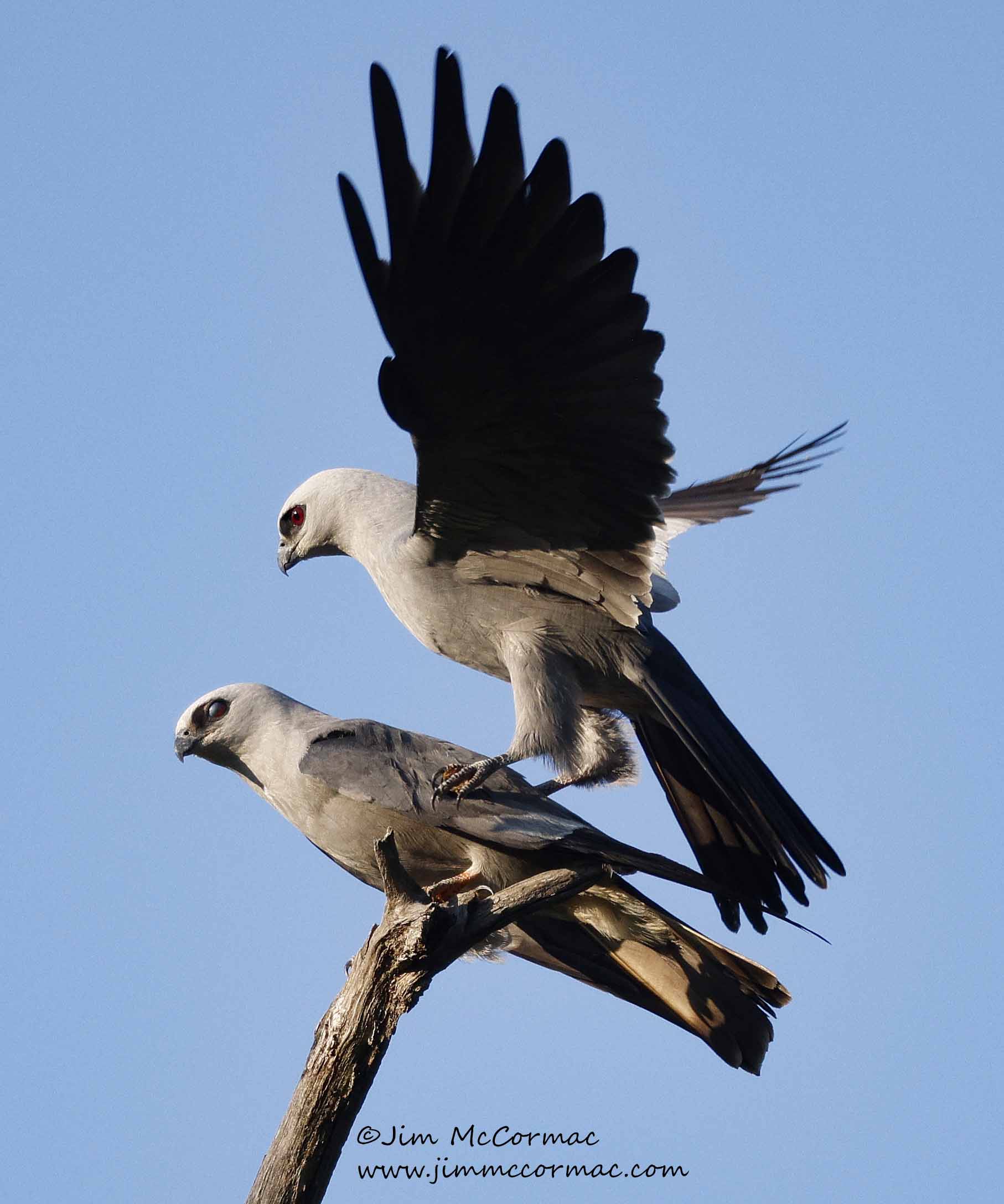
A male Mississippi Kite (Ictinia mississippiensis) lands atop his mate. Seconds later, he mounted her.

Last weekend the Midwest Native Plant Society hosted a wonderful conference at Shawnee State Park's lodge. Nearly 200 people were in attendance, and there was much to see: plants galore, snakes, lots of birds, amphibians, and more. The 1,100-acre park is nestled within the 70,000 acres of Shawnee State Forest and the biodiversity is extreme. But it was hard to beat this pair of kites.

While botanizing in the depths of the forest 6 or 7 years ago, in early summer, I heard the unmistakable calls of Mississippi Kites, but could not clap eyes on them. The following year park naturalist Jenny Richards located presumably the same birds near the nature center where they were a fixture much of that summer. A pair of kites has been present ever since.

This year the kites have shifted their base camp to the cabins at the lodge. There are a couple conspicuous dead snags between cabins 14 and 15, and when not out hunting one or both kites sit in those snags where they cannot be missed. There are even conveniently located benches with great views. It's kind of like going to the movies, except you're watching real live kites.

And the kites put on a show. It seemed that about every time the male would join the female at the snags, he would mount her in a hopefully successful effort to produce kitelets. Sometimes he would bring her a grasshopper. Occasionally one of the kites would perch atop an oak directly over the viewing area - they are hardly shrinking violets and paid people no mind. We were especially pleased to see them carrying sticks to a likely nest site somewhere in the nearby forest.

Kites are light and incredibly agile. Flyers extraordinaire, they deftly pluck insects such as cicadas (they'll emerge a bit later) dragonflies, and grasshoppers from the air. Small snakes and birds are also fair game.

The first Ohio record of Mississippi Kite (in modern times at least) was in 1978 in Franklin County. When Bruce Peterjohn published his 2nd edition of The Birds of Ohio in 2001, he only was aware of nine records. In the two decades since then, records have skyrocketed, and multiple birds are now documented annually. The first confirmed nesting was in 2008 in Hocking County and now there are probably at least a few nesting pairs in southern Ohio.

The Shawnee kites are easily observed and if you're in the area, it'd be worth stopping by for a look. If they aren't on the snags around cabin 15, just wait a bit and they'll likely appear. Nearly everyone who attended the recent conference got to see them, and often large throngs of people assembled to ooh and aah over the sporty kites.


Friday, July 9, 2021

Shawnee Nature Safari - a superb conference! September 10-12, 2021


A typical autumnal scene in the nearly 70,000 acre Shawnee State Forest in Scioto County, Ohio, as photographed a few years ago. The forest is one of the most biodiverse locales in eastern North America,

The Midwest Native Plant Society, whose raison d'etre is to organize and run the Midwest Native Plant Conference (already sold out this year), also hosts one or two spur conferences annually. And this fall's event will be a doozy. It's been dubbed the Shawnee Nature Safari and will take place the weekend of September 10-12. Base camp is the wonderful Shawnee State Park Lodge nestled in the center of the state forest.

A major focus of this event, as is the case with all of our events, is to get people out in the field. We'll be doing that with the help of some of Ohio's most knowledgeable natural history experts. September in Shawnee is a great time for learning about fall flora, but all of those plants - some 1,000 native species in the forest! - drives animal life. Plenty of southbound migrant birds will be passing through, and butterflies should still be plentiful and diverse. But not as much as moths, the (mostly) nocturnal butterflies. We will make special efforts to lure them in at night, and will also engage in nighttime safaris looking for caterpillars.

There will be speakers each evening. I'll be talking about native flora, the caterpillars that eat them, and their role in the bigger picture of conservation on Friday night. On Saturday evening, conservation biologist Jack Stenger will give a program on promoting plants for biodiverse landscapes. And for those so inclined, I will lead an outdoors photography workshop (limited number of participants) on Sunday morning.

The event is already filling rapidly, but there is still space and we'd love to have you join us. For all of the details and registration information, just GO HERE.

Friday, July 19, 2019

Shawnee Photography Workshop: August 23-25, 2019

Early morning fog  mists the edges of a small lake within Shawnee State Forest. Fragrant water-lily, Nymphaea odorants, blankets the water's surface.

If you've read this blog much, you've likely heard talk of the amazing Shawnee State Forest in southern Ohio's Adams and Scioto counties. Indeed, the prior post mostly deals with this place. I've been to this area a lot; it's my favorite region of the state. The biodiversity is mind-numbing, and it's all encased in exceptionally scenic habitats.

Debbie DiCarlo and I are doing one of our field-based photo workshops here on August 23-25. This is a time of riches, photographically speaking. We will also seek out some of the lesser known creatures - read on for a few examples. We've got a few spaces left, and would love to have you. All of the details are RIGHT HERE.

Shawnee and vicinity hosts a bounty of butterflies. Twenty-five species or more would not be surprising on a good day. This is a red-spotted purple, one of the showiest butterflies and one that is quite common here.

This region is botanically superb, with 1,000+ native plant species. Thus, the animal diversity is staggering. Cardinal-flower, Lobelia cardinalis, should be in good shape at the time of the workshop and it draws spicebush swallowtails (seen here) in big numbers. Ruby-throated hummingbirds are also frequent visitors. We may be able to see some very interesting "albino" cardinal-flowers as well.

A focus of this workshop will be moths and other creatures of the night. It's easy to draw moths to properly illuminated sheets, and that's what we'll do. This is an Io moth, one of many species that make for fantastic moth portraiture shots. We should see a stupefying array of moths, and learn solid techniques for photographing them, as well as interesting ways of viewing these creatures.

If you want photos that few people have, this may be the workshop for you. Part of our nocturnal pursuits will involve caterpillars and we should find many, of numerous species. Most caterpillars are nocturnally active, the better to avoid daytime predators such as birds. This is a black-spotted prominent, an utterly fantastical bag of goo. We found it on last year's Shawnee workshop, within sight of the lodge and cabins (where we stay). It was just one of many exceptionally photogenic cats that we encountered.

We also have an EXTREMELY COOL photo opportunity arranged, that will wow you and anyone you share your work with, but I'm not saying what it is for now :-)

Again, for full details and registration info, CLICK HERE.