I visited Chillicothe, Ohio, last Monday evening, to deliver a presentation to the Scioto Valley Bird & Nature Club. It's always a treat to visit this city, which is steeped in Ohio history. Chillicothe was our first capital, and then after a brief peregrination to Zanesville for two years, it again served as capital for about five more years. In 1816 the legislature voted to shift the capital north to Columbus, my hometown, and for better or worse it's been the same ever since.
Chillicothe's home county of Ross is incredibly biodiverse. The Appalachian foothills taper out into the glaciated plains to the west here, meaning that there is lots of topographic variation. Interesting habitats abound, and after the talk to the club, several us went out for a nocturnal prowl at
Buzzard's Roost Preserve. This sprawling 1,200 acre woodland lies along Paint Creek just west of Chillicothe, and I've never failed to find interesting subjects there.
As always, it was a treat to visit the club, and catch up with people I've known a long time but don't often get to see. After all was said and done, Kelly Williams, Joe Letsche, Michelle Ward, Debbie and Gary McFadden, Tiffany Pritchard, Lisa Ratcliff, Brandan Gray and yours truly made the short trip over to the "Roost" (apologies if I'm forgetting anyone!). It was the best nocturnal foray I've had in a while; we found piles of interesting animals. The caterpillars were over the top, and perhaps I'll get around to sharing some of them. For now, though, I will confine my bloviations to one of our coolest serpents.
As 11 pm clicked by and we grew weary, the group started stumbling back to the vehicles. Intrepid Joe Letsche, the preserve manager and
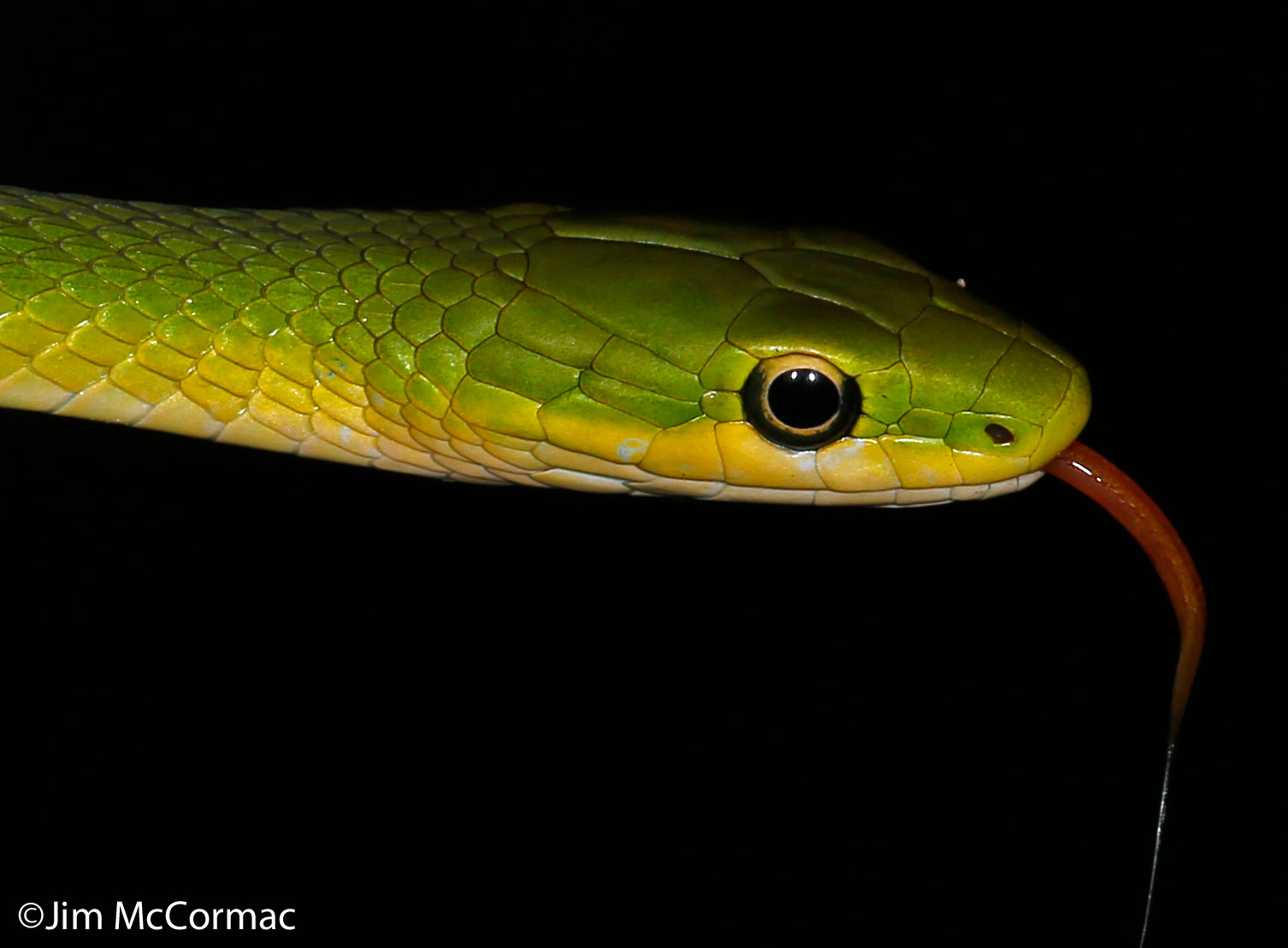
Ross County Park District employee, kept poking through the woody shrubs buffering the forested area, looking for snakes. And Voila! Not far from the parking lot, he located this sleeping beauty - a Rough Greensnake,
Opheodrys aestivus. I made this image immediately after Joe found the animal.
I become acquainted with these gentle snakes long ago, and after first finding them, always assumed they were nocturnal. To me, the eyes look disproportionality large, a feature one might expect of a creature that plies its trade after nightfall, as most snakes do. But they're don't - Rough Greensnakes hunt during the day, and sleep it off at night.
RGS's are highly arboreal, and spend much if not nearly all of their time aloft in trees and shrubs. Joe has become expert at finding them, and to date has located and marked 45 individuals at Buzzard's Roost Preserve. He is trying to ferret out the mysteries of their comings and goings.
This animal was found in just about exactly the same type of situation that the rest of the ones that I've seen have been in - head-high tangles of dense growth, in this case scrubby black locust and grapevines.
We have two species of greensnake in Ohio, and a good way to separate them is by the scales. In the case of the RGS, they are keeled, as seen here. The keel is that slitlike flange running down the middle of each scale. Our other species is the much rarer Smooth Greensnake,
Opheodrys vernalis, and its scales are without keels. I saw my first specimen of the latter last year, and wrote about it
RIGHT HERE.
Rough Greensnakes are at the northern limits of their range in southern Ohio, and have been documented in about 14 counties. Obviously, as Joe Letsche has shown, they can be locally common. But due to their shy mannerisms, arboreal habits, and coloration that allows them to blend with the foliage, they're easy to overlook. When seen well, a RGS is a hit with nearly everyone. The gorgeous lime-green dorsal coloring fades to a stunning lemony hue below, and the big black eyes punctuate a gentle face. And gentle they are - greensnakes almost never attempt to bite (none of the ones that I've handled have). Even people afflicted with mild ophidiophobia sometimes will hold them.
Thanks to Joe for guiding us into Buzzard's Roost after dark, and to everyone else who came along and helped spot many interesting creatures.




.JPG)
