We're up to 68 owls in 30 counties in Ohio, by my reckoning. CLICK HERE for the latest distribution map, which is regularly updated.
Thursday, December 19, 2013


Theft of images. A real problem!
A while back, the inimitable myrmecologist Alex Wild made a post about Google's reverse image search capabilities. Alex captures absolutely stunning macro images of ants and other small things at his blog, Myrmecos. He, like me, has a lot of money and time invested in his photography and equipment. Anyway, Alex's post was on his other blog, Compound Eye, and dealt with the frequency with which people steal images from other people's websites and use them without permission or attribution. It's a good read, and the post generated scored of comments about the issue of using others work without credit. Read it HERE. Sometimes, these thefts are fairly innocuous: people sharing them on Pinterest or on personal blogs. Other times, less savory types are trying to pass other people's work off as their own, or even attempting to sell it.
After reading Alex's post, I meant to delve into The Google's reverse image search, and see what photos of mine might have been pirated. But I am always busy, and never got around to it. Today, Kenn Kaufman made a post on our Ohio Birds Listserv regarding a Common Eider that was recently reported to eBird, with a photo. The eider would be a mega-rarity of high order in Ohio. Kaufman's reverse image search revealed that the photo was in fact taken several years ago by Cleveland birder Jerry Talkington, and was run with one of Jim McCarty's columns in the Cleveland Plain Dealer.
This prompted me to finally dip into Google's reverse image search, and the results were depressing. I'm not naïve about this stuff - I know that people right click and snag photos from the web all the time. My images, like most posted to the web, are greatly compressed and I figure they're too small to reproduce on any scale. I've seen my photos appear elsewhere without credit a number of times, and that prompted me to post the notice about use of photographs that appears on the right side of this page. Interestingly, after putting that up a year or so ago, the number of requests to use photos sky-rocketed - I have probably received 40-50 over the last year.
But that warning wasn't good enough. The photo theft thing has been gnawing at me more than usual, as a couple of people have approached me in the last few months wanting high-resolution images that they could use for their own purposes. Trying to be a nice guy, I sent them the images on their promise that they would pay the agreed upon fee. Nothing. So much for being a nice guy. I've also had the same lack of payment issue with a couple of articles that I've written and were published. Guess one can't rely on "handshake" agreements anymore.
Anyway, tonight I picked one of my images that I thought might be popular, and prone to theft. It's below:
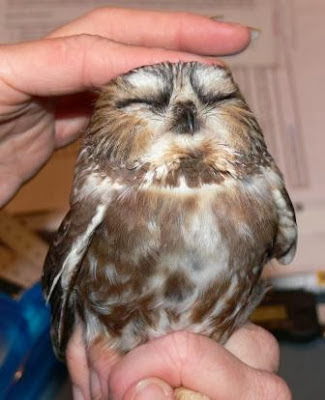 A particularly adorable Northern Saw-whet Owl that appeared on my blog in THIS POST way back in 2007. I dropped the image into the Google machine, and was stunned at the hits that came back! There were several dozen websites using the photo, from all over the place, nearly all unknown to me and with no credit. I certainly didn't provide these pirates with the image.
That was depressing. There's no way I'd ever have time to contact all these sites and ask them to remove the image. And that owl is the only image that I've searched on so far. Not really sure that I want to check any others, as I'm sure I'd find legions of other thefts. I've posted a lot of pretty cool original photos over the years, in 1,263 blog entries since I began using BlogSpot in 2007.
Some argue that once one posts a photo on the Internet, it's fair game. I disagree. I view it in the same light as plagiarism, particularly if the thief doesn't cite the source. After all, it's me, or Alex, or anyone else who has invested in camera equipment and made the effort to go afield and capture interesting images, who did all the work and paid the price.
As Alex Wild points out, there is really no way you can completely safeguard your image. Watermarks can be removed. Right click disabling software can be defeated. Even shrinking the photo doesn't totally solve the problem - it can still be used in many capacities.
I'm not the most tech-savvy guy in the world, admittedly. If anyone knows ways of thwarting photo thieves, I'd love to hear them.
After reading Alex's post, I meant to delve into The Google's reverse image search, and see what photos of mine might have been pirated. But I am always busy, and never got around to it. Today, Kenn Kaufman made a post on our Ohio Birds Listserv regarding a Common Eider that was recently reported to eBird, with a photo. The eider would be a mega-rarity of high order in Ohio. Kaufman's reverse image search revealed that the photo was in fact taken several years ago by Cleveland birder Jerry Talkington, and was run with one of Jim McCarty's columns in the Cleveland Plain Dealer.
This prompted me to finally dip into Google's reverse image search, and the results were depressing. I'm not naïve about this stuff - I know that people right click and snag photos from the web all the time. My images, like most posted to the web, are greatly compressed and I figure they're too small to reproduce on any scale. I've seen my photos appear elsewhere without credit a number of times, and that prompted me to post the notice about use of photographs that appears on the right side of this page. Interestingly, after putting that up a year or so ago, the number of requests to use photos sky-rocketed - I have probably received 40-50 over the last year.
But that warning wasn't good enough. The photo theft thing has been gnawing at me more than usual, as a couple of people have approached me in the last few months wanting high-resolution images that they could use for their own purposes. Trying to be a nice guy, I sent them the images on their promise that they would pay the agreed upon fee. Nothing. So much for being a nice guy. I've also had the same lack of payment issue with a couple of articles that I've written and were published. Guess one can't rely on "handshake" agreements anymore.
Anyway, tonight I picked one of my images that I thought might be popular, and prone to theft. It's below:

That was depressing. There's no way I'd ever have time to contact all these sites and ask them to remove the image. And that owl is the only image that I've searched on so far. Not really sure that I want to check any others, as I'm sure I'd find legions of other thefts. I've posted a lot of pretty cool original photos over the years, in 1,263 blog entries since I began using BlogSpot in 2007.
Some argue that once one posts a photo on the Internet, it's fair game. I disagree. I view it in the same light as plagiarism, particularly if the thief doesn't cite the source. After all, it's me, or Alex, or anyone else who has invested in camera equipment and made the effort to go afield and capture interesting images, who did all the work and paid the price.
As Alex Wild points out, there is really no way you can completely safeguard your image. Watermarks can be removed. Right click disabling software can be defeated. Even shrinking the photo doesn't totally solve the problem - it can still be used in many capacities.
I'm not the most tech-savvy guy in the world, admittedly. If anyone knows ways of thwarting photo thieves, I'd love to hear them.
Tuesday, December 17, 2013
Nettie Bay, Michigan: May 2014!

That's the grounds of NettieBay Lodge, above, with its lakefront cabins bordering Lake Nettie. Towering oaks and white pine support lots of birds, including the resident pair of Pine Warblers. American Woodcock display in the front yard. Eastern Whip-poor-wills carry on in the woods, sometimes upstaged by the local Barred Owls. Yellow-bellied Sapsuckers (the commonest breeding woodpecker), Rose-breasted Grosbeaks, and Purple Finches are common yard birds. Much more, too, and we haven't even made it out of the "yard"!

On my inaugural trip into the county, I quickly saw that things were going to be awesome when I found a completely unexpected (to me) population of Kirtland's Warblers within a half-hour of the lodge. And it only got better from there.


I'll promise you a good time if you can make the trip, and lots of opportunities to see and learn about birds, other animals, and plants. To sign on, touch base with Jackie Schuler at NettieBay Lodge, RIGHT HERE. So far, we've filled each of the trips in short order, so if you're interested, I'd check into it pretty soon.
Sunday, December 15, 2013
Sumac creates biological hotspots!

The weather isn't obvious in the photo, but it was dismal. The temperature at 8 am was 34 F, and rose to only 37 F. Frosty temps are no problem, but the nonstop rain that ranged from light to moderate showers was an issue. To me, there are no worse weather conditions than drenching rain at temperatures just above freezing. Makes it much harder to find birds.

Sorry for the dreaded white sky background in these photos, but there's nothing I could do about that. White skies are the absolute worse for photographic backdrops, and we get a lot of those skies in Ohio winters.


One effect of having a big flock of active robins in a large woodland is that their hustle and bustle attracts lots of other birds. The sumac entices the robins. Their conspicuous activity draws many other birds who then forage in the vicinity even though the hangers-on aren't necessarily after the sumac's fruit. I probably had at least a dozen species in the mixed flock with the robin nucleus. In the songbird world, plants ultimately orchestrate the show.


In the above photo, we see Smooth Sumac in full flower in mid-summer. The oceans of tiny greenish-yellow flowers attract legions of interesting pollinating insects. When I am out and about, camera in hand, and spot flowering sumac I always veer over for a look. I've obtained many a great insect image at these flowers.

Keep in mind next summer's Midwest Native Plant Conference in Dayton, Ohio: August 1st thru 3rd. That's an awesome venue to learn more about native flora, buy quality plants, and generally have a great time.
Saturday, December 14, 2013
The origin of all these Snowy Owls?
As about everyone who is into birds in eastern North America knows, this is the winter of the Snowy Owl (I wrote about them HERE, and am keeping an updated map and numbers of the owls in Ohio). Even scores of nonbirders are aware of the incursion of these massive tundra owls, thanks to intensive coverage in the media. A common question surrounding this phenomenon centers on their origins. Just about everyone I've talked to about Snowy Owls wants to know where they originated.
That's an easy question, in a general sense. The Arctic tundra. But that answer covers a lot of ground. The tundra, of course, blankets the upper rim of the entire North American continent (not to mention polar regions around the entire top of the world). So, the refined question becomes: "Where exactly are these owls coming from?". That's often a hard thing to pinpoint. It's not like the Arctic is crawling with birders, and vast regions of the tundra see few if any people, especially people who are keeping specific tabs on Snowy Owls.
Bruce Mactavish provides the likely answer on his Newfoundland Birding Blog. Bruce has birding the Canadian island of Newfoundland for nearly 40 years, and his is a well known name amongst birders. We're pretty happy with our 61 (reported to date) Snowy Owls in Ohio, and that is an incredible number. Just imagine last weekend in southeastern Newfoundland. Bruce and other birders found a total of 301 (yes, 301!) Snowy Owls during their weekend wanderings! He has absolutely stunning photos of some of these birds on his blog.
Anyway, Bruce made various inquiries of researchers who were in the high reaches of the tundra, where the Snowy Owls breed, last summer. To cut to the chase, it appears that the northernmost reaches of Quebec experienced a peak population of lemmings, and the owl nesting success spiked big time in response to the bounty of prey. Mactavish shared an amazing photo of an owl nest ringed with the carcasses of 70 lemmings augmented with eight voles posted on his blog. The eggs haven't even hatched yet! There was certainly no shortage of food for those owlets, and one might assume that most of the other nests in northern Quebec also resembled fortresses surrounded by ramparts of dead rodents. Researchers operating in tundra regions west, east, and north of this area reported low to normal numbers of Snowy Owls.

The area in red shows the approximate region where our Snowy Owls likely originated. Owls have been turning up all over the Great Lakes region, and the eastern seaboard of Canada and the U.S. Some of have made it as far south as North Carolina and Bermuda (yes, Bermuda!). Owls are still turning up, so keep your eyes peeled.
Thursday, December 12, 2013
Cool Altocumulus Clouds
Yesterday, I had the pleasure of getting afield with Joe Faulkner and Vicki Derr. They gave me a tour of the Rehoboth Reclamation Grasslands in Perry County. This massive strip mine complex is an interesting place, and already producing interesting bird life. I've got a lot of photos from our journey, and will hope to cobble together a piece when time permits.
At one point, we dropped into a valley full of wetlands, and got out to check for Swamp Sparrows and whatever else might be around. After a bit of searching, I turned the other direction, and Whoa! The sky was ribbed with a fantastic formation of clouds, as if a giant pinwheel was centered on some distant point and slowly revolving through the sky. It was a striking atmospheric spectacle, and I tried to capture the clouds with my camera.

These, apparently, are classified as Altocumulus Clouds. They typically form between 7,000 to 20,000 feet, and can take on the look of rolling uniform layers, such as in this formation. It was a stunning skyscape, to be sure.
I'm glad we bumbled under these clouds. It's easy to get too busy to take time to appreciate - or notice - magnificent spectacles such as this.
At one point, we dropped into a valley full of wetlands, and got out to check for Swamp Sparrows and whatever else might be around. After a bit of searching, I turned the other direction, and Whoa! The sky was ribbed with a fantastic formation of clouds, as if a giant pinwheel was centered on some distant point and slowly revolving through the sky. It was a striking atmospheric spectacle, and I tried to capture the clouds with my camera.

As always, click the photo to enlarge
These, apparently, are classified as Altocumulus Clouds. They typically form between 7,000 to 20,000 feet, and can take on the look of rolling uniform layers, such as in this formation. It was a stunning skyscape, to be sure.
I'm glad we bumbled under these clouds. It's easy to get too busy to take time to appreciate - or notice - magnificent spectacles such as this.
Tuesday, December 10, 2013
Snowy Owl report for Ohio (with regular updates)
UPDATE NOTICE: I first created this article on December 10, summarizing all of the Snowy Owl reports that I was aware of in Ohio. I then shared this with the 2,200+ member Birding Ohio Facebook page (Kudos to Jeff Loughman for founding that group). More reports came in, and the owl tally is now up to 70 birds in 30 counties. I have been hearing about new owls daily, and I will update the map and running tally below as new information arrives. LAST UPDATE: December 19th.

Photo: John Howard, Highland County, Ohio, December 1, 2013
I wrote about the ongoing irruption of Snowy Owls HERE on December 1, and at that time about a dozen of the big white(ish) birds had been reported in Ohio. Well, they just keep on coming! To date, I've heard of 70 owls in the state, and they are attracting attention far and wide. Most of the local newspapers in areas where the owls have appeared have written about them, and Snowy Owls have made national media as well.
One particularly noteworthy story involved JFK Airport in New York City. Owls have been dropping in to feed along the runways, and word leaked out that several had been shot by airport personnel. There had been five owl-plane collisions, and the airport felt that extermination with extreme prejudice was required. Of course, there are other ways of handling such a situation, and Boston Logan Airport provided the example. There, runway owls have been live-trapped and released elsewhere for many years. After a hue and a cry from the public, JFK to their great credit quickly adopted the more humane method of owl deterrence. NBC4 in New York covered the story, and Corey Finger of 10000 Birds was featured. He did a great job, and this news story was probably instrumental in effecting change. That piece IS HERE.
Anyway, back to the Buckeye State. Every day, it seems, one or a few more owls come to light. Following is a map showing their distribution, along with a number representing how many have been reported in each county. If you know of any additional owls, please send me a note: jimmccormac35@gmail.com

NOTE ABOUT SIGHTINGS: Many of these birds have not lingered, apparently, and were only seen on one day. Several reports have come to light several days after the fact, too. In some cases, the landowners have made it clear that they did not want their location made public due to private property issues. I and others try to run down the specifics of sightings, and when possible make the information available to the birding community. Two good places to keep up to date on Snowy Owl sightings are the Ohio Birds Listserv, and the Facebook Birding Ohio site.
Subscribe to:
Posts (Atom)