Tuesday, November 4, 2014

River Otters squeaking like squeeze toys

Now here's something one doesn't hear everyday. Laura Hughes recently sent along another fabulous trail cam video that she and her husband made in the backwoods of Monroe County in eastern Ohio. This one features a trio of frolicking River Otters, Lontra canadensis. As you'll see, they approach the camera quite closely; in fact, one of them brushes it with its whiskers. Turn the volume up, though - the otters are delivering their amusing little squeaky calls, and those are sounds that most people have never heard, I dare say.


Video by David and Laura Hughes

Sunday, November 2, 2014

Hike to Buzzardroost Rock

Last Sunday, October 25, dawned crisp and clear. I know, because I watched the sun came up as I drove to one of my favorite places in Ohio. This day was to be the last of the great fall days, weatherwise, and I wanted to be atop a certain conspicuous promontory soon after sunrise.

The sign above points the way to one of the best - and most significant - hikes in the state. The Buzzardroost Rock trail is about a 4.5 mile round trip, and worth every footfall. It is part of the vast Edge of Appalachia Preserve in Adams County. I toted my backpack full of camera gear along, and managed to make a few passable photos during the trek.

The scenery, from a fall leaf color perspective, was still stunning if slightly past peak. One of many great things about living in the vast eastern deciduous forest region is the conspicuous change of seasons. Nothing signals the changing of the guard like late autumn's brilliant burst of foliage. Of course, the color is but a short-lived harbinger of the coming of Old Man Winter, but the next few months of snow and cold will bring their own charms, and make the arrival of spring that much sweeter.

Not a bad canopy to have over one's head! I found myself constantly ogling the trees, searching for the perfect shot. Myriad options presented themselves, and scads of photos were taken, but I like this image as well as anything I clicked off on this pristine day. For those of a photographic bent, it was shot with the Canon 5D Mark III rigged with Canon's 17-40L wide-angle lens, using a focal length of 17 mm. ISO was set to 100, shutter speed was 1/200, and the lens was stopped down to f/8. I was lying on my back in the leaf litter to better get this perspective.


After a fairly speedy hike, I reached the trail's terminus and the namesake Buzzardroost Rock while the sun still hung low in the east. Limestone cliffs tower 70 feet above the forest floor, and the view from the rock is extraordinary. You MUST make this trip at some point.

Buzzardroost Rock is part of the sprawling Edge of Appalachia Preserve, which is co-managed by the Cincinnati Museum Center and the Ohio Chapter of The Nature Conservancy. The preserve now encompasses about 16,000 acres, and TNC regularly adds new parcels. Their Sunshine Ridge corridor project is an effort to link "The Edge" to the 65,000 acre Shawnee State Forest, which lies not far to the east.

The Shawnee/Edge region is the wildest landscape remaining in Ohio, and one of the most significant biological hotspots east of the Mississippi River in North America. Rare habitats and unusual flora and fauna abound, and I have featured scores of them on this blog over the years. The primary reason that so many natural history events - at least ones that I have had a hand in - take place down here is because of the natural diversity. Mothapalooza, Flora-Quest, numerous Ohio Ornithological Society conferences, and the Appalachian Butterfly Conference, are but a few. People attending Mothapalooza III next year will once again be wowed by this area, and one of the trips will journey to the very rock that you are now virtually visiting.

Ohio Brush Creek carves a whopping dimple through heavily forested terrain. This stream is one of Ohio's healthiest, in large part because so much of the buffering landscape has not been badly abused and is largely protected.

The straw-brown tufts of grass at cliff's edge may not look like much, but looks can be deceiving. This plant is Plains Muhlenbergia, Muhlenbergia cuspidata, an Ohio endangered species. It is one of numerous threatened and endangered species found on Edge of Appalachia properties.

On the return trip, I adopted a much more leisurely pace and explored habitats such as this prairie opening. Signs of former pasturing were present, but managers are working to return this spot, and many others, to barrens prairies. The botanical diversity in places such as this is fabulous, and botanists can lose themselves for hours searching about barrens prairies. It was a habitat similar to this that I made the photos of Stiff Gentians featured in the previous post.

While their collective voices have largely been muted, a number of singing insects still held on. This is a Treetop Bush Katydid, Scudderia fasciata. Many of the katydids seem to color up somewhat as fall fades, their increased reddish pigments serving to better allow the insects to blend with senescent fall foliage. This animal is a male, and note his ear, just below the knee on its foreleg. While that may seem to be an odd place to have one's ear, it serves these insects well. By having its ears as far apart as possible, the insect can better triangulate on sounds and pinpoint their source.

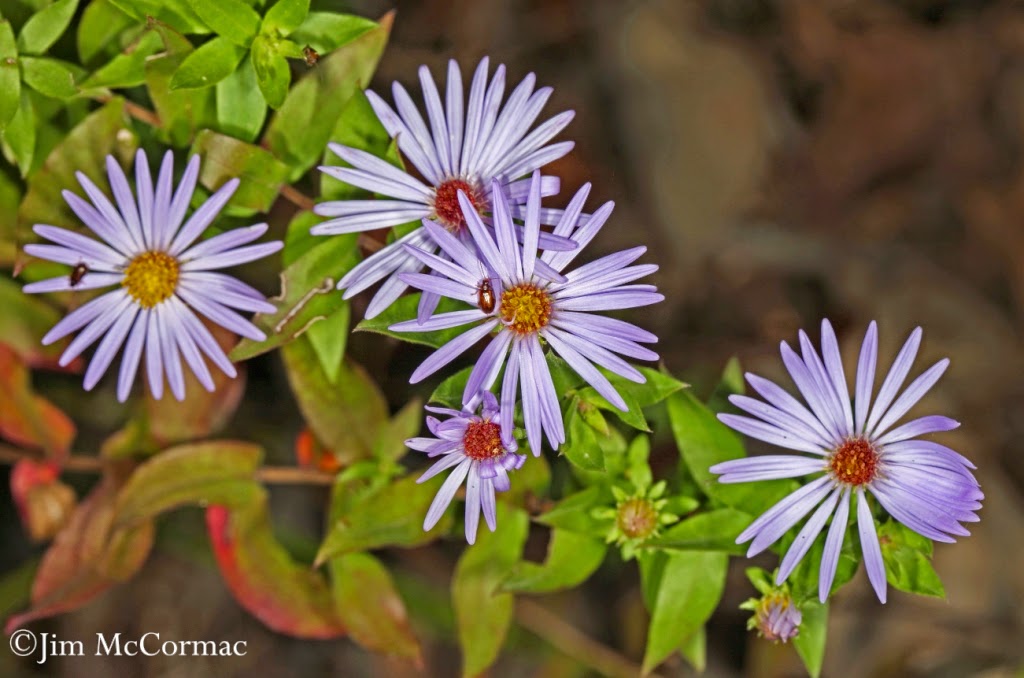
Asters are without doubt the botanical markers of fall's conclusion, and many species hold on past first frosts. This one is a rarity, the Shale-barren Aster, Symphyotrichum oblongifolium (Sim-fee-oh-tri-kum oh-blon-gih-fol-ee-um). Horticulturists have worked wonders with this species, and a cultivar is now widespread and available at many nurseries. Get one if you can. Shale-barren Aster is a pollinator magnet extraordinaire.

If you get the chance to visit the Edge of Appalachia Preserve, by all means do so. More information is available RIGHT HERE, and HERE.

Saturday, November 1, 2014

Stiff Gentian, Gentianella quinquefolia

A particularly luxuriant Stiff Gentian, Gentianella quinquefolia, is apparently content in an Adams County, Ohio cedar glade. It shared space with dozens of others, and I made these images last Sunday, October 26 - a date by which most flowers have tossed in the towel. This showy gentian is a true harbinger of Autumn's end.

The flowers of Stiff Gentian are photo-sensitive, opening fully when spurred by the sun's rays. The nectar within is alluring to a host of late season pollinating insects, especially members of the order Hymenoptera (bees and wasps). I parked myself near some especially robust gentians, camera in hand and rigged with the macro setup.

I didn't have to wait long before interesting subjects appeared. This was my favorite, and an animal that I had not previously photographed (at least well). If I'm correct, it is a so-called sweat bee, and possibly one in the genus Augochloropsis. I hedge on the identification because this is a large group of insects, with many look-alikes. For a piker like me, a species-specific ID is more than difficult. But whatever you call it, the animal is quite showy and well worth our close inspection.

The little bee struggles mightily to pull itself from the confines of a mostly closed flower. I'm sure it was worth the investment of energy. The gentians were probably grateful for its trespasses, too. Bees - native bees, not European honeybees - are essential to the gentians' life cycle.

The entire trip into the flower didn't last but ten seconds or so. After plumbing the depths of the flower, the bee was off to the next.

Most of our roughly 1,800 native plant species (in Ohio) would quickly fade away were it not for the army of native pollinators that service them.

Saturday, October 25, 2014

Beautiful mushrooms, ill consequences

On my recent foray through Kent Bog, written about HERE, I couldn't help to notice a multitude of colorful mushrooms. Nor could I resist going prostrate on the wet boardwalk to make images. I am not much of a mushroom expert, but find them irresistible photography subjects. I've got a large pile of mystery mushroom photos awaiting identification.

I do think I know the name of this blood-orange beauty. It is Russula emetica, and that scientific epithetic should tell you all you need to know about its edibility. Emetic comes from the Greek word emetikos, which means vomiting. My identification may well be incorrect; apparently Russula mushrooms are many, with lots of look-alikes. Let me know if you know better.

While nearly everyone would find these 'shrooms pleasing to the eye, probably no one would find them pleasing to the palate. Here are two of its common names: "The Sickener", and the "Vomiting Russula".

Not exactly the sort of fungus one is apt to put on the pizza.

Whatever you call it, the mushroom is certainly eye candy. They stood out like colorful beacons against the damp leaf litter underlying Kent Bog's tamarack forest; the brightest jots of color in the place on this cool late October day.

The underside of the showy cap was divided into a neat arrangement of gills.

Although it may have been natural deterioration - many mushrooms don't last that long in their fruiting body form - it looked as if something had been nibbling at the Russulas. Who, given their powerful emetic properties, would be so foolhardy?

I wonder if Eastern Box Turtles still survive in Kent Bog and its protected environs? These reptilian tanks are well known for their love of nasty and even downright deadly mushrooms. The turtles must have cast-iron constitutions. I once encountered a turtle in the act of scarfing down a "Vomiting Russula", but saw no evidence that the turtle hurled as a result. In fact, it had left a lengthy trail of ravaged mushrooms in its slow and plodding wake. Many mushrooms, like may-apples, grow at just the right height for a low-slung tortoise to notice, and harvest.

Thursday, October 23, 2014

A pictorial stroll through Kent Bog

A trip to Akron last Saturday took me near one of Ohio's most iconic natural areas, so I left early to spend some time in Kent Bog. Or, as it is formally known, the Tom S. Cooperrider Kent Bog State Nature Preserve. Tom deserves the honor. The Kent State University botanist has done lots of great things, and served as a mentor for many, yours truly included.

Kent Bog is a local (and state) treasure, and is heavily used by the people of Kent and surrounding areas.That such a place would survive in a rather heavily developed area is a bit of a miracle. I believe local support for the bog's well being has warded off one or two development schemes that would have taken place on its margins. If you get the chance, visit Kent Bog. Directions and other details are RIGHT HERE.

Water droplets dangle from Highbush Blueberry, Vaccinium corymbosum.

As fate would have it, the day that I visited was wet. Very wet. Rolling waves of showers washed over nearly all day, punctuated by brief respites from the rain. I'm certainly not going to melt, but camera gear does not like being drenched. Nonetheless, I and my camera made the trek through the bog, and managed to come away with a few images.

Onto the boardwalk we go. Kent Bog is quite wet and spongy, and a trail of planking not only makes things easier for visitors, it also controls access. It would not behoove this rare plant community to have people going every which way. The one-half mile boardwalk is an easy stroll; far easier than free-form mucking through a place like this, I can tell you from plenty of experience.

Even a mildly astute observer of nature will notice plants that seem quite unusual, at least for Ohio. Scads of ghostly-barked Gray Birch, Betula populifolia, occupy the bog. While common here, this is a rare species in Ohio.

The long acuminate leaves of Gray Birch, yellowing with age. This is a northern plant, near its southern limits at this site.

We penetrate deeper into the bog, which looks far more like Canada than Ohio at this point. Kent Bog is a glacial relict at this latitude; to find habitats such as this commonly, one would have to travel far to the north. Bogs would have been common in northeast Ohio up until a thousand or so years ago. Most have long succumbed to the advance of vegetative succession.

Etching the names of donors into the boardwalk is a great way to help fund an expensive trail. Dozens of boards are inscribed with donor names at Kent Bog, and each dedicated board's donation was adequate to fund construction of a stretch of boardwalk.

The bog was alive with migrant birds during my visit. For many, Kent Bog would have been a comfortable home away from home - just like the northern boreal forest where they bred or were spawned last summer. This is a tiny Ruby-crowned Kinglet, curious about my presence. Plenty of Golden-crowned Kinglets were also present. Rusty Blackbirds issued squeaky creaks from the bog's depths, and Yellow-rumped Warblers were everywhere. Once, while cowering under a dense tamarack during a particularly enthusiastic shower, a Winter Wren came within a few feet to stare at me with bright eyes. It undoubtedly wondered about the large hominid in its turf, but quickly lost interest and resumed foraging among the branches.


Ah! A rare bolt of blue from on high! There was probably a grand total of 15 minutes of intermittent sunshine in the morning, and when I saw it coming I rushed to good vantage spots. Here, we look into a gap framed by Tamarack, Larix laricina.

Tamarack is a deciduous conifer. Before long, it'll lose its needles, but before they go they'll turn a stunning golden color. Kent Bog's Tamarack forest should be looking quite colorful in the next week or so; I was just a bit ahead of the color.

A couple of hundred miles to the north, Tamarack becomes extremely common but in Ohio it is limited to the relatively few bogs that remain. At some point in its distant past, Kent Bog was an open lake. It was created by a giant ice block calved from the retreating Wisconsin Glacier about 12,000 years ago. Plants more or less immediately began the process of colonizing the cold wet soil and mire left in the glacier's wake. Kettle lakes initially were ringed with plant life, including Tamarack. Over time, the plants grew out into the lake, and ultimately flora completely fills the lake - the natural fate that most Ohio bogs have experienced. Kent Bog has no open water remaining, and its thick cloak of Tamarack is essentially its last hurrah. Eventually the bog will transform into a deciduous swamp woods dominated by maple and other softwoods.

I spent a fair bit of time fooling with a lens that I don't use enough: the Tamron 70-200 f/2.8. This lens is awesome for landscape and people shots, and wildlife if the subject is fairly close. In the shot above, the lens is wide open at f/2.8, which gives the image a rather dreamy/blurry look that I find somewhat pleasing. The very last shot in this post was shot with the same lens at f/8, and you can compare that sharper look with this image.

The building block of bogs is Sphagnum moss, or "peat". Sphagnum holds water like a sponge, and exudes acidity as a byproduct of its growth. This creates a substrate that is hostile and uninhabitable for most plants; many that can grow here are specialized to these conditions.

A definite bog specialist is Tawny Cottongrass, Eriophorum virginicum. It is not a grass at all, but rather a sedge.

A common shrub in Kent Bog's understory is one of only three native Ohio hollies, the Winterberry, Ilex verticillata. Its brilliant orange-red berries are stunning.

As one nears the end of the boardwalk - if you went clockwise - a great mass of a shrublet known as Leatherleaf, Chamaedaphne calyculata, comes into view. This member of the heath family can be extremely abundant in its northern haunts. In fact, it is so prolific in some peatlands that they are termed "Leatherleaf Bogs".

Just past the Leatherleaf patch is a conspicuous brown hay. Rather rare hay, as we shall see.

The previous photo shows a field of senescent Virginia Chain Fern, Woodwardia virginica. This species, like most of the others that I've mentioned, is mostly a bog specialist, at least in Ohio. It is rare and local in our state.

The last stretch of trail navigates a gorgeous patch of upland forest dominated by oak, beech, maple, sassafras and other species that prefer to keep their roots out of the drink.

Kent Bog will be looking exceptionally showy for the next few weeks, but it looks great at any season. I hope you find the time to visit and experience one of our few remaining bogs.

Tuesday, October 21, 2014

The Buck Moths ride again

Last weekend was a whirlwind tour of the state. I was in northeast Ohio on Saturday to give a talk for Summit County Metro Parks (thanks for having me, Meghan!). Since that program wasn't until 7 pm, I headed up early to visit some iconic natural areas and make some images.

In the photo above, we're looking off the massive bluffs of Hach-Otis State Nature Preserve. Fall color was nearing peak. I only regret that it was a rainy, overcast day. A bright blue sky day would have made the leaf color sizzle, but one takes what one gets.

The following day, it was up early and off to southern Ohio at the other end of the state. This view is from the Copperhead Lookout fire tower in Shawnee State Forest, and it's evident that fall color is not quite as advanced down there.

If you would like a suggestion for a last hurrah fall field trip, I'd suggest Shawnee this weekend. The leaf color should be outstanding, and as you shall see if you forge on with this post, there are other interesting things to observe.

Colorful Sugar Maple leaves brighten the ground.

While tree leaves are changing hues and falling to the ground, one of our most interesting treelets is bursting into bloom. Witch-hazel, Hamamelis virginiana, was in flower in both northern and southern Ohio last weekend. The spindly yellow flowers are easy to overlook among the fading leaves.

Long confetti-like petals radiate from the Witch-hazel's corolla - an odd looking flower indeed.

But to the subject at hand, Buck Moths, Hemileuca maia. I picked up my friend Grace Cochran in Chillicothe bright and early Sunday morning, and we went down to Shawnee to hunt bucks. To me, this large and interestingly marked moth is as much a sign of autumn's closure as anything. But only in certain regions, at least in Ohio. Buck Moths are limited to the hill country of southern and southeastern Ohio, and another population occurs in the Oak Openings west of Toledo.

To pursue Buck Moths, you've got to head afield late, after most moths are done for the year. They begin flying in mid-October or thereabouts, and can be found into November.

This is the Buck Moth caterpillar, and it is a voracious consumer of oaks. They are said to favor the foliage of trees in the red oak group. In any event, you want to seek the adult moths in forests heavily populated with oaks.

Antennae at half mast, a male Buck Moth seemingly glares at the photographer. Note the dense hair, which is almost furlike. Such a coat benefits an insect that flies this late in the season, when air temperatures may only be in the 50's F.

Buck Moths do have the good manners to fly during the day, which makes finding them fairly easy. Slowly cruising the forest roads of Shawnee is probably the easiest way to find them. Wait until you spot a moth winging by, park, and start chasing. Problem is, most of the moths that you see will be males in rabid pursuit of females. They rarely stop in their relentless tracking of pheromones, and all too often shoot by and off into the woods never to be seen again.

Like a good geek, I suppose, I keep an insect net in the trunk. Using that, I was able to bag a few moths for closer inspection. All were released unharmed, and off they went, right back on the females' trail.

Here we can see the exceptionally well-furred abdomen of a male Buck Moth. We know it is a male by the bright orange tassel adorning the tip of the abdomen. When captured, the moth will wag and curl the abdomen, and that behavior along with the bright colors may be intimidating to potential predators.

It isn't every fall that I can get out and pursue big Buck Moths, but fall isn't quite the same without such a Lepidopteran hunt. Thanks to Grace for helping to wrangle the moths, and for participating in the hunt.

Sunday, October 19, 2014

Fringed Gentians

 
As most plants decline, fringed gentians put on a show

THE COLUMBUS DISPATCH
October 19, 2014

NATURE
Jim McCormac

Thou blossom bright with autumn dew,
And colored with the heaven’s own blue,
That openest when the quiet light
Succeeds the keen and frosty night.
 
— excerpted from To the Fringed Gentian by William Cullen Bryant

Fall’s frosty days are here, and colder weather and shorter days have muted autumn’s spectacular wildflowers.

Some flowers persist in a losing battle with Old Man Winter. The riotous bouquet of asters, colored in blue, white and purple, struggle mightily to hold on. Their rich hues are punctuated by lemony goldenrod flowers, another of winter’s botanical deniers.

None of fall’s holdouts compare, however, to the king of autumn flowers: the fringed gentian.

On Oct. 5, a date that seems too late for wildflower hunting, I visited a rich fen in Ross County. After a short trek through pasture and scruffy woods, we burst into a wet meadow browned with sedges. Breezy gusts showered leaves from the surrounding trees, and nippy air called for warm jackets.

In spite of the late date, we were greeted by one of Ohio’s most spectacular wildflower displays. Sprinkled among the senescent grasses and sedges were thousands of fringed gentians, just hitting their stride. Like cobalt bursts of botanical fireworks, their gorgeous blue flowers glittered throughout the meadow.

A fringed gentian blossom almost defies adequate description. It’s as if the petals have been spun from silk dyed the richest royal blue. The mythical seamstress craftily allowed the petals’ edges to tatter and fray, creating a look of artful sloppy elegance.

Gentians are named for King Gentius, a ruler of ancient Illyria (which included Albania, Greece and Macedonia). According to the Roman naturalist Pliny, Gentius first discovered the purported medicinal properties of this family.

The gentians constitute a big family, with some 1,600 species worldwide; Ohio is home to only 14 of them. Among their rank, the fringed gentians rule.

The species written about here is the western fringed gentian (Gentianopsis virgata). The eastern fringed gentian is similar; in fact, some botanists haggle about the plants’ uniqueness. Both are beautiful.
Fringed gentian is rare in Ohio. It was once found in 26 counties; today, the plants occur in perhaps half of them.

This species is picky about its haunts, growing only in boggy peatlands. A 1992 study published in The Ohio Journal of Science showed that 98 percent of Ohio’s peatlands have been destroyed since European settlement. Development of land for agricultural purposes was the major culprit.

The fringed gentian is a stunning icon of habitats that we have largely erased. Many of its associates have also become rare. The flowers of blue silk should serve as a reminder to protect what we still have.

Naturalist Jim McCormac writes a biweekly column for The Dispatch. He also writes about nature at www.jimmccormac.blogspot.com.