Saturday, June 11, 2011

Mammals of the North Woods

My recent NettieBay Lodge Expeditions in northern Michigan's Presque Isle County were mostly about birds, and we did well - 153 species in a week. We also learned a lot about plants, and I wouldn't even try to tot up that total list. In short, we look at anything and everything, but always prioritizing the birds. After all, a bird can fly off so it's always best to immediately avail one's self of a viewing opportunity before the bird in question decides to bail.

Another group that we did well with was mammals. I already blogged about the porcupines and their dens, but that prickly rodent was only one of seventeen mammal species that we observed. Followng are a few of the ones that I managed to turn into pixels.

There are scads of beaver up there, and we saw a few true jumbos. But none of the chunky tail-slappers came in range of my camera. Here's some big, in your face, evidence, though. The local beavers of this particular lake had recently dropped this bigtooth aspen, at least in part so they could get at the succulent upper branches. Note how they've stripped the bark from the upper part of the tree, down there at the far end.

A striped skunk waddling through a field and rooting about for grubs. I initially misidentified this one. How, you may ask, did our blogger manage to botch the identity of one of the most recognizable mammals in North America? Well, it was broad daylight, and this skunk was way off in a field of tall grass. I could only see little patches of it as it rustled about, and my first thought was, badger! After all, badgers are white and black on the face and probably more prone to be out and about during the day.

Anyway, I tossed the car to the roadside and ran towards the animal in the hopes of working my way closer. It didn't take but a few lopes in the beast's direction before I saw what it truly was. Oh well, it allowed me fairly close and I ws able to make a few photos. Skunks are actually fine-looking animals if one can get over their reputation.

Eastern chipmunks were everywhere. The cute little busybodies are generally in perpetual motion. One individual was making regular raids on the NettieBay Lodge feeders, stuffing his cheeks with peanuts. Once full of loot, he'd race off to a distant woodpile to cache them. Try as I might, I never managed a shot of the chippy with cheeks bulging out to nearly double the size of his head. HERE'S a piece I wrote a while back about chipmunks and the sounds that they produce.

There were also scads of eastern gray squirrels, but with a twist - most of them are melanistic; so-called "black" squirrels. Maybe because I am used to seeing the gray-colored gray squirrels, I can't get enough of these exotic beauties. There were normally colored individuals, but they were outnumbered by these dark versions, which also appeared to be more aggressive.

A genetic trait causes the dark coloration, and litters of squirrels can have both gray and black individuals. Black squirrels have long been known from scattererd locales in Ohio, but they appear to be becoming more frequent.

King of the squirrels, a red squirrel, sometimes known by the monikers chickaree or red jimmy. They are hyper aggressive and rule the roost. A red squirrel will easily drive off much larger gray or fox squirrels despite being dwarfed by these bigger species. Their loud shrill scolding notes are quickly learned by birders working the north woods.

We stopped at a convenient state park for a break, and noticed a thirteen-lined ground squirrel loitering about the mowed grassy lot in an uncharacteristically bold fashion. Sure enough, just like the chickadees at your feeder, this guy had been the recipient of handouts and had become acclimated to people.

I don't condone feeding ground squirrels picnic fare, but if others do I'll take the photo ops. Thirteen-lined ground squirrels are not exactly extroverts, but the lure of this chip was too much, and he slowly jigged and jagged nearer.

Finally, with a gentle tug he took the chip and raced to one of his holes to enjoy the spoils. I suppose the positive side of this unusual taming of a normally wary mammal is that people who would never otherwise see one of the handsome little ground squirrels get to admire one up close and personal, and hopefully become more interested in the natural world as a result. I made a more in depth post about ground squirrels HERE.

Finally, a life mammal for your blogger! A northern flying squirrel comes into the peanut feeder at NettieBay Lodge. I had heard these up here last year, but never laid eyes on one. This year, they had discovered the feeders and we noticed one gliding around one evening. So, we pulled up some chairs on the back patio and it wasn't long before one of the furry little fellows swooped in and lit on a feeder.

Just like the southern flying squirrels down here, this one was tame as a kitten and I was able to approach it within five feet. It cared not a whit, armed with the knowledge that it is probably 100 times faster and more agile than your camera-wielding blogger.

I love watching flying squirrels, and am delighted that the lodge setup is attracting them. These feeders are full of great birds during the day, and now at night we can watch these tiny squirrels. I don't know if you've ever seen one of these, but flyers are about the fastest arboreal mammals you'll ever want to see. They'd make Spiderman look like the clumsiest of oafs. It's as if they've got velcro for footpads, and an excited squirrel will roar up, down, and around the trees at astonishing speeds, occasionally launching into space and gliding to another tree. Quite a show.

We're doing two more of these forays at NettieBay in late May of next year, and attendees will get to see many of these mammals in addition to scores of birds, plants, and other interesting things not to mention beautiful landscapes at every turn. If you are interested, contact Jackie at NettieBay HERE. We keep the groups to ten people each, and I believe they're already over half full so let her know soon if you can make it.

Thursday, June 9, 2011

House Funnel Weaver returns

A little over a year ago, I made some posts - RIGHT HERE, and HERE - about a long-lived house funnel weaver spider, Tegeneria domestica, that had taken up residence in my basement. It lived for at least nine months, as I recall, but finally kicked the bucket several months back. I know it died, because one day I saw its dessicated husk in the middle of the web.

Well, I left the web stand, sort of to see what might happen. Lest you think me a slovenly housekeeper, I'm not - the upstairs floors are generally neat as a pin. But the basement, well, not so much. Besides, many of your various and sundry creepie-crawlies tend to hide in the dank recesses of basements during the day, and emerge under cover of nightfall. Why not let the spiders remain with them, as they'll only capture the more free-ranging critters that you might like even less.

Anyway, this house funnel weaver's web is behind my dryer, and it's quite an architectural gem. The main sheet web, stretching from wall to wall and forming a triangle, is thick as a blanket and has held up well. So, I was down there earlier today, and lo and behold, a new tenant has moved in! Apparently funnel weavers will appropriate another's web if the opportunity arises. I guess that makes sense, as it takes a lot of silk and a lot of labor to make one of these things.

I took my macro lens down to the basement this evening, and made a few photos of the new spider. Funnel weavers like to sit right at the entrance of their retreat, watching and waiting. If some hapless victim falls onto that sheet, it's curtains - the spider will immediately rush forth and in the blink of an eye pounce and subdue the prey with a savage bite.

I'll be curious to see how long this one lasts. Insofar as I know, this is her first day on the job, in this web. There really isn't much animal life down there, in my basement, so I might have to try and remember to catch the occasional cricket or something and toss it in. If I do feed her, I'll be sure and have the camera handy for action shots.

I'm sure you'll just love that.

Wednesday, June 8, 2011

Eastern Babia beetles mating

UPDATE: I originally had this bug identified as the red-shouldered leaf beetle, Saxinis saucia. How wrong I was! Janet Creamer, who really knows insects, pointed out that it is actually the similar Eastern Babia, Babia quadriguttata. I stand corrected and thank you, Janet! Check out her blog, HERE. Now. someone tell me just what the heck "Babia" means!

On a recent expedition into the LaRue Pine Hills of southern Illinois' Shawnee National Forest, my attention was momentarily diverted by an interesting little beetle. As I was preparing to lock it into the sights of my macro lens, I saw others of his ilk. And these others were engaging in far more interesting behavior than was the solo guy.

Eastern babia beetles, Babia quadriguttata, busily engaged in the process of making more of their kind.

These are good-looking bugs, albeit tiny ones. I'd say five or ten of them could fit on a quarter. Like so many insects, Eastern babias are easily passed by, due to their diminutive stature, but if noticed and inspected turn out to be veritable objets d' art. Glossy black and shiny as fresh paint, the beetles are emblazoned with a brilliant scarlet shoulder epaulet.

What was especially amusing is HER reaction to HIM. The guy finally jumped through whatever hoops is necessary for the males of this species to score, and look how she responds. He is busily at work, doing his best, and she continues on eating furrows from the leaf! A total diss, I'd think. This sort of disrespect cannot do much for the male babia's self esteem.

So, I have learned two things about babias. They are responsible for some of the caterpillar-like grooves eaten from leaves, and the women treat their men rather shabbily.

As far as other natural history tidbits regarding this quite showy and interesting little bug, well, there doesn't seem to be much information out there.

The wacky world of insects is always full of surprises.

Monday, June 6, 2011

Midwest Native Plant Conference

Queen-of-the-prairie, Filipendula rubra, the official plant of this year's Midwest Native Plant Conference.

This is the third year for the conference, and if you have any interest in natural history and plants, you'll probably get a lot out of this event. The dates are July 8th thru 10th, and the location is the beautiful Bergamo Center in Dayton, Ohio, on the richly diverse grounds of the Mt. St. John Nature Preserve.

Swamp Rose, Rosa palustris. As the conference plant, Queen-of-the-prairie, is in the rose family, I've featured just a small smattering of Ohio's native roses in this post.

There are about 1,850 native plant species in Ohio, and many more if one takes the entire Midwest into account. Many of our natives are more showy and of greater interest than typical cookie-cutter non-native species commonly utilized in landscaping. Natives also have an enormous advantage in that our native insects are co-evolved with them, and that means much greater animal diversity, even if you live on a small suburban lot.

The gorgeous Canada plum, Prunus nigra, adding a jolt of snowy white to an early spring Ohio woodland. This small treelet is rare in Ohio, but like many of its plum compadres, is an attractive plant that also produces fruits that will eventually fuel birds and other wildlife.

Flowering raspberry, Rubus odoratus, which in my opinion is easily the most attractive of its ilk to be found in these parts. One of the staples of the Midwest Native Plant Conference is vendors of native plants. You'll be able to find and purchase many species of native flora. Maybe not all of these native roses that I'm sharing here, but there'll be a ton of stuff, including plants that you may well not even knew existed.

 Another beautiful shrubby rose family member, ninebark, Physocarpus opulifolius.

The conference features a fine cast of speakers, covering a broad range of topics. Some of this year's subjects include the aster family, controlling weeds, butterflies, dragonflies, prairies, hummingbirds, orchids, and trees. We emphasize animals a lot, as native plants = animal diversity.

Goat's-beard, Aruncus dioicus, its thin spires of creamy-white flowers bursting outwards like a fireworks display. This semi-shrubby rose attracts insect pollinators like you wouldn't believe. The insect diversity, in turn, spawns a fascinating ecological food chain that rises to the level of birds such as the Summer Tanager. Even if this plant didn't do anything beyond look pretty, it'd still be worth having for its looks alone.

Not all roses are big and woody. This is a prostrate little herbaceous rose called silverweed, Argentina anserina.

Another conference fixture are field trips. Groups will visit some of the most interesting natural areas in west-central Ohio, including prairies and fens. The flora of these habitats is peak in mid July, and you'll be sure to see lots of interesting things. Expert guides lead every expedition, so little will be missed.

I really encourage you to attend the Midwest Native Plant Conference. Encouraging the use of native plants in the landscape is one of the most important things that we can do to help the environment, and this conference makes learning about plants - and acquiring them - easy.

The complete lowdown on the conference is RIGHT HERE, and click HERE for the registration page.

Hope to see you there!

Saturday, June 4, 2011

Common Merganser - success!

A hen Common Merganser, with chicks, Little Beaver Creek, Columbiana County, Ohio, June 2nd. Jim Dolan and Dan Justice explored the stream looking for evidence of successful nesting, and were rewarded. Jim took this photo, and the next, as was kind enough to share them with us.

Little Beaver Creek, which ranks high among the highest quality rivers in Ohio, has the only known regularly breeding population of these massive saw-billed fish-eating ducks in the state. Thanks to the work of Jim, Dan, and others, they seem to be slowly increasing, too.

You can read more about the mergansers HERE. Thanks to Jim Dolan for the update, and the use of his photos.

Thursday, June 2, 2011

The industrious Downy Woodpecker

About the Downy Woodpecker, Audubon (1842) said this: "[it] is perhaps not surpassed by any of its tribe in hardiness, industry, or vivacity". The Father of American Ornithology, Alexander Wilson (1832), also heaped accolades on our smallest woodpecker, saying that "the principal characteristics of this little bird are diligence, familiarity, perseverance".

I would agree with these great men, and offer up some evidence of the Downy's clever resourcefulness below.

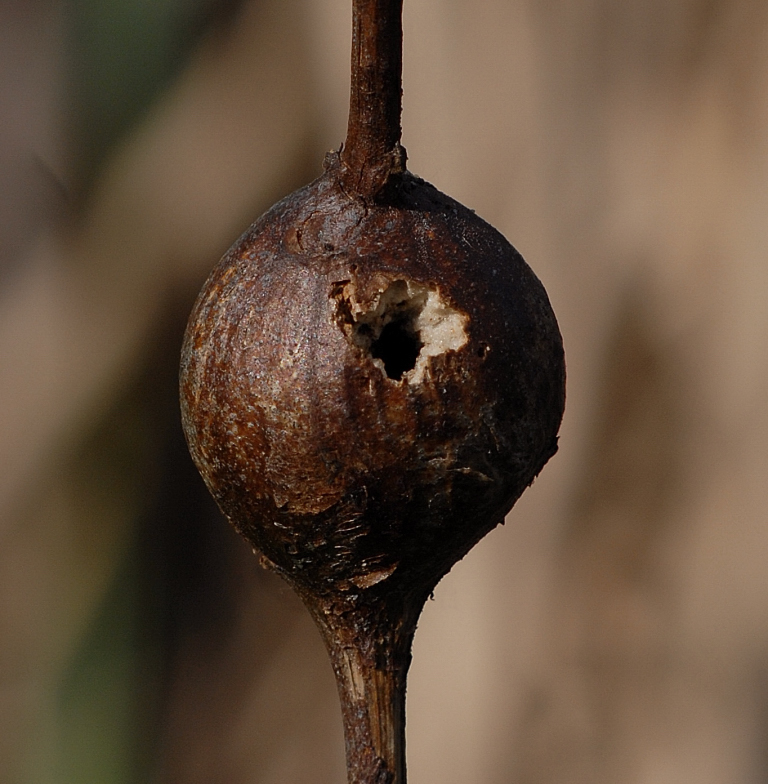
You've probably noticed these, if you've spent much time in goldenrod patches. While it looks as if the plant (tall goldenrod, Solidago altissima) has swallowed a golf ball, this spherical growth is actually caused by the goldenrod gall fly. The tiny fly injects an egg into the plant's tissue, and in response the goldenrod forms layers of very hard nearly woody tissue around the invading object. I wrote about this phenomenon in some detail HERE.

The upshot is that a very tasty succulent little fly grub is ensconced within that tough tissue, safe from all but the hardest working of predators. Enter the Downy Woodpecker, and an amazing series of photos kindly shared by Warren Uxley, naturalist with the Crawford County (Ohio) Park District.

Photo: Warren Uxley

Look at enough of these goldenrod gall fly galls, and it won't be long before you see one that has been excavated. Such a hole could only be the work of the industrious little Downy Woodpecker.

Photo: Warren Uxley

Voila! Caught in the act. The hard-working and intelligent little birds know all about these galls and what lies within, and make frequent forays into old fields to work over the goldenrods.

Photo: Warren Uxley

And here is the object of their desire, the tasty grub of the goldenrod gall fly. I've never eaten one of these, but must make the assumption that they are delicacy enough to warrant all of the work required to extricate one.

Bravo, little Picoides pubescens! And thanks to Warren for the cool series of photographs.

Wednesday, June 1, 2011

Some plants of the north

On my recent NettieBay expeditions in northern Michigan's Presque Isle County, we saw many interesting plants. The ones that follow are of particular interest if you do most of your flora-chasing in Ohio or points south. For the most part, these are plants of cool northern climates, and barely nip into Ohio, or don't at all in one case.

This fen, hard on the shores of Lake Huron, is a botanical eden. Serious plant-seekers will go ape here. Cold flowing sheet water spreads out over a massive bed of limestone, creating strongly alkaline soils and frigid root zone temperatures. Only the specially adapted survive, and some of these specialists are among our most interesting plants. See all of those purplish clumps? They're pitcher-plants, Sarracenia purpurea, a truly carnivorous plant.

This little beauty was my personal favorite, and early bloomer that it is, the flowers had already passed on many plants. But many plants still looked fine, and their pale purple blossoms added little jolts of color to the fen. We also saw small rafts growing in gravelley swales in the protected lee of Huron's beaches.

It's bird's-eye primrose, Primula mistassinica. I shut my camera's aperture down as much as I could in the shot above, to get enough depth of field to show the plant's basal rosette of leaves. There are no cauline, or stem, leaves, and the flowers are held perhaps six inches above the ground.

The flowers of bird's-eye primrose are striking upon inspection, with their lemon-yellow "eye". Note the bifid, or cleft, petals, as if some elf had snipped a wedge from the tip of each. The curious scientific epithet mistassinica stems from Lake Mistassini, where the plant was apparently first found. This lake lies in Quebec's north country, and is the largest natural lake that is wholly within the province. It must be a spectacular place, and the name alone makes me want to visit it someday.

A real showstopper, this one, and this individual looked like a miniature shrub. It's rose twisted-stalk, Streptopus lanceolatus, and if it reminds you a bit of a Solomon's-seal you'd be ranking high in botanical acuity.

Rose twisted-stalk is a lily and closely related to Solomon's-seals, as evidenced by the flowers that dangle beneath the leaves, held by threadlike pendant pedicels. This is a nearly magical plant, and it would seem to be one that would captivate the gardening crowd, but I'm not sure it has been much captured and domesticated.

I find everything about this species of interest, and think that it is particularly photogenic. One could easily lose a lot of time trying to capture rose twisted-stalk's various nuances and angles. You'll not find many opportunities for that in Ohio: it is endangered here and only known from a very few small populations in the extreme northeastern corner of the state.

One day, we ventured out onto a quaking bog mat surrounding a glacial kettle lake. I don't know if you have ever explored such a habitat, but when doing so caution is called for. Kettle bogs such as the one above began life (in this case, not even 12,000 years ago) when an enormous block of ice calved from the face of the retreating glacier. With a giant plop, the icy block drilled down into the soft muck left in the glacier's wake; sort of like dropping an ice cube into a chocolate Wendy's Frosty.

Plants nearly instantly began the process of invading the barren, frigid water body, and now, some 10,000 years later, we have a classic kettle bog. The remaining open water in the middle of the kettle is ringed by mats of Sphagnum moss laced together with a fascinating diversity of acid-loving bog plants. The bog mat, where we will go to see our next featured plant, is like a thin spongy veneer of plant life, often overlaying water. Break through, and you could be in for some real problems. Jump up and down on a good bog mat, and it'll set the substrate to rippling and quaking like a waterbed.

Eventually the lake will completely fill with plant matter, its ultimate fate to be conversion into woodland.

While traipsing about the quaking bog mat, we were understandably quite interested to come across these curious pea-like trifoliate leaves.

That's because those leaves were attached to these - the indescribably stunning flowers of bogbean, or buckbean, Menyanthes trifoliata. The showy little flowers are crystalline-white, and heavily bearded with interesting tassel-like fringes. This species was once placed in the gentian family, a group renowned for beauty, but apparently we must now accept bogbean's placement into its own family, the Menyanthaceae. Oh well, something this extraordinary probably deserves such recognition.

There were a great many of these bogbeans festooning the bog's mat, and is often the case, as it was here, one must work hard to place themselves in its company. In our case, it meant threading through a damp white cedar swamp, ducking and weaving between low-hanging branches all the while taking pains to avoid miry wallows. Once on the mat, even more care must be taken to prevent a misstep that might send one slipping through the peat.

It was well worth the effort it took to see all of these plants, though, and of course in the process we saw a great many birds and other fauna and flora of the north.