 A charmer, to be sure, is Erect Dayflower, Commelina erecta, seen here in some of the best sand prairie in the midwestern United States. I was thrilled to finally see this plant in the wild, and catch it at the peak of bloom to boot. All of the dayflowers are lookers, but this is perhaps the showiest.
 Dayflowers are monocots closely related to spiderworts, and rushes for that matter. The botanically inquisitive will not be overwhelmed with species to learn: we have but two native species in these parts. Two others are widely established weeds originally native to Asia; Asiatic Dayflower, Commelina communis, is the best known and most frequently encountered.
Erect Dayflower is as native as they come, and often occurs in superbly diverse prairies, as at Jasper-Pulaski. The genus is named for the Dutch botanist Jan Commelin. As with some other dayflowers, two of the petals are extraordinarily bold, showy, and blue; the third is depauperate and whitish, hardly matching the glory of its two siblings. This weak petal is the lower one.
On to the story, now that our plant has set the stage.
 In 1991, the above was released. Manual of Vascular Plants of Northeastern United States and Adjacent Canada was burdened with a lengthy and cumbersome moniker, but this was the bible of vegetation botanists had been eagerly awaiting. You might say it was the counterpart to birding's big Sibley guide, and when it emerged we snapped it up. Few were disappointed. Written by the brilliant Arthur Cronquist, the manual was innovative in the extreme. Not for the casual, it has no photos or sketches, just pure dichotomous keys and individual descriptions of plants. But we finally had a thorough, accurate and up to date guide to ALL the plants in our region.
So, like many others, I pored through the manual with a keen eye, looking for new information and lore. And before long, I came to page 656. And Commelina erecta. And Cronquist's range description: "...to Pa., O., Mi..." What!? Ohio! We had no record of this species in the state, and discovering it here would be akin to finding a breeding Swainson's Warbler. Surely Arthur Cronquist knew something the rest of us didn't. After all, he worked out of the fabled New York Botanical Garden, and had one of North America's most comprehensive collections of plants at his fingertips in their herbarium. Not to mention his vast experience and exploration. Maybe Arthur had found the plant in an Ohio pass-through and neglected to let on to the rest of us.
 Action was required to ferret out the status of this dayflower in Ohio. So on December 27, 1991, I tapped out the above letter. It is addressed to Patricia Holmgren, who was the Director of the New York Botanical Garden's herbarium. I had previous contact with her in the course of sending along numerous plant collections from Ohio to be deposited in their esteemed institution, and Ms. Holmgren had always been very gracious. Thus, I thought she might help solve the dayflower mystery, being in the same facility as ARTHUR CRONQUIST, who I didn't dare contact.
In case you can't make it out, my letter says: "
Dear Pat:
I sincerely appreciate the help you have given me in the past, and hope you can assist with another request, this time concerning Commelina erecta L. Cronquist (1991) lists Ohio as included in the range of this species, yet I know of no specimen in Ohio herbaria and the plant is unmentioned in works dealing with Ohio flora. Perhaps there is a sheet in the NYBG herbarium, and if so, could you send me a copy of the specimen and label?
Thanks very much for your time and consideration.
Sincerely,
James S. McCormac"
 Lo and behold, a few weeks later I received a reply letter, dated January 7, 2002. And who should the author be, but Art Cronquist himself! If you click on the letters above, they should enlarge to make for easier reading. In case you can't below is Cronquist's letter:
"Dear Dr. McCormac (his error; no Dr. here!)
Dr. Holmgren has passed on to me your recent inquiry about the attribution of Commelina erecta to Ohio in the recent G. & C. Manual (Gleason & Cronquist). I remember, from the days when I was going to Sunday school regularly, being warned, "Be sure your sin will be found out". The attribution of C. erecta to Ohio goes back to Gleason's version of the Britton & Brown flora, published in 1952. It is not unreasonable on its face, and I did not check it out for the two editions of the manual. I don't now find anything in the herbarium to validate the record.
It might be well to check with Dr. Robert Faden, of the Smithsonian Institution, about the distribution of this species. He is a specialist in Commelinaceae, and he annotated our material of Commelina several years ago. He may have some records that neither one of us knows about.
Sincerely yours,
Arthur Cronquist
Senior Scientist"
Needless to say, this 30 year old eager botanist was ecstatic to have received a letter from the MAN himself, and I could hardly believe he had written me personally over what might be considered such a trite matter. But Cronquist knew the field botanist mindset, being one himself. He knew that discovery of a new native plant to a state was a big deal, and thus took the time to set the record straight. What's more, he did it with humor and style. I especially liked the part of his letter where he states "I remember, from the days when I was going to Sunday School regularly, being warned 'Be sure your sins will be found out'".
 Arthur John Cronquist, 1919 - 1992. Cronquist passed away on March 22, 1992, two and a half months after he wrote the dayflower letter to me. He went out doing what he loved best - studying plants. While examining specimens of Mentzelia at Brigham Young University in Utah, he suddenly collapsed, dead of massive heart failure at the age of 73.
Cronquist was an extraordinary intellectual, and an innovator on many levels. He is probably most famous for his revision of the taxonomic system of plants, eventually creating what came to be known as the Cronquist System, a scheme that is widely accepted and in use today. The fact that he would take the time to answer a query from a complete unknown meant a great deal to me, and taught me a big lesson about encouraging others. I've never forgotten Arthur Cronquist's taking the time to pen me that letter, and it was the first thing I thought of when I realized I was looking at a beautiful specimen of Commelina erecta last Friday.
To me, Cronquist lives on throught that gorgeous species of dayflower.


 Jasper-Pulaski Wildlife Area in northwestern Indiana. For all you non-Hoosiers, it's Pull-ask-eye! Not Pull-ask-ee! Practioners of the local dialect are firm on this point. At least we got the Jass-per right. This place is legendary for the masses of migrant Sandhill Cranes that collect late each fall, creating an avian spectacle that is one of the midwest's must-see avian events.
 Here's our crew, and a distinguished group (not claiming myself) it is. Mike and I hatched plans last year, so he had plenty of time to get others involved, and many of those that you see here are the very best field botanists and ecologists in the Great Lakes region. Their involvement made for a heck of a trip, and I saw many "life" plants, some of them the rarest of the rare in the lower Great Lakes. From left to right (back row): Tom Post, Mike Homoya, Daniel Boone, Roger Hedge, Janet Creamer. Front row: Jim McCormac, Lee Casebere, Ben Eddy. Photo by John Ervin.
 J-P is an incredible place of global significance. Within its 8,000 acres are outstanding examples of dry sand prairie, and prairie wetlands filled with regionally mega-rare coastal plain disjunct plants. Like so many of our greatest protected natural resources, J-P was purchased with money from hunters and anglers, a fact that should be recognized by users of these sites no matter what their interest in visiting. The time has long since come when we need to draw more people that are interested in the environment into helping to pay for its protection. But that's a subject for some other time...
 I knew it was a good omen when one of the first plants that I spotted as our trip began was the above. Sure, you may not get overly excited about a smartweed, but I sure did with this one. It is Carey's Smartweed, Persicaria careyi, and this is NOT the similar, weedy Dock-leaved Smartweed, Persicaria lapathifolia, that one sees everywhere. This plant hasn't been seen in Ohio since Edwin Moseley collected a specimen in 1920 in Erie County. It was a lifer for me, and the much-traveled Daniel Boone.
 Floating Bladderwort, Utricularia radiata. This aquatic oddity was high on our target list, and we found a number. Bladderworts are the largest group of carnivorous plants with about 250 species worldwide, and all of them are interesting. This one is fascinating. It is free-floating, with roots that are inflated like pontoons. Thus, it is quite bouyant. The tiny bladders are born on rootlets at the tip of the primary root branches, and it is within these little sacs where death occurs. Small organisms are attracted to the bladders by chemicals secreted by the plant, and touch guard hairs that operate the bladder. The sensitive hairs trigger the bladder door, just like a mouse trap, and it opens inward with such force that the prey is sucked in. The door snaps shut and the bladderwort has a meal.
 Floating Bladderwort distribution. This plant is one of the very rare disjuncts that Jasper-Pulaski is noted for. It is primarily coastal plain in distribution, with rare and local isolated populations in northwest Indiana and southwest Michigan. There is more than one theory as to how these plants came to be here. The best, in my view, is the "sidewalk" theory. Basically, these species migrated from east to west along the face of the retreating Wisconsin glacier, when its wake was wet and mucky.
 You can see why Indiana botanists and even those from further afield get excited by seeing Floating Bladderwort. It's range in Michigan only encompasses two counties. If you don't come here, you are in for a long drive to see this species along the coast.
 A true showy jewel of the J-P wetlands, Virginia Meadow-beauty, Rhexia virginica. It is quite common, although Rhexia is in general quite the rarity in our region. The calyces, sans flowers, look just like tiny water pitchers, as can be seen in the lower left. The family Melastomataceae, to which this species belongs, becomes far more prolific in tropical regions.
 Another of the exciting mega-rarities that we found, Creeping St. John's-wort, Hypericum adpressum. Unfortunately for photographic purposes, it was beyond flower, but nonetheless the plants have a pleasing aspect to them. This is another that doesn't occur in Ohio and has a sparse midwestern distribution.
 Not just any old wetland. Two of the dominant plants in this photo are also extremely rare south of the Great Lakes. The big sedge with the brown spikes in the foreground is Horned Beaksedge, Rhynchospora macrostachya, another of the coastal plain refugees. It is very rare in the midwest, but quite common in J-P wetlands. The grassy plant, often forming floating mats, is another great rarity, Robbins's Spikerush, Eleocharis robbinsii.
 Here's the little charmers. Well, not so little, in fact. A hefty Wood Stork's wings span over 5 feet, and a whopper can weigh over 5 lbs. In nutshell, these are big in your face birds. But, perhaps not so charming, as we shall see...
 A face only a mother stork could love. All three birds are first-years, as evidenced by the pale bills and undeveloped facial skin. Thanks to Heather Nagy, who allowed me the use of her fine scope to get this and the next shot - digiscoping, as they say.
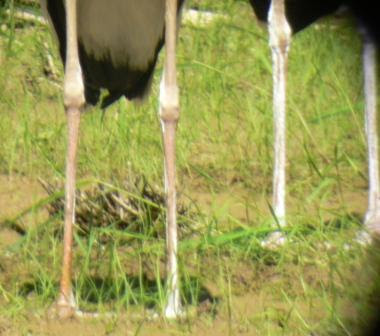 Evidence that Wood Storks aren't sent to Charm School. Their legs often look washed with white, and indeed they are. This isn't their normal color, though. In an ingenious if not somewhat grotesque fit of evolution - or lack thereof - storks have a peculiar cooling system. They defecate on their legs. This expelled material, properly termed guano, is watery and presumably ejecting it all over one's exposed legs helps in cooling internal body temperatures during piping hot days. One incidental side-effect of this strange behavior, I happened to notice, is that the guano pools around the roosting birds. You can see a bit of that in this photo. And what is attracted to guano? Butterflies! I noticed several species coursing about the stork's feet, dipping into the stork feces. There is probably a Master's Thesis in there... "Use of Foraging Butterflies at Guano-soaked Wood Stork Soil".
 Here we find the young bullbat on August 21, looking just about like an adult. Still has traces of down peeking through, and nice rich buffy feather edging, but this one should be pretty near flight-ready. His nestmate has already left the nest.
 By now, this bird could be quite far from Toledo and
 Ground zero for the Wood Storks. The small wetland they are frequenting is outlined in red. This site is several miles south of Coshocton, in southern Coshocton County. Township Rd. 145 goes east-west between State Rtes 83 and 93. This road travels along low-lying and oft-flooded Wills Creek, and there are interesting wetlands galore in the area.
 This is the stork habitat. Those three white dots are our birds. As Bruce Glick had noted in a posting to the Ohio Birds listserv, this area has a very Floridian feel to it, with plenty of swampy ground. The storks must feel right at home. I can't wait to get back and do a bit of botanizing. In my short trip, I saw a number of interesting and unusual plants, some of which are often indicators of other good stuff. Should be lots of dragonflies in the vicinity as well.
 Three juvenile storks. If their bills were above water, which they seldom were, you would see that they are pale ivory-yellow - a character of young birds. Storks feed in large measure by feel. The tips of their bills are sensitive and they feel around in mucky water where it is often too cloudy for visual prey detection.
 A better view of one of the birds, albeit head still submerged. This morning was very dark and misty - not good conditions for photography of birds, and I didn't manage many good shots of the storks standing upright.
 Most of the prey that I could see them catching appeared to be crayfish, perhaps some snails, and other small aquatic life. This one lucked into a big Longear Sunfish, and had fun wolfing it down. Once he got it headed the right way, it wriggled down the gullet fairly readily.
 Wood Storks are big, impressive beasts. Their overall robustness was especially apparent when they would flap their wings. I've seen many of them in the south, but like most Ohio birders, never in Ohio. In fact, this bird was #356 for my state list, but who's counting :-)
 Beachfront Cape May with the famed lighthouse off in the yonder. This area is owned and managed by The Nature Conservancy, and is one of the best remaining oceanside habitats.
 Royal Terns abound on the beach. Here, a squawking juvenile begs for food. Like Caspian Terns, the young of this species follow the adults around long after being fledged, demanding handouts from the long-suffering adults.
 It was nice to see these diminutive little Fish Crows, and hear their odd laughing snorts. American Crows were also about; the size difference between the two is conspicuous. Fish Crows are coastal in distribution, ranging up the Mississippi Valley. They should eventually be turn up along the Ohio River in Ohio. This one had a cheese puff or something probably equally unhealthy. Crows are not noted for discerning palates.
 Plenty of Black Skimmers were around. The Nature Conservancy protects large areas of beach, to improve nesting success of this species along with Piping Plovers and Least Terns.
 Black Skimmers are wild-looking birds. They even attract the attention of non-birders. While photographing them, I was approached by some people who wondered what they were. They kind of look like little street toughs, wearing hoodies pulled down low over their eyes. Their bill is a marvel of evolution. Skimmers skim: they fly along the water's surface, dipping the lower mandible in as they course along, thus snatching up tasty aquatic morsels.
 This tiny little beast is one of the treehoppers, and several dozen of them could pack onto a quarter. During the day, they often wedge into the axle of a leaf, blending remarkably well with the plant. At night, they become more free-ranging, although when spooked by giants with flashing lights, still tend to retreat to the junction of a leaf and stem, where they at first blush look remarkably like a stipule.
 This tiny cricket is a Say's Trig, I believe. It is a quarter-inch or so in length. You've heard trigs. They produce low trills that are an oft-present background noise. This species makes a musical, silvery trill that carries well, considering the miniscule size of the musician.
 As you can imagine - or may not be able to imagine - I was quite pleased to find this big katydid. It produces an interesting and very distinctive song that sounds a bit like a raspy frog - ree-dip! It's an Oblong-winged Katydid, and like the rest of their ilk, can be very hard to find. Nearly impossible during the day, when they sit around in the foliage looking just like leaves. I heard this one, and finally located him sitting low on the leaf of a Giant Ragweed. Like nearly all katydids, they are nocturnal and sing at night. Keen of senses, they'll clam up when a person draws near, increasing the challenge of finding the songster.
 A closer view of its upper body. We know it's a male, one, because it was singing, and two, because of that traingular brownish patch. That is the stridulatory area; the parts that he scrapes together to produce his song. These raspy melodies are known as stridulations. Katydids are beautiful and fascinating insects, but certainly underappreciated. Few people ever see them!
 A closer view of the base of the Oblong-winged Katydid's wings. These insects are essentially doing what male birds do - singing to attract mates. The singing insects start to come on strong just about the time that our breeding birds are waning, having already fledged their young. For birders, learning the insect vocalizations can be terrific practice for keeping one's ears in tune. From mid-July til frost, you'll have a bounty of challenging new subjects to learn.