Sunday, January 5, 2014

Hellbenders trying to hang on

 
Hellbenders trying to hang on
 

Columbus Dispatch
January 5, 2014

NATURE
Jim McCormac

The constellation of nicknames for the Eastern hellbender — snot otter, devil dog and Allegheny alligator — shows that it is an odd beast indeed.

An old hellbender can exceed 2 feet in length and weigh 3 pounds. That dwarfs most of Ohio’s 23 other salamander species.

Hellbenders live up to their name. They look as if the Marvel Comics superhero the Thing has come to life in the form of an amphibian.

A hellbender resembles the rocks in which it lives. Small, piggish eyes cap a seemingly shapeless head fronted with an exceptionally large mouth. The amorphous body blends seamlessly between head, middle and tail. The creature is wrinkled like a lasagna noodle, and small misshapen feet seem to have been tacked on as an afterthought.

These salamanders are tough hombres. They live in a world of extremes. Hellbenders frequent rough, rocky streams that are prone to severe seasonal flooding, summertime drought, brutal ice scouring and water temperatures that can vary by 50 degrees or more.

People seldom see hellbenders, which hide under huge rock slabs during the day and emerge to hunt at night. Their favored prey is crayfish.

Hellbenders live throughout much of the Appalachian Mountains and Ohio River Valley but have become rare in many areas. The creatures can handle whatever Mother Nature throws at them, but they have met their match in man. Once, hellbenders were probably found in all of the major Ohio River drainages in Ohio. Today, they are listed as endangered and survive in only a handful of locales.

Silt from farm fields, chemical pollution, acid runoff from mines and other unnatural factors have done in hellbenders. On the plus side, some ancestral streams have experienced recent water-quality improvements, and efforts are afoot to re-establish hellbenders.

The Ohio Division of Wildlife, the Wilds, and the Columbus and Toledo zoos have orchestrated a recovery program. Hellbenders are reared from the egg and then turned over to an innovative program sponsored by the Marion Correctional Institution. Prisoners raise the salamanders to a size suitable for returning to the wild.

Let’s hope hellbenders flourish. They’re an important part of Ohio’s natural heritage, dating back to the Jurassic Period and dinosaurs. Their presence speaks of healthy streams and good water quality.

Naturalist Jim McCormac writes a column for The Dispatch on the first and third Sundays of the month. He also writes about nature at www.jim mccormac.blogspot.com.

Wednesday, January 1, 2014

A very lucky Snowy Owl, and an owl in prison

With well over 100 Snowy Owls thus far reported in Ohio - biggest irruption in many decades - interesting stories are bound to arise. These birds draw lots of attention, and nearly everyone who has the fortune of seeing one is suitably impressed. An upshot of the owls' conspicuousness and popularity is that we get lots of reports from people that aren't in the birding network. That allows a better tally and more thorough documentation of an invasion (to use a much overused descriptor) that we aren't likely to see on this scale for decades, if history is a guideline.

One downside, for the owls, is that nearly all of them are juveniles, and utterly unfamiliar with vehicles. Couple that naiveté with their propensity to hunt near roads, and fly close to the ground, and owl-vehicle strikes will happen. I've heard of at least four cases of Snowy Owls killed in collisions with vehicles so far, and some say that this is the biggest cause of mortality for owls south of the breeding grounds, at least in populous areas. 

So, when I first saw these photos, I was bummed - another owl gets grilled. But a quick skim of the email they were attached to reveals a happy ending, it seems. The gentleman was driving along a rural Wood County road when the owl came out of nowhere and bashed into the front of his pickup truck.

The collision was hard enough to crack one of the slats in the grill - these birds can weigh 4-5 lbs, or more - and the owl popped right through and was stuck between the grill and the engine compartment. But it is still alive, and fortunate indeed that the right guy was driving the truck.

The driver quickly worked the owl free, and placed it on the passenger seat in the warm cab of the truck. While the bird was undoubtedly a bit dazed and confused, and some feathers appear out of place, it doesn't look too worse for the wear. Anyway, while the guy was no doubt pondering what to do with the animal, it shook itself off, and darted out the door. The driver reports that it flew strongly across the fields, and out of sight. Here's hoping it suffered no lasting damage. If it had to collide with a vehicle, it's probably good that it happened to be this one, as many people probably wouldn't have been able to deal with the situation rapidly, and successfully extricate the bird.

UPDATE: This same owl, apparently, is doing well and hunting in the same area, at least as of January 1. Look for it near the junction of South Dixie Highway and State Route 281 in Wood County, not far south of the town of Rudolph.


This video comes from one of Ohio's prisons, and offers an interesting choice of habitats. The person who made the video reports that there are plenty of fields and wide-open habitats around the facility, and they are hopeful that the bird will stay for a while. It's pretty cool to see the big white owl cruise right over the concertina wire.

Snowy Owls continue to turn up in new spots about every day, with at least 113 reported in 39 counties to date. An update and map are RIGHT HERE.

Monday, December 30, 2013

Snowy Owl in urban Columbus!

The urban jungle of Columbus, Ohio, about ten minutes from my office. I was peacefully eating my lunch at my desk today, when word came down from Scott Albaugh that one of his students had just seen a Snowy Owl. The bird was sitting high atop a water tower along Huntley Blvd, right where the yellow stick pin in this map is. Whoa! This I had to see!

I asked one of our administrative assistants, Vicki, if she would like to see (hopefully) a real live Hedwig, she said of course (who wouldn't!), and ten minutes later we were on the scene.

This is the street view, courtesy my Droid's camera. I had driven my non-field car into the office today, and it was clean as a whistle - no scope, binoculars, cameras, nothing. I borrowed a pair of bins before leaving, but upon arrival found another dozen birders there, with plenty of optical power.

Scott's student deserves the Medal of Eagle Eyes for spotting this owl. This unmagnified view shows the tower, from where we gazed upon the owl. I suppose if you click this photo to enlarge, you can make it a small protuberance on the left side of the summit of the tower, but it isn't obvious. Furthermore, this is not the type of locale that one would necessarily be on their toes for Snowy Owls.

Photo: Karen Chism

Yet there was the bird, a young of the year female, showing lots of dark stippling. By now, other birders were arriving, as word had been put out via Facebook and the Ohio Birds Listserv. It had been sitting up there for at least an hour at this point. I appreciate Karen Chism allowing me the use of her photos - pretty darn good, considering the distance!

SIDEBAR: I have noticed an increasing trend, and a rather disturbing one, of criticism of owl photos. Facebook is the place to see this sort of strange and often ignorant attack. Someone will post a photo, often like this one, and someone else will jump in and accuse them of being too close to the owl, and "bothering" it. While I'm not denying that can happen, in many cases they are looking at an image that was taken with a 500 mm lens, like Karen's, that was then cropped heavily. Look at the first landscape image, then the above image. Cameras can do amazing things these days. Don't launch attacks on photographers if you don't know the circumstances in which the photo was made, please. I've even noticed that a number of photographers must feel guilt-tripped, as there seems to be an increasing tendency for some to make sure and note their image was "heavily cropped" in an attempt to stave off the keyboard warriors' attacks before they start.

Photo: Karen Chism

After we watched the great white owl for a while, it began to stretch and shake out its wings a bit. Then, Presto! It leapt into the air, quickly gained altitude, and headed unerringly due south. It'd be interesting to know where it is now.

This wasn't the only new owl to come to light today. I heard of four others, and insofar as I can calculate, there have been reports of 112 owls in 39 counties since the first one was reported on November 22. CLICK HERE for the latest update and map.

Sunday, December 29, 2013

Raccoons well-suited for survival

 
RACCOONS WELL-SUITED FOR SURVIVAL

Columbus Dispatch
Sunday, December 29, 2013

NATURE
Jim McCormac

Edward Crump presided over Tennessee’s political machine for much of the first half of the 20th century. The former Memphis mayor, in campaigning against political foe Estes Kefauver, portrayed the Democratic challenger for a U.S. Senate seat as being “raccoonlike” and a “communist puppet."
In response, Kefauver wore a raccoon-skin cap when on the stump and stated, “I may be a pet coon, but I’m not Boss Crump’s pet coon.”

Kefauver won the 1948 election handily.

Being compared to a raccoon isn’t such a bad thing. It’s more flattering than being compared to a skunk.

Raccoons are abundant and range throughout Ohio. Close relatives of bears, they are instantly identifiable by their black bandit mask and ringed tail. A big one can weigh 35 pounds. The wily mammals occur in all habitats and may thrive best in citified landscapes.

Raccoons are consummate omnivores, meaning that they’ll eat almost anything. The meal plan includes our castoffs, as victims of plundered trash cans have learned.

The Algonquin Indian name for raccoon is aroughcoune, which means “He scratches with his hands.” These masked bandits indeed have handlike paws, and their prints are easily recognized along muddy creek banks. Raccoons use their appendages with great dexterity, and they can open refrigerator doors, gates and other impediments that would thwart most beasts.

They are great climbers and often spotted high in trees. To facilitate headfirst descents, a raccoon can rotate its hind paws 180 degrees.

In northern climes, raccoons go on autumnal food binges, packing on massive quantities of fat. Up to a third of a successful glutton’s body weight is blubber. So much fat is stored that a raccoon can ride out winter without eating, if need be. They don’t truly hibernate but will remain holed up in a den for extended periods during cold snaps. Come spring, a raccoon might weigh half of what it did at winter’s onset.

For such a seemingly bright animal, raccoons don’t make their own dens. They use tree cavities, rocky crevices, hollow logs and sometimes storm sewers. Motorists are sometimes startled to see two eyes glowing from a sewer’s grate, reflected by the car’s headlights.

Raccoons mate in late winter or early spring, and the female gives birth to as many as eight coonlets in April or May. They grow rapidly, and before long will be sneaking through the night plundering crayfish from creeks and raiding unprotected trash cans. The mincing humpbacked gait of a coon is unmistakable.

In the 1950s, ABC aired a TV series featuring Fess Parker as the coonskin-capped Davy Crockett. Sales of the furry headgear skyrocketed to 5,000 a day. By the mid-1970s, the raccoon was the most economically important North American fur bearer.

By the early 1980s, a prime pelt could fetch $30 — now, about $72. Today, exterminators probably make more money from raccoons than trappers do.

Naturalist Jim McCormac writes a column for The Dispatch on the first and third Sundays of the month. He also writes about nature at www.jimmccormac.blogspot.com.

Thursday, December 26, 2013

Golden Eagle on deer carcass!

I received an interesting email this afternoon, accompanied by photos, from Fred Rau of the Dayton area. Fred, who owns property in rural western Pike County, runs a trail cam on his land, and of late has had its lens pointed at a White-tailed Deer carcass. What a surprise he got when he checked it recently!
 
Trail cam photo courtesy Fred Rau

A Golden Eagle, its namesake nape aglow, eyes the venison steak. This photo and the others were taken on the morning of December 22nd - last Sunday. The cam is motion-activated, and will run for a few weeks before its batteries die. Fred will be back down to check it soon, and it'll be interesting to see if he has any additional shots of the eagle.

 Trail cam photo courtesy Fred Rau

This spot is on an upland ridge along the edges of a clear cut. What looks to be American Beakgrass, Diarrhena americana, provides the ground cover. An amazing shot, this one, as the eagle mounts its carcass. To my eye, it looks to be a subadult bird, but not a juvenile (first-year). Golden Eagles don't obtain fully adult plumage until their first year of life, when they will appear darkest overall. This animal still has a fair bit of white in the wings and tail. Perhaps a 2nd or 3rd year bird.

 Trail cam photo courtesy Fred Rau

I happen to know the area where Fred documented this eagle, and it is along a large wooded valley interspersed with lots of large clearcuts of varying ages of succession, and extensive agricultural lands not far to the west. The human population is sparse in this region, too. Not a bad land use mosaic to support an overwintering Golden Eagle.

 Trail cam photo courtesy Fred Rau

Golden Eagles are quite rare at any time in Ohio. We get maybe a half-dozen reports annually in migration, mid-March thru April and October/November being prime times. Overwintering birds are few and far between, but might be showing an ever so slight uptick. Of course, the famous bird(s) at the Wilds in Muskingum County are best known and have been found for the past decade or so. Although we couldn't find them last Saturday on the Chandlersville Christmas Bird Count.

Two winters ago, a juvenile Golden Eagle was found and photographed in Knox County, MORE INFO HERE. There have been a number of other sightings from recent winters, too. Golden Eagle is far more frequent in the western U.S.; the eastern breeding population is much scarcer. We don't know where the origins of this bird or the others found in Ohio in winter are, but it surely would be interesting to know. The states of Georgia and Tennessee have successfully hacked birds back into the wild in the last two decades, although I don't know the current status in those states. Historically, it was thought that Golden Eagles nested in many of the eastern states.

Here's a map showing the specific location of the Golden Eagle, in Pike County. State Rte. 32 (James A. Rhodes Highway) runs to the south, and State Rte. 124 is to the north. There's a decent chance this bird will hang out in the area for a while and perhaps overwinter. Anyone in the area should keep an eye out.

Wednesday, December 25, 2013

Woodpeckers boom, probably because of invasive pest

The skeleton of a Green Ash, Fraxinus pennsylvanica, is tagged with a sign telling us what caused its demise.  The Emerald Ash Borer (EAB), Agrilus planipennis, is an Asian wood-boring beetle in the Buprestidae family. It was first detected in southeastern Michigan, adjacent to Ohio, in 2002. The bug quickly spread like wildfire, and was found in Ohio in 2003. It's gone far beyond Ohio; as of early December, EAB has been documented in over 20 states (CLICK HERE for a current distribution map).

EAB larvae are phloem feeders, and these grubs bore elaborate galleries just under the bark, as seen in the photo above. The end result is that the tree eventually can no longer uptake water and nutrients and it dies. In the Midwest, Green Ash and White Ash, Fraxinus americana, are the most common ashes and thus the most frequently killed, but EAB does not discriminate. Our other three species (in Ohio) are also destroyed.

The ash borer lays waste to ash trees on an incredible scale. The above photo is of a wetland along Lake Erie's Sandusky Bay, taken in August 2011. In places, it's like winter in summer due to all of the dead ash. That area and much of northwest and central Ohio look even worse now. Where I live, in the center of the state, nearly all of our ash are gone. The city of Columbus removed most of the dead ash husks along the streets in my neighborhood within the last year.

As ash trees can comprise up to 40% of forest communities, especially in low-lying damp areas such as in this photo, the impact of EAB is extreme. There most certainly will be losers, in addition to the ash themselves. A host of moth species are ash-dependent; their caterpillars must feed on the foliage of these trees. Their prognosis is dicey at best, and we may lose a number of these animals. There are undoubtedly many other ash-dependent organisms as well. Any genus of tree as prolific as are the ashes will serve as important keystones for many animals.
 
Red-bellied Woodpecker, Melanerpes carolinus

The downfall of ash will also spawn some winners, at least in the short term. An obvious group of beneficiaries are woodpeckers. The fat juicy EAB grubs are easily available to these chisel-billed hammerheads, and woodpeckers quickly learn to exploit this new food source. In fact, I believe it was abnormally high woodpecker activity that first alerted people to the initial infestation in Michigan.

Here in Ohio, there is little question that woodpecker populations are increasing across the board. This increase has been apparent for a while. I edited the winter season for the Ohio Cardinal for 2009-10, and made this comment under the Downy Woodpecker account, after noting that its Christmas Bird Count total was easily the largest ever reported: One must wonder what temporarily beneficial impact the runaway proliferation of the invasive Emerald Ash Borer is having on woodpecker populations.

A few recent papers SUCH AS THIS showing increases in certain woodpecker populations tied to EAB, and a recent media request seeking my opinion on the matter, prompted me to revisit the Ohio Christmas Bird Count (CBC) data. While problems may exist with CBC data, I think it works well in documenting woodpecker trends. Woodpeckers, for the most part, are easily identified, and rather conspicuous and likely to be found.

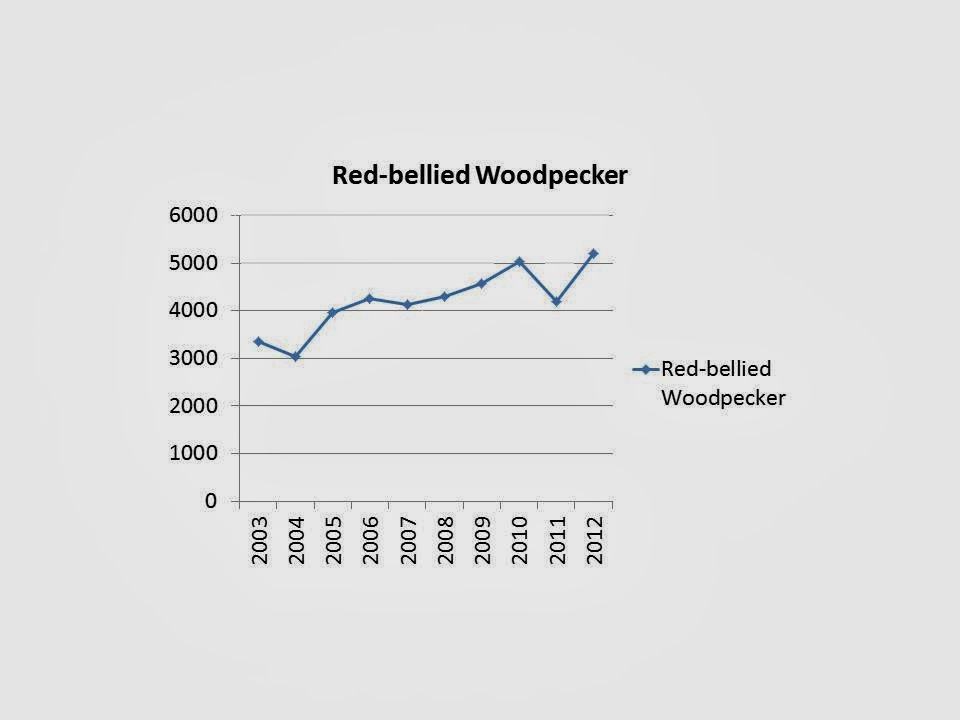
The following graphs represent the collective data of all Ohio CBC's from the years 2003 (onset of the EAB invasion) to 2012 (last year that CBC data is available). I threw in White-breasted Nuthatch, too, as these bark feeders are well known for taking wood boring grubs, including species in the Bupestridae. The results are telling. It'll be interesting to see what this winter's crop of CBC reports brings, but it'll be a while before all of that data is accessible. Likewise, the summaries of woodpeckers for the Ohio Breeding Bird Atlas will be interesting, and the Atlas book should be out sometime in 2014.

Downy Woodpecker is the most abundant of the six common breeding woodpecker species in Ohio. Last winter's CBC total was the 2nd highest ever reported, and showed an increase of 52% over 2003.

While not a woodpecker, obviously, White-breasted Nuthatches also exploit tree bark ecosystems and feed on beetle grubs at least occasionally. Their population is at record high levels, with an increase of 66% over 2003 numbers.

The Red-bellied Woodpecker is the second most common species of woodpecker in Ohio, and it's thriving. 2012 CBC totals were a 55% increase over 2003, and a record high count.

Hairy Woodpeckers are more strongly tied to large contiguous woodlands and mature trees than most of the other species, but they too are doing well. Their 2012 count was the 3rd highest, and a 62% spike over 2003 numbers.

The giant Pileated Woodpecker, our largest species by far and an animal capable of wreaking havoc on wood-boring beetle grubs, is booming. Last winter's CBC tally was 56% higher than in 2003, and was a record high count. This species, like the Hairy Woodpecker, is probably benefiting from other factors too. As Ohio's forests continue to increase in area, and more wooded acreage reaches mature climax stage, this species continues to flourish and it was expanding its reach prior to the EAB invasion.

Northern Flickers also set a high count record on last year's CBC's and posted a jaw-dropping increase of 476% over 2003 totals. Other variables besides the availability of EAB grubs play into this one, though. Flickers are highly migratory and their numbers vary during Ohio winters. Weather and perhaps factors other than EAB may influence numbers of this species more profoundly than most of the other woodpecker species.

Red-headed Woodpeckers exhibit a peak and valley cycle, with peaks every two or three years, and this pattern predates EAB. This boom and bust interval may relate to mast crops such as acorns, as the Red-heads are heavily dependent upon mast as a wintertime food source. Nonetheless, they've fared well: 2012 CBC numbers were 81% higher than in 2003, and scored a record high.

Finally, the Yellow-bellied Sapsucker, our only woodpecker that could be termed a Neotropical migrant. It is a rare Ohio breeder, mostly in the extreme northeastern counties, but a fairly common to common migrant and winter resident. Some individuals make it all the way to southern Central America in winter. Sapsuckers also feed heavily on tree sap via their specialized well fields. These variables aside and since they certainly can and do excavate grubs under the bark, I threw it in. The 2012 CBC total was the 3rd highest ever and a whopping 87% over the 2003 count.

There are certainly a host of variables aside from the Emerald Ash Borer that can effect the population status of our woodpeckers. But evidence is increasingly suggesting that the new and abundant food source is stimulating population growth, at least in some species. One thing seems certain. Whatever the causes, it's high times for our woodpeckers.

Sunday, December 22, 2013

Birding (and mammaling) at the Wilds

Yesterday was the Chandlersville Chistmas Bird Count, ably orchestrated by compiler Scott Albaugh. Scott's been running the count for the past five years or so, and I've been along for all or most of them. The day dawned overcast and rainy, and it didn't abate until the very end of the day. At least it was fairly warm, with temperatures in the upper 50's. Such wet balmy weather allowed us to add an amphibian to the count list - Spring Peeper.

The 15-mile diameter count circle is quite diverse, including large tracts of woodlands, numerous ponds and wetlands, and vast grasslands. It's a lot of ground to cover, and we don't have too many people to deploy. If you enjoy bird counts, put the Chandlersville count on your calendar for next year.

Most birders know this region of southeastern Muskingum County because of the Wilds, a sprawling 10,000-acre large animal conservation and research facility. The Wilds, and thousands of acres of surrounding lands, were cleared and flattened in the course of coal strip mining. Diverse mixed mesophytic forests were destroyed, and in their place, "reclamation" resulted in expansive rolling grasslands. But to make lemonade from lemons, the new and utterly artificial grasslands have proven to be beneficial breeding habitat for a declining suite of grassland birds, and good wintering grounds for a variety of raptors.

I am fortunate indeed that Mr. Albaugh assigns me to cover the fenced off interior of the Wilds. These areas are normally off-limits, unless you take one of the tours in the open season. The Wilds provides us with hosts who escort our team throughout the inner sanctum, and it is always interesting. Kudos to the management of the Wilds for supporting research, surveys, and management of native birds, in addition to their core work involving large mammals.

Susan Nash and I were paired with Win Fox and Rachael Glover, who are apprentices at the Wilds. They were fabulous hosts and excellent spotters, and shuttled us though the core of the Wilds. Once inside the fence, one will quickly be reminded who the VIP's are. These Bactrian Camels were reticent to move from the road as we approached.

The Wilds' various big game comes first, and all we could do was hope that the camels decided to allow us past. They did, finally, sidling to the edge of the road while we hoped that they wouldn't spit in the window.

At another point, a fine herd of Bactrian Deer browsed near the road. Note the herd's stud-in-chief, center, with the huge rack. In all, the Wilds works with over 20 species of large mammals, including rarities such as Przewalski’s Wild Horse. This species had disappeared from its native range in Mongolia and China by the end of the 1960's. The Wilds' and other facilities' successful propagation programs has allowed about 400 of the horses to be reintroduced back into their native haunts.

The Wilds also works with Cheetah, Fringe-eared Oryx, Greater One-horned Asian Rhino, Persian Onager, Giraffe, African Wild Dog and many others. Seeing strange beasts such as these as one birds the place is a rather surreal experience. Be sure and take a tour of the Wilds sometime. It is one of the most interesting outdoor experiences that one can find in Ohio. CLICK HERE for details.

Many indigenous mammals also can be found on the Wilds' property. This Red Fox (some would argue it ISN'T native!) was huddled in a sheltered spot along a fence, trying its best to stay out of the steady rain. Scores of White-tailed Deer roam the landscape, as do plenty of Coyotes. This area seems to have plenty of Bobcats, too, and I saw my first wild one here back in 2009, and detailed the experience, with photos, RIGHT HERE.

In spite of the nonstop rain, we did fairly well with the birds. Our team tallied 46 species, including plenty of waterfowl, a count first Double-crested Cormorant, two Ruffed Grouse, three Short-eared Owls, gorgeous examples of both light and dark morph Rough-legged Hawks, and much more.

If you want an interesting wintertime immersion into the Wilds, consider signing up for the Ohio Ornithological Society's annual foray on January 18th. We've been doing this event for a decade, and about 150 birders usually show up. It's a blast, with lots of interesting birding. Details HERE.