Sunday, July 10, 2011

A "chameleon" frog and a murderous "bumblebee"

We had a great time this weekend at the Midwest Native Plant Conference, and major props to all of the organizers of that affair. As usual, all the details were well thought out and executed perfectly. Stay tuned for info about next year's event.

On the conference's final day, Sunday, we have field trips. These forays visit natural areas rich in biodiversity and native flora, so that conference attendees can see native plants in their natural haunts, and better learn how they interact with the rest of the world. I was one of the trip leaders at the legendary Cedar Bog and we saw lots of noteworthy native plants. But as usual, the trip morphed into a natural history free for all and non-chlorophyll-bearing organisms were not ignored.

This morning's expedition was helped greatly by the presence of Steve McKee, Cheryl Harner, and Nina Harfmann. All are great naturalists and all know Cedar Bog's various charms well. But a New Sheriff came to town, and we were delighted to have him along. Derek Hennen was the conference's scholarship recipient; he's a student at Marietta College. Check his blog, RIGHT HERE. Turns out Derek is a heckuva entomologist and overall naturalist, and we probably learned more from him than he from us! The two critters featured here were spotted by Derek.

Gray treefrog, Hyla versicolor. It's that "versicolor" in the scientific name that is a key point of interest with this little suction-cup footed tree climber. I shot the above photo in Indiana a few years back. The frog is stuck to the bark of a black oak, and is supremely confident in his ability to blend with his surroundings. But as we shall see, these wondrous little amphibians are truly versatile in their coloration.

Same frog, different color. The aforementioned Derek spotted this "gray" treefrog ensconced among the foliage of a white cedar, and doing a pretty darn good job of matching its surroundings. Certainly nothing like the previous photo of a gray treefrog doing its best to mirror the bark of a crusty gray tree. Note the pale Missouri-shaped patch below the eye. That's a constant, no matter what color our chameleofrog decides to be.

There is another essentially identical species, the Cope's gray treefrog, and I once posted about that one HERE.

Ah, the bumblebee, a soft and fuzzy loveable insect if there ever was one. Black and yellow Bombus bumblebees are a fixture around flowering plants, busily rushing about sucking up nectar and getting their "fur" thoroughly doused with pollen. Bumbling off to another plant, they complete the pollination process, hundreds of times a day.

Bumble Bee

by CJ Heck

Today I saw a bumblebee.

He was on a pretty rose.

I leaned in to look at him,

and he stung me on my nose!

I wasn’t gonna squish him,

only watch and see …

but I’ll never get THAT close again

to a grouchy grumble-bee.

Well, Poet Heck ain't seen nothin' yet when it comes to dangerous "bumblebees"!

We were strolling down the boardwalk at Cedar Bog when a muted roar arose behind us. The stragglers had found something cool! We rushed back to discover that sharp-eyed Derek had spotted this bumblebee that is decidedly NOT a bumblebee perched on some shady foliage. We saw through its act instantly, and I was particularly elated as only once before had I had opportunity to fix one of these in my camera lens, and I muffed the shots.

We move in and things get creepier. Yes, the beast clearly resembles a bumblebee, but things aren't quite lining up. Sure, the body is big, plump and banded in black and yellow fuzz. Its abdomen curves downward like that of a bee, and even the wings cant backwards in bumblebee fashion, although they look a bit longish.

It's a robber fly! Not even closely related to a bee, but in an entirely different family.

The jig is up when we take a close look. The very short antennae, big widely spaced goggle eyes, and especially that menacing-looking syringelike proboscis on its snout mark this animal as a robber fly. It is one of many species in the genus Laphria, all or nearly all of which are absolutely remarkable mimics of the large fuzzy bees that we know so well.

CLICK HERE to read a column that I wrote recently for the Columbus Dispatch that delves into the workings of the remarkable robber flies. Robber flies are highly predatory and big ones such as this Laphria bee mimic can bring down prey as big as themselves. When a victim is spotted, the fly shoots out in pursuit - believe me, this robber fly can fly the socks off a real bumblebee - and engulfs it prey. A quick jab to the thorax with that menacing proboscis and it's curtains. The victim is injected with chemicals that quickly immobilize it, and rapidly liquefy its innards. Once a milk shake-like consistency had been reached, the prey's contents are sucked out via the fly's proboscis just as you would slurp the contents of your shake with a drinking straw.

Why look like a bee if you are a fly? There are a few theories. One has it that by resembling a bumblebee, the fly can more easily infiltrate the real bees as they work over flower patches. The preoccupied bees are unlikely to notice the interloper. This subterfuge puts the fly in an easy position to attack and kill one of its lookalikes.

Another has it that the fly may help itself to avoid predation by other bigger tougher beasts by looking like something that sports classic back and yellow warning coloration, and is a known stinger. If that's true, this plan backfires upon occasion. The ferocious red-footed cannibal fly, our largest robber fly in these parts, preys on bumblebees and would probably have no compunction about grabbing a Laphria mimic bee.

I think the first theory makes the most sense. Most bugs probably don't pay much mind to bumblebees as they are not predacious and insects have been conditioned not to fear them. And bumblebees are abundant and ubiquitous, and 999 times out of a thousand they really are bumblebees. So, by resembling one of the harmless nectar-seekers our robber fly can lurk in the corners, ignored and dismissed by the other bugs as just another harmless bee. Until it roars out and lays waste to the unwary and unsuspecting bug that didn't pay ettention to details.

Thursday, July 7, 2011

Midwest Birding Symposium - get yer tickets, NOW!

The birding event of the century will soon be upon us, and as fate would have it, the Midwest Birding Symposium will take place right here in Ohio. If you have even the slightest interest in birds - actually, even if you strongly dislike birds - you should make this scene, man. It is fun, educational, social, and fun. CLICK HERE to visit the MBS's fabulous new site with every detail about the fest.

Put on by Bird Watcher's Digest, the Ohio Ornithological Society, and the Lakeside Association, this may be the best run event of any kind in the world. Well, it's close, anyway. Come, and you'll be flabbergasted by the thought and detail that goes into the execution of the MBS.

Ground zero for festivities is the charming village of Lakeside, located on the Marblehead Peninsula and butted directly up against one of the globe's great waterbodies, Lake Erie.

A view from Lakeside's back deck. That's not the ocean, it's our 4th largest Great Lake by area, and the smallest by volume. And probably the birdiest. Lake Erie is legendary for its birdlife, and the MBS takes place near the peak of songbird migration. One need not leave the heavily wooded grounds to find lots of birds. But you can. We've set up topnotch guides at the best birding hotspots in the region. Last MBS, in 2009, a Kirtland's Warbler was found at East Harbor State Park, about ten minutes from Lakeside. The majority of the nearly 1,000 attendees got to see it. This year, festival organizers have arranged for a Horned Puffin to appear off that pier in the photo above.

Quaint does not begin to describe the village of Lakeside. That's the historic Lakeside Inn, above. One can leisurely stroll these quiet streets without fear of being mowed down by speeding buses or jake-braking semis. Everything that's part of MBS - and the venues are many and varied - is within an easy walk of any point. Should your feet tire, they've arranged golf cart - really nice golf carts! - shuttle services.

Nearly everyone that you encounter within Lakeside during MBS will be a birdwatcher. Those are some, right there standing in that street. It's as if birders take over the town, and a friendlier lot you'll be hard pressed to find.

The exhibition hall is worth the price of admssion alone. All manner of vendors hawking all kinds of wares will be present. There'll be famous and not so famous authors, their books, optics peddlers, tour companies, artists, sellers of great literature, and much more.

A highlight for many is the fabulous lineup of speakers. This is the cavernous Hoover Auditorium, which seats a couple of thousand bodies and is used for keynotes. Quite a spectacle having this many birders under one roof.

Believe me, if you come to the Midwest Birding Symposium, you'll enjoy it. This is by no shakes a stuffy gathering of pith-helmeted geeks arguing about feather molt in subadult Blue-gray Gnatcathers. Well, OK, there may be some of those types, but they'll be greatly outnumbered by more normal folks.

Just visit the MBS WEBSITE for the complete scoop, including speakers, birding sites, the special Lake Erie cruise, lodging and everything else you can think of.


One last note. The Midwest Birding Symposium is held every other year, and after two consecutive runs in one state, it migrates to another state. This is its last run in Ohio for some time. In 2009, a record crowd of nearly 1,000 gathered at Lakeside. You can see posts that I made about that year's event HERE, HERE, and HERE. Gathering that number of like-minded people together serves lots of purposes, not the least of which is sending a strong message that there are many people who care about birds and our environment. Hunters and anglers learned long ago the power of unity and it has served conservation well. Gatherings like the MBS can only serve to bring more birders together and strengthen our collective voice.

Hope to see you at Lakeside in September!

Wednesday, July 6, 2011

Eastern hercules beetle

I recently received an email from Claudia Phillips, reporting what she thought to be a hercules beetle, found climbing a tree outside of her Portsmouth, Ohio office. Claudia offered to send along a few pics, and that she did.

Photo: Claudia Phillips

The King of the Beetles, at least in these parts. Ms. Phillips had indeed found an eastern hercules beetle, Dynastes tityus. Lucky her; I've yet to see one of these. We can also thank Claudia for having the foresight to stick a ruler in the photo so that we can get the scale of this carapaced monster. This one is a  male - they get a bit bigger than females - and it stretches the tape to two inches or more. I suppose your average Joe, upon finding such a creature, would EEK in horror and bash it with a club. I'm glad that beetle-friendly Claudia found the beetle, and decided to share it with us.

Photo: John Howard

Knowing little of these gargantuans, I emailed my friend John Howard, who lives in Adams County, which is adjacent to Scioto County where Claudia found her hercules beetle. Sure enough, John knew the bug and typically runs across two or three a year. He was good enough to send along a few of his stellar photos. This one is a male.

Photo: John Howard

Eastern hercules beetles are inextricably entertwined with dead wood. The females lay their eggs into rotting wood, and after a few months it hatches, releasing a grub which will grow to finger size. The grub wends its way through the rotting log, devouring pulp and eventually reaching elephantine proportions. If a Pileated Woodpecker gets wise to the grub and excavates it, the bird'll have the protein-rich equivalent of a footlong hotdog. Failing predation, the grub will form a hardened coccoon of wood bits cemented together with its saliva, and pupate for several months. Finally, come spring, the magnificent beetle that we see in these photos emerges, to the delight or horror of all those who see one.

Never underestimate the value of dead trees! To say that dead and dying trees, and logs littering the forest, are overaged or otherwise wasted is the height of ecological ignorance. An incredible web of life is spun in decaying timber; this spectacular beetle is but one of the more grandiose of the punkwood chewers.

Photo: John Howard

Stag hercules beetles certainly look fierce, with those jumbo horns. They're really not; the adult beetles feed primarily on sap that oozes from trees. But when it comes rutting time, watch out! Rival males square off and joust with one another using those horns. I'm sure that a battle between two of these titans is a sight to see.

Thanks to Claudia Phillips for sharing her wonderful find, and John Howard for providing his outstanding photos.

Tuesday, July 5, 2011

Dickcissel

We've had an outbreak of Dickcissels in Ohio, but this is much better than, say, an outbreak of acne. Dickcissels are charming little cardinalids of the Great Plains and midwestern prairie regions, and Ohio gets very few some years. In boom years, we get lots. The proper term for such boom and bust cycles is cyclically irruptive.

As can be seen from this Dickcissel range map, courtesy the Birds of North America online series of monographs, Ohio lies on the far eastern cusp of this species' range. That map is actually a pretty good rendition of the distribution of the tallgrass prairie, most of which has been destroyed and of which the Dickcissel is a resident. Fortunately, this songbird has adapted and now does fairly well in a variety of agricultural situations and reverting meadows and fields.

Check its winter range. Dickcissels really get into the deep south, and the majority of the populations winters in a very small region in northern South America, primarily in Venezuela. There, they mass into roosts that can number into the millions and foraging birds radiate out into grain fields during the day. They can cause crop damage, and there have been instances of mass poisoning in an effort to rid fields of what are likely regarded as feathered locusts by some agriculturists.

This pastoral scene is classic Dickcissel breeding country here in Ohio. In fact, click the photo to enlarge and look carefully at 1:00 in that dead American plum and there one sits, singing boisterously. With no effort, I found about 12-15 singing males in Marion and Wyandot counties yesterday. I returned home to see a post on the Ohio Birds listserv from Rick Counts, who had been hunting Dickcissels in locales near to where I had been. Rick found about 60 territorial birds. Probably just about any suitable field in western Ohio could have Dickcissels this year.

Here's the fellow in the plum tree, singing its peculiar mechanical song. Curiously, to my ear the species that sounds most similar is an unrelated bird that often breeds in the same fields that Dickcissels do, the Sedge Wren. In fact, I found both species occupying a field yesterday and their rapid staccato melodies could easily be compared.

From the front, Dickcissels resemble little meadowlarks, what with their lemony breast with a black chevron splashed across the chest. Their bright, cheery songs add much charm to the meadows and fields, and at least in Ohio, this is the year to go hear them.

Monday, July 4, 2011

Night-flowering primrose

I recently made a few posts, HERE and HERE, about the suburban wildlife sanctuary that is my parent's yard. But there's more. One evening, I purposely hung out in the backyard as dusk passed into darkness to record the opening of a very special flower; a truly spectacular blooming.

Large-flowered evening-primrose, Oenothera glazioviana. This big, shrubby and showy cultivated primrose is commonly employed in captive plantings. My parent's yard has some pleasing snarls of the stuff, and this photo was taken just before dusk. We can see the long-cylindrical slightly reddish-tinged flower buds still closed tight as a drum. Older flowers, which opened the previous evening, can be seen at the lower left looking faded and brownish. Evening-primrose flowers only last for one evening.

This VIDEO shows the almost magical opening of the flowers. I set my camera on a tripod and let the video roll. Once a flower reaches critical mass, it only takes about two minutes, if that, for the structure to go from tightly rolled bud to fully open flower. You can easily see the whole process unravel before your eyes. No sooner has the flower popped fully open than a moth shoots in to investigate. The reason that evening-primrose flowers open at night is to lure their primary pollinators, moths. The plants' flowers are noctodorous; they release a subtle fragrance at night to lure the lepidopterans. Thanks to Chris Coulon for editing my video footage.

Over 15 minutes or so, the evening-primrose plant goes from no flowers to an incredibly showy shrublet heavily adorned with large lemon-yellow blossoms. By this stage, it is quite dark outside and numerous pollinating moths will be darting about the blossoms. It is very cool to just stand by the plant and watch as the blossoms POP open, for that's just what they do. Apparently specialized photoreceptor cells detect shifts in light, which then trigger rapid cell expansion in the flowers and their attendant sepals. This rush of fluid engorges the cells and causes the flowers to quickly explode to life.


Evening-primrose flowers are hermaphroditic; they contain both male and female parts and thus are self-compatible. Deep in the recesses of the corolla in the center of the flower are the nectaries; the sugary goodies sought by pollinating moths. The eight stamens tipped with their pollen-coated anthers project from the flower's center. Also jutting from the depths of the flower and projecting further outwards is the style, which is capped with a curious four-parted stigma. The style and its stigmas can be seen at the bottom of the flower, laying lax against the petals. It is the stigmas that must receive the pollen from the anthers in order for the plant to be successfully pollinated.

And here is one of the animals that the flower tries so hard to woo - a moth. As soon as the blossom opens, it begins to emit a subtle but distinct fragrance and the moths waste no time investigating. Moths are perfect for this task, and the beauty of evolution has wrought a harmonious relationship between two very different organisms.


Drawn by the flower's odor, the moth navigates to the center of the bloom and plunges its long threadlike tongue deep into its depths to reach the nectar. Well, as anyone who has ever observed a moth knows, they are somewhat clumsy and quite fluttery - hardly the exacting aerialists that hummingbirds are. So, in the process of nectar-diving, the somewhat oafish moth bumbles into that mini forest of stamens and their pollen-dusted anthers. Pollen then adheres to the insect's fuzzy body. Further bumbling by the moth is likely to cause it to glance off the dangling stigmas as it drops from the flower once it has sated itself with nectar. Thus, in the blink of an eye the unsuspecting moth transfers the pollen to the necessary receptors and that will eventually lead to fertile sed and new evening-primrose plants.

Saturday, July 2, 2011

One Big Bullfrog

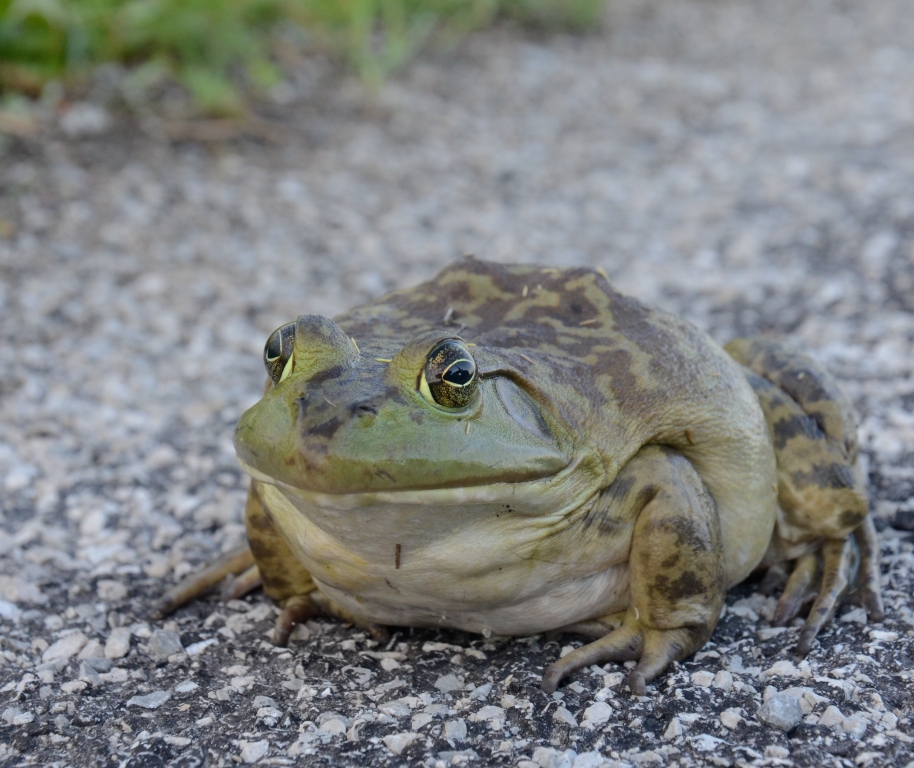
A while back, I was cruising a rural lane enjoying the sights when an enormous lump on the road caught my eye. As I moved nearer, wondering what the unidentified mass might be - bear scat, horse apple, osage-orange fruit?! - the pile transformed into a bullfrog. Possibly the largest bullfrog that I've ever seen, and if I as yet have nothing more to point to in my life, I can honestly say that I've seen a lot of bullfrogs.

A true whopper of an American bullfrog, Rana catesbeiana. This photo was taken from my car window. I had the camera at hand, and figured I'd best snap a shot or two quickly, lest the spring-loaded legs of the long-toed beast catapult it into the weeds.

A note on the bullfrog's name: some authorities have made the case that this species and others should be placed in the much harder to pronounce genus Lithobates (Rana - Ray-nah; Lithobates - Lih-tho-bat-ees). The jury seems out on this proposal so I stick with the long-used name and the one that will be employed in all of your field guides. Whatever the case, the scientific epithet catesbeiana refers to the brilliant and productive English naturalist Mark Catesby (1692-1749). Among his many talents, Catesby was a skilled artist. Check out his rendering of his namesake bullfrog HERE.

Anyway, it turns out I had no worries about the bullfrog fleeing. The thing was not even in the slightest intimidated of me, or my 3,200 lb. car. It just sat there, regarding me with a Yoda-like inscrutability. It's likely that, if the frog had any thoughts at all regarding me, it was lament that I was probably too large to enwrap with its long viscous tongue, by which I could then be pulled into its expandable mouth and swallowed whole.

So I got out of my auto and lay on the pavement with the frog; always, always, working my hardest to bring you the best angles of creatures great and small. Even this intrusion failed to faze her. Now, from a much closer distance, she continued to inspect me with an unblinking stare. Not one millimeter did she move, and if this frog has anything to be grateful for, it is that I am not a frog-legger. There was a meal to be had here, and they say bullfrog gams taste like chicken.

Oh, I called her a "her". The way to tell bullfrog sexes apart is by the "ear", which is more appropriately referred to as the tympanic membrane. This is that drumskinlike round organ just behind the eye. In girls, the typanic membrane is about the same size as the eye; in males it is considerably larger.

I'd say this frog's body - just the body - was about six inches in length, maybe a bit more. Throw in the outstretched legs and you'd use up about all of the real estate on a foot-long ruler measuring her if she was dangled from her toes.

Such a massive predatory amphibian can catch prey we don't normally think of as meeting their demise at the hands (tongues?) of frogs. Big bullfrogs are known to snap up songbirds, small turtles, snakes, and nearly anything else that it is capable of overpowering and stuffing down its gullet. In a fabulous case of forever lamenting NOT having the camera close at hand, I once was walking a marsh's edge and observed numerous massive bullfrogs sitting in the shallows. One looked a bit odd, and after glassing it with the binocs, I saw a somewhat smaller frog, its head still jutting from its captor's mouth.

Bullfrogs create one of the classic summertime sounds, their loud growling roars echoing from ponds and wetlands. And I'm sure that the female starring in this blog has produced her share of little green monsters.

Friday, July 1, 2011

A suburban jungle

The last go-round here at the blog, I shared my parent's front yard, and some of the native plants that reside there. Well, the backyard - which doesn't have to conform so strongly to the curb appeal  suburban dress code - is an even cooler place. Off we go...

This is how a yard should look! If I dare wander out there on one of my visits with macro lens in tow, I'll likely be gone a long time. There are so many interesting insects that are atracted to the plants, and birds galore. The yard list is well over 100 species and includes notables such as Connecticut Warbler. Keep in mind, this is a typically sized suburban lot, somewhere between a third and a half acre. If everyone had a yard like this, there'd be a lot more wildlife around.

There are still plenty of non-native traditional garden plants, such as these orange day lilies, Hemerocallis fulva.

But the day lilies share space with lots of indigenous flora such as this butterfly-weed, Asclepias tuberosa. Butterfly-weed is a tried and true butterfly magnet, and it also attracts many other interesting pollinators.

Gardeners can't be begrudged their old school fare, such as this European bellflower, Campanula rapunculoides. I've got nothing against such plants. They're beautiful and add a dash of panache, but certainly don't spawn the ecological ladders that the natives do.

Nestled in near those bellflowers is this narrow-leaved mountain mint, Pycnanthemum tenuifolium, another nice native. In artificial urban/suburban environments, this is probably a good way to go - traditional not necessarily native garden plants intertwined with high-production natives that host many insects. After all, that's what one is essentially doing when going native in the garden - growing insects. That runs counter to many a gardener's philosophy, which is complete and utter eradication of bugs. Do that, and you'll have a pretty quiet patch, and less birds and other wildlife.

Even the fencerow is a pleasing mixture of native versus non. The vines scaling the fence near the foreground is one of our coolest natives...

Trumpet honeysuckle, Lonicera sempervirens. True, it barely reaches southern Ohio as part of its natural range - this yard is in Columbus - but who cares. If we split hairs to that degree, we'll just confuse people and create discouragement. This is an astonishingly good looking species, and as a major bonus Ruby-throated Hummingbirds love the stuff. In fact, hummers are frequent at this plant, and in recent years have nested nearby.

The back of the backyard. Growth back here has gotten so dense that Gray Catbirds, which are dependent upon thick cover, have begun nesting here. Overshadowing trees include a large black walnut, Juglans nigra, a tulip tree, Liriodendron tulipifera, and sweetgum, Liquidambar styraciflua. The foliage of a redbud, Cercis canadensis, can be seen in the top left of the photo.

I find this very cool. This yard, like so many others, began life as a blank slate, its original growth scrubbed clean by the developer. It's no coincidence that the lightning bugs put on a show on summer eves, and scads of cool moths enliven the night - they aren't getting sprayed to death with chemicals, and they've got plants to host upon.

Shows what one can do with a bit of time and effort.