Monday, August 8, 2016

17-year brood of cicadas becomes feast for Ohio birds

A periodical cicada, photographed in Ross County

August 7, 2016

NATURE
Jim McCormac

William Bradford, a five-time governor of Plymouth Colony in Massachusetts, was perhaps the first European to describe one of the world’s most incredible insect irruptions.

In 1633, the Pilgrims had been in the New World for 13 years and probably thought they had learned much about their adopted land. Surprises still waited.

That year saw the emergence of a brood of 17-year periodical cicadas in the Plymouth area. Bradford wrote the following in his "Of Plymouth Plantation," which documented early Pilgrim life: “ ... all the month of May, there was such a quantity of a great sort of flyes like for bignesss to wasps or bumblebees, which came out of holes in the ground … and ate green things, and made such a constant yelling noise as made all the woods ring of them, and ready to deaf the hearers.”

Periodical cicadas are far better understood today than in Bradford’s time. It took time to sort out the complex life cycle of these strange bugs, though. Nearly two centuries after the Pilgrims’ cicada encounter, Dr. Samuel Hildreth of Marietta, Ohio, began to ferret out the mysteries of these mostly subterranean insects.

Today, scientists have largely unraveled the mysteries of periodical cicadas. They spend almost their entire existence underground feeding on sap from tree roots. After 17 years, the nymph cicadas drill to the surface and transform into adults. The males then proceed to sing, creating the din that attracts so much attention.

The six-legged horde lasts a little longer than a month, beginning in late May and culminating in females depositing eggs within tree branches. These branches eventually drop to the ground, and the fledgling nymphs bore into the ground.

The periodic outbreaks vary from region to region, and each is numbered. Ohio hosts four broods, and 2016 saw the emergence of Brood V, which extends over almost the entire eastern half of the state.

For birds, the cicada emergence is like entomological M&M’s dropping from the sky. Almost every species that can catch the big bugs will eat them. I saw robins and red-winged blackbirds deftly plucking cicadas from the air.

The Ohio Ornithological Society queried its members and documented cicada feeding by 44 bird species. These included all our woodpeckers, the ring-billed gull, the screech owl, the Eastern bluebird and two species of raptors.

To me, the most interesting avian response involved cuckoos. We have two species — the yellow-billed and black-billed cuckoos — and both seemed to skyrocket in numbers. I saw or heard them everywhere I went in cicada country, sometimes five or six simultaneously.

Cuckoos apparently invade areas of cicada irruptions en masse to take advantage of the food bounty. They will even become brood parasites: Female cuckoos produce excess eggs that will be dumped in other birds’ nests.

Residents living within Brood V boundaries will enjoy 16 years of tranquility. But brace yourselves for 2033.

Naturalist Jim McCormac writes a column for The Dispatch on the first, third and fifth Sundays of the month. He also writes about nature at www.jimmccormac.blogspot.com.

Tuesday, August 2, 2016

Salt Marsh Moth: Carpet-bombing reproduction strategy

A Salt Marsh Moth, Estigmene acrea, peeks around a corner at the camera. Were it the size of a swan, we'd be terrified. As it is, most of us probably think it's cute.

Despite the geographically inappropriate name, this species is common throughout Ohio, including urban haunts such as where I dwell. I made the image above back in 2012, in the shadow of downtown Columbus's skyscrapers. They also appear from time to time at my nightlights.

After returning from some late night errand on the evening of July 27, I noticed a female Salt Marsh Moth had fluttered into the sphere of my porch light. When I left for work early the next morning, it was still present, firmly ensconced in a sheltered spot near the front door.

When I returned home that evening (July 28), big things had happened. The female moth had dumped eggs galore. I estimate (too lazy to count them all, but have at it if it tickles your fancy) about 400 of the tiny beadlike eggs. She very carefully squirts the miniscule eggs out like some sort of lepidopteran assembly line worker, depositing them in neat, tightly packed rows. The eggs are somewhat viscous, and adhere firmly to the substrate.

A glance around revealed a male had joined her, apparently during the day while I was gone. He, of course, is a necessity for reproduction. Moths can be exceptionally good at locating members of the opposite sex via pheromones. Highly sensitive receptors in their antennae allow the males to unerringly navigate to females, even if they are considerable distances away.

I was curious to observe the hatching of the caterpillars, and figured it would only be three or four days before they popped forth. Sure enough, when I arrived home on the evening of August 1, the eggs had noticeably darkened, and it looked like the hatching was eminent. When I checked on them around 9:30 that evening, caterpillars were busting loose.

Brand new first instar caterpillars wriggle loose from their eggs. At this point, they are incredibly small, perhaps a millimeter or so in length. Most people, if they noticed them at all, would probably not recognize the little larvae for what they are. They'll grow like weeds, at least those that successfully run the predatorial gauntlet. One of these caterpillar will molt five times, each time emerging larger than before. Each stage between molts is termed an instar. When it reaches the last instar, it'll be hundreds of times more massive than at this point.

As the night wore on, the eruption of caterpillars grew more intense. When I made this image - probably around 11 pm - a great many had already chewed their way free. Nearly all of the rest were well on their way. In this photo, you can see caterpillars largely free of the shell, eggs whose occupants have already escaped, and lots of eggs with the cats actively chewing their way out.

Making acceptable images of this Lilliputian scene was no easy feat, in large part because the moth had placed the eggs in a tough to access spot. I couldn't use a tripod to stabilize my rig for ultra-crisp exposures. For the last image, I used Canon's remarkable MP-E 65mm mega-macro lens. It can produce stunning images of the tiniest subjects, but demands dead still stabilization which was hard to achieve in this situation. Nonetheless, watching the cats emerging through the microscope-like view offered by this lens was cool. I could see them moving inside the opaque eggs, then suddenly a tiny hole would appear. The caterpillar would rapidly chew its way out at that point, taking only a few minutes or so to free itself once it first opened a hole.

The little caterpillars will face many perils, and most won't survive the predatory gauntlet. They've got to reach suitable food plants - many acceptable host plants are nearby - and eat and grow while avoid being eaten themselves. In spite of their best efforts, there will be near complete mortality. David Wagner, caterpillar expert and author of Caterpillars of Eastern North America, estimates that for many moth species larval mortality is about 99%. This is why many moths produce so many eggs. It's necessary in order to ensure that a few of them make it all the way to adulthood. Those that don't make it serve a vital purpose, too - they are part of Nature's complex food chain, and fuel a great many other animal species.

Sunday, July 31, 2016

Pollinator Workshop: August 13, Caesar Creek

An Obedient-plant, Physostegia virginiana, fairly bristles with native pollinating bees. An air traffic controller is practically required to keep the bees from colliding. I made this image this morning at Wahkeena Nature Preserve in Fairfield County. There is a sizable colony of this plant there, and they were swarming with pollinators.

I have been remiss in remembering to plug what will be a fantastic event. On August 13, the Midwest Native Plant Society is sponsoring a pollinator workshop, featuring a start-studded cast of speakers. Following the talks, we head afield to nearby native plant-filled habitats that should be bristling with pollinators. The venue is the roomy visitor's center at Caesar Creek in Wayne County. It's sure to be a fun and informative day. For all of the details, and registration info, CLICK HERE.

Thursday, July 28, 2016

A trip through Boch Hollow

A stunning piece of scenery, even by Hocking Hills standards. I'd had a visit to Boch Hollow State Nature Preserve on the to-do list for a long time, and finally, last Saturday, the trip materialized. Boch is at the extreme northern edge of the Hocking Hills, in northern Hocking County, and it's a relatively recent acquisition by the Ohio Division of Natural Areas and Preserves, or at least parts of it are.

Boch Hollow encompasses about 570 acres, and all of it is interesting, but the scenic crown jewel is the gorge above. PLEASE NOTE: This section of the preserve is permit only. A permit is available through the Division of Natural Areas and Preserves. I'd long known of the magical falls in these first two photos, and this was my main photographic quarry on this mission. I was there soon after sunrise, and made a series of images before moving into the larger, publicly accessible part of the preserve.

A tighter view of the mini box canyon, which is now known as Robinson Falls. Looks can be deceiving. While the narrowness of the chasm gives the illusion of depth, it's probably only 10-12 feet from the water to that log in the upper right corner of the photo. No matter, the rock and water still create a stunning palette of shapes and colors. I was fortunate in that there had been a good shower within a day of my visit, and a decent volume of water was flowing over the falls. Nonetheless, I hope to return in April at a time when the water volume is greater.

After the falls shoot, I hopped in the car and drove around to the main parking lot. After some deliberation, I decided to travel light and hunt mostly SMALL THINGS. So on went the 100mm macro lens, and off I went. Hairy Wood Mint, Blephilia hirsuta, was frequent along the main trail, sometimes forming sizable patches.

Scarcer but as conspicuous as any flower out there was the Rose-pink Gentian, Sabatia angularis. The caterpillars of a beautiful moth, the Short-lined Chocolate, are known to feed on the gentian's foliage.

While you might not know it from this photo, Field Milkwort, Polygala sanguinea, is rather easy to miss. It is often elfin in stature, and grows intermixed with more overpowering plants. The rose-colored "shingles" are actually bracts (modified leaves); the true flowers are the tiny yellow structures at the summit.

Where there is a good diversity of native flora, there will usually be a fascinating array of insects. This is a Hummingbird Clearwing Moth, Hemaris thysbe. It was avidly working the nectaries of White Bergamot (Monarda clinopodia if you are a splitter; M. fistulosa var. clinopodia if you are a lumper).

Hummingbird moths are sphinx moths, and active during the day. Photographing them is a bit tricky, but generally not nearly as tough as shooting real hummingbirds. The moths are pretty consistent in their foraging patterns, and the photographer can usually predict their movements and be ready. Then it is just a matter of knowing how to use your camera effectively.

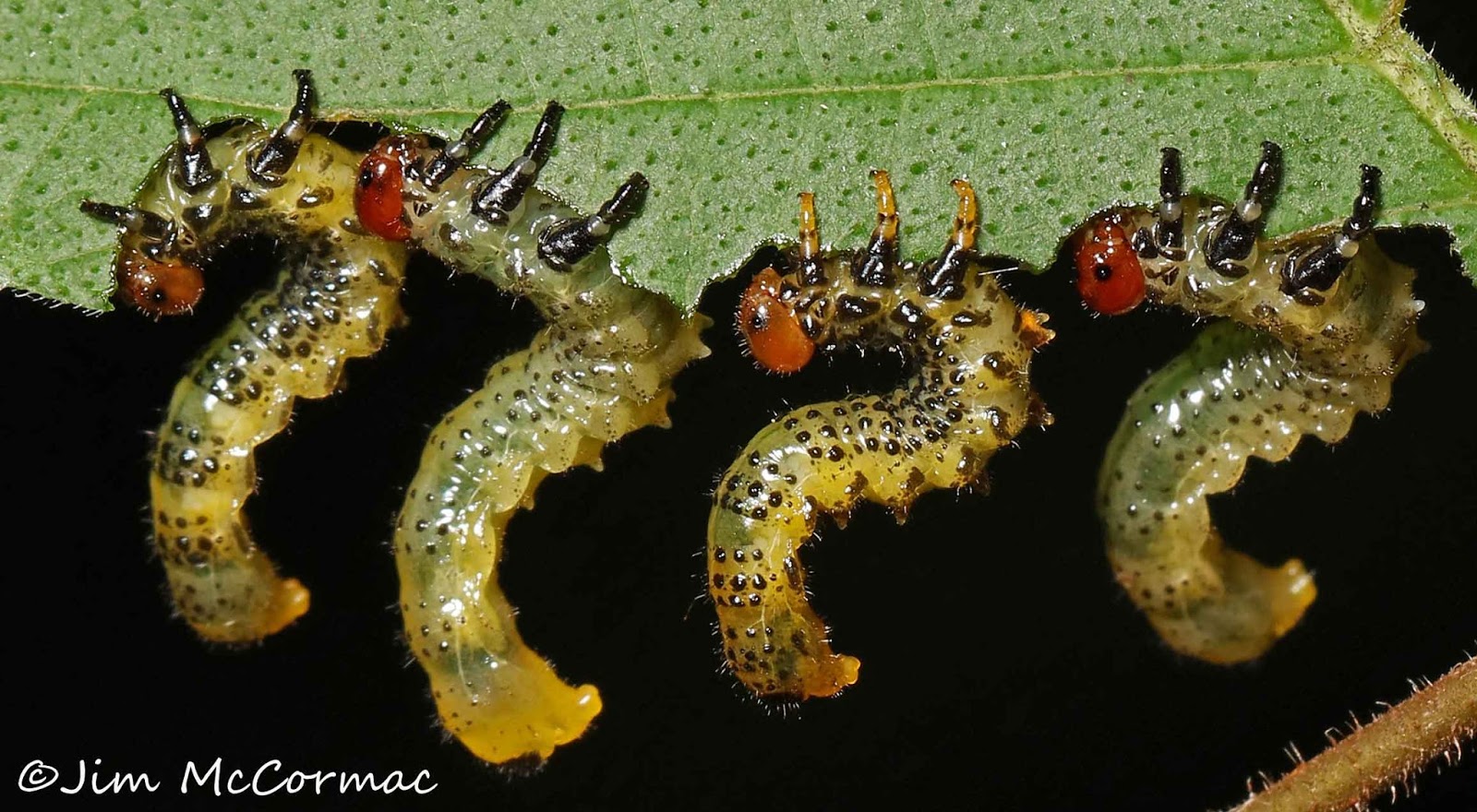
A quartet of Elm Argid Sawflies, Arge scapularis, dangle rather artistically from a leaf. When threatened, they and other sawfly larvae adopt this curious S-shaped posture, for reasons unknown to me. While they resemble caterpillars, sawflies are actually the larvae of a type of wasp - quite unrelated to moths and butterflies, which produce true caterpillars.

Speaking of wasps, here is a bizarre wasp mimic. It is a moth - MOTH, I say! - but does an astonishing job of looking like something that packs a punch. In fact, when I saw it from afar flitting through some grasses, my first thought was it was some type of wood wasp and I'm usually savvy to this mimicry business. But it is the Eupatorium Borer, Carmenta bassiformis (I think - there are a number of look-alike species in this group). There was plenty of Boneset, Eupatorium perfoliatum, nearby.

Ferocious, but fortunately on a wee scale. This is a robberfly known as Laphria canis (one of the species within this complex. Thanks Benjamin Coulter for the ID expertise). Note the withered husk of a tiny fly dangling from the robberfly's proboscis. Tip to the reincarnation crowd: Don't come back as an insect. You're liable to meet your end at the hand of something like this.

A ways up the main trail from the parking lot is a small pond. Even though it isn't large, the pond was loaded with life and I spent some time there attempting to create images of the creatures around it. One of the most common dragonflies was the Blue Dasher, Pachydiplax longipennis, which is always a favorite photo subject.

I spotted this mammoth Six-spotted Fishing Spider, Dolomedes triton, hunting along the edges of some cattails. Small Eastern Amberwing dragonflies, which usually skim low over the water's surface, came dangerously close to the spider on occasion. When they did, the spider would come to life with a lightning-fast leap in their direction. Alas for the spider, it never got one. I was hoping it would, as what a shot that would make and I was ready for it.

Here is a far less terrifying spider, at least to most people. It is a showy little cobweb weaver known as Theridion frondeum (no common name). I discovered her within a leaf that she had rolled into a shelter and silked into place. A protective mother, she remained atop her egg sac.

A huge bonus was this Gray Petaltail, Tachopteryx thoreyi. These giant dragonflies are never common, and occur around damp marshy seeps in wooded habitats. Typical perching posture is as seen - head up on the side of a tree trunk. But they are noted for their propensity to land on people, and sure enough, at one point it did dart out and land on my arm. They mean no harm, and aren't threatening - we just make good perches.

All too soon, it was noon and the temperatures on this incredibly steamy, muggy day had already reached the 90's and it was time to pack it in for the day. Not a bad assemblage of biodiversity for a morning's ramble, though.

A trip through Boch Hollow

A stunning piece of scenery, even by Hocking Hills standards. I'd had a visit to Boch Hollow State Nature Preserve on the to-do list for a long time, and finally, last Saturday, the trip materialized. Boch is at the extreme northern edge of the Hocking Hills, in northern Hocking County, and it's a relatively recent acquisition by the Ohio Division of Natural Areas and Preserves, or at least parts of it are.

Boch Hollow encompasses about 570 acres, and all of it is interesting, but the scenic crown jewel is the gorge above. PLEASE NOTE: This section of the preserve is permit only. A permit is available through the Division of Natural Areas and Preserves. I'd long known of the magical falls in these first two photos, and this was my main photographic quarry on this mission. I was there soon after sunrise, and made a series of images before moving into the larger, publicly accessible part of the preserve.

A tighter view of the mini box canyon, which is now known as Robinson Falls. Looks can be deceiving. While the narrowness of the chasm gives the illusion of depth, it's probably only 10-12 feet from the water to that log in the upper right corner of the photo. No matter, the rock and water still create a stunning palette of shapes and colors. I was fortunate in that there had been a good shower within a day of my visit, and a decent volume of water was flowing over the falls. Nonetheless, I hope to return in April at time when the water volume is greater.

After the falls shoot, I hopped in the car and drove around to the main parking lot. After some deliberation, I decided to travel light and hunt mostly SMALL THINGS. So on went the 100mm macro lens, and off I went. Hairy Wood Mint, Blephilia hirsuta, was frequent along the main trail, sometimes forming sizable patches.

Scarcer but as conspicuous as any flower out there was the Rose-pink Gentian, Sabatia angularis. The caterpillars of a beautiful moth, the Short-lined Chocolate, are known to feed on the gentian's foliage.

While you might not know it from this photo, Field Milkwort, Polygala sanguinea, is rather easy to miss. It is often elfin in stature, and grows intermixed with more overpowering plants. The rose-colored "shingles" are actually bracts (modified leaves); the true flowers are the tiny yellow structures at the summit.

Where there is a good diversity of native flora, there will usually be a fascinating array of insects. This is a Hummingbird Clearwing Moth, Hemaris thysbe. It was avidly working the nectaries of White Bergamot (Monarda clinopodia if you are a splitter; M. fistulosa var. clinopodia if you are a lumper).

Hummingbird moths are sphinx moths, and active during the day. Photographing them is a bit tricky, but generally not nearly as tough as shooting real hummingbirds. The moths are pretty consistent in their foraging patterns, and the photographer can pretty well predict their movements and be ready. Then it is just a matter of knowing how to use your camera effectively.

A quartet of Elm Argid Sawflies, Arge scapularis, dangle rather artistically from a leaf. When threatened, they and other sawflies adopt this curious S-shaped posture, for reasons unknown to me. While they resemble caterpillars, sawflies are actually the larvae of a type of wasp - quite unrelated to moths and butterflies, which produce true caterpillars.

Ferocious, but fortunately on a wee scale. This is a robberfly known as Laphria canis (one of the species within this complex. Thanks Benjamin Coulter for the ID expertise). Note the withered husk of a tiny fly dangling from the robberfly's proboscis. Tip to the reincarnation crowd: Don't come back as an insect. You're liable to meet your end at the hand of something like this.

A ways up the main trail from the parking lot is a small pond. Even though it isn't large, the pond was loaded with life and I spent some time there attempting to create images of the creatures around it. One of the most common dragonflies was the Blue Dasher, Pachydiplax longipennis, which is always a favorite photo subject.

I spotted this mammoth Six-spotted Fishing Spider, Dolomedes triton, hunting along the edges of some cattails. Small Eastern Amberwing dragonflies, which usually skim low over the water's surface, came dangerously close to the spider on occasion. When they did, the spider would come to life with a lightning fast leap in their direction. Alas for the spider, it never got one. I was hoping it would, as what a shot that would make and I was ready for it.

A huge bonus was this Gray Petaltail, Tachopteryx thoreyi. These huge dragonflies are never common, and occur around damp marshy seeps in wooded habitats. Typically perching posture is as seen - head up on the side of a tree trunk. But they are noted for their propensity to land on people, and sure enough, at one point it did dart out and land on my arm. They mean no harm, and aren't threatening - we just make good perches.

All too soon, it was noon and the temperatures on this incredibly steamy, muggy day had already reached the 90's and it was time to pack it in for the day. Not a bad assemblage of biodiversity for a morning's ramble, though.

Wednesday, July 27, 2016

Exploding seeds, or the magic of ballistochory

The beautiful lemony flower of a Pale Jewelweed, Impatiens pallida, dangles beneath the succulent foliage. We have one other native species in this genus (in Ohio), the Spotted Jewelweed, I. capensis, which has orange flowers. Both are very common in moist woods, often in semi-deep shade. Bumblebees are major pollinators, and hummingbirds are also smitten with the flowers.

Once successfully pollinated and seeds have developed, the trick is to find a way to disperse those seeds reasonably far from the parent. That's how plants maintain and/or expand their populations, and they've got a big bag of tricks to abet their migrations. Some plants have sticky fruit, and mammals unwittingly move them about. Other fruits float, and are readily dispersed by water. Yet others are windborn. Ants and other insects cart away seeds. There are many other mechanisms of seed dispersal, but we're going to talk about ballistochory.

It's not hard to see where the common name "jewelweed" comes from. The water-resistant leaves are waxy, and cause liquid to bead up into beautiful gemlike drops.

But it is the fruit of Impatiens that we're here to discuss. That would be the cylindrical misshapen package hovering over the leaf on a slender pedicel. This fruit is ripe, or close enough, and within are three or four seeds. The outer shell of the fruit is comprised of five elastic evanescent strips called valves. Thin bands of weaker tissue bind the valves together. Inside the fruit, the seeds are held in place by a specialized piece of tissue called the replum.

I stimulated dehiscence, or "popping" of the fruit seen in the previous image. Impatiens capsules are like little grenades ready to explode when ripe, and the slightest touch pops them open. In order to keep all the parts upon explosion, one must cup the fruit within a closed fist.

The lumps on the left are two of the seeds. On the right is the tangled mass of spent valves. During the growth process, the inside and outside of the valves are subjected to different tensions, so that the outer and inner walls have decidedly different stresses placed on them. When the fruit is ripe and finally dehisces, the thin veins of tissue holding the valves together abruptly rip. This causes a nearly instantaneous release of pressure in the valves, causing them to instantly revert to an unstressed state. In the process, the seeds are hurled forcefully outward, sometimes flying a few feet. The effect is similar to popping a fully expanded balloon, and the subsequent instant shriveling of the rubber shell.

Impatiens fruit are ripening nicely about now, and you can test explosive ballistochory seed dispersal for yourself. Nest time you see a big fat fruit, just tap it and watch the botanical bomb go off. Better yet, cup the fruit tightly in your hand to capture the seeds. Then eat them. They taste just like fresh walnuts.

Monday, July 25, 2016

Huffman Prairie, catchflys, and hummingbirds

Sunrise over Huffman Prairie, as seen last Friday. This 100(ish) acre prairie patch is located at the south end of Wright-Patterson Air Force Base near Dayton, Ohio.

Dave Nolin, recently retired Director of Conservation for Five Rivers Metroparks, sent me a few photos of the prairie last week. It looked so spectacular, just nearing peak bloom, that I couldn't wait to go see it in person. So, I took Friday off and was there before daybreak. So amazing was the place that I went back for an encore on Sunday morning. Some photos from these excursions follow.

Major kudos go to the management of the giant air force base for their support of Huffman Prairie, which sits on their property. Double kudos to Dave Nolin, who spent the better part of three decades working with the base to provide the best possible management for the prairie. All that long hard work is bearing major fruit today, as we shall see. Even though Dave has left the helm at Five Rivers Metroparks, the staff there continues with the fine work.

On the prairie's south edge sits this replica of the Wright Brother's original hangar - yes, those Wrights, Orville and Wilbur! This is the site where they researched and improved their aircraft, and where many early test flights took place. By 1910, a mere seven years after their inaugural flight at Kitty Hawk, North Carolina, they had founded the Wright Flying School at Huffman Field. Today, flying machines representing the current pinnacle of aviation routinely fly the skies over the huge air force base just north of this hangar.

In a delicious irony, Barn Swallows fill the Wright Brothers hangar with their nests instead of artificial flying machines. These feathered speedsters are incredible aeronauts, and one might argue that no manmade flying machine can rival their flight skills.

Now, I'm sure, you'll understand why I was in a hurry to get there! A sea of coneflowers, catchfly, blazing-stars and scores of other prairie plants create a fantastic palette of color.

Standing out like crimson beacons is the Royal Catchfly, Silene regia, this one embedded in a cushion of Purple Coneflower, Echinacea purpurea. The catchfly is a pure prairie plant, and never have I seen so much of it in one locale.

To Ruby-throated Hummingbirds, Royal Catchfly is irresistible. If there are any hummers about, you can be sure that sooner than later the catchfly's brilliant blossoms will draw them over. On Friday, I guesstimated (an accurate estimate is probably impossible) that at least 100 hummingbirds were present, and likely far more than that. At times, I would see 6 or 8 birds from one spot, and that's a big prairie with scads of catchfly.

A female hummingbird dips deep into the flower's corolla, seeking nectar rewards. The catchfly has coevolved with long-billed hummingbirds. The flowers do not have stiff petals (landing pads) and thus the core of the flower is inaccessible to many insects, other than swallowtail butterflies. Furthermore, the sticky gluelike calyx (the green and white striped tube below the flower) prevents access to climbing insects. But these little feathered helicopters have no difficulty at all in dealing with catchfly flowers, and work them speedily and efficiently. The birds are probably their most important pollinators.

A camera's eye view of the prairie. I picked a prime spot with many catchfly plants in fairly close proximity, including several "signal tower" plants - catchflys that were much taller than most of the surrounding vegetation and thus great lures to feeding hummers. The flash rig atop the camera allowed me to send soft fill flash out to about 50-60 feet, giving me a good radius to work in.

Once I had my spot picked, I just stayed there. Five hours on Friday, and about four hours on Sunday. Obtaining crisp photos of feeding hummingbirds is no easy task. I find it is best to stay quietly in one spot, and let them come to me. Which they did, on a regular basis. About a dozen times, a nearby hummingbird would suddenly take notice of me and the camera, shoot about ten feet straight up in the air and move closer, and hover for a few seconds obviously checking me out. About half the time, they'd decide they didn't like the large invader and shoot off to some more distant flowers. The other times, they'd seemingly decide I was OK and drop right back down and commence feeding.

I have little problem remaining immobile for long periods when the surrounding environment is as interesting as this prairie. A Blue Grosbeak made the rounds, serenading me with its forceful finchy warble. Two local Common Yellowthroat males routinely delivered their fabulous aerial flight songs at close range. Bobolinks occasionally darted overhead, issuing their pleasing musical pink! pink! call notes. Young Eastern Cottontails nibbled on succulents just down the path. Giant Swallowtails coursed by, and one female paused nearby to deposit eggs on a wafer-ash. And on went the wildlife parade, nonstop. Plus, it was a great opportunity to observe the habits of the hummingbirds. They are easily among our most feisty animals, and if a Ruby-throated Hummingbird was the size of a swan, we'd be in serious trouble. Were they that big, I'm sure I would have been impaled and tossed aside for my transgressions into their turf. As often as not, a hummer would just have set up perfectly for a photo, when another would whir by and the fight would be on! The birds would chase one other at top speed across the prairie, sometimes shooting high into the sky. At one point, an American Robin had the temerity to attempt to wing over the prairie, and a hummingbird (outmassed by 25 times by the comparatively huge thrush) immediately launched skyward and sent it packing.

From a photography perspective, trying to capture hummingbird photos is fun and challenging. The birds are often rather unpredictable, and usually don't remain at any given flower for more than a few seconds. One must learn to be fast on the trigger and smooth and accurate in tracking the fast-moving quarry. When all goes reasonably well, photos such as this one can result. I FAR prefer shooting the birds on native wildflowers than feeders, too.

Interspersed with the typical catchfly plants were a number of specimens of this variant, a salmon-colored form. This is a decidedly rare type, and I've only seen it in a handful of spots, and always in very low numbers. One of the reasons that I picked the stakeout spot that I did was because an exceptionally large and striking salmon plant was within close distance (the plant in the photo). To capture a hummingbird nectaring at one of these flowers would be exceptional, probably the best trophy photo one could get in this place. So, I kept an exceptionally close watch for hummers moving in on the salmon catchfly.

Yes! After several hummer visits to the salmon catchfly and an equal number of missed photo opportunities, I finally managed this one image. While not technically my best effort, the photo is OK and can (and will) be improved upon later. The image above is a quick edit of the jpeg. I shot this with my Canon 5DS-R, and the RAW file of this shot is about 70 megabytes and that allows for some wonderful tweaking of imperfections.

If you get the opportunity to visit Huffman Prairie in the next week or two, do it. The prairie will still be looking magnificent, and you're sure to see plenty of hummingbirds and other critters.