Showing posts with label lake erie. Show all posts

Tuesday, December 6, 2022

Northern Gannet on Lake Erie!

Last Sunday, December 4, I took a trip to one of my favorite Lake Erie hotspots, the municipal pier at Huron, Ohio, in Erie County. I was undecided about any trip until late the night before, due to some pending projects, but ultimately felt it was in my best interest to get out for a while and try to trip the shutter on some interesting targets. And I found a completely unexpected and mega-interesting target.

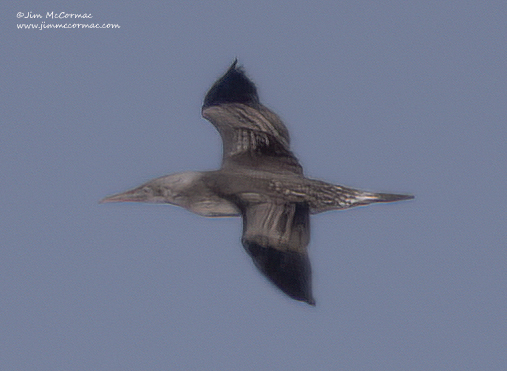
A juvenile Northern Gannet (Morus bassanus)! The mouth of the Huron River and nearby Lake Erie was teeming with gulls, mostly Ring-billed and Herring gulls. A smattering of Bonaparte's Gulls, and at least one Lesser Black-backed and a few Great Black-backed gulls, too. I had walked out to the furthest southwestern corner of the riprap wall surrounding the huge dredge impoundment on the west side of the pier, as this position offered a commanding view of the action, and the light was good.

I wasn't in position for ten minutes when I saw an enormous bird cruise in from the direction of the open lake. I got my big lens on it ASAP and verified that it was indeed a gannet. The camera was all set for action, as I was already focused on shooting birds in flight. The Canon R5 was in electronic shutter mode, which yields a burst rate of 20 frames a second. Unfortunately, the gannet was at a distance of perhaps a quarter mile or so and never came nearer than that. But fortunately, I was shooting with the Canon 800mm f/5.6 lens, and had the 1.4x extender attached, making for an 1120 mm lens. Even with that firepower, this image was the best that I could do - and it's extremely cropped - but it leaves no question regarding the identification.

Northern Gannets are certainly not unprecedented on Lake Erie, but they are great rarities. They appear every few years, but I think the last report prior to this one dates to 2017. It's the third gannet that I've seen on Lake Erie.

Within a few minutes of the bird vanishing towards Cedar Point to the west (I got to watch it for perhaps 2-3 minutes) I got word out to the birding community via Facebook. And scuttled my other plans to hit other lakefront locales. I proceeded out to the end of the pier, which offers a commanding view of Lake Erie, and hoped the big bird would reappear. A number of other birders stopped by as well, but at least by the time that I left around 3:30, the gannet had not reappeared. Hopefully it will turn up in the area again and others can see it. The lake between Huron and Cleveland is the zone for wayward gannets on Lake Erie, and that's where most Ohio records come from.

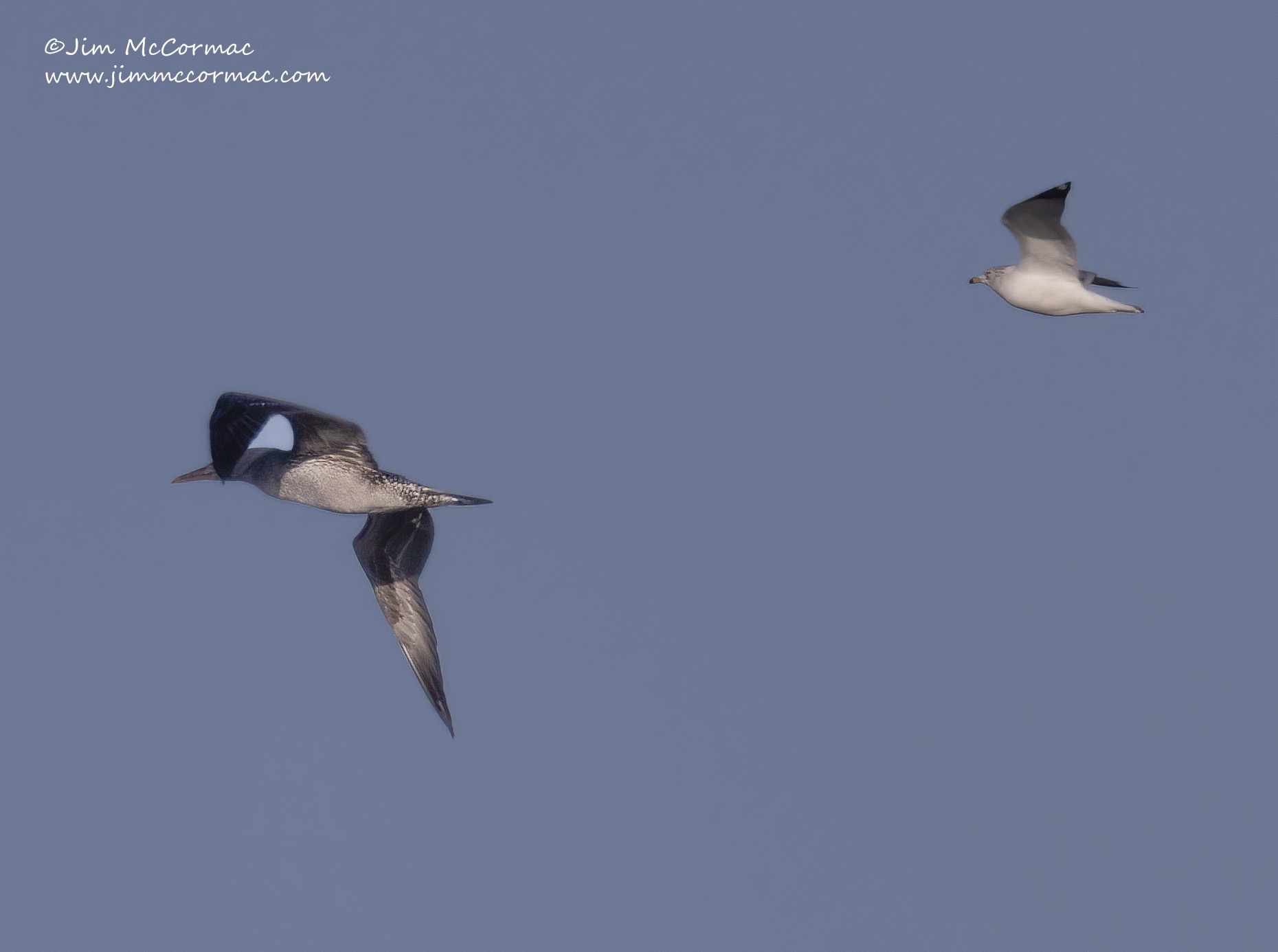
This is the first image that I took of the gannet, shortly after spotting it. The big seabird dwarfs the nearby Ring-billed Gull.

I suspect that gannets that appear on Lake Erie or elsewhere on the Great Lakes originate from the massive colony (100,000+ birds!) on Bonaventure Island at Perce, Quebec. That's the red dot on the Google Earth map above. "Ile Bonaventure" sits at the terminus of the Gaspe Peninsula, in the expansive Gulf of St. Lawrence. This is the outflow for the entirety of the Great Lakes. I believe all Ohio gannet records are of juveniles. Apparently, the naive youngsters mistake west for east, and instead of heading out into the Atlantic Ocean to winter with the other gannets, the wayward birds head up the St. Lawrence River and inland. They pass by the iconic Canadian cities of Montreal and Toronto, through Lake Ontario, on past Niagara Falls and up the Niagara River, and into Lake Erie. It's about 1,100 miles from Bonaventure Island to Huron, Ohio, as the gannet would fly.

A juvenile Northern Gannet in the Atlantic Ocean off Ocean City, Maryland. I made this image on February 27, 2022, during a pelagic seabird trip run by George Armistead and his company, Hillstar Nature. We saw many gannets, of all ages.

It takes gannets 4-5 years to attain full adult plumage. After their first (juvenile) year in which they are all brown like the bird that I photographed, immature gannets start to develop a patchwork of white. In general, they go from darker to whiter but there is great plumage variability even among gannets of the same age. All or virtually all Lake Erie gannet records are of brown first-year birds.

A smattering of the 100,000+ Northern Gannets that nest on Bonaventure Island in the Gulf of St. Lawrence. This is the likely source of origin for wayward juvenile gannets that appear on the Great Lakes. I made this image on July 1, 2018.

Saturday, December 18, 2021

Lake Erie, November gale

As always, click the photo to enlarge

While going through images for a project yesterday, I came across this image from November 18, 2014. I had to give a talk in Cleveland that night, so I went up early to photograph gulls at Eastlake, on Lake Erie. The conditions were brutal: gale force winds, and temps in the low teens. For a brief moment near day's end, the sun suddenly lit the waves and their atomized mist, creating a stunning scene. I raced back to my car and swapped lenses and managed a handful of shots while the light was manageable. My hands were so cold I remember struggling to get the lenses on and off. The gulls, naturally, were unfazed by the wind and cold. I do not know what they thought of the beauty of the scene they occupied.
 

Monday, January 8, 2018

A mass of mergansers

Last Saturday, I made my umpteenth million trip to Lake Erie, that great water body that sits about two hours to my north. The lake is an irresistible draw, especially for one who is deeply into birds. Of the 420+ species that have been found in Ohio to date, well over 400 have occurred along Lake Erie.

Many of my excursions to our 4th largest Great Lake (by far the smallest, by water volume) have been in winter. Conditions can be brutal, but if you're willing to tough it out, the rewards are often great. I had no doubt that this day, January 6, would be a bit nippy. At one point on the drive up, near Lodi, the mercury registered - (minus!) 11 F!

By the time I arrived at Miller Park, in the shadow of the big power plant at Avon Lake, it had warmed to 5 F. Offsetting that warming trend were strong icy winds blasting across frozen Lake Erie from the north. Warm water outflows from the plant always keep a big patch of water from freezing, and winter birding is always interesting at this spot. Unfortunately, insofar as photography went, the copious puffs and tendrils of steam resulting from the clash between "warm" water and cold air precluded much in the way of shooting birds.

No matter, I spent two hours at the end of the pier watching the avian show. Lots of the true feathered tough guys gamboled about as if on a Floridian spring break. Herring gulls were abundant, having usurped the ring-billed gull's normal rank as commonest gull, as is always the case when true winter sets in. Lots of giant great black-backed gulls were about, looking nearly eaglesque from afar. A few ghostly arctic larids made the scene, a pair of glaucous gulls and an Iceland gull. There were scores of mergansers, both common and red-breasted, and many common goldeneyes. The latter is sometimes known as "whistler" due to the distinctive quavering sound produced by their wings in flight - a sound I was treated to on several occasions. As nearly always, a rogue American coot was toughing it out - world's toughest rail!

When it gets as cold as it's been, fantastic ice formations develop. This hunter's blind at Lorain Harbor is encased in frozen water, and large windrows of ice can be seen on Lake Erie in the backdrop.

In my last post, I wrote about birds' adaptability to cold. These Canada geese demonstrate winter hardiness. As soon as I walked onto the pier at Miller Park, I was struck by the spectacle of these ice-covered geese lolling about, resting and snoozing. It was 5 F and windy when I made this photo. The geese illustrate the supreme insulating effects of feathers.

After Avon Lake, it was back to the Jeep to warm up on the short drive west to Lorain, and its harbor. As an aside, about a year ago I got a 2017 Jeep Cherokee Trailhawk, which is proving to be a supreme winter vehicle. One of its bells among the whistles is a heated steering wheel. When those started showing up on cars, I considered it an excessive bauble. Not anymore. Greatest hand-warmer there is, after an extended immersion into polar temperatures.

Upon arrival to Lorain Harbor, I noticed a sizable elongate dark smudge on the ice, as seen in the above photograph. A polynya - packed with fowl! Aside II: "Polynya" is a Russian word that refers to an open water patch among sea ice. It's a great word that was brought into the birder lexicon when it was discovered in 1995 that spectacled eiders, whose whereabouts in winter was previously a mystery, were overwintering on polynyas in the Bering Sea. I see no reason why it can't be adapted to freshwater conditions.

Anyway, back to our Lake Erie polynya and its occupants. Mergansers! By the boatload! You can count up the individuals in this photo - I'm not! - and extrapolate, but there must have been a few thousand birds in this lead. The majority were red-breasted mergansers, although their ranks were spiced with a fair number of common mergansers. One thing is for sure - if you were a fish, you would NOT want to swim under this hole!

Here's a tight shot of the ever-shifting pack, using a gleaming white male common merganser as a centerpiece. Sharp-eyed birders will pick out some hen common mergs among the masses. The latter have brighter rufous heads, and a much cleaner demarcation between the white throat and rusty head than do the female red-breasted mergansers.

I spent quite some time watching this amazing frenzy of life in an otherwise frozen landscape. Birds were always coming and going - how do they take off and land in this crowd?! - and I bet the underwater view of the feeding birds would be incredible. There's a challenge for a serious aquatic videographer!


Monday, January 28, 2013

Major Gull-fest on Lake Erie

The fabled East 72nd Street park, along Cleveland's Lake Erie shoreline. This site is one of the best places to seek gulls in the Great Lakes, and North America for that matter. And why, you might ponder, would anyone in their right mind want to chase after "sea gulls"? Well, because gulls (decidedly NOT "sea gulls"!) are among the coolest, most visually stunning, aerobatic, and interesting of any of our bird families. Throw in the fun, and at times majorly vexing, identification challenges and the ever-present possibility of a major rarity, and what's not to like?

Reports of massive gull concentrations were coming hot and heavy from E. 72nd last week, and I could finally stand it no more. So, last Saturday I departed from Columbus at O'dark:thirty and arrived in Cleveland bright and early.

Intrepid birders scan the waters. This type of birding is not for the fair weather binocular-toter. Gulling is at its best when frigid temperatures have caused Lake Erie to ice over, and the hot waters (more on that in a bit) is the only open water in the immediate vicinity. It wasn't so bad this morning, actually - temps were in the low 20's, and the wind was fairly mild.

This video reveals a bit of the ambiance of gull-choked waters. The scene is one of constant cacophony and action, as the gulls loaf, fight, fly, spar, and bugle. It's a bit like packing thousands of thugs, all representing rival gangs, into a small room.

This power plant, located across I-90, is the reason that E. 72nd is so good for wintertime gulling. As part of its operations, the plant discharges warm water into Lake Erie, which causes a sizable open water area to form, even in the coldest weather. The warm water also attracts scads and scads of a fish species known as Gizzard Shad, Dorosoma cepedianum. The shad are not native to the lake, and fair poorly when water temperatures plummet. They're easy pickings for the opportunistic gulls, who make the most of the fishy bounty.

It's always worth scanning the tops of the power plant's stacks. The broad-shouldered lump on the left side of the stack is one of the local Peregrine Falcons. All is as tranquil as can be in gull land as long as the falcons remain dormant. When one makes a pass over the waters - they feed on gulls and ducks - hold on to your hat! Pandemonium is likely to ensue.

It doesn't take an ornithologist to determine when a falcon is afoot. Most of the gulls explode skyward, creating a fabulous visual spectacle. Last Saturday, there were perhaps 20-30,000 gulls in the immediate area; certainly enough to create a cloud when spooked. Die-hard Cleveland birders were tallying as many as 100,000 a few days prior!

Although it is exciting when a falcon or perhaps a Bald Eagle sends everyone aloft, it is often maddening for the birder. It takes a lot of time to scope through the masses, and some tricky individual gulls require detailed study. When you've found something especially noteworthy, say an Iceland Gull, and all of a sudden the birds explode into the air like 20,000 pieces of confetti caught up in a hurricane, it can be a chore to relocate the bird when they all settle back down.

The shot above reveals a taste of the interesting gulling that E. 72nd can offer. Most of the birds are Herring Gulls of various ages, along with a few Ring-billed Gulls. These two species are far and away the most common, with Herrings often dominating when weather conditions are at their most brutal and wintry. There are also a few Great Black-backed Gulls, and a Glaucous Gull.

When there are so many birds constantly milling about, photographers all too often end up with shots like this. I was after a first-cycle Herring Gull when this Ring-billed Gull had the bad manners to fly right in front of my camera. The intended subject can be seen as a brown lump with a foot sticking out, directly below the offending gull.

I clicked off 1,450 images this day, and a few of them were keepers. Gulls are lots of fun to photograph, and I'll share some of my images of specific species, including a few of the rare species, in later posts.

This turned out to be a fun shot. I was after the bird in the direct center of the shot, with the bright yellow bill and gleaming white head and neck. It turned out to be the most interesting gull there, and I'll share more about it later. When I reviewed this image later, I was pleased to see that I had inadvertently captured a young Herring Gull kamikaze'ing at the water in a very steep angle of attack. Gulls are extraordinary aeronauts and spectacular aerobatics are just part of their daily routines. I sometimes wonder, as Jonathan Livingstone Seagull's cohorts failed to do, if they realize just how good they really are. Regardless of what thoughts or consciousness streams through the minds of gulls, they sure are fun to watch.

More on the gulls of Lake Erie to follow.