Showing posts with label tiger salamander. Show all posts

Monday, February 25, 2019

Salamanders begin to run

A bizarre "unisexual" salamander scrambles over some old elm bark in its single-minded drive to reach its ancestral breeding pool. This salamander is a blend of any of a few of several species, or maybe all: blue-spotted, Jefferson, smallmouth, and tiger. I have written more about the unisexuals in THIS POST from a number of years ago. I'm not sure they - the experts - know much more about them now then they did back then.

Last Saturday night was the first potentially good run for salamanders in my neck of the woods. It was about 50 F, and mild showers dampened the ground. That's when the mole salamanders in the genus Ambystoma emerge from subterranean pairs and march overland to their breeding pools. For whatever reason, not many were on the move in the west-central Ohio locale where I hunted. Maybe it wasn't wet enough. Only two of the aforementioned unisexuals were found. But, a major Holy Grail and the species that I was most interested in finding did reveal itself.

Read on...

Yes! A whopper of a tiger salamander! I was just about to throw in the towel after lots of country lane cruising when this bruiser appeared on the road. It was about 9 inches long - they can get nearly a foot in length - and smack in the middle of the wet pavement. After a brief photo session, the animal was placed in wet grass well off the road, on the side that he was headed for. Good thing, too, as several cars whipped along while I was working with him, and the slow-moving amphibian surely would have been pancaked. Road mortality in salamanders is a significant threat in some areas.

Tiger salamanders are among our rarer amphibians, and I'd dare say most people haven't seen one. Big ones like this are a sight to behold, and finding one - better yet, many - makes the late wet nights well worth venturing out in.

I'd say the big salamander runs are still in the future, and I'll do my best to be out there for them. Expect some more salamander imagery before long.


Saturday, March 22, 2014

First amphibians of the year

A Western Chorus Frog, Pseudacris triseriata, sits in a wet pool, the upper half of his body above the water.

I should qualify the title of this post: First amphibians of the year (FOR ME)! This has been a brutal and prolonged winter, and even now, in mid-March, the frosty old man is reluctant to take back the snow and ice. Here in central Ohio, we've scarcely had any of the decently warm (50 F or above) rainy nights that amphibian-seekers pine for. It seems that the majority of frogs and salamanders have yet to make the vernal pilgrimage to the breeding pools, and individuals are just trickling in bit by bit - no massive migrations of yet.

Last night was one of the few warm evenings we've had, but it wasn't wet. Dryness inhibits major movements of amphibians; they much prefer to move towards breeding haunts when everything is nice and soaked. Nonetheless, I knew that at least some Spring Peepers and Western Chorus Frogs would be in the wetlands, and I really wanted crisp images of the latter for an upcoming column. So, I headed to one of my favorite amphibian routes near Bellefontaine last night, stopping first to pick up Bellefontainite and amphibian enthusiast Cheryl Erwin.

Sure enough, the peepers and chorus frogs were in good tune, but not in the numbers they soon will be. Just smatterings of individuals calling from wetlands where there should soon be many more, if the weather ever warms. This Western Chorus Frog is the same individual as in the first photo, just seen from another angle and while he was singing. The animal was issuing his guttural creaking trill regularly, counter-singing with another frog about fifteen feet away.

Getting images of singing chorus frogs can often be a challenge. They seem to prefer staying towards the interior of their wetlands, and that means out in the deeper water. To capture this animal on pixels, I waded into water that soon threatened to overtop my knee boots. After spotting the animal from about fifteen feet, I slowly crept up while he sang. Then came the cold, wet part. I dropped to my knees to get down closer to my subject's level, and leaned in close. Getting, of course, soaked in the process and filling the boots. Someday I'll resort to hip or chest waders, but somehow getting as wet as my subjects makes me feel more a part of the whole scene.

A giant Eastern Tiger Salamander, Ambystoma tigrinum, lumbers from the wet grassy verge of a large seasonally inundated wetland. We were quite pleased to find a few of these jumbos around one of their breeding haunts, but I don't think the majority have yet arrived. Tiger Salamanders prefer open grassy wetlands - not the wooded vernal pools of most of their Ambystomid brethren.

The vernal emergence and migration of salamanders will never cease to amaze me, and I get out as much as possible to look for them. There are usually only a few good nights when temperature and moisture are conducive to mass movements, and I'll hope to catch a better night within a week or two.

Fortunately, my favorite Tiger Salamander breeding site is along a road that floods out completely in a few spots, and has few houses along it. Thus, the vehicular traffic is almost nonexistent. Getting pancaked by cars is a real threat to these animals as they attempt to move overland to the wetlands. When development brings too many roads and too much traffic, the salamander populations are likely to eventually disappear.
 

Friday, March 9, 2012

Tiger salamanders, Take II

An eastern tiger salamander, Ambystoma tigrinum, our largest and burliest salamander (in Ohio). This photo was taken alongside a breeding pool in Logan County, Ohio, last night.

If you wish to seek mole salamanders - the Ambystomids - it is necessary to remain flexible. One must await the magical ingredients of fairly warm weather, coupled with rain, in early spring. And then head out at night, when these strange subterranean creatures emerge from the ground and march overland to favored breeding pools. This means one cannot plan these forays well in advance - you have to go on the salamanders' schedule and they don't give much notice.

I though last night might be a good night for seeking tiger salamanders. Constant rains drenched the central Ohio landscape throughout the day yesterday, and the temperature rose to a salamander-friendly 55 degrees. I shot home after work, took care of some things, and was headed towards tiger country west of Columbus around 6:30 pm. The rain had ceased by then, and to my dismay the temperature plummeted to 42 degrees before I was 15 minutes into my travels. No good for mass migrations, but I figured I would check a breeding pool or two and see if any tiger salamanders had yet made their way to the breeding grounds.
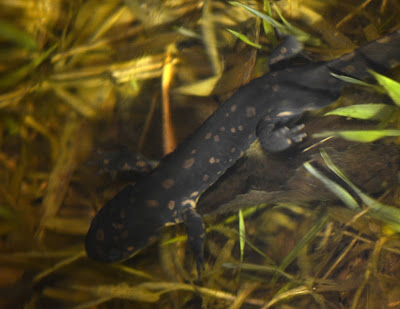
Yes! As expected given the weather, I saw no salamanders crossing the roads, which had mostly dried out by the time I reached Logan County, but I was rewarded with the sight of several dozen salamanders swimming in a pool. The guy above was photographed through the water - he is about two feet under the surface. Tiger salamanders are outstanding swimmers, and it was a treat to watch several dozen of the giant amphibians gracefully floating about, or rocketing around like torpedoes. These animals have large paddlelike feet and a laterally compressed tail similar to a muskrat's, and they use these adaptations to swim with the greatest of ease.

Tiger salamanders might suggest spotted salamanders, Ambystoma maculatum, at first glance, but they differ in several ways. One, the tigers are comparatively much more massive - a bit like comparing a Great Black-backed Gull to a Ring-billed Gull. The head is big and broad, and enormous in comparison to the rest of the animal's body. The spotting on a tiger is more messy - unlike the clean rows of bright yellow dots on a spotted salamander - and tiger spots are a dull mustard-yellow. I saw several individuals last night that were nearly unmarked and mostly blackish.

I apologize for the less than stellar quality of my images. There was no time to round up anyone else to go along, and trying to carefully handle the animals - always keep your hands wet! - and juggle the camera and a flashlight at the same time gets to be a bit much. Shooting at night requires careful manipulation of the camera's flashes, something that I couldn't adequately deal with last night. Thus, it was necessary to really jack up the brightness and contrast post-processing.

One of the burly bruisers poses on the pond's margin. I find the life cycle of these amphibians to be exceedingly interesting, and shrouded in mystery. Tiger salamanders emerge from the ground for only a few days, and their goal is to trek to breeding pools to court, lay eggs, and reproduce themselves. After this important task is complete, the tigers leave the pools, and once again disappear from our world. They spend nearly all their days under the ground, probably moving through mole tunnels, crayfish burrows, or other subterranean nooks and crannies. Very little is known of them and their other mole salamander kin; studying such beasts in the wild, other than at the breeding pools, is nearly impossible.

The animal in the photo above was a big one, maybe eight or nine inches in length. Tiger salamanders can get bigger than that; supposedly indivduals up to 14 inches have been found. They are the amphibious counterparts to box turtles in the longevity department, too, and can probably live for a few decades if all goes well.

Here's the distribution of the eastern tiger salamander, map courtesy the New York State Department of Environmental Conservation. Ohio represents the eastern edge of the interior populations, and much of this distribution mirrors the formerly great midwestern prairie ecosystem. It does seem that Ohio's best populations of tiger salamanders occur in former prairie areas, and many breeding sites such as I visited last night are in very open habitats, not the forested vernal pools that one often associates with Ambystomid salamanders. Tiger salamanders also range down the Mississippi Valley and then along sandy Gulf and Atlantic coastal plains. This U-shaped distribution pattern is shared by a number of other aquatic animals, and a great many species of wetland plants.

I don't think the major run of tiger salamanders has yet occurred. I saw no spermatophores - male sperm packets - in the pond, nor any eggs. Right now, the forecast for Monday calls for rain, and temperatures in the upper 50's. If that prediction pans out, I'll be back in west-central Ohio hunting tigers.

Tiger salamander


A big tiger salamander, Ambystoma tigrinum, plows through the grassy verge of a breeding pond. I was out last night, and found this specimen, and dozens of others. Tiger salamanders can reach a foot in length, and are truly impressive. More to follow...

Thursday, March 12, 2009

Salamanders, Newts, and Unisexuals

Last Tuesday night was good for hunting salamanders - not great, but good. A crew of us dispatched to the meadows and swampy woods of Logan County, near Bellefontaine (beautiful fountain, in French), and found more than enough to occupy our interest. We had hoped hard for rain - about the only time I ever do - and it came, but not until 1 am. Rain lubricates the landscape, and creates much better conditions for salamanders making the overland journey to breeding pools. A long night, I didn't get back home until 4 am, but well worthwhile.

Some of the amphibious crew emerges from a wetland, late at night. L to R: Greg Lipps (more on him in a sec); Chip Gross, an outdoor writer who was gathering material for an upcoming story for Country Living Magazine; and videographer/narrator extraordinaire Skip Trask, who films for Wild Ohio TV.

Mr. Salamander, Greg Lipps, panning for amphibious gold: Tiger Salamanders. Greg is a phenom - one of the most knowledgeable herpetologists in the Midwest, a field dynamo, generous with his knowledge, and full of irrepressible energy. We were fortunate to have him along this night. This blog entry is all about salamanders, but Greg pulled another kind of spectacular beast out of one of the wetlands we visited, and I'm going to blog that separately, later.

Our host, and an exceptional all-around naturalist, Troy Shively. Troy grew up in Logan County and knows its every nook and cranny. He led us to some great spots for the wriggly ones.

Presto! As if by magic, these mini-dragons appear above ground for a few days each spring, seek breeding pools, mate and lay eggs, and vanish back into the earth. This is our largest salamander, the Tiger Salamander, Ambystoma tigrinum. It was the A-list salamander for the eve, the one we really hoped to find. And we did, maybe a dozen or so.

Here, your wet wind-tousled and tired blogger holds a Tiger Salamander to create a size scale. Some jumbos can reach a foot in length! Tigers seem to be associated with Ohio's former prairie regions, and they prefer much more open landscapes than other species. Some individuals are boldly marked with yellow dots and smudges; most of the ones that we caught this night were rather dull.

Tiger Salamander, heading into a breeding pool. As if pulled by a magnet, they forge over, through, and around obstacles in their quest to reach the ponds and reproduce. Tigers prefer deeper water than their allies, and this pond was probably a good four feet deep in the center. We were able to spot the giants under the clear water as they hung in the water column, rested on the bottom, or darted rapidly about, fishlike.

Troy led us to a spectacular road that bisected wet woods dotted with vernal pools. Late in the night, after the rain began, we saw many salamanders crossing the roadway. This Spotted Salamander, Ambystoma maculatum, was in one of the nearby woodland pools. I'll never tire of seeing these.


We saw many Red-spotted Newts, Notophthalmus viridescens, both in the pools and crossing the road, as this one is doing. The critter above is known as a Red Eft, which is the larval, terrestrial stage of the newt. Efts might live up to three years away from water, boldly roaming the forest floor. Forgive me the anthropomorphism, but they really are "bold". It isn't uncommon to see efts wandering about during the day, especially after a shower. Not much will mess with them - efts are quite poisonous. Allegedly, there is a case of a college student dying after efts were foolishly substituted for goldfish in that age-old bit of frat boy foolishness, the goldfish-eating contest.
When the newt matures, it returns to the water and becomes strictly aquatic, and might live for several more years.

Now we come to the unisexual part. You may have been wondering about that. Well, I was talking about this beast - an odd and poorly understood "species". We saw plenty of them, and all appeared to be part of a hybrid swarm that produces all female populations of these curious animals. There are probably three parental species involved: Blue-spotted Salamander, Ambystoma laterale; Smallmouth Salamander, A. texanum; and Jefferson Salamander, A. jeffersonianum. The blue flecking, characteristic of Blue-spotted, is evident on this individual, and many showed strong traits of Smallmouths.

Greg is actively working on this mystery, and took genetic material from a number of the individuals that we encountered. Much work remains to ferret out the answers to this puzzle. Whatever they may be, they're still cool to find, and exceptionally entertaining. This one found me troubling, and paused, rearing its neck up, cobra-like. Check the following video out for a very cool unisexual display.

As you will note, "Video Magic" wants me to buy their product. Maybe I will; they did a good job of compressing this vid down enough so that Blogger would load it. The video shows a unisexual salamander crossing the road, and us agitating it so that the animal would perform its fascinating defense display. When threatened, they sometimes raise their tail and wave it hypnotically, as a lure to the predator. The idea is that the coon or whatever will key in on the tail, and grab that rather than the body and all of the vital organs. When it does, the tail or parts thereof snap off, and Mr. Coon gets a slimy eel-like mouthful of some of the most godawful viscous gunky-tasting junk imaginable. He'll not want to visit that party again, and our salamander escapes, sans tail, which it may partially regenerate.
Lots of strange stuff in the realm of salamanders.