Showing posts with label magee marsh wildlife area. Show all posts

Tuesday, May 17, 2016

A warbler extravaganza at Magee Marsh Wildlife Area!

I spent the weekend up in the marshland region of western Lake Erie, and am darn glad that I did. Saturday was excellent, with many notable bird observations, but none to rival the amazing Curlew Sandpiper that Steve Jones found. The bird was in its breeding finery, and wowed hundreds of birders. Kudos to Steve for producing the 6th Ohio record of this Eurasian vagrant. I've got plenty of photos of the bird, and will try and post some of them here eventually.

Sunday dawned COLD - a nippy 35 F at sunrise. Brisk winds didn't make things feel any warmer. As the fabled Bird Trail at Magee Marsh Wildlife Area had seen an influx of birds on Friday evening, I figured that they'd all still be around, augmented by any new arrivals on Saturday night. The migrants would be resting and refueling, building fat deposits and energy for the flight across Lake and on to points north.

No one who was at Magee on Sunday morning was disappointed. The birds were absolutely incredible. I've been going to Magee since before there was a boardwalk, and have seen years of bounty and bust. This was BOUNTY with a capital B. Of the myriad birders present that day, I'm sure there were plenty of greenhorns, and they must have been blown away by the spectacle. I know I was.

Following is a montage of warblers (I saw MUCH more than warblers!) that I photographed along the boardwalk on Sunday morning. The only camera that I used was the Canon 7D II, coupled to Canon's incredible 100-400 II lens, and handheld. I've probably said it before but I'll say it again - this is one of the best rigs for handheld shooting. A plus is that this lens will focus down to 3.5 feet. Believe it or not, there were times when birds were too close for other photogs to focus on, but my setup allowed me to.

SHAMELESS PLUG: If you're interested in learning more about photographic techniques, for birds and many other subjects, David FitzSimmons, Art Weber and I will be teaching a photo workshop at beautiful Lakeside, Ohio on September 20-22. We've got all kinds of cool stuff to show attendees, and plenty of birds will be passing through in their fall transit. Details and registration are RIGHT HERE.

Chestnut-sided Warbler

Tennessee Warbler

Bay-breasted Warbler

Cape May Warbler

Cape May Warbler, female

Yellow Warbler

Another Yellow Warbler (because they're cool)

Blackpoll Warbler

Magnolia Warbler

Yellow-rumped Warbler

Black-throated Green Warbler

Black-and-white Warbler

Nashville Warbler

Palm Warbler

Northern Parula

Prothonotary Warbler

Blackburnian Warbler

Sunday, May 10, 2015

Magee Marsh warbler madness

A tiny fraction of the thousands of birders that descended upon Magee Marsh Wildlife Area in Lucas and Ottawa counties, Ohio, last Friday. Even more people were in the area the next day, which was International Migratory Bird Day. Spring songbird migration is near peak, the Biggest Week in American Birding is in full swing, and there are few better places to be if you are a warbler enthusiast.

I was there all day Friday and Saturday, and a good chunk of today as well. In all, I spent about 20 hours on the boardwalk "Bird Trail", mostly working with newer birders and helping them find and identify birds. Consequently, I took far fewer images than I normally would in that amount of field time, but did manage a few. The Canon 7D Mark II coupled to the 100-400 mm 4.5-5.6 II was slung over my shoulder, so shots of irresistible subjects would not be missed. By the way, this rig is certainly one of the best for handheld bird shots. Not only that, it is extremely versatile and I also used it to photograph snakes, muskrats, and even orchids this weekend. There were solid keepers in every group. I'll try to find time to write about this marvelous Canon pairing sometime.

A Yellow Warbler milliseconds before it sprang from the branch. It was one of untold thousands in the area. The marshes of western Lake Erie may be the Yellow Warbler capital of the world. These gorgeous warblers are smitten with soggy soils grown over with willow shrubs, and there's an abundance of such habitat at Magee and vicinity.

I've enjoyed experimenting with different photographic techniques for birds. This image was taken with the aforementioned rig, at f/5.6, a shutter speed of 1/640, and ISO at 250. When I know or suspect that my avian subject is going to put on a sudden burst of speed, my natural inclination is to bump the shutter speed WAY up to try and freeze the action. You know, get the image crisp enough so that the individual shafts of the primary flight feathers are crystal clear.

Such tactics surely do make for a good image, but so can using shutter speeds that aren't nearly fast enough to freeze all of the action. For this photo, my focus was locked on the bird's face, and when he started to move, I rattled off a 10 frames per second burst mode. I like the way this shot came out: face, eyes, and upper breast sharp, but the rest of the Yellow Warbler is an artistic blur of wildly gyrating feathers. As always, click the image to expand it.

I'll try and post some other images from my weekend at Magee later.

Sunday, May 11, 2014

Magee Marsh Bird Trail

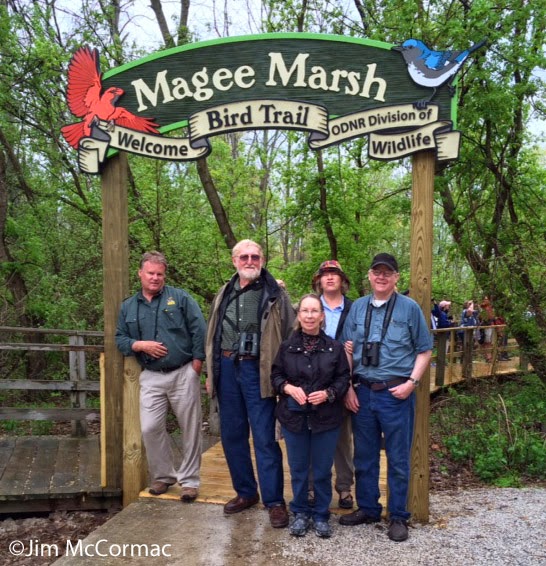
Your narrator (L) poses with friends Steve and Marian Moeckel, Marian's sister Barbara, and Jim Berry under the new archway at the entrance to the world famous Magee Marsh Wildlife Area "Bird Trail".

We were just a few of the many thousands of birders who descended upon the trail, as they do every year, to bear witness to an amazing migratory spectacle. The 37-acre patch of woods and wetlands bisected by the mile long elevated boardwalk offers some of the best birding in North America. People come from nearly everywhere - every state, and many foreign countries. Perhaps 75,000 birders will visit the area from late April through May.

I spent the past three days at Magee, and spent nearly all of that time on the boardwalk. The birds were fabulous - best on Friday, but Saturday and today were also very good. I really enjoy helping new or newer birders find and identify birds, and for the most part, that's what I did. In the process I did snap some photos, of course, and will hopefully find time to share a few more of them in later posts.

Tom Bartlett (seated on ladder, right) conducts his Big Sit, just as he has for many years. Tom goes up there around dawn, and doesn't descend until the day's end. He only counts birds that he sees or hears from the ladder, and his best tally was 112 species. Last I talked to him, he was at 100 with plenty of daylight left. Proceeds raised by Tom's per-species pledges go to support the work of the Black Swamp Bird Observatory.

A group of women took a break in a nice spot with a commanding view of Lake Erie. Can't blame them; after 8 or so hours on my feet I was ready to take a load off, too.

Perhaps the ladies in the previous photo were watching the numerous Common Terns pass by, as they fished the waters of Lake Erie. One of the groups that I helped lead enjoyed watching a male bringing fish to a female that he was courting, which he then offered to her.

Two American Woodcocks were on nests immediately adjacent to the parking lots. The female in the photo is incubating eggs just feet from high people traffic areas. The Division of Wildlife staff tape off the area to keep people a safe distance from the woodcocks, which don't seem put out at all. They nest in these sites every year.

Warblers, of course, get the lion's share of attention. This male Bay-breasted Warbler posed beautifully for an assembled throng of paparazzi, sitting just a few feet away in a box-elder. Such views are commonplace at Magee. Warblers are often at arm's reach, and I would not even hazard a guess at how many millions of photos are taken here each May. In all, at least 31 warblers species were found while I was there.

If you can break away, get to Magee in the next week or so. It's well worth the trip.

Friday, April 18, 2014

Magee Marsh's legendary boardwalk


This mile long elevated wooden boardwalk is one of the most famous trails in North America. Winding through a 30-acre patch of swamp forest and wetland at Magee Marsh Wildlife Area, it is a destination for tens of thousands of birders, especially in May. In May 2012, traffic counter surveys conservatively estimated over 66,000 visitors made the pilgrimage to the "Bird Trail". The number may have been even higher, like around 75,000 or more people. And nearly all of them are birders, of every stripe and level of expertise. They come to witness the magic of Neotropical birds - flycatchers, vireos, thrushes, orioles, tanagers, and others. And, of course, WARBLERS! Nothing gets the blood flowing like warblers, and they are the standout stars in a cast of exceptional players.

It is possible to see over 100 species along the boardwalk and elsewhere in Magee Marsh on a good day. Most of the songbirds have come from the tropics: Central America, South America, the Caribbean. Many will have flown 1,500 miles or more northward to reach Magee, and the Bird Trail woods is but a way station as they journey to more northerly locales. Upon reaching Lake Erie, which at a glance through a songbird's eyes appears an endless ocean, the birds stop to rest and refuel. It's only 28 miles across the lake to Canada, if one takes the longest route, but most of the birds hedge their bets and stay to fatten up for a bit before making the crossing. And in the process, thrill thousands of birders who can observe the feathered transients at close range.


This scene is not atypical along the Bird Trail during the second weekend in May, which is the best timeframe for maximum bird numbers and diversity. Epic crowds to be sure, but a scene that everyone should experience. It's amazing to see so many birders gathered together, and one major plus is that virtually no Connecticut or Kirtland's warblers or any other rarity will go undetected.

The 25th anniversary of the Magee Marsh Bird Trail boardwalk is this year. A quarter-century of ever-growing foot traffic, coupled with the humid conditions of the swamp forest, has taken its toll on the wooden planking. The vaunted trail is in need of refurbishing.


Enter the Friends of Magee Marsh. This group exists to support the wildlife area and does so in many ways. Their latest and greatest project involves an ambitious fundraising effort with the aim of completely redoing the boardwalk. The Friends have already raised $25,000, and begun to transform dollars into boards. When you visit this spring, you'll see that sections of the boardwalk, at either end, have been replaced. In the photo above, old wood in the foreground meets brand spanking new lumber. The new wood should last for a long time to come.

A view down the steps from the tower near the boardwalk's west end. The punky old wood of the tower's spur trail is now fresh and new.

Ambitious efforts such as this don't come cheap. An estimated $300,000 is needed to complete renovations to the boardwalk. When you're at Magee this spring, you'll see this sign near the boardwalk. Please help support the project. If every birder who visited Magee in May dropped a fiver towards the boardwalk, it'd easily be a done deal.

Five bucks is a small price to pay to support the legendary Bird Trail boardwalk that has played such a huge role in North American birding. There is no entrance fee to gain access to Magee Marsh Wildlife Area, so perhaps this year you can donate a five dollar bill to the Friends of Magee Marsh, and consider it a one-time voluntary user fee that goes for an absolutely fantastic cause.

Major thanks go to the Friends of Magee Marsh for spearheading this project; be sure to give them your regards (and donation) when you're at Magee this spring. Or CLICK HERE to help.

Monday, May 13, 2013

A pictorial trip along the "Bird Trail"

A snippet of the parking lot at Magee Marsh Wildlife Area, on the shores of western Lake Erie. This site is world famous among birders, and with good cause. It is a premier stopover area for scores of neotropical songbirds in migration. In the peak month of spring migration, something like 100,000 people will visit. I was there yesterday, and managed a few photos, which follow...

You can find nearly every state's license plate in the parking lots at some time or another. Including some good ones. "Twitcher" is a British term for one who chases birds.

The Ohio Division of Wildlife owns and manages Magee Marsh, and the mile long boardwalk and the 37-acre swamp woods through which it passes. This boardwalk has long been known as the "Bird Trail", even before there was a boardwalk.

The Division of Wildlife also owns the 2,200 surrounding acres, which holds one of the finest marshes on Lake Erie. The parking lots and beach were once a state park, called Crane Creek. The Division of Parks and Recreation transferred that property to the Division of Wildlife several years ago, hence "Crane Creek State Park" is no more, although people still erroneously refer to the area by that name.

If you're a birder, and you visit Magee Marsh, thank the Division of Wildlife, perhaps by purchasing an Ohio Wildlife Legacy Stamp. It's expensive to host the throngs of birders that visit. All of those port-a-johns, for instance, cost about $15,000 to rent for peak spring migration. As this year's visitors saw, the Division makes special efforts to accommodate birders, many of whom may not know that Magee was purchased entirely through revenue generated by hunting license revenue, and Pittman-Robertson funds.

One doesn't have to go far to see cool birds. Someone stuck oranges along the parking lot, and brilliantly colored Baltimore Orioles found them appealing.

An adult male American Redstart sports the colors of Halloween. These little warblers seldom pause; they are frantic bundles of energy, raging through the foliage and spooking bugs from the leaves.

Magnolia Warblers sport just about every field mark that you'd want to see on a songbird: eyestripe, wingbars, tail spots, breast streaks, and gaudy coloration.

A personal favorite is the elegant White-crowned Sparrow. They were conspicuous, and the males were constantly singing their mournful buzzy wheezes.

Some sharp-eyed birder spotted this American Woodcock rooting for invertebrates. It is forehead deep in the muck, its long bill several inches into the soil.

As I made my images, through all manner of obstacles, the woodcock fanned its wings. It is a male. The outermost primary feathers - at the bottom of the wing in this photo - are much narrower than the others. They're narrow in the female, too, but not this narrow. When the male does its fabulous aerial courtship display flights, the wind rushing through these skinny bladelike outer primaries creates the twittering sound that we hear.

Throat aflame, a brilliant Blackburnian Warbler skips to another branch. This animal has come a LONG way to be with us. They winter in highlands of the Andes Mountains in South America, and it is bound for the boreal forest of Canada.

An avian zebra, the male Black-and-white Warbler is resplendent in its coat of inky stripes. This warbler was once known as the "Pied Creeper", and its elongated hind claw allows the warbler to scamper along bark as adeptly as a nuthatch.

A surefire crowd-pleaser is the Prothonotary Warbler, which appears to be crafted from molten gold. This is the only cavity-nesting wood-warbler in the east, and a pair or two usually nest along the Bird Trail.

It's easy to see why the Northern Parula was once called the "Olive-backed Warbler". Parulas are truly dinky; our smallest eastern warbler, weighing the same as three pennies.

Wearing a cap of chestnut, the Palm Warbler spends much time on the ground, and often out in the open - an unusual behavior for a warbler. While the "palm" descriptor conjures images of tropical beaches, this species breeds as far north as trees grow, all the way to the shores of Hudson Bay. Wisely, they do winter in the Caribbean and coastal Mexico and Central America, where palm trees are common.

A Nashville Warbler contorts itself to reach insects within the flowers of a Peach-leaved Willow, Salix amygdaloides. Alexander Wilson shot the first specimen in Tennessee, in migration, but the bird doesn't breed anywhere near the Volunteer State.

The most common breeding warbler at Magee Marsh is the Yellow Warbler, and a beautiful bird it is. This male was also feeding among the willow flowers, but simply could not help bursting into song from time to time. After delivering his loud Sweet-Sweet-I'm-So-Sweet!, he'd dive back into the flowers for more goodies.

Sunday, April 22, 2012

Magee Marsh and early warblers

I spent part of today at one of Ohio's most iconic birding hotspots, the legendary "Bird Trail" at Magee Marsh Wildlife Area. This mile+ boardwalk winds through a 30-some acre patch of swampy woods on Lake Erie's south shore, and the place is a beacon for migrant songbirds. Today was raw and blustery, with temperatures in the low 40's and strong winds. Birds were relatively few, but included some of my favorite species.

You'll not see many scenes like this come May - the boardwalk will be packed with birders, and in places it'll resemble the sidewalks in Times Square at lunch hour. But on a good day the birds will outnumber the birders and the diversity of warblers and other songbirds can be fabulous.

And make no mistake - warblers are the People's Choice when it comes to the favorite group of birds at Magee. I led a walk yesterday elsewhere in Ohio, and Dick And Jane Ward showed up sporting this wonderful license plate.

One of our most striking warblers is the Yellow-rumped Warbler, Setophaga coronata, and plenty of them were around today. "Butter-butts" are early migrants and reach a crescendo in late April. They're also VERY common, and all too many people begin to ignore them; we become jaded by their numbers. But adult males such as this bird are utterly striking and few other warbler species can hold a candle to one in the looks department.

Female and subadult Yellow-rumped Warblers are more muted but have a certain charm nonetheless.

We also saw plenty of Palm Warblers, Setophaga palmarum, another early warbler migrant. Palms habitually feed low to the ground, or even on the ground, and are incessant tail-waggers. This bird is a male, and of the nominate subspecies palmarum: the "Western" Palm Warbler. Once in a long while, we get an "Eastern" Palm Warbler, S. p. hypochrysea. The males of this subspecies have a showy lemony-yellow wash throughout the underparts.

If you are among the many thousands of birders who will visit Magee Marsh and its fantastic bird trail, consider supporting the Friends of Magee Marsh. The hard work of this all-volunteer non-profit organization helps maintain the boardwalk, and other vital functions of the wildlife area. Among their myriad accomplishments is an ongoing all out war against garlic mustard and other invasive weeds, which of course ultimately makes for better more bird-friendly habitat. Membership is inexpensive; GO HERE for details.