Sunday, March 20, 2022

Last night's amphibian run


A Green Frog (Lithobates clamitans) stares inscrutably at the cameraman. It was one of a number that I saw last evening.

Last night's conditions were very good for a vernal amphibian migration. The temperatures stayed in the mid-50's F, and late afternoon showers persisted into the early evening. The ground was wet, the air was warm, and the amphibians were hopping and crawling overland to breeding pools.

Rather than go to some wooded vernal pool sites where I knew there would be scads of species such as Spotted Salamanders (Ambystoma maculatum) and other subjects, I opted for the open country of the hinterlands of Champaign and Logan counties in west-central Ohio. The primary reason: our largest mole salamander, which I will share shortly.

Spring Peepers (Pseudacris crucifer) filled the nighttime air with their loud peeps. Shallow wetlands harbored many of the tine blowhards, and their collective song was audible for long distances. Joining them were numerous Western Chorus Frogs (Pseudacris triseriata). The latter's song is a raspy grate, often likened to running a finger down the teeth of a comb. But amplified through a Marshall stack.

The Northern Leopard Frog (Lithobates pipiens) was the most common frog on the move. This handsome amphibian thrives in open country and marshes. Joining them were many American Toads (Anaxyrus americanus).

At one spot, where a country lane bisects a small woodlot, a Unisexual Salamander (Ambystoma hybrid) was crossing the road. This locale has many of these strange hybrids, but by this time late in the evening the rain had ceased, conditions were drying, and amphibian movement had slowed.

The "Unis" are a strange and imperfectly understood group of mole salamanders. They include the DNA of several species, potentially, including Blue-spotted, Eastern Tiger, Jefferson, and Smallmouth salamanders. All of them, or nearly so, are females. To delve into deeper detail about the Unisexual Salamanders, go RIGHT HERE.

And the star of the show! An Eastern Tiger Salamander (Ambystoma tigrinum) pushes its way through grasses as it marches to - or perhaps from - a breeding pool. This is our largest mole salamander, and exceptional individuals can be nine inches or so in length.

A tiger crosses a road. As always, after taking photos it was moved off the road (on the side that it was headed for). We saw five of them in total, and four were in a breeding pool. We thoroughly checked that pool first thing after nightfall and could not locate any. Several hours later, we easily and quickly found the four, suggesting that they were just entering the pool. No egg masses or spermatophores (male sperm packets) could be seen, further suggesting that the big mole salamanders were just arriving at their breeding pools.

All in all, a wonderful night of communing with the amphibians.

Friday, March 18, 2022

Get ready for warblers: Pine Warblers are back on territory


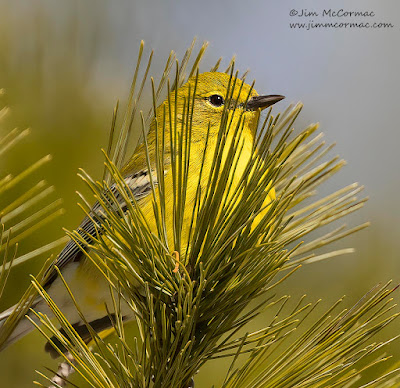
A male Pine Warbler (Setophaga pinus) perches, quite appropriately, on a pinecone. This big White Pine (Pinus strobus) was part of his turf. I photographed this bird last Monday in Hocking County, Ohio, and the warbler was probably newly arrived and busy establishing his territory. While small numbers of Pine Warblers will overwinter in Ohio, I suspect this one wintered further south, as most do.

Pine Warblers are the first to arrive back on territory and commence singing and this one was in fine song. Of our breeding warblers - Yellow-rumped Warbler (Setophaga coronata), which commonly overwinters, is not a nester here), the Pine Warbler leads the spring parade. Before long, Louisiana Waterthrush (Parkesia motacilla) will appear very soon, then Black-and-white Warbler (Mniotilta varia), Black-throated Green Warbler (Setophaga virens), Northern Parula (Setophaga americana), and Yellow-throated Warbler (Setophaga dominica) will soon follow up. Not long after the warbler rush will be on.

I watched this Pine Warbler foraging for some time. Here, he rests among dense fascicles of pine needles. I saw him grab a few small caterpillars but was unable to photo-document them. Quite a few species of moth caterpillars specialize on feeding on pine, and a number mimic the needles to a remarkable degree. Thus, Pine Warblers employ a slow deliberate creeping style of foraging rather than the maniacal rushing about of many other warblers. Even for the sharp-eyed warbler, these pine needle caterpillars are probably pretty tough to spot and require more methodical searching.

Friday, March 11, 2022

My photography in the pages of Columbus Monthly magazine!

I was quite flattered - and surprised - when Randy Edwards, a Columbus writer with an impressive resume, approached me last winter about doing a profile of my photography work. We met in the field on a frigid winter day for an outdoor experience, me with camera in tow. As it was too cold to take notes, we later repaired to a nearby McDonald's for coffee, finger-thawing, and discussion.

Randy's piece appears in this month's Columbus Monthly, and features over a dozen of my images, covering a broad range of species. If you would like to have a look, GO HERE.

Monday, March 7, 2022

Celebrating 100 years of "Nature" column


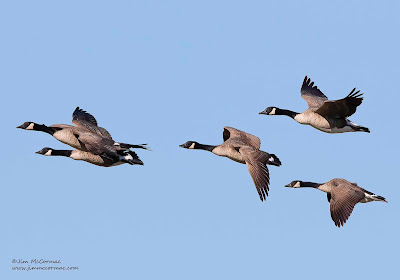
The Canada goose was the first animal mentioned in The Dispatch's inaugural Nature column by Ed Thomas in 1922/Jim McCormac

Celebrating 100 years of "Nature" column

Columbus Dispatch
March 6, 2022

NATURE
Jim McCormac

On March 5, 1922, a lawyer-turned-naturalist named Edward Sinclair Thomas penned the first incarnation of this column. The Dispatch had asked him to write a short series of articles about birds, and Thomas eagerly took up the challenge.

His writings proved popular, and the newspaper asked him to continue with the column. He did so with a passion, stamping out weekly columns for the next 59 years. Thomas wrote over 3,000 articles in all, in addition to his weekly “Blendon Woods — Metro Parks — Central Ohio Park System” series that was geared toward kids.

Thomas was born in Woodsfield, Ohio, on April 22, 1891 — fittingly, as April 22 would much later become the date of the annual Earth Day celebration.

The very first animal mentioned in Thomas’ inaugural column was, “A flight of wild geese…” referring to the now-ubiquitous Canada goose. A century ago, geese were not nearly so frequent and a wild skein of honkers passing overhead piqued great interest in the citizenry far below.

Thomas didn’t confine his prose to birds. He was an old-school naturalist, an ecological Renaissance man who once would have been termed a natural philosopher. He had expertise in flora, singing insects (the orthoptera), geology, amphibians, mammals and more — and he wrote about them all.

His last column appeared on Sept. 6, 1981, just about five months before his death on Feb. 16, 1982.

Thomas inspired many people with his encyclopedic knowledge of natural history and his passion. One of them was a young naturalist named Jim Fry. Thomas became a mentor to Fry, who went on to become a professional naturalist. He worked for Columbus and Franklin County Metro Parks for over three decades, with much of his tenure at Blendon Woods.

Fry took over the column in 1981, segueing seamlessly from Thomas' final piece. By this point the column was dubbed Nature — same as it is today. Fry, who now lives in Hocking County — not far from Thomas’ cherished retreat known as Neotoma – is an ornithologist of note.

For the next 29 years, Fry regaled readers with his adventures involving birds, both rare and common. An inveterate lister, Fry annually racked up large lists of species in Ohio. He was well-known for his spur-of-the-moment chases of great rarities, no matter where they might appear. His regular fodder of bird subjects was often interspersed with other subjects in keeping with Thomas’ template of diversity.

In all, Fry wrote 802 columns. By the time he took over Nature, it had shifted to a bi-weekly format or I’m sure he would have written double that number.

Fry, in turn, was a mentor to me. I met him when I was still in middle school, and he was stationed at Blendon Woods. Because of my strong interest in birds, he took me under his wing, so to speak. I became a fixture at Blendon, soaking up knowledge from one of Ohio’s most accomplished birders.

In late 2009, Fry decided to cap his pen and hand off the column. I was flattered when he recommended me as his successor. I had already been writing a science column for The Dispatch, but when my editor offered me the Nature column, I jumped at the chance. This column is my 336th to date.

I appreciate The Dispatch’s long-standing role in supporting conservation and natural history. If there’s a longer running nature column in an American newspaper, I’m unaware of it. If you know of one that bests our centennial-eclipsing Nature column, please let me know.

Naturalist Jim McCormac writes a column for The Dispatch on the first, third and fifth Sundays of the month. He also writes about nature at www.jimmccormac.blogspot.com.

Friday, March 4, 2022

Common Redpolls, feeding on Black Alder


A male American Goldfinch (Spinus tristis) feasts on the seeds of Black Alder (Alnus glutinosa). Much as I love goldfinches, this was not the species that made me visit a grove of invasive nonnative alders. The main reason was a close relative of the goldfinch, and a species far scarcer in Ohio.

I made this trip - and these images - back on February 15. In part because of my curiosity about the plant that my target birds were feeding on (avidly!), I wanted to write about the experience. It's just taken me this long to get around to it.

A female Common Redpoll (Acanthis flammea) sits among the abundant fruits of Black Alder (sometimes called European Alder). She is fluffed like a puffball in the frosty temperatures - low-20's F as I recall. Nippy as that may seem, it is nothing for these finches of the far north.

She was part of a flock of perhaps 75 birds that had been in residence at Willow Point Wildlife Area on Sandusky Bay, Erie County, Ohio, for several weeks. There is no question that the alder was part of the allure for them. I spent about two hours with the group, and all they did while I was there was feast on alder fruit. In the photo above, the cone-like structures are the pistillate (female) catkins. They produce the seeds that were so coveted by the finches. The pinkish slender elongate structures are the staminate (male) catkins. Alders are in the birch family (Betulaceae), and redpolls are quite fond of feeding on plants in that group.

However, I would not have guessed they'd work over Black Alder, a small tree that always makes me cringe when I see it. This Eurasian species was brought to the New World long ago, and has been planted ornamentally, and as erosion control. I suspect wildlife agencies may have at one time planted it at one time, too. I don't know how the alder got to this site, but it is thriving and has formed fairly extensive dense stands.

A redpoll dangles acrobatically to better pop cone scales off and access seeds. Look at those little leggings! Redpolls are a delight to watch, and a quiet observer can usually do so at close range. The small finches can be incredibly tame. At times, birds were coming to within five feet of me - well inside my lens's minimum focusing distance.

It was snow-covered, and the dark cone scales littered the ground under feeding areas. Similar to crossbills, the flock was mostly silent when busy with feeding, and showers of scales rained down. When they took to the wing, it was a riot of redpoll vocalizations, and the flock could not be missed.

A major issue with Black Alder is its dense growth. As the plants mature, they shade out the ground below and greatly reduce or eliminate native flora. This is particularly vexing at this site. The southern shore of Sandusky Bay is known to harbor populations of the federally threatened Prairie White-fringed Orchid (Platanthera leucophaea) and the site where these alders are looks fine for that spectacular orchid (See HERE for photos of the orchid and one of its pollinators). But not when overrun by alders.

A striking male Common Redpoll looks like it got pelted with raspberries. The showy little songbird was taking a brief rest and look-around before diving back into the alder cones.

This tale illustrates that even the most pernicious of weeds can have a plus side. There's no question that these redpolls found favor in the fruit, as did the goldfinches. Does that justify planting Black Alders in wild places for erosion control or wildlife? No, in my opinion. Any wildlife that is lured by the invasive tree certainly does not need or depend on the alder. And the diversity of native flora cast out by the alder invasion serves far more ecological functions.

But I will admit that in winter - especially winters with redpoll irruptions - I will pay more mind to Black Alders when I see them.

Wednesday, March 2, 2022

Delmarva Fox Squirrel

As always, click the photo to enlarge. You’ll want to enlarge this one to fully appreciate how beautiful a squirrel can be.

A Delmarva Fox Squirrel (Sciurus niger cinereus) noshes on the fruit of greenbrier in the genus Smilax (I’m unsure of the species). This distinctive subspecies made the inaugural U.S. Fish & Wildlife Service listing of endangered species in 1967. At that time, the squirrel had plummeted in numbers, and was reduced to only four counties in Maryland’s eastern shore region. Thanks in large part to habitat restoration and protection, the beautiful rodent has rebounded and it was removed from the endangered list in 2015.

Seeing this large silvery squirrel, and hopefully making photos, was high on my list for this trip to Maryland and Virginia. Obviously I met with success, but the photography part wasn’t that easy. I found these squirrels to be rather bashful, and prone to running, scaling trees, or remaining in thick cover when approached.

But some perseverance paid off and eventually I was able to work with several animals and get nice images. I’ll try and make a more complete post on the Delmarva Fox Squirrel after I return home, including other imagery of them and their haunts.


Monday, February 28, 2022

Delmarva Peninsula


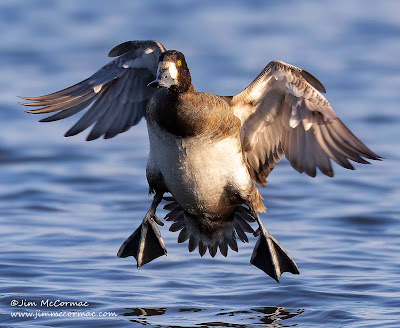
A hen Lesser Scaup comes in for a landing. Ducks are quite graceful in flight, and on the water. But there is this moment of uncharacteristic awkwardness when they transition from air to liquid. Cambridge, Maryland, this afternoon.

I'm in the Delmarva Peninsula region of Maryland, with a bit of time in adjacent Virginia. It's been amazing thus far, and the waterfowl numbers are impressive. I did a 12-hour pelagic boat trip from Ocean City yesterday, and we had many notable observations, including 14 Atlantic Puffins, numerous Razorbills, several Common Murres, and a Dovekie.

More on all this, and what's yet to come, later!