Monday, April 1, 2013

"Bigfoot", finally indisputably documented, in Ohio!

If you've followed this blog very much, you've probably seen some of the remarkable videography that I've shared, courtesy of Dave and Laura Hughes. Their knowledge of animal behavior, and access to a remote region filled with wildlife, has enabled them to use high-tech trail cams to achieve amazing results. Examples of their work include footage of Beaver, Bobcat, and Coyote (click on any of those animal names to see the video).

Well, once I and many others saw the results of the Hughes' sophisticated videography and their incredible footage of animals which are normally nearly impossible to observe, our thoughts quickly turned to one of the most enigmatic and unresolved mysteries in the natural sciences. Bigfoot.


This is "Frame 352" from the now legendary video shot by Robert Gimlin and Roger Patterson in 1967 in California. The pair claims to have briefly encountered a "cryptid", or unknown animal, and managed to get a brief film that includes the screen capture above. Their video has been subject to intense scrutiny, and no one has ever been able to prove or disprove its validity. And that's saying a lot, as many of science's best and brightest minds have long pursued the mystery of Bigfoot, as well as its various closely related "species" such as Sasquatch, Grass Ape, Yeti, etc. Indeed, professional organizations have sprung up that are dedicated to researching - and locating - the creatures that many scientists are, for now, labeling Homorilla erectus. A growing camp of scientists and biologists believe that these creatures clearly represent a missing link between apes in the genus Gorilla, and humans - genus Homo.

The Hughes have been surveilling and filming intensely for several years in Monroe County, near the Ohio River. Not far from their sites lies Salt Fork State Park in Guernsey County, which is in the upper lefthand corner of this map. This sparsely populated region of dense forests and rugged terrain probably produces more sightings and encounters with large bipedal cryptids than any other place on earth; certainly in North America. Such has been the spate of encounters in this area that Salt Fork State Park is the venue for the annual Ohio Bigfoot Conference, which takes place on April 13. It is the biggest and best organized of its kind.

Given the remarkable advances in remotely operated camera and video technology, many authorities believed it would only be a matter of time before solid evidence regarding the existence of Homorilla erectus was brought to light. I figured that, given their incredible success in documenting well known but incredibly secretive mammals in Monroe County, it might well be the Hughes that produced evidence of H. erectus.

The Hughes check their camera rigs frequently, and remain alert for any new animal signs. For some time, they have noticed evidence of unidentified large animals - large broken branches, saplings that have been bulled over, and big but always obscure and unrecognizable footprints. Finally, early last winter one of their motion-activated photo cams picked up this fuzzy image. It appears to be a biped, walking upright that appears humanlike. The photo is just not good enough to state with certainty what this creature is, however.

However, now a site with suspicious activity was clearly identified, and the Hughes ramped up surveillance in the area. Their work led to this video, a few weeks after the previous still photo was captured. This video is intriguing, as it clearly shows an upright humanlike figure, but is also frustrating as the cryptid passes through at the periphery of the camera's reach, and does not allow for detailed study.

Recently and not far from where the above video was made, a still camera was tripped and obtained this image. It appears that the creature is moving fast, and details are blurry. But there seems to be little doubt that a nonhuman biped is involved, and by using the known size of surrounding vegetation, the Hughes gauged its height to be around 6'10".

In spite of diligently maintaining their camera rigs and recording nearly every night since these stills and video were made, the Hughes have yet to obtain any other footage. The cryptid in their films is almost certainly not a human, however. Given that the video and stills were made in a region where literally dozens of sightings of Bigfootlike creatures have been made, we must assume that it is likely the animal that, for now, is being dubbed Homorilla erectus.

The photo above was made on March 27. In only two weeks, several hundred biologists and amateur cryptid hunters will descend on nearby Salt Fork State Park for the Ohio Bigfoot Conference. With all of those trained eyes, we can only hope that they will turn up this creature, or another like it.


Sunday, March 31, 2013

Finally, up comes the flora

Yesterday dawned bright and clear, with temperatures soaring into the low 60's. After this interminably long winter, with well below average temperatures and above average snowfall, it was quite nice to finally see the first botanical sparks of spring popping to life. So it was a treat to connect with John Howard, Susan Nash, and Daniel Boone and go exploring some of Adams County's best habitats, such as this prairie opening.

Daniel Boone poses by a White Cedar, Thuja occidentalis, that is probably far older than its size would suggest. Growth comes slow in a rocky opening such as this, and the tree is probably in excess of a century in age. Hard to see in the photo, but Dan's left hand touches a small Dwarf Hackberry, Celtis tenuifolia - just one of many rare plants that occur in habitats such as this.

Until this trip, I had seen only a handful of "wildflowers" in bloom in my tundra-like neck of the woods, and nearly all of those were weedy nonnatives. That changed with this foray. This shrub or treelet, the American Hazelnut, Corylus americana, flowers well in advance of leafout, and its pendant spikelets of male flowers are quite conspicuous and reveal the plants allegiance to the birch family. Far less noticable are the pistillate, or female, flowers. Look at the branch's tip in the photo's upper righthand corner - there it is, the tiny scarlet flower.

One of the woodlands that we explored had large rafts of this small parsley family member, the Harbinger-of-spring, Erigenia bulbosa. It is sometimes known by the equally apt name of Salt-and-pepper.

We stopped by a robust station of Snow Trillium, Trillium nivale - probably the largest population in Ohio. Most plants have up and down years, and this is a boom year for this stand of trillium. They were not yet peak, yet we saw many thousands of plants.

One of spring's faithful harbingers are the hepatica, and we saw scores of Sharp-lobed Hepatica, Hepatica acutiloba. I began to notice incredibly small beetles on hepatica several year ago, and now that my eye is attuned I see them on as many or more plants than not. This beetle belongs to the subfamily Nitidulinae of sap-feeding beetles (thanks Anthony Rodgers!), but we don't know the species. These beetles busily clamber about the anthers, plundering pollen, and must play a vital role in the life cycle of hepaticas.

A must-see spring spectacle in this neck of the woods is the mass blooming of Goldenstar, Erythronium rostratum, one of our rarest lilies. I was not optimistic that the plants would be above ground, given the lateness of the spring, but good ole Dan Boone was correct in his confidence and I'm glad that we stopped by. Goldenstar resembles the common, widespread Yellow Trout Lily, E. americanum, but its petals are held in a flat plane rather than being strongly recurved, and the tepals (they are not technically petals) have an orangish cast.

This rarity has a scattered and local distribution, with the Ohio station at its northern limits. Interestingly, I believe that this is the only native plant that was accidentally omitted from th Manual of Vascular Plants of Northeastern United States and Adjacent Canada, that I discussed in this RECENT POST.

After a while, we ventured into open sandy habitats along the Ohio River in search of other plants. Lots of weedy nonnative chickweeds and mustards where tinting the otherwise barren fields, and sprinkled among them were these native American Field Pansies, Viola bicolor. Note the conspicuous purple nectar guides leading into the glowing yellow center of the flower - these colorful ornamentations are there to draw pollinating insects to the core of the flower.

Finally, we concluded with a stop to an interesting Ohio River sand terrace to seek one of our primary targets, the Little Whitlow-grass, Draba brachycarpa. To call this elfin mustard diminutive would be an understatement. The plant just to the left of the dime is in peak bloom; the smaller plant just to the left of that has already flowered and is setting fruit. These particular plants are not runts, but are about average in size. Little Whitlow-grass (not a grass of course; I'm unsure of the origins of this curious common name but suspect it originates from some Old World group of plants) is so small that you can't really spot them while standing upright.

A closeup of an inflorescence in the act of opening, with tightly closed purplish-red buds in the center. You could probably easily pile 100 of those miniature flowers on the dime in the previous photo. In spite of their tiny size, the flowers are frequently visited by a variety of little bees, flies and other early to emerge pollinators.

This Little Whitlow-grass has already set fruit. The oval pods are known as siliques (sil-eeks), which is specialized mustard terminology. They'll ripen in short order, and pepper the ground below with scores of dustlike seeds. If the conditions where the seed fell are suitable next year, up will pop more whitlow-grass, thus perpetuating the life cycle of this critically endangered (in Ohio) annual plant.

Friday, March 29, 2013

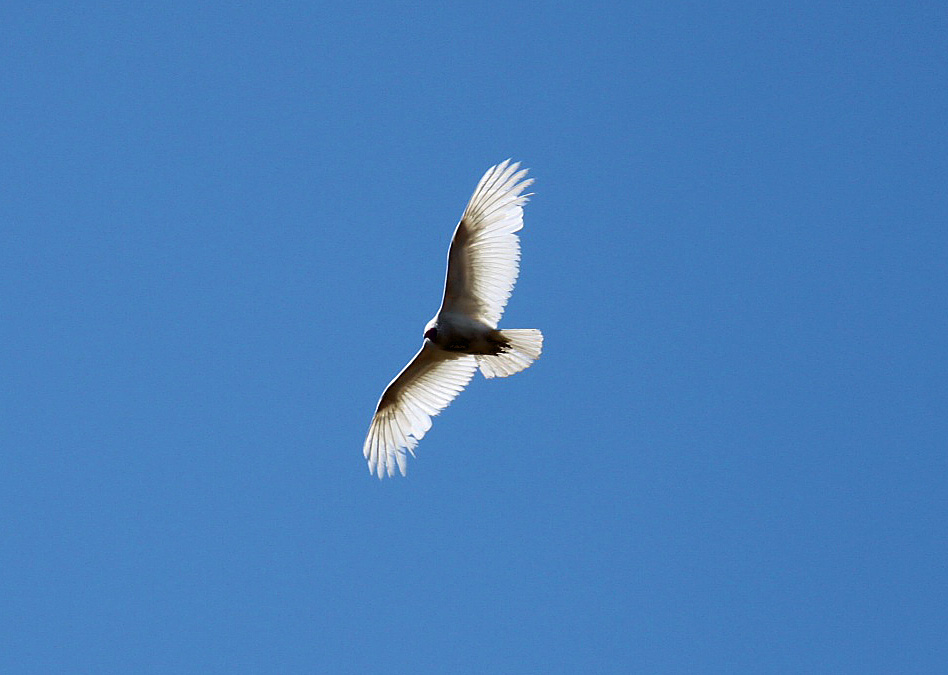
A snow white Turkey Vulture!

Photo: Kathi Groves

Imagine peering up into the clear blue ether, and seeing this giant white bird wafting over. You'd do a double take, and a birder would slam on the brakes and hop out for a better look. That's what Kathi Groves did yesterday as she cruised up Frederick Pike in Montgomery County, just north of Interstate 70 near Dayton.

Fortunately, she had a camera handy and the presence of mind to snap a few photos. Bev & Ed Neubauer suggested that she send them along to me, and I'm glad that Kathi did because now I can share them with you.

Photo: Kathi Groves

The Turkey Vultures are in full migration mode right now, and it's commonplace to see them drifting high overhead. But most of these dark undertakers of the bird world don't look anything like this! Kathi's vulture is leucistic, and highly so. This genetic anomaly causes melanins, or dark pigments, to be washed out and pale. Most typically leucism manifests itself in a "piebald" pattern - patchy blotches of white, or perhaps just one prominent white bodypart such as the white-headed American Robin that someone just sent me a photo of. Leucism is a numbers game - the more animals in a population, the more likely that an individual will carry this recessive trait. That's why the most commonly reported leucistic birds tend to be abundant species such as American Robins, Red-tailed Hawks, and Turkey Vultures.

Kathi's vulture may be the whitest one that I've seen, but it isn't the only one. For years, a leucistic Turkey Vulture frequented the vicinity of Egypt Valley Wildlife Area in Belmont County, and became a local celebrity. It's patchy white wings made it stand out from afar, and I saw it on a few occasions. Then there's THIS BIRD, from a few years ago.

Photo: Kathi Groves

As Kathi watched, the vulture cruised earthward and alit in this yard. I can only imagine the surprise of the homeowners, if they happened to glance out the window and notice this thing.

Thanks to Kathi for sharing her discovery and photos! If you're in the area of Frederick Pike and I-70 in north Dayton, keep an eye peeled for this vulture, and please let me know if you see it. The bird may just be passing through, but perhaps it here to stay.

Wednesday, March 27, 2013

Ohio Botanical Symposium approaches!

A whole lotta plugs for various events on this here blog of late, I know. But late winter and early spring have become conference season in Ohio, it seems, and many of these events are well worth a pitch.
 
The Ohio Botanical Symposium is one of them. This will be the 13th year for the symposium, and it's grown like a weed. Your narrator pitched the idea for the symposium back in 1999, when I worked as a botanist for the ODNR's Division of Natural Areas. We started small - about 35 people in a classroom at the Ohio State University. The last go-round saw about 450 people, and the symposium has long since moved to much plusher digs.
 
So mark your calendar for Friday, April 5th, and check in HERE to register. The venue is the beautiful Villa Milano in Columbus. Following is a summary of the agenda, spiced with a few showy photos. It's a great slate of speakers and topics, any one of which is worth the price of admission.
 
Rob Naczi will be in the house and delivering the keynote. Rob's in the Big Apple now, working as the curator of North American Botany at the New York Botanical Garden. He'll be talking about his work to revise one of America's most iconic botanical works, the book above.

The tattered book in the photo is my original copy, and it was probably one of the first that was sent out. "The Manual" appeared in 1991, and mine has seen a lot of use and abuse in the intervening two decades. A lot of advances in our knowledge of flora occur in 20 years, and it's time for an update.

The brainpower behind the 1991 edition of The Manual was also a botanist housed at the New York Botanical Garden - Arthur Cronquist. Cronquist was a living legend for much of his botanical career, which encompassed most of his 73 year life. Tragically, he passed away in 1992, the year after his epic revision of The Manual was released.

I have an interesting story about Cronquist's book. Upon receipt of our copies, I and my peers immediately devoured the pages, searching for new tidbits and marveling  - and trying to comprehend - the new "Cronquist" system of taxonomy. I found a new tidbit indeed, on page 656 of The Manual. Under the account for the Erect Dayflower, Commelina erecta, Cronquist stated that it occurs in "Dry, usually sandy soil... [including] O. [Ohio]". Whoa! We knew of no Ohio records for this interesting plant, but its presence here would certainly be possible. I figured that Cronquist, with his vast stores of knowledge and access to the NY Botanical Garden's expansive herbarium, was privy to something that we didn't know. So I dashed off the letter above to Patricia Holmgren, director of the NYBG. If you click the letter, it'll expand for readability.

A few weeks later, I was floored to receive the letter above. The Man himself had written! Cronquist actually took the time to respond to my query, in his humorous style. That such an esteemed scientist - he was probably the most highly regarded active botanist in the country at that time - would take the time to respond to some unknown person in the heartland of Ohio made an enormous impression on me. As it turned out, he died only two and a half months after this letter was written.

Anyway, on with the talks. As has been done since the inaugural symposium, there will be a talk about the best plant finds of recent seasons, ably delivered by Tim Walters. The spindly little sedge above - a plant that perhaps only a botanist could love - was a star of one of the last Best Finds talks. It is Rocky Mountain Bulrush, Schoenoplectus saximontanus,  which was rediscovered by Dan Boone in Pickaway County in 2008. The last Ohio sighting prior to Dan's discovery was in the 1940's.

Judy Semroc, who is one of the region's best all around naturalists and photographers, will deliver a program on insect pollinators and their often specialized relationships with plants. Be prepared for plenty of stunning imagery.

One of the most entertaining and energetic botanical lecturers, anywhere, is David Brandenburg. He'll be talking about Ohio's asters, and that covers a lot of beautiful ground. Pictured is one of our most stunning species, the Smooth Aster, Symphyotrichum laeve.

Ginseng, Panax quinquefolius, is tops in value of the medicinal plants in our flora. Prices can hit $500 a pound for dried roots, and as a consequence the plant is becoming scarcer. Eric Burkhart of Penn State will explore the history of the ginseng industry.

Chris Bedel of the Cincinnati Museum will give a program on the 16,000 acre Edge of Appalachia Preserve in Adams County, one of Ohio's great bastions of biodiversity. Chris is a fabulously entertaining speaker, and full of knowledge about the area that he has managed and lived in for years.

I took this shot a few years ago at the base of the drive to the Eulett Center, which is the Museum's headquarters in the heart of the Edge. Our group was watching a Blue Grosbeak, teed up on that tree in the right center of the photo. Chuck-will's-widows nest just up the hill behind us. A half-dozen state-listed rare plants grow within a stone's throw. A cool katydid, recently described to science, is common in this spot. And the list just goes on and on...

Finally, John Mack will talk about a place that ranks high among the rarest of the rare, Daughmer Savanna in Crawford County. Nearly all of our prairie savannas have been destroyed, thus it was a major coup when Daughmer was purchased and protected as a state nature preserve a few years ago.

You won't want to miss the Ohio Botanical Symposium, so register soon, RIGHT HERE.

Monday, March 25, 2013

Feral cats and birds: the "debate" can be brutal

The issue of feral cats - house cats gone wild - has simmered for years. Occasional events trigger seismic eruptions in the "debate" between the pro-cat and anti-cat camps. In fairness, it should be noted that many of the so-called "anti-catters" are certainly not anti-cat. Many are like myself - I own three cats, all of which needed homes, and I have been smitten with felines since I was a tot. And mine DO NOT go outdoors. But I, like scores of others who might be labeled "anti-cat", recognize the massive problems caused by ferals. Conversely, many of the pro-catters also see the need to reduce the populations of cats gone wild, recognizing the damage that they do to native populations of birds and other animals. Many of us would like to see humane and sensible solutions adopted to reduce the millions of feral cats in this country.

The latest major flare-up in the cat wars occurred recently, when longtime writer and conservationist Ted Williams penned an anti feral cat op ed for the Orlando Sentinel. The National Audubon Society, which had run Williams' column "Incite" for 33 years, promptly parted ways with Williams when the cat poo hit the fan over the Sentinel piece.

Audubon's parting of ways with Ted Williams incited all manner of blog posts and other writings about that particular issue, and the larger issue of feral cats. If you want a fascinating insight into the emotions generated by the feral cat issue, read THIS entry that was made on the blog 10,000 Birds. The blog article will point you to Williams' controversial Sentinel article, which provides an overview of the feral cat issue. But what is really fascinating is the comments - about 124 of them! - on the blog. Predictably, the pro and anti feral cat camps go at it, but even people who should be on the same page are at each others throats. Read the blog, and its attendant comments, HERE.

Sunday, March 24, 2013

Gray Squirrels also come in black

Back on March 8, I found myself at Tom Ruggles' place in Zanesville, attempting to observe and photograph Jeffrey, his spectacular yellow Northern Cardinal. You can see photos and read about this amazing bird HERE.
 
As is often the case while watching feeders, we were routinely distracted by marauding squirrels. On this day, however, we found ourselves rather charmed by their antics, and I was thoroughly smitten by certain of these bushy-tailed rodents.
 
We noticed this pair of Gray Squirrels, Sciurus carolinensis, way out in the back part of the lot. I'm assuming this is an amorous pair filled with the seasonal lust of spring. They remained 20 feet up this tree, nearly nose to nose, for quite some time. A lesser male, presumably, watches wistfully from the tree to the left.

After a bit, the two squirrels sidled up side by side, possibly communicating telepathically (for all I know). They also remained like this for some time. Assuming the male was charming enough, the end result will be little squirrellets later this spring, the first of two batches. Gray Squirrels often have another breeding period in mid-summer.

Elfin squirrellets become big squirrels eventually, and turn their sights to the local bird feeders if any are at hand. Their fondness for seed leads to one of the greatest man vs. wildlife interactions in the lower 48 states. Frustrated feeders of birds wage all out war on the clever beasts, devising numerous ploys to prevent the furry spidermen from accessing the feeders. Normally, the squirrels win. This one is practically thumbing his nose at us, and we were but a few feet away peering through the windows. Tom's squirrel dog, which is essentially a miniature Golden Retriever, was right by our side and quaking and simmering with rage at the insolent interloper. However, I insisted that the dog put a cork in it so I could make photographs of the squirrels, which probably did not endear me to said canine.

This is the animal that I really wanted to see and make photos of - the "black" squirrel. There is a healthy population of these sooty-colored squirrels in Zanesville, and they intrigue me. Perhaps it is because I hail from a land which has no black squirrels. There are supposed to be colonies of them in and around Columbus, Ohio, where I live, but I never see them here. Only the grays. So the spectacle of one of these black squirrels is a treat for me, a bit like seeing an alien descend from Spaceship Oak.

Even though the so-called black squirrels look totally different than their gray brethren, they are pretty much one and the same. The blacks are melanistic Gray Squirrels - they have one or two special genes that rewires their genetics to produce an abundance of melanins, or dark pigments. While most are coal-black such as the fellow in the photo, sometimes individuals with blond, gray, or even white highlights can be found.

The city of Kent, Ohio is especially famous for its abundance of black squirrels. Supposedly, the original stock of 10 squirrels was imported in 1961 from Canada and they've since spread like wildfire. But melanistic Gray Squirrels occur naturally and most populations have probably long been present and were not assisted by people. The black squirrels are most prevalent in Ontario, Canada and the northeastern United States. One theory has it that the black form of the Gray Squirrel dominated prior to European settlement,  when forests were still primeval and their dark coats helped the squirrels better blend with the shady old-growth woodlands. As the forests were opened up and hunting of squirrels increased, gray forms were favored as they blended better with the changing habitats.

Thursday, March 21, 2013

Mothapalooza updates!

Mothapalooza is a field trip-based celebration of moths the likes of which the world has never seen! Well, I don't really know if that's a fact, but it is going to be an awesome extravaganza, of that I can assure you. We entered into the hatching and planning of this event with a slight bit of trepidation, not absolutely knowing if there would be enough moth enthusiasts to draw much of a crowd. Our fears have already been largely allayed. Even though Mothapalooza doesn't take place until the distant weekend of June 14-16, 70 people have already signed on. We can only accommodate about 120 folks, so register soon.
 
Obviously, moths will be a huge part of the aptly named Mothapalooza, but there's more, much more. The conference is based at the lodge in Shawnee State Park, which is surrounded by 60,000+ acres of state forest. A crow's caw to the west is the 15,000 acre Edge of Appalachia Preserve. We'll be exploring throughout this incredibly rich region, which is loaded with cool and rare plants, interesting breeding birds galore, and blizzards of moths. Bring extra cards for your camera.
 
We are excited to have bugman extraordinaire Eric Eaton on board and leading trips. That's Eric, in green shirt and cap, facing away from the camera. Eric is the principal author of the Kaufman Field Guide to Insects of North America, which is the people's favorite when it comes to easy to use references for identifying insects. Eaton was in the midst of teaching a wasp workshop when I took this photo. The building in the backdrop will be one of our moth-trapping sites at the Edge of Appalachia Preserve. We'll get all kinds of cool stuff at this site.

Doing its best to look like a bird dropping, albeit a rather cute bird dropping, is this Beautiful Wood-Nymph, Eudryas grata. It is but one of scores of interesting moth species that we'll see during Mothapalooza.

Mr. Caterpillar himself, David Wagner, will be a major part of the scene. That's Dave, far right, in the midst of beating interesting caterpillars from the foliage of those stunning Marsh Rose Mallow plants. Dave is a whiz when it comes to moth ID, too. Rich McCarty and Pete Whan are to Dave's left. They work for the Ohio Chapter of The Nature Conservancy and manage the Edge of Appalachia Preserve, and both will be helping with Mothapalooza. To the rear and sporting a headband is John Howard, an extraordinary naturalist whose photos I've shared many times on this blog. Nothing will escape detection and naming by this crew.

This is one of the numerous cool and interesting caterpillars that we should see: the Unexpected Cycnia, Cycnia inopinatus, a rarity in Ohio. They prefer to snack on Butterfly-weed, and match the flower color of that milkweed quite well.

In addition to numerous common moths, we'll dredge up some rarities such as this Coppery Orbexilum Moth, Hystricophora loricana, a species of very limited distribution.

We've even got the president of the Ohio Lepidopterists onboard with Mothapalooza, Dave Horn. This is Dave, standing in one of Adams County's prairie barrens. These sites are loaded with RARE THINGS, and we'll be checking them out. There are many other topflight experts working with Mothapalooza - too many to name in this blog without creating a small telephone book. Check the Mothapalooza website to see who's who.

Most moths are utterly stunning, although often on a tiny scale. This is a common species and one that we ought to see, the Common Spragueia, Spragueia leo. One of the Mothapalooza workshops focuses on photography, and John Howard and I will be conducting that session. We'll try to share some tips and tricks for capturing moths great and small on pixels, in all kinds of conditions including the black of night.

Thanks to the work of Cheryl Harner, who will also be helping, we've enticed lepidopterist Jaret Daniels up from Florida. Jaret knows butterflies - he literally wrote the book, Butterflies of Ohio. We'll not only be out after dark moth-seeking. Daytime trips will venture into some of the richest butterfly habitats north of the Ohio River.

Here's one of many specialty butterflies that we ought to turn up during Mothapalooza, the Juniper Hairstreak, Callophrys gryneus. This shot, and every photo in this post, was taken at the very sites that we'll be exploring during Mothapalooza.

We are proud to be linked with the greatest effort to promote moths the world has ever seen, National Moth Week. Be sure and visit their site, HERE. Moths play an incredibly important role in earth's ecosystems, and education about the value of moths and their caterpillars is a huge part of NMW and Mothapalooza.

We are also indebted to our other sponsors: The Ohio Division of Wildlife, Flora-Quest, and Midwest Native Plant Society, as well the vital support of the Ohio Chapter of The Nature Conservancy and the Cincinnati Museum Center.

If you're looking for an out-of-the-box experience that will be jampacked with interesting critters and plants in one of the most beautiful regions of Ohio, Mothapalooza is for you. See all of the details and registration info RIGHT HERE.