Thursday, February 17, 2022

The Logan Oak on Jeopardy! Actual video clip


So, here's my few seconds of Jeopardy! fame (my oak photo), from last night's show. The contestant Megan answers correctly and went on to win the round. And apparently Loganites got wind that their famous tree made Jeopardy! and that caused some excitement down there. Thanks to Janet Riemenschneider Green for sharing this video with me!

Wednesday, February 16, 2022

Logan Oak to appear on Jeopardy!

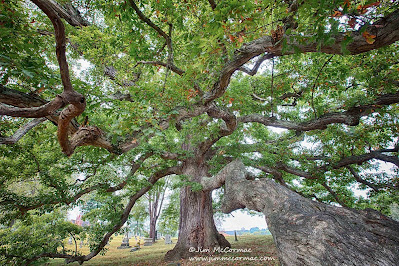
The centuries-old Logan Oak is an impressive White Oak (Quercus alba) indeed.

I made this photo of the fabled "Logan Oak" in September of 2019, never suspecting it might someday appear on the television show Jeopardy! I just wanted to see and try to photograph a cool tree. Yet, it will be on Jeopardy! tonight. Or so they tell me.  I was approached by an agent for the show last fall, which led to the deal to use the image. I don't know any details about how it'll be used, but as far as I know it's a green light.
 

Sunday, February 13, 2022

Skunk-cabbage: Hope to the winter-weary


Skunk-cabbage (Symplocarpus foetidus) in full flower this morning, February 13, 2022. This is a true harbinger of spring and the first of our native wildflowers to bloom. The fleshy liver-splotched spathe encloses a club-like spadix, visible through the opening. The little dots speckling the spadix are the flowers and their yellowish color is the pollen. It didn't feel much like spring when I made this image, though: 19 F and snowing. Franklin County, Ohio.

Friday, February 11, 2022

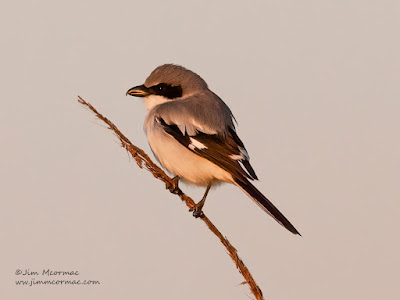
Loggerhead Shrike, AKA the "Butcherbird"


A Loggerhead Shrike (Lanius ludovicianus) tees up on flowering grass spike. This "butcherbird" was on the hunt.

I found the above bird near Jupiter, Florida, on January 14, 2022. Fortunately, shrikes are still somewhat common down there and not too tough to find. This bird was conspicuous as it teed up in prominent places, frequently calling. I watched it for some time, hoping to see it score a kill. It only made one attempt while I was there, chasing a Song Sparrow into the dense crown of a palm. The lucky sparrow escaped.

Potential prey that eludes a shrike are lucky indeed. They aren't nicknamed butcherbird for nothing. Probably due to their short legs and lack of talons, which makes it tough for the predatory songbirds to both hold victims and dismember them simultaneously, shrikes employ another tactic. They typically impale the victim on thorns, barbed wire, or other sharp objects. Once the prey item is so secured, they rip into it with a powerful raptorial bill. There was some barbed wire nearby, and I confess to having visions of the shrike using it to shish kabob that sparrow. On the other hand, I'm kind of glad the sparrow escaped. But I was a dispassionate observer, standing by to document whatever might happen without imposing my will.

Loggerhead Shrikes used to be uncommon but fairly widespread in Ohio. A number of times, in my younger days, I ran across them unexpectedly in rural areas. Always a great find, but certainly not an earth-shattering rarity. By 1980, their status had changed, much for the worse. By then, Loggerhead Shrike was a bonafide rarity, and it is even more so today. There may only be a few breeding pairs left in the state and the Ohio Division of Wildlife lists it as endangered.

The radical shift in agricultural practices undoubtedly played a big role in the shrike's demise. Mostly gone are the once common farms filled with meadows, shrubby fencerows, and other vestiges of non-crop habitat. Shrikes and many other bird species did well in the farm-scapes of yore. Today, it's mostly large industrial-scale agriculture with barely a trace of native flora and fauna.

The Loggerhead Shrike, in northerly latitudes such as Ohio, was a boom-and-bust species. It clearly colonized the state on the heels of deforestation and the opening up of the landscape. For several decades, the vegetation structure was conducive to shrikes and they peaked from around 1880 into the 1930's, but their heyday was short-lived in the big scheme. Loggerhead Shrike is not the only southern boom-and-bust species that has now vanished (or nearly so) from Ohio. Bachman's Sparrow and Bewick's Wren are two others that mirrored this pattern.

Fortunately, the fascinating and charismatic butcherbirds are still doing pretty well in the southern and westerly regions of their range. And if you're an Ohio birder, that's probably where you'll have to go to see them, at least in any numbers.

Sunday, February 6, 2022

Nature: Record highs and unusual sightings turn up in annual Christmas Bird Count

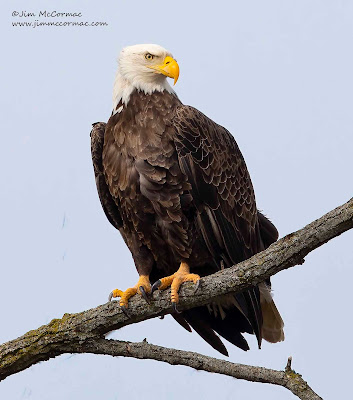
Fourteen bald eagles were tallied on the count, a record high/Jim McCormac

 Nature: Record highs and unusual sightings turn up in annual Christmas Bird Count

Columbus Dispatch
February 6, 2022

NATURE
Jim McCormac

The annual Christmas Bird Count (CBC), run under the auspices of the National Audubon Society, took place from Dec. 14 to Jan. 5. Well over 2,500 counts are conducted throughout the U.S., Canada and many other countries.

One of the oldest counts is the Columbus CBC. The inaugural count took place on Dec. 26, 1913, conducted by one observer. Fourteen species and 179 individuals were tallied. The count came nine months after the worst flood in Columbus history, which may have accounted for the low turnout of birds and birders.

The Columbus CBC was intermittent from 1913 to 1954. Since then, not a year has been missed and the last iteration took place on Dec. 19, 2021. Rob Thorn has served as compiler for over 20 years, and it’s a big job.

Thorn recently sent along a summary, and the 2021 count was one of the most productive ever. He marshalled the efforts of 88 observers. Only once has the count had more participants — in 2012, when 89 people helped.

The count area is a 15-mile diameter circle centered on Cassady and 5th avenues on the East Side, and that’s a lot of turf to cover.

Bernie Master, Tim Fitzpatrick and I covered a section of the South Side, including the sprawling Green Lawn Cemetery and the Columbus Impound Lot. We added a few goodies to the total, including merlin (a type of falcon) and fox sparrow.

A whopping 86 species were found, which has been eclipsed but once, also in 2012, when 89 species were counted. Many record high counts and unusual species turned up, and I’ll mention some below.

Seven trumpeter swans were found, a record high. This species was introduced (some say reintroduced) to Ohio in 1996 and is flourishing. Also in the fowl department, a blue-winged teal was exceptional. It is our least hardy duck and very rare in winter.

Red-shouldered hawks continue to expand, and a record count of 15 was made. Bald eagles also continue their meteoric increase. The 14 found was a record, but one that I predict is soon broken.

Eastern bluebirds, to the delight of many, also are doing well. A best ever 142 birds turned up. This gorgeous thrush has adapted well to suburbia. Less known is the elusive hermit thrush, but intrepid observers located nine of them. It might be a while before that total is bested.

Incredibly, four warbler species were documented. The only expected species is the rugged yellow-rumped warbler, and 49 were found. Completely unexpected was a black-throated green warbler, orange-crowned warbler, and two palm warblers. The latter three should be in the southern U.S. or even farther south.

A blue-gray gnatcatcher was a surprise. The spritely insectivore has been found on only six prior counts, the last in 2012.

Massive citizen science projects such as the Christmas Bird Count provide a wealth of data regarding avifauna. Some of the trends are negative, and some positive.

Up until 1970, double- or triple-digit numbers of northern bobwhite were found on every Columbus count. After that, few of the charismatic quail were located. Eight on the 1985 CBC were the last recorded. Bobwhite are victims of rampant development and wildlife-unfriendly agricultural practices.

On the other hand, opportunistic ring-billed gull numbers are soaring. Only single- or low double-digit numbers occurred in the count’s early years, if they were found at all. Gull numbers began to explode in the early 1990s, and counts have averaged 1,700 birds over the last 15 years. Our artificial lakes, reservoirs and prodigious human garbage have benefited the adaptable omnivores.

Thanks to Rob Thorn for his hard work and years of CBC stewardship, and to all of the count participants for their contributions.

Naturalist Jim McCormac writes a column for The Dispatch on the first, third and fifth Sundays of the month. He also writes about nature at www.jimmccormac.blogspot.com.

Wednesday, February 2, 2022

Winter warblers

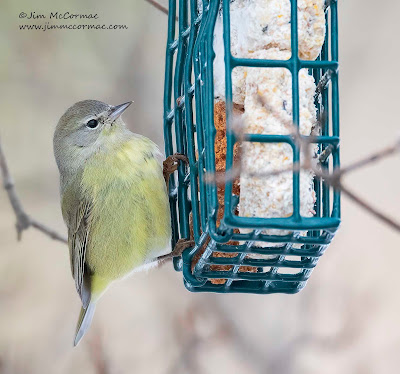
An Orange-crowned Warbler (Leiothlypis celata) clings to a suet feeder at Sharon Woods Metro Park in Columbus, Ohio. I made this photo on January 27, 2022 and the bird appeared there in January 15 - 12 days prior. The Orange-crowned Warbler is a hardy species and a late migrant, with tardy individuals still passing south through Ohio into November. However, mid-winter records like this seem to represent birds that are attempting to overwinter. And there is another Orange-crowned Warbler elsewhere in Columbus.

Large numbers of Orange-crowned Warblers winter in the U.S., from the lower Atlantic coastal plain states south through Florida and along the Gulf states through Texas. As warblers go, they do not range very far south, with the southern terminus of typical wintering grounds being northern Central America. So, an Orange-crowned Warbler attempting to ride out the cold season in Ohio doesn't seem like to much of a stretch.

But not so long ago, it apparently was. Excluding December records, which may represent very late migrants, Bruce Peterjohn in his scholarly work The Birds of Ohio lists only three verified January/February records of Orange-crowned Warblers. Bruce's revised edition appeared in 2001, so we're only talking two decades ago. A check of eBird records for January/February from 2001 to the present reveals about 20 records (and there are others). That's a huge increase in records. Either birders have become more adept at finding Orange-crowned Warblers or there are simply more of them to be found. I would lean towards the latter.

And it isn't just Orange-crowned Warblers attempting to ride out the snow and cold. This year's Columbus Christmas Bird Count documented three other warbler species in addition to one of the Orange-crowned Warblers, which was in the count circle. Yellow-rumped Warbler was predictable, as this is our hardiest warbler species and the only one that overwinters in numbers at this latitude. But Black-throated Green and Palm warblers (one of each) were decidedly unexpected. And possibly missed was Pine Warbler, one of which routinely overwinters at a local cemetery. However, the Pine Warbler is not a great surprise as it's our second hardiest warbler and probably routinely overwinters in Ohio, at least in forested southern regions.

While Orange-crowned Warblers have become nearly an annual wintertime phenomenon in Ohio, at least ten other species not mentioned above have been documented in January/February over the last decade. A number of them multiple times, too. They are Black-and-white Warbler, Black-throated Blue Warbler, Common Yellowthroat (another semi-hardy species and not completely unexpected), Magnolia Warbler, Nashville Warbler, Northern Waterthrush, Ovenbird, Tennessee Warbler, Wilson's Warbler, and Yellow-throated Warbler.

I'm sure other species will be added to the Ohio January/February list in coming years.

Monday, January 31, 2022

Nature: Once common red wolf now among rarest of the rare

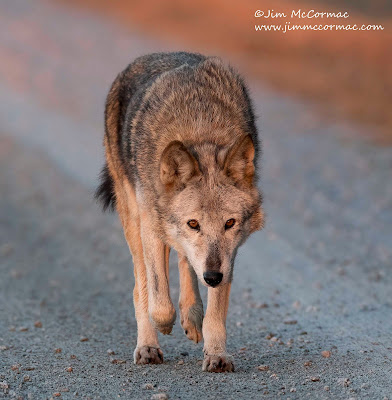
A female red wolf approaches Jim McCormac in the Alligator River National Wildlife Refuge in North Carolina/Jim McCormac
 

Nature: Once common red wolf now among rarest of the rare

Columbus Dispatch
January 30, 2022

NATURE
Jim McCormac

NOTE: See end of column for a link to an excellent film about red wolves.

January 11 was an unforgettable day. I was in the Alligator River National Wildlife Refuge in eastern North Carolina, a sprawling 152,000-acre mosaic of habitats. Mostly I was after waterfowl: thousands of northern pintail and tundra swans use the area, along with other species of fowl. My camera was my weapon.

Near day’s end, I was slowly cruising a seldom-used dirt track. I spotted an object nearly a half-mile down the lane and glassed it with 10-power binoculars. A canid! Either a coyote, or something much more special.

I pulled the Jeep off the track, exited with my big telephoto lens and hid behind the vehicle. Amazingly, the animal kept heading my way, periodically stopping to look about. Occasionally it would make brief forays into the vegetation but then return to the road.

As it got nearer, I saw it was an animal that I had no expectations of seeing – a red wolf! Luckily, I was downwind, and the wolf apparently was unaware of me. It surely saw the vehicle but apparently wasn’t put off by that. I kept clicking off shots, with the majestic mammal eventually approaching to about 75 feet.

At that point, the wolf fixed my lens with a glare (it still couldn’t see much of me), paused, then trotted into nearby woods and melted away. I suspect it had been hunting rabbits, which often come to road edges near dusk.

The federally endangered red wolf is among the rarest of the rare, with all remaining wild animals on the Alligator River refuge.

It wasn’t always so. Prior to European settlement, red wolves were common and ranged throughout the southeastern U.S., possibly including southern Ohio.

As settlers poured into the wilderness, wolf persecution began in earnest. Eventually, governments and farming coalitions offered bounties for their carcasses, and the massacres were successful. In 1978 the red wolf was declared extinct in the wild.

Wolves, possibly including both gray and red wolves, vanished from Ohio much earlier, by the mid-1800’s, victims of relentless persecution.

Fortunately, a number of red wolves had been live-trapped and these formed a captive colony housed at the Point Defiance Zoo & Aquarium in Washington State. In 1987, some of these animals were released into Alligator River.

The wolves flourished in their Carolinian refuge, peaking at perhaps 120 animals in the early 2010’s.

But lots of people still despise wolves, and many of the Carolina wolves have been shot or poisoned if they dared stray onto private lands. As of now, perhaps 17 wolves remain in the wild. The animal that I saw turned out to be a 12-year-old female, known to biologists as “1849”.

It is no longer possible for apex predators such as wolves to survive in vast swaths of the U.S. Human conflict and habitat loss are the primary reasons, and when human interests are at stake, we virtually always prevail.

If only present-day Americans had the deep connection to nature that the Cherokee people did, wolves would have far less to fear. Cherokees ranged over much of the southeast, knew the red wolf well, and held the mammal in reverence, seldom killing them.

Now, to protect the whole of our biodiversity necessitates protecting vast swaths of land, such as the Alligator River National Wildlife Refuge. But even that might not be enough for wide-ranging mammals like wolves. Time will tell how the red wolf saga plays out, and I’m rooting for the wily canines.

Naturalist Jim McCormac writes a column for The Dispatch on the first, third and fifth Sundays of the month. He also writes about nature at www.jimmccormac.blogspot.com.
Justin Grubb, creator of Running Wild Media and native of Worthington, Ohio, released a documentary film about red wolves in 2020. It features excellent footage of wolves and does an excellent job of telling their story. See it RIGHT HERE.