Monday, July 4, 2011

Night-flowering primrose

I recently made a few posts, HERE and HERE, about the suburban wildlife sanctuary that is my parent's yard. But there's more. One evening, I purposely hung out in the backyard as dusk passed into darkness to record the opening of a very special flower; a truly spectacular blooming.

Large-flowered evening-primrose, Oenothera glazioviana. This big, shrubby and showy cultivated primrose is commonly employed in captive plantings. My parent's yard has some pleasing snarls of the stuff, and this photo was taken just before dusk. We can see the long-cylindrical slightly reddish-tinged flower buds still closed tight as a drum. Older flowers, which opened the previous evening, can be seen at the lower left looking faded and brownish. Evening-primrose flowers only last for one evening.

This VIDEO shows the almost magical opening of the flowers. I set my camera on a tripod and let the video roll. Once a flower reaches critical mass, it only takes about two minutes, if that, for the structure to go from tightly rolled bud to fully open flower. You can easily see the whole process unravel before your eyes. No sooner has the flower popped fully open than a moth shoots in to investigate. The reason that evening-primrose flowers open at night is to lure their primary pollinators, moths. The plants' flowers are noctodorous; they release a subtle fragrance at night to lure the lepidopterans. Thanks to Chris Coulon for editing my video footage.

Over 15 minutes or so, the evening-primrose plant goes from no flowers to an incredibly showy shrublet heavily adorned with large lemon-yellow blossoms. By this stage, it is quite dark outside and numerous pollinating moths will be darting about the blossoms. It is very cool to just stand by the plant and watch as the blossoms POP open, for that's just what they do. Apparently specialized photoreceptor cells detect shifts in light, which then trigger rapid cell expansion in the flowers and their attendant sepals. This rush of fluid engorges the cells and causes the flowers to quickly explode to life.


Evening-primrose flowers are hermaphroditic; they contain both male and female parts and thus are self-compatible. Deep in the recesses of the corolla in the center of the flower are the nectaries; the sugary goodies sought by pollinating moths. The eight stamens tipped with their pollen-coated anthers project from the flower's center. Also jutting from the depths of the flower and projecting further outwards is the style, which is capped with a curious four-parted stigma. The style and its stigmas can be seen at the bottom of the flower, laying lax against the petals. It is the stigmas that must receive the pollen from the anthers in order for the plant to be successfully pollinated.

And here is one of the animals that the flower tries so hard to woo - a moth. As soon as the blossom opens, it begins to emit a subtle but distinct fragrance and the moths waste no time investigating. Moths are perfect for this task, and the beauty of evolution has wrought a harmonious relationship between two very different organisms.


Drawn by the flower's odor, the moth navigates to the center of the bloom and plunges its long threadlike tongue deep into its depths to reach the nectar. Well, as anyone who has ever observed a moth knows, they are somewhat clumsy and quite fluttery - hardly the exacting aerialists that hummingbirds are. So, in the process of nectar-diving, the somewhat oafish moth bumbles into that mini forest of stamens and their pollen-dusted anthers. Pollen then adheres to the insect's fuzzy body. Further bumbling by the moth is likely to cause it to glance off the dangling stigmas as it drops from the flower once it has sated itself with nectar. Thus, in the blink of an eye the unsuspecting moth transfers the pollen to the necessary receptors and that will eventually lead to fertile sed and new evening-primrose plants.

Saturday, July 2, 2011

One Big Bullfrog

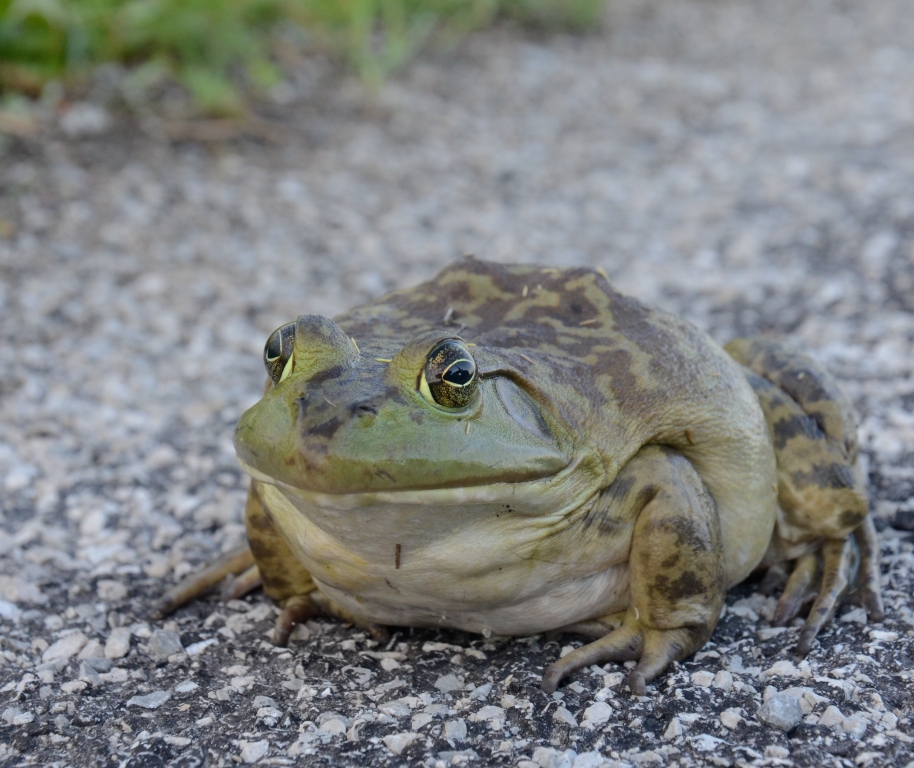
A while back, I was cruising a rural lane enjoying the sights when an enormous lump on the road caught my eye. As I moved nearer, wondering what the unidentified mass might be - bear scat, horse apple, osage-orange fruit?! - the pile transformed into a bullfrog. Possibly the largest bullfrog that I've ever seen, and if I as yet have nothing more to point to in my life, I can honestly say that I've seen a lot of bullfrogs.

A true whopper of an American bullfrog, Rana catesbeiana. This photo was taken from my car window. I had the camera at hand, and figured I'd best snap a shot or two quickly, lest the spring-loaded legs of the long-toed beast catapult it into the weeds.

A note on the bullfrog's name: some authorities have made the case that this species and others should be placed in the much harder to pronounce genus Lithobates (Rana - Ray-nah; Lithobates - Lih-tho-bat-ees). The jury seems out on this proposal so I stick with the long-used name and the one that will be employed in all of your field guides. Whatever the case, the scientific epithet catesbeiana refers to the brilliant and productive English naturalist Mark Catesby (1692-1749). Among his many talents, Catesby was a skilled artist. Check out his rendering of his namesake bullfrog HERE.

Anyway, it turns out I had no worries about the bullfrog fleeing. The thing was not even in the slightest intimidated of me, or my 3,200 lb. car. It just sat there, regarding me with a Yoda-like inscrutability. It's likely that, if the frog had any thoughts at all regarding me, it was lament that I was probably too large to enwrap with its long viscous tongue, by which I could then be pulled into its expandable mouth and swallowed whole.

So I got out of my auto and lay on the pavement with the frog; always, always, working my hardest to bring you the best angles of creatures great and small. Even this intrusion failed to faze her. Now, from a much closer distance, she continued to inspect me with an unblinking stare. Not one millimeter did she move, and if this frog has anything to be grateful for, it is that I am not a frog-legger. There was a meal to be had here, and they say bullfrog gams taste like chicken.

Oh, I called her a "her". The way to tell bullfrog sexes apart is by the "ear", which is more appropriately referred to as the tympanic membrane. This is that drumskinlike round organ just behind the eye. In girls, the typanic membrane is about the same size as the eye; in males it is considerably larger.

I'd say this frog's body - just the body - was about six inches in length, maybe a bit more. Throw in the outstretched legs and you'd use up about all of the real estate on a foot-long ruler measuring her if she was dangled from her toes.

Such a massive predatory amphibian can catch prey we don't normally think of as meeting their demise at the hands (tongues?) of frogs. Big bullfrogs are known to snap up songbirds, small turtles, snakes, and nearly anything else that it is capable of overpowering and stuffing down its gullet. In a fabulous case of forever lamenting NOT having the camera close at hand, I once was walking a marsh's edge and observed numerous massive bullfrogs sitting in the shallows. One looked a bit odd, and after glassing it with the binocs, I saw a somewhat smaller frog, its head still jutting from its captor's mouth.

Bullfrogs create one of the classic summertime sounds, their loud growling roars echoing from ponds and wetlands. And I'm sure that the female starring in this blog has produced her share of little green monsters.

Friday, July 1, 2011

A suburban jungle

The last go-round here at the blog, I shared my parent's front yard, and some of the native plants that reside there. Well, the backyard - which doesn't have to conform so strongly to the curb appeal  suburban dress code - is an even cooler place. Off we go...

This is how a yard should look! If I dare wander out there on one of my visits with macro lens in tow, I'll likely be gone a long time. There are so many interesting insects that are atracted to the plants, and birds galore. The yard list is well over 100 species and includes notables such as Connecticut Warbler. Keep in mind, this is a typically sized suburban lot, somewhere between a third and a half acre. If everyone had a yard like this, there'd be a lot more wildlife around.

There are still plenty of non-native traditional garden plants, such as these orange day lilies, Hemerocallis fulva.

But the day lilies share space with lots of indigenous flora such as this butterfly-weed, Asclepias tuberosa. Butterfly-weed is a tried and true butterfly magnet, and it also attracts many other interesting pollinators.

Gardeners can't be begrudged their old school fare, such as this European bellflower, Campanula rapunculoides. I've got nothing against such plants. They're beautiful and add a dash of panache, but certainly don't spawn the ecological ladders that the natives do.

Nestled in near those bellflowers is this narrow-leaved mountain mint, Pycnanthemum tenuifolium, another nice native. In artificial urban/suburban environments, this is probably a good way to go - traditional not necessarily native garden plants intertwined with high-production natives that host many insects. After all, that's what one is essentially doing when going native in the garden - growing insects. That runs counter to many a gardener's philosophy, which is complete and utter eradication of bugs. Do that, and you'll have a pretty quiet patch, and less birds and other wildlife.

Even the fencerow is a pleasing mixture of native versus non. The vines scaling the fence near the foreground is one of our coolest natives...

Trumpet honeysuckle, Lonicera sempervirens. True, it barely reaches southern Ohio as part of its natural range - this yard is in Columbus - but who cares. If we split hairs to that degree, we'll just confuse people and create discouragement. This is an astonishingly good looking species, and as a major bonus Ruby-throated Hummingbirds love the stuff. In fact, hummers are frequent at this plant, and in recent years have nested nearby.

The back of the backyard. Growth back here has gotten so dense that Gray Catbirds, which are dependent upon thick cover, have begun nesting here. Overshadowing trees include a large black walnut, Juglans nigra, a tulip tree, Liriodendron tulipifera, and sweetgum, Liquidambar styraciflua. The foliage of a redbud, Cercis canadensis, can be seen in the top left of the photo.

I find this very cool. This yard, like so many others, began life as a blank slate, its original growth scrubbed clean by the developer. It's no coincidence that the lightning bugs put on a show on summer eves, and scads of cool moths enliven the night - they aren't getting sprayed to death with chemicals, and they've got plants to host upon.

Shows what one can do with a bit of time and effort.

Wednesday, June 29, 2011

Suburban wildlife

My parents live in the heart of suburbia, in Worthington, Ohio. My mother is a longtime gardener, and has always kept an interesting stable of plant life. When I came into being some years back and gradually became aware of birds, I began to encourage additional plantings. At that time - I was just a tot - I had not yet developed any sophistication about flora; I just knew that MORE plants and MORE cover meant MORE birds. Being that I wasn't to be mobile beyond the limits of my bicycle for a good number of years, it seemed wise to lure as many birds as possible to MY location, and plants seemed to help with that.

Well, a number of years have passed by, my parents still live in that same house, and their level of sophistication involving the garden has evolved. Many native plant species now share space with a dwindled number of day lilies, four-o-clocks and the like. I was up the other day for a visit, and was pleasantly surprised by all of the beasts great and small that had adopted their yard and the plants within.


The walk from the driveway to the front door is a brief one, but an interesting trip nonetheless.

In part because of this luxuriant Helianthus sunflower. It's right along the front walk, and I noticed a lot of action in its boughs as I walked past. Directly in front of the sunflower is a smooth beard's-tongue, Penstemon digitalis (another native!), and my mother reports that Ruby-throated Hummingbirds stop by to sip from its flowers.

I saw that many of the sunflower's stems teemed with tiny red aphids - very cool!

Here's a closeup (as always, you can click the pic to enlarge). These are red sunflower aphids, Uroleucon helianthicola, which apparently are quite happy to nosh on this planted sunflower. Some of the aphids still have their wings, as that's how some them disperse to establish new colonies. Their probosci (snouts) are firmly inserted into the plant tissue, and the tiny insects are happily sucking out nutritious liquids. Happy, that is, until the goldfinches stop by and strip some of them off the stems like boys chomping corn off a cob, which mom reports seeing.

Whether the aphids ultimately kill the sunflower remains to be seen, but for now they have probably provided fodder for all kinds of predators such as those goldfinches. They'll stay, and if some enemies rise up against them and wipe out the colony, so be it.

Myriad flies of several species were in constant attendance. Whether they are seeking honeydew secretions from the aphids, lapping up detritus left over from aphid bore holes, or are just there to watch the show remains unknown to me. Like the aphids, the flies were doing no harm, and certainly weren't rushing the house or causing concern.

I and my camera were excited to see these orange and black brutes wandering about in Sunflower World; comparative giants among the tiny aphids.

They are false milkweed bugs, Lygaeus turcicus (thank you Janet Creamer for helping me identify these. Janet's excellent blog is RIGHT HERE). My initial reaction was that they were one of the milkweed bugs, and I guess they are, sort of. While false milkweed bugs occur on milkweed plants, they routinely jump ship and feed on plants in the sunflower family.

I'm sure this one sunflower plant spawns plenty of other action that I didn't see in my limited observation time. It certainly created a bit of intellectual stimulation between passing the fifteen feet from my car door to the house's front door. Even just a few native plants can cause a massive boost in biodiversity. You would never see this sort of action on a hosta or most other alien garden fare.

And that's just the front yard, which has to be kept rather tidy and groomed for appearance's sake. Wait'll you see the far wilder backyard!

Again, if you wish to delve more deeply into the world of native plants and their myriad benefits, visit the Midwest Native Plant Conference.

Tuesday, June 28, 2011

Native plants rule!

The 3rd annual Midwest Native Plant Conference is approaching: July 8, 9, & 10 in Dayton, Ohio. If you are interested in native wildlife, this conference is for you. The focus is on native plants, but indigenous flora is the building block upon which animals flourish. Check the agenda out RIGHT HERE. There is a Saturday-only option as well, if time is tight.

One of the conference's field trip sites is the legendary Cedar Bog near Urbana. I was there last Saturday, ostensibly to teach a workshop on breeding birds, and we saw/heard plenty of those. But our group didn't ignore the entire ecosystem, either, and what an ecosystem! We saw a great many interesting plants and animals, and a few of the former follow.

Tightly clustered tiny white flowers collectively create a large and showy domelike inflorescence in elderberry, Sambucus nigra ssp. canadensis. This common shrub is a staple of woodland borders, fencerows, ditches and lots of other habitats. A member of the honeysuckle family (Caprifoliaceae), its berries are often harvested for the production of various foodstuffs; even elderberry wine.

Elderberry, especially when in flower, lures an amazing diversity of interesting insects. They in turn attract predators higher up in the insect food chain, which then can become food for birds and higher animals. An elderberry specialist of the insect world is an absolutely gorgeous beetle called the elderberry borer. I have wanted to see one of these gems since I first saw a photo, and finally added one to my beetle life list a few weekends ago. I'll share it later, in a post about the wacky world of beetles.

Resembling a cluster of elfin beach balls, the fruit of starry false solomon's-seal, Maianthemum stellatum, provides a point of interest in Cedar Bog's wet woods. A member of the wildly diverse lily family (Liliaceae), this species is nowhere near as common as the false solomon's-seal, or solomon's plume, M. racemosum, at least in Ohio. Starry false solomon's-seal requires rich limey soil with an above neutral pH.

Certain to grab the eye in Cedar Bog's rich fen meadows is this odd member of the sunflower family (Asteraceae). It is fen indian-plantain, Arnoglossum plantagineum. It is quite rare in Ohio and highly restricted to high quality fens.

Further proof of the lily world's diversity can be found in this curious little herb, false asphodel, Triantha glutinosa. These little fellows might stretch to 8 inches or so in height, and occupy open marly flats within the fen meadow community. It, too, is quite rare in Ohio and is listed as threatened. The specific epithet, glutinosa, means "sticky" and that they are. The stem, especially the upper regions, are heavily beset with glandular hairs and so sticky that small insects frequently become stuck and perish. This stimulates questions about carnivory. Does the plant then absorb useful nitrogen and proteins from these bugs? I don't know that anyone has studied Triantha in this light.

Stars of the meadow, at this season, are the showy grass-pink orchids, Calopogon tuberosus. Grass-pinks are found in fens and bogs, and seeing how well over 90% of those habitats have been destroyed in Ohio since European colonization, the orchid has become quite scarce. Click the photo and you'll better see the small wasp that has landed on the labellum, or lip, of the flower.

Most orchids have the labellum fixed at the lower part of the flower; this arrangement is reversed in Calopogon. The labellum is adorned with a thick brush of hairs which look as if they are coated in tasty nectar. They're not - it's a ruse, but one that has attracted this wasp. The wasp wasn't heavy enough, but if a bee - a common pollinator - lands on that brush of hairs, the labellum will quickly fold downwards, catapulting the bee onto the column where it will be dusted with pollen. Should the bee already carry pollen from another orchid, it'll transfer that to the the stigma and thus pollinate the grass-pink. Apparently, it's primarily the younger bumblebees that fall for this trick; older bees become wise to the deceptive ways of the orchid and learn that there is no tasty nectar reward and ignore the grass-pinks.

Anyway, come out to the Midwest Native Plant Conference and learn much more about our botanical world - and you can even buy some plants!

Monday, June 27, 2011

Purple Fringed Orchid

A mountainside road, scaling the heights of a high peak in the Great Smoky Mountains National Park. Lots of stuff to see on such a drive, but my eye was grabbed by a quick flash of purple in the ditch...

Excellent! Purple fringed orchid, Platanthera pyscodes, a plant I had not seen for a number of years. It's quite the rarity in Ohio, where it is considered threatened and known from but a few sites. These plants were whoppers as well, towering to about two feet in height.

To be technical, I should probably call this one small purple fringed orchid, to distinguish it from the extremely similar large purple fringed orchid, P. grandiflora. Unless you have firsthand experience with both of these closely allied species, you're going to struggle to figure out which one you've got. Some authorities have submerged the latter into the former, and just give grandiflora a varietal rank - Platanthera psycodes var. grandiflora.

The purple fringed orchids are, beyond any shadow of a doubt, among the most beautiful of North American orchids. The lacerated or fringed flowers are works of art, and the color is nearly shocking. Anyone would be impressed. I hope you get to see this plant sometime, if you've not already.

Sunday, June 26, 2011

Junco nest

The view from near the summit of Clingman's Dome in the Great Smoky Mountains National Park. This high altitude knob straddles the North Carolina/Tennessee state line, and rises to 6,643 feet - the highest point in the Smokies. Red spruce, Picea rubens, and Fraser Fir, Abies fraseri, form the dominant plant community but all is not well in coniferland. All of those dead snags are fir that have been attacked and killed by balsam woolly adelgid, Adelges piceae, an introduced insect pest.

Removal of the mature fir has wrought lots of changes in these mountain forests' ecology, including bird life. Nonetheless, many boreal breeders still thrive on Clingman's Dome, including Dark-eyed Junco. Juncos are one of America's best known birds, due to their frequency at winterime backyard feeding stations throughout much of the country. For instance, last winter in my state of Ohio, the Dark-eyed Junco was the second most frequently reported species tallied as part of the Cornell Lab of Ornithology's Project FeederWatch.

Yet only a tiny percentage of all of the people who buy seed and ogle juncos probably know the bird on its nesting grounds. These sparrows breed primarily in coniferous boreal forests, far to the north of the vast majority of folks who feed them in the winter. So, we'll go have a look at how little juncos are made.

At the end of the road leading to Clingman Dome's summit, there is a parking lot and then a steep half-mile trail to the absolute peak and an interesting observation tower. I made this trek both days that I was in the Smokies, hoping for clear skies and grand vistas for photography. It wasn't to be; both times clounds were thick and all-enveloping, allowing only the occasional misty portal into the mountains beyond.

The hikes were hardly a waste of time, though. Many interesting plants, birds and other animals will be seen as one lumbers up and stumbles down the mountainside. On Hike One I noticed an adult Dark-eyed Junco perched near the trail, bill stuffed with a large and scrumptious insect morsel. Obviously a nest was close at hand, complete with young, so I backed off and waited for Mrs. Junco to give up the lair.

And that she did, flitting down to a small well-vegetated opening and into a well-hidden alcove largely masked by plants. It's that small brownish opening dead center in the photo. She was in there for just a moment, and from my perch I could hear the young juncos' wheezy cries reach a fevered pitch as they sought her attention and the insect.

I have found a number of junco nests over the years, and they all pretty much have resembled this one in regards to site characteristics, although the composition of plant species varies. I will take a risk by breaking new etymological ground, and coin a new word for junco nests: phytotroglodytean (phyto = of plants; troglodyte = of caves; cave-dwelling).

Whatever you call a junco nest, it's almost certain to be well hidden. Scads of people walk within ten feet of this nest, every day, and I doubt that hardly any of them noticed it. Nor would I, had I not seen the adult junco with a mouthful of fresh food.

Right after the adult junco departed after a feeding, I found the right angle, and zoomed the camera into the junco's cave hoping that the youngsters would be visible. And one of them was; the others  - three, most likely - remained hidden in the nest cave's darker recesses. Their's is a neat little hiding spot, and juncos excel at creating such nurseries. They must know what they are doing - this species is one of the most common birds in North America.

The next morning, I was pleased to see Senora Junco once again busily delivering insects to the juniors and cramming them down their throats, as the nonstop parade of touristos huffed by up the hill, oblivious to the production of the little "snowbirds". Many of the passersby undoubtedly spend money to purchase seed that fuel wintering juncos, and only know these charismatic little birds from their frosty wintertime backyards.