Monday, December 14, 2009

Props to Ned Keller!

Ned Keller, in a rare state of repose with three furry friends. The animals appear to be looking to Ned for guidance, as so many of us bipeds do.

A Big Congratulations are in order for Ned, who is the 2009 recipient of the Stewart Welsh Conservation Award. This honor is bestowed by the Hamilton County (Ohio) Park District, and goes to individuals who have made a profound difference in environmental protection in southwest Ohio. 2009 marks only the second year that the award has been given, and it is fitting that Ned would be one of its first recipients. Stewart Welsh was a longtime advocate for the environment and was instrumental in establishing the park district's land management program, ultimately helping to make Hamilton County Parks one of the finest park systems in Ohio.

Ned, an attorney by trade, touches lots of people in Ohio, whether they know it or not. Our Ohio Birds listserv, which carries thousands of posts annually and is one of the largest in the country, is aptly managed by Ned and has been for a long time. That's why it is so problem-free, and the listserv has evolved into an indispensable tool for Ohio birders to quickly share their sightings.

He is also secretary of the Ohio Bird Records Committee, a challenging task if there ever were one. Ned was also on board from Day One with the still relatively new Ohio Ornithological Society, serving on its board and helping in many ways. His guidance was, and is, vital to the organization.

Ned is also active in lots of ways in the Cincinnati area, helping to spearhead the massive Cinci Christmas Bird Count, oversee the wonderful Birding in Cincinnati website, help with the local Ohio Young Birders Club, and undoubtedly far more other things of which I've got no idea.

You get the point. This is a guy who volunteers a LOT of his time to help others. And in top of everything, he is just a great guy who is enthusiastic about birds and nature in general. Too bad he can't be cloned.

Congratulations, Ned!

Sunday, December 13, 2009

Allen's Hummingbird - Ohio's first!

The Ohio birding news is now dominated by a tiny 3 gram feathered dynamo known as an Allen's Hummingbird. And with good reason: this is the first documented record of this westerner for the state.

Coincidentally, Pennsylvania's first Allen's Hummingbird record came almost simultaneously, when in a remarkably similar situation to the one described here, Scott Wiedensaul banded and documented one at a Keystone State feeder.


Pastoral Holmes County countryside makes for scenic drives. That's a horse and buggy way down the road - a common conveyance in these parts.

State firsts really get the listers apoplectic with twitcher's disease, and I must confess to suffering from the affliction. When I hear about a bird in Ohio that I've not seen in the state, a restless discontent settles in that is only cured by the chase. For me, it's only this way with my home state list. I generally have no yen to chase New Jersey Ivory Gulls or East Coast Pink-footed Geese - most of these birds I've seen somewhere, or will someday, and it isn't that important where I see them. In fact, to me it's generally more rewarding to see and watch a species on its home turf, where it ought to be.

But, perhaps because I've birding the Buckeye State for so long, my resident list is a big one and the urge to add to it is irresistable. Yesterday's expedition was successful, and the Allen's Hummingbird provided me with my 361st notch on my Ohio list.

A major bonus of this chase was the bird's location - Holmes County. Located in the rolling hills of northeast Ohio, this county has produced an inordinate number of spectacular birds: Green Violet-ear, Violet-green Swallow, Long-billed Curlew, Swallow-tailed Kite, and many more. This plethora of exceptional records is in large part due to the exceptional concentration of stellar birders, many of which are Amish.

The region is also much more bird-friendly than the agriculture-intensive flatlands of the glaciated till plains, where mega-farms have nearly eliminated most habitat in many areas. The photo above shows neat rows of shocked corn, baled Amish style.

Ground zero for our target, the home of Mae Miller, who has graciously welcomed the birding community. A great many visitors have come to view the feathered wonder, and now that it's identification has been confirmed, there'll be a great many more. Look closely and you'll see a throng of admirers in that treeline beyond the silver Toyota Prius.

In a remarkable spot of good luck, Ms. Miller's house and the hummingbird fall within the bounds of a Christmas Bird Count. Should the bird linger for another week or so, they'll be able to tick off a humdinger of a count bird.

One of the more heavily scrutinized backyards in the state. The feeder hangs near that projecting back porch. Our subject has apparently been frequenting this site since late September, and up until a few days ago, was presumed to be a Rufous Hummingbird.

Hummingbirds can be astonishingly hardy, and here's some evidence. There's the feeder in the upper right hand corner, and a thermometer below. When I took the photo, around 9:30 am, it was reading in the low 20's. My car's thermometer read 14 degrees in the lower valleys nearby as I traveled to the spot. As long as these tiny birds can find adequate food, they can survive such temperatures, at least for a while.

Finally - here it is, the state record Allen's Hummingbird on his feeder. You'd not be able to prove that's what it is from this photo, though. We could see the bird far better through our optics, but even then it is difficult if not impossible to be certain of its identity.

Allen's Hummingbird is in the genus Selasphorus, along with the very similar Rufous Hummingbird, of which Ohio gets several a year on average. While adult males are fairly straightforward, females and immature birds are far trickier to tell apart.


Here's a short video of the bird sipping sugar water, then darting off through the frigid air. I didn't have to wait long to see it - I actually spotted the bird flying to the feeder as I walked up to the site. It makes regular and fairly frequent visits, and I don't think anyone who has come has missed seeing it.

This is a MUCH better photo, courtesy of Allen Chartier. Allen is one of the area's few licensed hummingbird banders, and he has made numerous trips to Ohio from his home state of Michigan to band Ohio hummers. Allen's work has been invaluable in verifying the identity of our vagrant hummingbirds, including this one.

Unfortunately, a bit of misinformation about this bird made its way onto our Ohio Birds listserv, and hopefully it hasn't deterred interested birders from seeing this hummingbird if they were so inclined. Anyway, Allen took the time to post accurate info about our specimen, and I quote him below:

"Ohio Birders,

Please let me clarify things before the wild speculation gets even wilder.
Interpreting the use of the word "probable" in the email announcing the presence of this bird is erroneous (my preference would have been "highly likely"). In-hand, Rufous and Allen's Hummingbirds can be identified more than 99% of the time using a combination of plumage characters, feather shapes, and measurements.

I have banded nearly 60 Rufous Hummingbirds in three states, but have never banded an Allen's though I have worked with them in Louisiana with another bander. This individual has only 8 tail feathers instead of the usual 10. And although it is an immature bird, 7 of the 10 tail feathers are adult-type. The measured widths of both outer tail feathers (one is adult, one is immature) are both diagnosticly narrow (up to 1/2 mm narrower than a Rufous should be) for Allen's Hummingbird. This is probably sufficient for the bird to be accepted by the state records committee, though I don't want to pre-judge that.

My caution in being "only" 99% certain of the ID when I left the home was based on this being a first state record, and the fact that I wasn't positive which two feathers were missing. I was simply being cautious until I made the 200+ mile drive home to be able to check more references and look at my photos of the bird more closely to verify some of my suspicions about these missing tail feathers. I like to be thorough before claiming a first state record. All the tail feathers of this bird are very pointed, and the outer three are very narrow.

With good views of the spread tail, it is reasonable to say that it could be identified in the field with perhaps 80-90% confidence (depending on how experienced you are with these birds).


So, the bottom line is that it would be nearly impossible to make a case that this is a Rufous Hummingbird, based on the measurements. Please do not put off going to see this bird based simply on the use of the word "probable" and subsequent misinterpretations of it. The homeowner is very gracious and willing, and the bird should be cooperative, but who knows for how long."

A view of the tail of the Holmes County Allen's Hummingbird, showing the characteristic very narrow outer tail feathers, or rectrices. For this kind of view, one must have the bird in hand. Capturing and banding hummers normally does not faze them in the slightest. The whole operation can be done in ten minutes or so, allowing the bander to collect weight, measurements, and other diagnostic information, and place a truly tiny silver band on one of its legs. The hummingbird will often be back at the feeder minutes later.

For comparison, here is the tail of a Rufous Hummingbird, courtesy of Bill Hilton's excellent blog, This Week at Hilton Pond. This species has, on a comparative scale, much broader outer tail feathers.

Ohio now has several dozen records of Rufous Hummingbird. It's a western species with a broad distribution - our only hummingbird that breeds in Alaska.


The Allen's Hummingbird has a much smaller range, and consequently there are a lot less of them. This is undoubtedly one factor as to why there are FAR fewer records in the east than there are of Rufous Hummingbird.

The increasing numbers of vagrant hummingbirds in the eastern U.S. is a fascinating phenomenon, and there are probably some good reasons for it. But that's another post.

Thanks to Mae Miller for her hospitality and good stewardship of the bird, and to Allen Chartier for his tireless efforts to learn more about hummingbirds, and in particular for his work on this bird.

Thursday, December 10, 2009

Word of the day: Seiche


Waves batter the Lake Erie shoreline. Ohio's north coast is an inland sea - Erie is the 4th largest of the Great Lakes in surface area. And it is the shallowest, with an average depth of just 62 feet.

Because of its shallowness, Lake Erie is prone to vicious wave action generated by storms pushed along by high winds. Conditions on the lake can go from placid to savage in the blink of an eye, making it one of the world's most dangerous water bodies. Many a ship has been unwillingly moored in Davey Jones' locker, on the floor of the lake. Indeed, one of the highest densities of shipwrecks anywhere on the globe rest on Erie's bottom.

Stretching 241 miles from stem to stern, Lake Erie is bookended by the port cities of Toledo, Ohio, and Buffalo, New York.

As anyone residing in these parts knows, we've had some roof-shaking, limb-cracking, umbrella-obliterating high winds the past few days. This front roared out of the west, and barreled down the center of Erie.

And this created an exceptional example of a fascinating hydrological phenomenon known as a seiche. Inhabitants of the lake are fully aware of seiches, whether or not they know them by name, but many non-lake people are surprised to learn about seiches.

Basically, a seiche is a wind-driven massive shift of water - high prolonged winds push Erie's water from one end to the other, causing water to pile up at a higher depth on the downwind side. It's as if you took a bowl of water, and blasted your hair dryer into the bowl from the side. As long as you kept the air flowing, water would stay higher on the far side of the bowl.


Yesterday's gales produced one humdinger of a seiche on Lake Erie. The chart above, from yesterday, shows the sudden drop in water level at Toledo.


Well, all of the water - Lake Erie holds some 116 cubic miles of the stuff! - has to go somewhere. And that would be Buffalo, at the eastern end. Soon after Toledo lost ELEVEN feet of water, Buffalo's water level spiked by 11 feet. That's a Seiche Royale!

Monday, December 7, 2009

Things that lurk in the basement

Spiderlings hatch from eggs.

Each one has eight tiny legs.

A spider has more eyes than you. Most have eight, and you have two.

A spider has two body parts. Across its web it quickly darts.

From a spider's spinnerets, sticky spider silk jets.

Spiders feel the frantic tugs, Of their favorite food; it's bugs!

Janet Bruno

Ah, the shady recesses of a corner of my basement. And a very cool spider web. To the average Joe or Joette, this would be an undesirable cobweb to be swept away.

Not me. I like spiders. And, within reason will keep them around. Why not? Look at it like this: most of these house spiders are going to stay in their webs, and their webs are pretty obvious. So, you know where the spider is.

But not so with all the little critters they are capturing and purging from the house on your behalf. All manner of tiny invertebrates hole up in nooks and crannies during the day, and emerge at night to explore your home. But they'll explore no more, once they bumble into the spider's lair.

I bet you've got one of the above webs, or at least have had one. It is the handiwork of the House Funnel Weaver, Tegenaria domestica, a frequently encountered species. The webs are typically hammocked in a corner like the one above, and they can last a long time. The spider will add to it daily, until the sheet web becomes a thick, silky blanket. The red arrow points to its funnel - the den in which the spider hides and awaits victims.

Closer view of the funnel, which is built into the corner of the web. She is in there, just out of sight. Drop a small cricket onto the web, if you've got one, and you'll see her pretty quick, though. House Funnel Spiders use the surface tension of the web to feel prey. When something jostles the silk, out rushes the spider and quickly dispatches the prey and makes a meal of it. Chances are, whatever it captures is something that you don't want in your house, either.

Terrible choice, eh? You keep the spider - hard to knowingly do, especially for an arachnophobe - and reap the benefits of a cost-free predator ridding your abode of undesirable little beasts that scuttle in the night. The tradeoff? You've got to have a pet spider.

Photo courtesy Dr. Richard Bradley
Mrs. Tegenaria emerges from her funnel. Fortunately for us, they are only a 1/4 inch or so long. Should the fits and spurts of evolution ever produce spiders that are the size of Canada Lynx, whatever humanoids scrabble about the globe at that time shall be in serious peril.

Before you brush that next "cobweb" into oblivion, first pause to think about the engineering marvel that you are laying waste to. Spider webs may represent the pinnacle in small animal engineering. Ornate and incredible in design, webs are designed to effectively snare prey in many ways, depending on the species. Some spiders can produce over a half dozen types of silk - some strands thicker, some thinner, some very glutinous, other silks non-sticky, etc.

Some webs catch flying critters. Others specialize in grabbing ground and wall-crawlers, like our blog subject. Some species use specialized silken strands to knock bugs from the air and into a primary web. One species actually swings a silk rope like a lasso and snatches moths from the air!
Photo courtesy Dr. Richard Bradley
The last thing an earwig will see on this planet - the visage of a pouncing House Funnel Spider!

For some reason, certain animals spook us to an inordinate degree. Spiders most definitely do. But as is the case with most things, familiarity breeds appreciation. Spiders are interesting, and worthy of a closer look.

To learn more about Ohio's spiders, and even help contribute to our knowledge of them, visit the home of the Ohio Spider Survey.

Sunday, December 6, 2009

Wonder what the kids'll look like?

The following photos are the work of German photographer Tanja Askani, and as might be expected, they're rapidly migrating around the globe courtesy the World Wide Web.

Wild animals sometimes form odd pair bonds, and this one ranks high among strange couplings. But a deer and a rabbit?! What would the offspring be? A "deerbit"?

You can read a bit more about this odd couple here; one of the comments explains the situation more fully, including how deer and rabbit met.


Thursday, December 3, 2009

Red-breasted Mergansers

Red-breasted Mergansers (mostly) on Lake Erie, east of Cleveland, November 2006. Lake Erie, especially the waters between the islands (South Bass, Kelleys, etc) and east to the Ashtabula area, is a major staging area for this species.

Our Ohio Birds listserv has hosted lots of discussion about this species, some of it from veteran lake-watchers who have a good grasp on waterbird movements on the lake. There is a general consensus that numbers have declined, but trying to determine by how much, or what the causes may be, is not easy.

I remember on many occasions seeing passing swarms of mergansers that were so massive and so dense that the flocks looked all the world like storm clouds scudding rapidly low over the water. Trying to estimate their numbers was practically an excercise in futility; certainly falling more into the "guesstimate" than estimate category. As many as 250,000 mergs have been claimed in one day in years past.

There are still a lot of birds on Lake Erie. I've been fortunate enough to have the opportunity to fly low over the lake in an airplane a number of times in recent weeks, specifically to estimate bird numbers and species. Aerial perspectives give observers a far more realistic picture of what's going on out on Lake Erie than onshore observers can hope for, in part because we can travel far beyond the reach of onshore optics, can cover much more ground, and can see many more birds simultaneously.

Estimating Red-breasted Merganser numbers on Lake Erie is still tough!

Red-breasted Mergansers are flighty critters; far more so than other waterfowl that we encounter on the lake. They are prone to frequent liftoffs and aerial sorties, and may do lots of circular wanderings, compounding the likelihood of double-counting. This is especially true when estimating from an onshore site, where it's possible many of the same birds will pass by in a relatively short window.

So, while merg numbers may be down from record highs of the 1980's, there are still lots of birds out there. Estimates from the last week or so from aerial surveys calculate well over 80,000, and these tallies are a lot more solid than prior estimates made from the ground. And it's almost certain that many birds are missed - it's impossible to find them all, even from an airplane.

It's premature to speculate as to exactly what may be causing the demise of Red-breasted Mergansers on Lake Erie, or even if they truly are declining.

There will be some interesting data on this issue emerging, and a good upcoming opportunity to learn more about the status of migratory waterbirds on Lake Erie. I'll report more on that later.

Sunday, November 29, 2009

Robins and Global Warming

Earlier this year, the National Audubon Society (NAS) released a report entitled: Birds and Climate Change: Ecological Disruption in Motion.

It didn't take much of a perusal to cause red flags to fly up. Basically, NAS studied 305 species of North American birds using the past 40 years of Christmas Bird Count data as their primary stock, and claim that the majority of the study subjects are expanding their winter ranges northward. The report garnered good press, which I suspect was the primary intent. However, the report has also been criticized as overly broad-reaching in its conclusion that global warming has caused widespread northward range expansions of birds.

I rarely use this blog to criticize, but the NAS has put this report forth under the mantle of good science; therefore it is only fair to dissect it. And dissect the report in detail I will not, but the claims of tying in some of these alleged range expansions with global warming is worth a look. Mind you, buried in their report is a brief disclaimer stating that other factors may also be responsible for range expansions, but the overwhelming message is that climate change is to blame.

For the record, I do want to say that I certainly believe man-induced weather changes are occurring - I don't believe it possible to wreak the ecological havoc that our species is and not have such consequences. But jumping on sensationalist climate change bandwagons and using shoddy claims to back a PR campaign for purposes of a fundraising/membership drive is not too cool, either.

Gorgeous male American Robin. According to NAS, robins have expanded their wintering range northward by 206 miles in the last 40 years. I wouldn't dispute that. The real questions is... why? I'll offer what may be a more justifiable and documentable theory than global warming in a minute.

Of the 305 study species in the NAS report, 64% have advanced their winter ranges northward, according to the report authors' analysis. The other 36% went southward, apparently. But of the northbound birds, most species' expansion is seemingly inconsequential; possibly statistically insignificant. We're talking one, two, maybe ten or twenty miles in some cases.

So, I culled the heavy-hitters - species that have moved over 200 miles northward. There are nineteen of them and it's an interesting list. Global warming is the NAS position for these expansions; I will offer a few other possible explanations. I'm saving the robin for last, but here are the other 18 species grouped under alternative hypotheses that might allow species to expand northward in winter or be more likely to be detected (some species are included in more than one category as multiple factors may be involved):

INCREASED PREVALENCE OF FEEDERS
Steller's Jay
Fox Sparrow
House Finch
Purple Finch
Pine Siskin
Red-breasted Nuthatch
"Rufous-sided" Towhee (Eastern and Spotted are lumped)

INCREASED OBSERVERS AND REPORTING ON CBC'S (An example: for the 1st 10 years of the 40 year study period, the Canadian province of Ontario averaged 27 counts and 725 0bservers annually. For the second quarter, this ballooned to 38 counts and 1,192 observers. In the third 10 year period there were 50 counts and 1,283 observers. In the final quarter there were 63 counts and 1,754 observers annually. These factors, along with increased bird feeding, would certainly seem to play a role in keeping birds north, and increasing the detection and reporting of them)
Steller's Jay
Purple Finch
Pine Siskin
Boreal Chickadee
Red-breasted Nuthatch
American Three-toed Woodpecker
Spruce Grouse

INTRODUCTIONS (Species either accidentally or intentionally liberated and still actively expanding their ranges)
House Finch (eastern populations result of 1940 release in New York; still expanding in areas)
Wild Turkey (Fish and Game agencies are actively reintroducing turkey in many areas)

INCREASED FOOD SOURCES (either waste associated with expanding human population, or non-native plants)
Ring-billed Gull
American Robin

INCREASE IN BIRDER SOPHISTICATION (better knowledge of winter distribution and where to find birds; increased use of boats for pelagic species; I-pod and audio technology to locate secretive species)
Pygmy Nuthatch
Marbled Murrelet
Virginia Rail
Spruce Grouse

NOT SURE (I don't spend time in the winter range, and am not sure of what factors might be involved)
Varied Thrush

GOOD GLOBAL WARMING CANDIDATES? (These species require open water; obviously warming temperatures would allow them to remain further north)
Ring-necked Duck
Red-breasted Merganser

Now, let's get to the case of the American Robin. The photo above shows the "new" woodland understory of Ohio and an ever increasing area of the Upper Midwest. Any of several species of bush honeysuckles (Lonicera spp.) are overrunning the landscape, providing millions of juicy berries that not long ago were unavailable. If you are a frugivorous (fruit-eating) bird, this means new feeding opportunities.

Robin snags an earthworm. During warmer months, robins prey heavily on worms and other small animals; in colder months they switch to a diet heavily dominated by fruit.
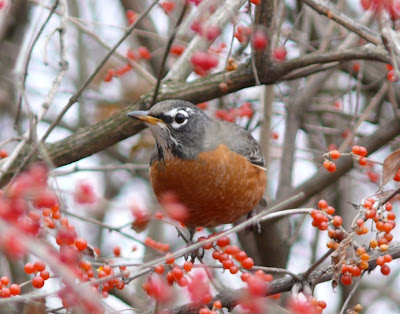
Female American Robin surrounded by the fruit of Amur Honeysuckle, Lonicera maackii, upon which it and dozens of other robins were gorging. This photo was taken in Columbus, Ohio, on the Columbus Christmas Bird Count, December 2008. The massive amount of non-native honeysuckle fruit now available is enticing robins to winter further north in ever greater numbers.

Bush honeysuckles, native to Eurasia, were originally planted for their pleasing aesthetic qualities - showy, shiny fruit and pretty fragrant flowers - as well as wildlife food. These plants now serve as a prime example of the folly of intentionally introducing non-native species, as they have proliferated to the point where native plants have been adversely impacted, ecological webs fractured, and bird populations have been influenced to winter north of where they ought to be.

Perhaps the first academic botanical text to mention Ohio's worst invader honeysuckle, Amur Honeysuckle, was E.L. Braun's Woody Plants of Ohio, published in 1961. Here is what Ms. Braun said about the plant 48 years ago: "Reported only from Hamilton County, where it is becoming abundant in pastures and woodlands".

The map above is from a 1995 publication, The Dicotyledoneae of Ohio: Part 2, by botanist Tom Cooperrider. We can see that a tremendous expansion of Amur Honeysuckle has occurred in the 34 years since Braun's note.

This map of Amur Honeysuckle is hot off the presses, courtesy of Rick Gardner, botanist for the Ohio Department of Natural Resources. Like all good plant maps, it is based on specimens, and shows the continued invasion of Amur Honeysuckle. Based on my travels, I am confident in saying that the plant is present in all of Ohio's 88 counties, even if specimen records don't yet document that. Furthermore, it is absolutely abundant in many areas, producing robin food by the bushel. Not just Ohio, either - honeysuckles are on the rampage in many areas.

Global warming undoubtedly is causing impacts to some birds, other animals, and plants. But tarring a whole suite of bird species with the global warming brush, as NAS has done in their report, is misleading. Many other factors come into play, and it is only fair to analyze those as well.