Yesterday marked the second annual Ohio Young Birders Club conference, and it was an event to be proud of. The inaugural conference was held at Ottawa National Wildlife Refuge's new visitor, a fine venue but one in which we were bursting at the seams. So this year it was on to a bigger facility: the Chestnut Ridge Elementary School in Walnut Creek, smack in the heart of scenic Holmes County.
Hats off to Kim Kaufman and all of her able volunteers at the Black Swamp Bird Observatory for not only making this conference possible, but for spearheading the whole young birders agenda. It is a growing movement here in Ohio, and their example is migrating far beyond the state's boundaries. Several other states have been in communication with Kim and BSBO seeking tips for starting their own programs, and a few have already sprung up. The American Birding Association even sent along Steve Carbol, their education manager, to study the program. Steve is a fantastic addition to ABA and it was a pleasure to meet him.
About 110 attendees made the scene, most from Ohio, but I remember people from Indiana, Michigan, Florida, Pennsylvania, Kentucky, and Connecticut. I'm sure I'm forgetting some, too. Insofar as I know, this would make the 2nd OYBC conference the biggest of its kind, truly something to be proud of.
 We started the day in the field, which is probably the best way to start such a conference. The locale was the vast wetlands of Funk Bottoms Wildlife Area, and the day began misty and cool. Here's the mob scene at the start, which was quickly organized into separate parties which then headed out to find birds.
 Best bird of the day, and not the way you'll ever want to find one. This Barn Owl, a threatened breeding species in Ohio, was floating face down in the wetland. We speculate that it was attempting to capture a frog or some other aquatic beast, and dove into the water. The aquatic vegetation was dense in this spot, and the owl became snared and couldn't free itself. A teachable moment was made of the situation. The aforementioned Steve Carbol boldly waded into the muck-bottomed duckweed-choked mire and retrieved the bird. After good looks were had by all present, Andy Jones bundled it up and will make it part of the Cleveland Museum of Natural History's bird collection, which he curates.
 Fortunately, most of the birds that we saw were alive and well, including these Sandhill Cranes. We saw plenty of those; probably 30 or 40 were in the area and treated us to their haunting prehistoric rattles, and impressive visages. Lots of other birds were seen, and Funk was lousy with Swamp Sparrows. This should be a great place to search for both Le Conte's and Nelson's Sharp-tailed Sparrows in the coming weeks. As if bidding our team farewell, a beautiful Peregrine Falcon appeared and sat high in a dead snag.
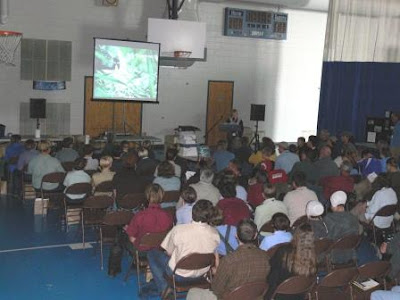 We repaired to the school, and an excellent lunch, then it was into the meat of the program. This conference, like its successor, is entirely run by people that are in the age bracket required for OYBC membership: 12 to 18. Ben Thornton, age 14, was the emcee and performed so well that he runs the risk of being emcee for life at these gigs. Great job, Ben!
First up was Auriel Van Der Laar, who gave a program on the rail research that she has been involved with in the western Lake Erie marshes. This is ground-breaking work, and she, like all of the speakers, did an outstanding job of communication both with words and their PowerPoints. Bret McCarty was next, articulating the allure of winter time birding along the Cleveland lakefront, and offering up images of all the fantastic birds to be found. One must be willing to brave the cold, but as Bret demonstrated, those who do will see lots of interesting gulls and waterfowl. Then it was Jared Merriman, who gave an insightful program about ecotourism and birding. This guy has been around, for being 17! Jared took us on a whirlwind tour throughout the America's, and made the point that birders and our travels can be a positive influence on conservation.

Like misbehaving schoolboys, this crew rode the back benches of the auditorium. Closest to furthest, it's Jeff Bouton, extreme birder, globetrotter, and rep for Leica Sport Optics; Bill Thompson III, editor of Bird Watcher's Digest; and Jim McCarty, reporter for the Cleveland Plain Dealer and author of a wonderful weekly birding column. Wedged between Bill and Jim are Phoebe Thompson and Bret McCarty.

This bird was in Jacob Bowman's talk, and it's a stumper. This is why Bill is looking through his bins in the preceding photo and why many of us bring our binocs along to talks like these - so we can practice our birding skills. Good luck trying to figure this one out!
After a break and the chance to meet people and catch up with old friends, it was back for the remaining programs. Jacob Bowman led off with an updated accounting of his ongoing BIG YEAR. If I remember correctly, he is at 243 to date and this is all in the general area of Holmes County. What makes this a truly monumental achievement is that he has done it all by BICYCLE! Next up was Ethan Kistler and Brad Wilkinson, who jointly gave a wonderful program on their recent travels to Ecuador. In addition to showing great shots of birds like Booted Racquettail and the intriguing habitats that are to be found, they tied in the positive effects of ecotourism on conserving Ecuadorian habitats. Topping off the program was our keynote speaker, Hope Batchellor, age 16, from Petersburg, New York. Hope became intrigued with the lack of published information relating to fledgling songbirds, especially their vocalizations, and set out to add to our knowledge. She treated attendees to not only photos of various fledgling species that she has worked with, but also recordings of their calls. A lot of this information, particularly the recordings, are not well represented in collections and her work and program were very impressive.
 Here's the crew that made the whole day possible. Left to right: Ethan Kistler, Ben Thornton, Brad Wilkinson, Auriel Van Der Laar, Bret McCarty, Jared Merriman, Jacob Bowman, and Hope Batcheller. Great job everyone, and congratulations to each of you!
The Ohio Young Birders Club welcomes adult supporting members. This is a great way to support the club - please join us! For more information just GO RIGHT HERE.
 Costa Rican roadside scenery. This stream, tinted whitish-blue by mineral deposits, coursed under a roadway on the lower Caribbean slope. Of course, we stopped to admire the view and in the process found lots of wonderful birds and plants. Any stop anywhere is almost certain to produce a lot of noteworthy sightings.
 A bit higher up the Caribbean slope. One can see the origin of the aptly named cloud forests in this shot. Even though it is only about half the size of Ohio, Costa Rica abounds in habitat diversity, ranging from humid lowland jungle to mountainous highlands populated by montane flora.
 Birding is stupendous. Getting great looks at many species is often not a problem. I photographed this Bare-throated Tiger-Heron from a boat in the jungles of Tortuguero National Park, a vast waterlogged coastal jungle along the shores of the Caribbean. Access is by boat only, and this method of transport offers stupendous views of birds, monkeys, sloths, caimans, and other sundry beasts. We'll be going here in 2009.
 Chestnut-mandibled Toucan, photographed while ingesting sensational Costa Rican java on the deck of the villa at Oro Verde preserve. We convene on this balcony each morning, and rack up dozens of species practically at one's fingertips. The cecropia tree that this toucan is gracing attracts incredible birds, including Oro Verde's mascot species, the Baird's Trogon. Oro Verde will be another stop on our itinerary.


 Golden Pholiota, Pholiota limonella. This is one of the wood decomposers, and an especially striking species. Fungi are rich and varied; some estimates put the worldwide species total at over one million. Of course, no one really knows, and if you want to enter a field that is ripe for new discoveries, become a mycologist (fungi scientist, or perhaps, a "fun guy").
 Golden Pholiotas feel funny. Touch one, and the sensation is just like sticking your finger into wet spongy bread dough. Kind of makes you recoil. And unlike good bread, you wouldn't want to eat it. This species wouldn't kill you, but according to firsthand accounts you would probably become unpleasantly ill.
 The aptly named Yellow-and-black Mud Dauber, a real beauty. Most wasps are visually striking, if one can get over the fact that a lot of them can give a gnarly sting. Fortunately for us, few if any are adapted to kill people, and for the most part are quite docile to humankind. I had my macro lens within inches of this guy. He was still in a bit of an early morning torpor, but quickly came to and set about hunting spiders.
 Some arbiter of fashion and style must have seen a wasp like this when he/she coined the wasp-waisted term. That is one threadlike abdomen, so small one wonders how this animal even functions. Sure creates a neat look, though.

 A fine trunk of an Eastern Cottonwood, Populus deltoides. Good Brown Creeper foraging substrate, but they aren't overly selective about the timber they work. They'll blend well with nearly anything. See him? Right there - dead center! We attracted this bird in close with skillful imitations, much to the delight of the crowd. Senor Creeper decided to chill for a bit and plastered himself to the bark over our heads for several minutes. A number of our party had not seen one before, or at least this well, so this may have been the most fawned over Brown Creeper on the globe that day.
 Same pic, cropped in a bit. Now, I am sure, you can see the bird. The tawny mottling on bark-brown feathers conspire to create the look of lichen-dappled bark, and when a creeper freezes they become nearly invisible. Woe to the insect attempting to hide in the fissures and furrows of the bark. Creepers very systematically and thoroughly poke and probe their way up the tree, probably missing little. Put yourself in their shoes. The perspective must be an interesting one.

 Good thing its only about an inch long. It's from critters like this that the Japanese no doubt find the inspiration to create some of those god-awful creatures in B-movie horror flicks. But this one is real. They do look a lot like praying mantids, at least the forelegs. Mantisflies are predators, and even though they are closely allied with lacewings and not praying mantises, convergent evolution is at work here, and they have evolved similar powerful forelegs, the better to seize prey with.
 There are a number of mantisflies, but I believe this one is Mantispa sayi. It has incredible cobalt-blue eyes with a star-shaped pattern in the center. You can see the Popeye-like forearms here. Wouldn't want to be the unfortunate insect that wandering into the path of this thing.
 This excellent photo courtesy Tim Daniel, Ohio Division of Wildlife. The forelegs armed with stiff raptorial spines can be seen. Those stiff spines reduce - probably eliminate - any chance of slipping through the mantisfly's clutches.
 Photographed last Saturday, right outside the
 He was actively engaged in frugivory, or fruit-eating. The berries of this Gray Dogwood held a strong allure, and the bird would make regular visits to sample them. It wouldn't swallow the fruit; rather it would carve out a hole in the top and suck the juices out. This species has a very fine bill and is well-known for foraging on nectar in migration and on the wintering grounds. During the breeding season in the boreal forests of northern North America, they depend heavily on spruce budworms.