Sunday, April 13, 2014

Darters and avian rarities

I saw a lot of our great state of Ohio this weekend (as etched out by the red line). On Saturday, I visited one of my favorite places, the vast Edge of Appalachia Preserve in Adams County. I was invited to participate in a field trip hosted by Josh Knights, director of The Nature Conservancy, and he, TNC'er Briana Walsh, and I led some Edge supporters through the wonders of Abner Hollow.


An impossibly colored male Rainbow Darter stares slack-jawed at your narrator.

This morning, I met three of the most knowledgeable aquatic ecologists you'll ever cross paths with at Little Darby Creek in southwest Franklin County. I'll tell that tale, with plenty of pictures, soon. After our highly successful fishing expedition, I headed north to Huron on Lake Erie. A very rare (in Ohio) Scissor-tailed Flycatcher has been frequenting a golf course there for several days. I saw it and basked in the bird's presence for several hours, and got plenty of photos. More on that tomorrow.

In all, I covered about 500 miles this weekend, from the Ohio River to Lake Erie, and took well over 1,000 images in the process. I look forward to sharing some with you as soon as I can sort them all out.

Friday, April 11, 2014

Neotropic Cormorant: One to watch for

Photo:Hans Hillewaert/Wiki Commons

The Neotropic Cormorant, Phalacrocorax brasiliensis, is one to watch for in Ohio. I believe we could be considered well overdue for an appearance by this diminutive relative of the Double-crested Cormorant. New Jersey birders are relishing that state's first record as I write this, and with luck Ohio birders will soon confirm this species in our state.

Neotropic Cormorants are very similar to the Double-crested Cormorant, and vagrants are likely to be fraternizing with that species. The first thing that will probably catch your eye is the size differential - the Neotropic Cormorant is noticeably smaller than its robust brethren. It's over a half-foot shorter in length, and a full foot shorter in the wingspan department. Neotropics also weigh about a pound less on average, and that translates to a bird that appears daintier than a Double-crested. The tail also looks big in proportion to the rest of the bird. Problem is, there are two subspecies of Double-crested Cormorant (normally occurring in Florida and the Caribbean) that are also noticeably smaller than the typical Double-crested Cormorant subspecies that we get in this part of the world. Upshot: you can't go on size alone for a positive identification. The elfin Double-crested Cormorant subspecies could also conceivably appear here, too.

Rather than me rehashing field marks here, consult your Sibley or other good guide for identification characters. And go on high alert if you do spot a tiny cormorant.

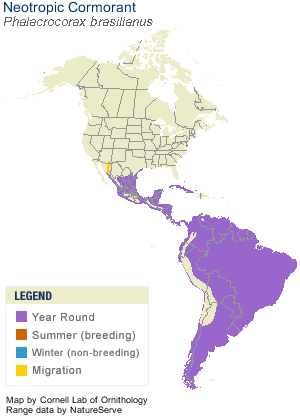
This fine map by the Cornell Lab of Ornithology shows the overall distribution of the Neotropic Cormorant. It's much more widespread in the Middle and South Americas than it is north of the Mexican border.

This is the Birds of North America Online map, and it gives us more detail regarding the northern limits of the Neotropic Cormorant's range. The dashed lines and outlying red dots indicate vagrancy, although I'm not sure the Pennsylvania record is correct. At least I couldn't find verification on the PA rare birds committee website. Even if it is in error, Pennsylvania will probably get one soon. This is a cormorant on the march. The overall population is growing, and new nesting colonies are cropping up outside of traditional breeding areas.

The number of Midwestern and Great Lakes region records has soared in the last decade or so. Illinois has had at eight since 1992, and Indiana has had at least five since 2011. A Neotropic Cormorant in 2012 was practically within a stone's throw of Cincinnati, and another was found in the state just a few days ago.

Kentucky is up to at least two records - 2007 and 2013 - and just across the International border at Point Pelee in Ontario, Canada, they've found three in the past few years, including last year. Point Pelee is only 23 miles from Kelleys Island in Ohio waters. Even Michigan has had one, in 2008.

You get my point. Neotropic Cormorant is a very likely candidate to appear in Ohio, so don't ignore those cormorants!

Wednesday, April 9, 2014

Red-necked Grebe update

Photo: Phil Fry.
This bird was on Kaiser Lake in Champaign County today, and was yet another county record in the ongoing invasion.

Red-necked Grebes are normally a rare sight in Ohio, or anywhere else in the interior U.S. south of the Great Lakes and away from the Atlantic Ocean. Not this spring, however - these chunky grebes have staged an invasion of epic proportions; a movement previously unrivaled in scope. I wrote in more detail about the likely origins of these birds, and the reasons for their massive invasion of interior eastern North America, RIGHT HERE.

If you know of any additional county records not depicted on the following map, please let me know. It's been tough to try and keep track of all the Red-necked Grebe reports that are bombarding various forums, and I haven't yet made a detailed eBird analysis to try and pick up additional records.

UPDATE: I posted this map, with a plea for additional sightings, to various Facebook birding pages today. A whopping 55 new birds came in, as well as three new counties. Thank you to everyone who contributes your sightings, whether it be to Facebook, the Ohio Birds Listserv, eBird, or anywhere else. An updated tally appears below the map.


I cobbled together this map showing the Ohio records. Data comes from reports submitted to the Ohio Birds Listserv, various Facebook birding groups, the Cincinnati and Toledo birding websites, and direct reports. I'm quite sure there are other records floating around, and as always I welcome additions, deletions, corrections of any sort, and of course, any praise, however faint, is always welcome :-)

The map depicts a staggering invasion of Red-necked Grebes. Sixty-three counties, and a total of 371 birds by my reckoning. This far eclipses the previous record flights, which took place in February and March of 1994, when 111+ grebes were tallied in Ohio, and 2003 when around 200 birds were reported. This year's irruption is not confined to Ohio; many eastern states are experiencing a similar incursion. And I'm sure we'll have additional records before April's end.

Monday, April 7, 2014

Muskrats deserve love as vital vole of wetlands


April 5, 2014

NATURE
Jim McCormac

In the beginning, Kitchi-Manitou, creator of Earth, populated the lands with the Anishinabe. After these original peoples descended into conflict and war, Kitchi-Manitou flooded the lands in retribution. Nanaboozhoo was the sole survivor, along with a handful of animals. One of them was a muskrat. From their log ark, Nanaboozhoo sent the muskrat diving below the floodwaters. It returned with a pawful of earth, and from that the lands were re-created.

— Ojibway legend

I’ve written natural history columns for The Dispatch for a decade — more than 160 pieces on almost as many subjects — but never about the muskrat. Given its prominence in creation lore, an essay on the “earth diver” is overdue.

Although muskrats resemble beavers, they are only distant relatives of the much larger rodents. The muskrat is related to mice and voles, and is essentially a supersize aquatic vole.

A hefty muskrat might weigh 4 pounds; a big beaver can be 70 pounds. Beavers also have a horizontally flattened tail, while the muskrat’s is laterally compressed, as if compacted in a vise.

Because muskrats are largely nocturnal, they aren’t often seen. But their lodges are conspicuous. The large domes rise from the water like small islands and are mostly composed of vegetation. Beaver lodges look similar but are typically much larger and built of sticks and other woody material.

Muskrat lodges are well-built and watertight. The underwater entrances allow the animals to slip in and out unseen. Secret passages don’t deter minks, and the ferocious weasels sometimes enter the lodge and slay the occupants.

The pelage of a muskrat is soft, sleek and water-repellant. Their furs are coveted by trappers, and current prices have soared to about $14 per pelt. Such prices spur more trapping, but muskrats remain abundant. Females usually have two annual litters averaging six kits each. During one three-month season, 10,191 muskrats were harvested in a 2,800-acre Lake Erie marsh.

Muskrats are an important cog in wetland ecology. They are prolific grazers of aquatic plants and help to keep marshes open and free of choking growth.

Semiopen marshes usually support greater animal diversity, including waterfowl. The lodges literally support ducks and geese, which sometimes nest atop the domes.

The muskrat plays a much larger role in nature than its lowly stature might suggest.

Naturalist Jim McCormac writes a column for The Dispatch on the first and third Sundays of the month. He also writes about nature at www.jimmccormac.blogspot.com.

Sunday, April 6, 2014

The amphibians arise!


A spotted salamander, Ambystoma maculatum, threads it way through a wet leafy forest floor. It, and many others of its kind, were on the march last Thursday evening. I always make time to go nocturnal with the first warm spring nights, and catch the eruption of amphibians - especially salamanders - as they rise and venture to breeding pools.

This is a smallmouth salamander, Ambystoma texanum, and it too was headed to a massive vernal pool complex. This animal and the preceding (and some of the upcoming) were found and photographed in Crawford County. Thanks to Josh Dyer with the Crawford County Park District for meeting up with Susan Nash and I, and sharing this place. If you get the opportunity to go to one of Josh's outings or programs, do it. CLICK HERE for information.

A spotted salamander rears up like a mini dragon, the better to see what kind of threat your narrator may pose. I am no threat, but cars certainly are. This one was crossing a roadway, and many don't make it across. On Wednesday night, I along with Cheryl Erwin visited one of my favorite sites, a wet woods in Logan County bisected by a rarely traveled country road. Big vernal pools bookend the roadway, and salamanders and other amphibians cross in droves. Even though few vehicles use the road, those that do pass by during migrations cause carnage. I was delighted to hear from LeeAnn Leslie Shively Swonguer that the township trustees recently closed the road temporarily during a big amphibian migration. That is awesome, and major kudos to LeeAnn as I suspect she had a lot to do with that. Many moist skins were saved that night.

The red eft larval stage of a red-spotted newt, Notophthalmus viridescens, crosses the roadway. An eft lives a terrestrial life for several years before entering the water of a pond or wetland, and living the remainder of its life as the adult newt. This particular road always has efts crossing it in early spring along with many other amphibians. I suspect they are making their final overland treks, and preparing to enter the water and transform into the adult stage.

A green frog, Lithobates clamitans, floats in several feet of cold water. I can tell you it was cold because I was standing in it.This particular pool was jamming with amphibians, and I quickly saw there would be photo opportunities here. Unfortunately, I had forgotten to throw my chest waders in the car, and only had knee boots. The water was far deeper than that. Oh well, if the frogs can stand it so can I, and in I went. Frogs are often FAR more approachable at night than they would be during daytime, and this one allowed me to get as close as I wanted.

Lots of frogs and some toads were crossing roads last Thursday night, taking advantage of the wet night to move to breeding sites. Included in their ranks was this gorgeous northern leopard frog, Lithobates pipiens. During the day, leopard frogs typically bound off in a series of enormous leaps, and can be rather difficult to approach closely. Not so at night. We lifted the girl off the road and placed her on a convenient stump for photographs, and to get her off the road. NOTE: If you must handle amphibians, make sure your hands are thoroughly wet so as to avoid damaging their skin. In general, it's best to not touch them, in my opinion, unless of course you are required to move them to safety.

I mentioned the frog is a "girl". You can tell the sexes apart by the size of the tympanum, or "ear" - that round spot directly behind the eye. In males, it is noticeably larger than the eye, and about the same size or slightly smaller in females.

The pools were alive with the sound of music - frog music. This is a western chorus frog, Pseudacris triseriata, singing away. Lots of them were rasping away just about anywhere there was a wetland. I recently wrote about this species in more detail HERE.


Click the video above for a brief recording of the distinctive song of a chorus frog, shot at close range in Josh's Crawford County vernal pool.

A tiny spring peeper, Pseudacris crucifer, glares at your narrator, who rather impolitely intruded on the frog's wetland.

Here's what a spring peeper in full puff looks like. I worked hard for this shot, I don't mind telling you. This was in the (cold!) wetland (with plenty of robust leeches!) that I waded around in for about one-half hour. My primary quest was to obtain good shots of singing peepers. Normally, in order to make such shots you have to enter the water, or at least your probability of encountering singers rises significantly if you do. Sure enough, I found about eight singing frogs, but all of them shut up as soon as I got within range. Finally, I spotted this guy over on the bank and he cooperated. Turns out I wouldn't have had to even go in the water to get the shot! Oh well, being one with the frogs is part of truly experiencing life in a frog-filled vernal pool.


I made this audio recording while standing waist deep in water, surrounded by numerous singing spring peepers. If you've never done this, you owe it to yourself. The din created by these tiny blowhards is mind-boggling. When in very close proximity, their calls actually hurt one's ears.

Get out and enjoy the peepers and other amphibians while you can. A person only has so many springs to experience, and you should not let even one of them slip by without listening to the music of the frogs.

Friday, April 4, 2014

Email updates for this blog!

I dropped down to the Birding Optics & Gear Expo tonight, and saw scads of fabulous people, binoculars, scopes and other trappings for outdoor enthusiasts. Be sure to get down there tomorrow or Sunday morning - it's at the Grange Insurance Audubon Center, and the details are RIGHT HERE.

While there, I imposed on Wendy Clark to help me figure out how to add an email update option for this blog. I am a bit of a techno-dunderhead when it comes to this sort of thing. Anyway, she rather quickly sorted the whole thing out and Voila! At the top right of the page, about opposite of the header for the latest blog post is a line "follow by email". Just below that is a box in which you can type your email address, and then click the "submit" button. You'll soon receive an email that includes a link. Click that link and it will confirm that you are now subscribed to the blog.

You'll be notified of any new posts or updated via email. People periodically asked me why I didn't have such a feature, including John, tonight at the Expo. That finally prompted me to buttonhole Wendy and see if she could help. She did, and I am most appreciative! So please, feel free to get news of updates via email!

Wednesday, April 2, 2014

Birding Optics & Gear Expo!

Your narrator stands knee deep in sedges, way back in the Okefenokee Swamp of Georgia. It goes without saying that a pair of binoculars hang around my neck. Those bins were put to good use on that trip, as I ogled everything from Sandhill cranes to gators to red-headed meadow katydids.

Good optics are a must for birders, or any natural history enthusiast. There are myriad options, and it's not often that one can find most of the top optics experts gathered in one building, with the whole range of their wares.

Warbler-watchers peer into the underbrush along the fabled Magee Marsh bird trail. Come May, and this place will bristle with birders armed with optics.

This weekend, April 4 thru 6, marks the second Birding Optics & Gear Expo. Orchestrated by Bird Watcher's Digest, the expo brings together the greatest names in optics: Celestron, Kowa, Leica, Swarovski, Zeiss, and more. CLICK HERE for details.

Members of the Kirtland Bird Club conduct a "sea watch" along Lake Erie at Perry Park in Lake County. A good scope is essential for picking out distant jaegers (we saw seven this day), scoters and other goodies.

The Birding Optics & Gear Expo takes place in the heart of Columbus, Ohio, at the Grange Insurance Audubon Center. There couldn't be a better place, as there's plenty of interesting vistas to test that potential new scope out on, and lots of things to train your new binoculars on.

The edge of this road at Ottawa National Wildlife Refuge bristles with scopes. These birders are seeking Upland Sandpipers.

There's probably not an optics-related question that would go unanswered at the Birding Optics & Gear Expo. The place will sport the top experts in the field, and they love to help people better understand the nuances of binoculars, scopes, and other field equipment.

Shorebird watching usually requires a scope. Being as a good scope is often a rather costly acquisition, having the opportunity to take a test drive is appealing, and smart. They'll have a long line of scopes set up at the expo for you to test out.

Your blogger is flanked by world dragonfly authority Dennis Paulson (left) and another dragonfly expert and ace birder, Bill Hull. We were using our binoculars to better observe and study free-flying dragonflies. Close-focusing binoculars are fabulous tool for observing insects. I often use mine to better locate interesting plants in tough to reach locales, too.

This was a scene from one of the First Ohio Ornithological Society conferences, at Shawnee State Forest. The group surrounds snake expert Doug Wynn (with white bag), who is coralling a large Timber Rattlesnake. Keeping one's distance is prudent, but binoculars allow one to count the snake's scales. By the way, the next OOS conference is at Shawnee, and you won't want to miss it. Details HERE.

Try and make it to the Optics Expo. The complete scoop is RIGHT HERE.