Sunday, February 6, 2011

Butcher-bird in the paper

Jim McCormac For The Dispatch
The dapper-looking loggerhead shrike can be deadly for its prey.

NATURE
'Butcher bird' shrike cuts a deceptively fine figure
Sunday, February 6, 2011

The Columbus Dispatch
Jim McCormac

Any feathered creature with the nickname butcher bird is sure to be a piece of work. Welcome to the carnivorous world of our most dangerous songbirds, the shrikes.

At first blush, a shrike suggests a Northern mockingbird, which is a species an Ohioan is far more likely to encounter. Both are black and gray with white flashes in the wings. Their resemblance is only superficial; the two are vastly different beasts.

Mockingbirds are fabulous mimics of all they hear. Their sweet melodies and pleasing appearance have won them status as the official bird of five states.

By contrast, the shrike is an avian Jack the Ripper. No state has designated it as its official bird.

There are two resident shrike species in North America, and both turn up in Ohio. The loggerhead shrike is a Southerner and once bred throughout much of the state. When settlers cleared the great forests that blanketed Ohio, loggerheads expanded north and did well for a while. Now, a variety of factors has caused them to go bust in the Buckeye State.

The Northern shrike is more likely to be found breeding across the tundra from Newfoundland to Alaska. The nearest breeders to Ohio are probably 1,000 miles to the north, and these shrikes come down only in winter.

Shrikes are lookers, wearing a dapper suit of gray accented with black wings and tail. Befitting their image as hoodlums, they sport a striking black mask a la Zorro.

Perhaps the most unusual feature of a shrike is its bill. It's as if some mad scientist welded a hawk's beak to an otherwise cute songbird. Thick and powerful, with a menacing hooked tip, this appendage spells doom for the shrike's prey.

Why the butcher bird label? Well, shrikes are the Vlad the Impalers of the bird world. They are efficient predators that lust for shredded meat.

A hungry shrike will go after almost anything up to its own size or even larger. There are reports of shrikes trying to rub out pigeons. A shrike measures just 10 inches long and weighs 2 ounces. Pigeons are 3 inches longer and weigh four times as much.

Among the more typical shrike fare are voles, mice, small songbirds and big grasshoppers.

The shrike scans for victims from a lofty perch, and when prey is spotted, it dashes forth. Dropping from the sky like a bomb, the shrike pounces on the unsuspecting animal and severs its vertebrae with a fearsome pinch on the neck from that mighty bill.

Then the fun starts. The shrike hauls its prey to a thorny shrub or barbed-wire fence and impales it securely on a spine. The bird then can tear it asunder and dine on flayed flesh without having to hold the victim with its short legs and talonless feet.

Be grateful that shrikes aren't condor-sized.

Naturalist Jim McCormac writes a column for The Dispatch the first and third Sundays of the month. He also writes about nature at jim.mccormac.blogspot.com.

Further afield

Now's the time to register for the Wildlife Diversity Conference, one of the largest such conferences in the country, to take place March 9 at the Aladdin Shrine Center, 3850 Stelzer Rd. Speakers will give presentations on hellbenders, rattlesnakes, sandhill cranes, soft-shell turtles and more.

For more information, call 1-800-WILDLIFE or visit HERE.

Thursday, February 3, 2011

Gators

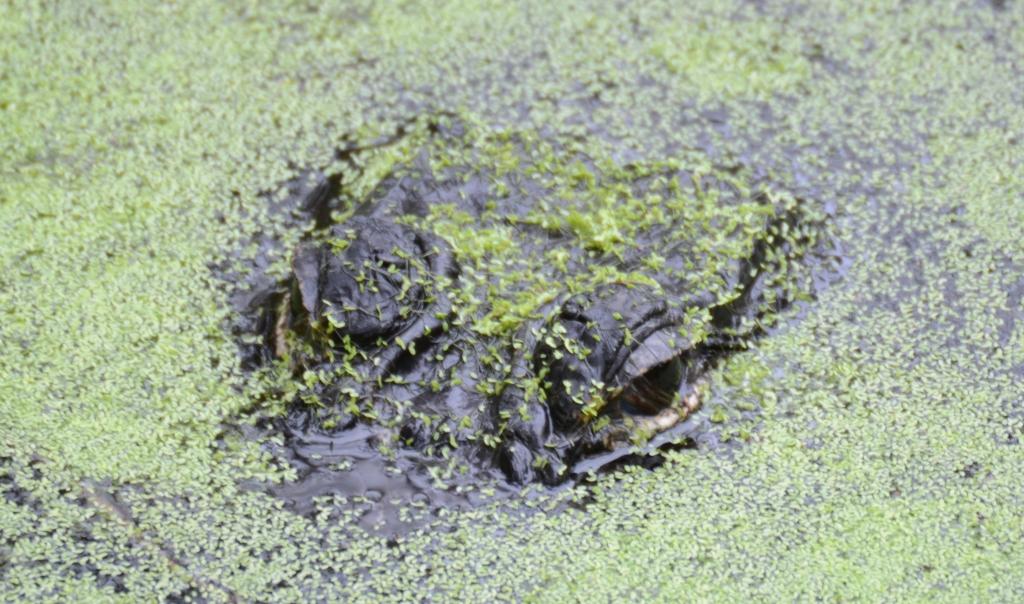
There's no shortage of American Alligators in south Florida. Nearly everywhere one goes, the toothy lizards are laying about, or poking their snouts ominously from the water. Although not very aggressive and hardly a threat to anyone with half a brain and an ounce of self-preservation, their presence does make one look at the murky swamp waters in a new light.

Probably no other animal in Florida excites the touristos like Alligator mississipiensis does. They're big, primitive, scary, and rise from the primordial ooze. What's not to like?

This big boy was one of the larger ones that I saw on my recent trip, but they can get a lot bigger than that. The males grow larger than the females, and there is at least one claim of a 19+ footer being bagged. That'd be exceptional; normally they'll not stretch more than 14 or 15 feet and such jumbos are rare.

Regardless of their size, you don't want to try and ride one sidesaddle or scratch 'em behind the ears. If it didn't flee, the gator might chomp you and that would hurt. Supposedly, the force of their jaws clamping together is one of the strongest pressures ever measured in an animal. A healthy gator can exert over 9,000 newtons of force with its downward clamp of the jaw. What's that mean? Well, 9,000 newtons is about equivalent to a ton of force. An expert boxer normally wouldn't generate half this force in his strongest blows. Plus, the gator has the added benefit of a lot of teeth with which to secure you, and the ability to keep those jaws shut so tightly you'd need TNT to blast yourself free.
Not something you see everyday - a baby alligator. they're colorfully banded with yellow at this stage, and about as close to "cute" as one of these reptiles ever manages to get. This little fellow was perhaps a bit more than a foot in length.

As cute and unintimidating as Jr. Gator was, it still would have been a bad idea to mess with him. This is Mom, and she was huge and ever so watchful. I detect some hostility and anger issues in her eyes, and it was a strong enough signal to keep everyone well back from her two little charges.

It's good that there are so many gators to see these days. It was only a few decades ago that scientists thought they would never recover to the point of being common. Unrestrained market hunting throughout much of the 1900's nearly eliminated alligators from much of the southern U.S., and in 1967 it was declared an endangered species. Multi-pronged recovery efforts following this designation were successful, and the gator was de-listed in 1987 and is once again a fixture of Florida wetlands.

Tuesday, February 1, 2011

His eyes are bigger than his stomach

While birding some wetlands in Florida a few days ago with Vince Lucas, we happened across this scene. Sorry the shot quality is not the greatest - the heron was some ways off - but you get the picture.

This Great Blue Heron had nabbed a walking catfish (we think that's what it is) that is probably a bit big to slide smoothly down the old gullet. We didn't have time to stick around long enough to see how this drama played out. I can't imagine the heron was able to make a meal of it, but it does illustrate the inherent dangers of moseying too close to one of these primitive dagger-beaks if you are lesser in stature.

Monday, January 31, 2011

Black Skimmer

Highly gregarious and ultra-cool, a squadron of Black Skimmers rests on a Florida sandbar.

At ease, skimmers look like grounded F-14 fighter jets. When the pack takes to the air, they are transformed into a gracefully coordinated body of long-winged birds that commands one's eye. Moving in sinuous columns, the skimmers put on quite the airshow.

When seen up close, a Black Skimmer takes on a comical appearance, what with the orange-based Bozo bill. They also look faintly thuggish; like an avian tough wearing a black hoodie pulled low over the eyes.

Hold your thumb over the bill and temporarily block it from view, and the bird looks long, sleek, and ternlike. Expose the bill, and the skimmer takes on an undeniably odd and amusing look. It's as if its beak is deformed. But it isn't - the skimmer offers evidence of the miraculous possibilities wrought by fits and spurts of evolution; how forces of selection can shape such strange-looking features that are so beautifully functional.

A Black Skimmer's normal working environment: inches off the water. This one appears to be scolding its reflection in a fishy backwater marsh. Agile and adept at close-quarter high-speed flight operations, skimmers swoosh low over the deck like barn-storming feathered crop dusters.

And here's how they get the skimmer tag. Swooshing towards the water in a graceful descent, the Black Skimmer gently lowers that elongated lower mandible into the water and slices a long wake.

Why?

Fish. In an amazing show of aeronautics, reaction time, and coordination, the skimmer sluices along, hoping to come into contact with a minnow or other small aquatic animal. When contact is made, it snaps that powerful thick bill shut in a nanosecond and secures a meal.

Pretty amazing stuff.

Sunday, January 30, 2011

Florida Snails

If you are amongst the myriad birders that migrate south to Florida to gawk over some of the Sunshine State's specialty birds, you must thank snails. But all is not well in the world of these univalved gastropods, as we shall see.

Windrows of apple snail shells litter the edge of a Florida marsh. I believe that all of these shells are of the introduced Island Apple Snail, Pomacea insularum. This invader, native to South America, has colonized much of peninsular Florida and can be locally abundant.
High on any birder's Florida wish list is the spectacular and aptly named Snail Kite, Rostrhamus sociabilis. This female has an apple snail in her mandibles. Snail Kites have an incredibly long tip to the upper mandible of the bill, and their slender bill has evolved to harvest snails from their hard shells. But not just any snail - Florida Apple Snails, Pomacea paludosa. Unfortunately for the kite - and the snail - Florida's only native apple snail is under siege from at least three threats: outright destruction of wetland habitats; alteration of water regimes in existing wetlands; and the invasion of four other non-native species of apple snails.

These invading snails displace the native apple snail, and it appears that young kites have a much tougher time extracting the meat from the larger and bulkier introduced species.
If the kites, which feed almost exclusively on apple snails, can't make the jump to the non-native snails, their prospects in Florida do not appear good.

Another wonderful Florida bird for U.S. birders is the Limpkin. What it lacks in plumage pizazz is more than made up for with earsplittingly loud piercing cries. Interestingly, this bird's range nearly mirrrors that of the Snail Kite, with Florida being the northernmost outpost. Like the kite, Limpkins are major snail consumers. As might be geussed from the size of their giant crowbar of a bill, Limpkins apparently can readily handle the enormous invader apple snails and seem to be thriving. I must have seen or heard a few hundred Limpkins in my short five days in Florida, including one favored spot where at least 65 were on display at once.

At a secluded hardwood hammock deep in the Everglades, I was delighted to see a number of Florida Tree Snails, Liguus fasciatus. These often colorful arboreal snails have become rare, and are now listed as a species of special concern by the state of Florida.

Showy and easily harvested, Florida Tree Snails are much sought by collectors, who have diminished or eliminated the snail's populations in some areas.

There are eight described subspecies of Florida Tree Snail, and they come in a dazzling variety of color forms. This one was my favorite of those that I saw.

Florida Tree Snails enter a period of aestivation, or dormancy, in December. They scale the trunks of smooth-barked trees, and once a favorable spot is found secure themselves tightly to the tree by forming an airtight, cementlike bond at the shell opening. As the snails often select eye-level resting locales they're easily noticed.

At least 58 color varieties of Florida tree Snail have been noted, and some of them are incredibly showy; Gastropodian gems of dazzling ornateness. Greedy collectors have killed off some of these forms, and any Florida Tree Snail, whether it be a Plain Jane or rainbow of color, should be left unmolested.

Friday, January 28, 2011

Cape Coral's Burrowing Owls

Cape Coral is a city of about 160,000 in Lee County, Florida, near the Gulf Coast. Apparently it is the 2nd largest Florida city by area, but it doesn't have a big city feel. It might be called the "Venice of the America's", as there are some 400 miles of canals - more than any other city on earth.

But I wasn't here to seek gondolas - it was one of the most curious of feathered beasts that I sought.

A seemingly innocuous side street in residential Cape Coral. But wait! What are those exclosures dotting the grassy sands?

They're ropes strung to delineate active Burrowing Owl burrows! Here, a little fellow peeks from his lair. The wooden stake is there to provide a perch. It isn't hard to find Burrowing Owls in Cape Coral. Just troll the side streets and look for the short wooden crosses and/or roped off plots. When such a site is found, get out and look closely for the little owl. Big sudden movements may startle them and the owl will instantly duck out of site underground, but with a bit of patience one can walk right up to them.

Burrowing Owls are diurnal - active in the day - and thus can be easy to observe. The Cape Coral birds, given their close proximity to people, have become quite tame. I was able to sidle to within ten feet of this bird, and it would scarcely even give me a glance. I can't even imagine how cool it would be to have these as "yard birds", and watch them court, hunt, and raise young at fingertip range.

Note the long powerful legs and big feet. This is an owl adapted for a thoroughly terrestrial lifestyle. Those stiltlike legs also elevate the owl and give it a better view of its surroundings. While perfectly capable of excavating a burrow of their own, Burrowing Owls often utilize old armadillo holes or those of other digging animals.

An estimated 1,000 pairs of Burrowing Owls dwell within Cape Coral's limits - the largest concentration of owls in the state. Like many other species of indigenous Florida wildlife, Burrowing Owls are under siege due to rampant, often poorly thought out development. This species is now listed as a species of "special concern" by the state, and a great many of their former haunts have been destroyed.

Total Burrowing Owl estimates for Florida range from a high of 10,000 pairs to as few as 3,000. Cut the difference and figure there's maybe 6,500 pairs still tunneling in the landscape, and one quickly sees the significance of Cape Coral as a refugia for these tunneling hooters. Perhaps one-sixth of ALL of Florida's Burrowing Owls live here.

To their credit, the city does work diligently to protect the owls, and promote their well-being. Developers are provided guidelines to work around nesting sites, and residents are encouraged to take steps to create better conditions for the owls. A group known as the Cape Coral Friends of Wildlife even sponsors a "Burrowing Owl Festival".

If you are ever in the area, take some time and investigate the Burrowing Owls of Cape Coral. Their relationship with people in this city of canals is certainly one of the more interesting interactions of man and beast.

Wednesday, January 26, 2011

Bill Thompson, Jr.: 1932 - 2011

Bill Thompson, Jr., back row, center, with his family. The world lost a great one when Bill passed on yesterday afternoon. It would take an abundance of superlatives to do Mr. Thompson justice. Everyone who ever encountered Bill came away feeling a little more important, a little better appreciated, and a little more liked. He was the kind of guy who always asked after others, was quick with a joke and a smile, and hid a mountain of talent behind a natural humility that had him more interested in you than talking about himself.

Bill, along with his wife Elsa, began Bird Watcher's Digest on a shoestring back in 1978, and of course the publication is now the best known amongst many such mags. There wasn't anything like BWD in 1978, and it was a most definite gamble to launch a birding-heavy magazine back then. But it worked.

I got to know Bill reasonably well over the last decade+, and it was always a high point to see him. The more I learned of him, the more impressed I became. When I found out he was a jazz pianist, it blew me away. He was hardly a guy to be pigeonholed, and Bill managed to do a lot of things in his long life, and do them well.

My condolences go out to the entire Thompson family, and Bill will be missed by scores of friends. The Marietta Times ran a nice piece on Bill's life today; it follows.

Marietta Times
Marietta leader dies at age 78
Bill Thompson remembered as a mentor and innovator
January 26, 2011 - By Sam Shawver, sshawver@mariettatimes.com

Bird Watcher's Digest co-founder and community leader Bill Thompson, Jr., died Tuesday afternoon. He was 78.

Andy Thompson, state representative and Bird Watcher's Digest publisher, said his father had developed pneumonia and was admitted to Marietta Memorial Hospital Friday. He died around 2 p.m. Tuesday of complications related to the pneumonia.

"My dad was a mentor to so many people in this community - he was a great role model," Andy Thompson said.

Julie Zickefoose, Bill Thompson's daughter-in-law and a contributing editor to Bird Watcher's Digest, described him as "a very generous and creative spirit."

"He loved and believed in Marietta like no one else," she said. "And he worked well into what would have been retirement age to make it better."

Zickefoose noted her father-in-law has many legacies, including the magazine and his work in the community, but another important memory to her is his musical talent.

"I think my favorite place to see him was behind the piano," she said. "He was an amazing jazz pianist, and he could take you places very few people can."

Bob Kirkbride, a longtime friend and former co-worker, said the community will really miss Bill Thompson.

"Bill and I worked together at Marietta College for about five years in the mid-1970s, although he was employed there much longer than I," he said. "He was vice president of development, and I was vice president for finance and administration. His job was to raise money, and mine was to save it."

Kirkbride said Bill Thompson deserves a lot of recognition for what he was able to do during his years with the college.

"Bill planted a lot of seeds with donors that the college continues to benefit from to this day," he said.

Thompson and Kirkbride also began working with many others in 1991 to build up the Marietta Community Foundation, a philanthropic organization that supports a myriad of community and charitable endeavors. Bill Thompson served as the foundation's president and CEO from 2007 to 2010.

"The foundation has now given more than $10 million to the community and also possesses an endowment of $10 million," Kirkbride said. "And Bill had an important part in that."

Mark Schwendeman is chairman of the Marietta Community Foundation Board.

"In his role as CEO and mine as board chairman, Bill and I had developed a great friendship," Schwendeman said.

"Probably one of his biggest legacies will be the 20/20 Fund project," he said. "Bill and Elsa (Bill's wife) worked together in that to bring the hot lunch program back into Marietta schools. And the foundation's new Vision Project, just under way, will benefit the community for years to come."

Marietta Mayor Michael Mullen had known Bill Thompson since the mayor was a teenager.

"His son, Bill III, and I played music together more than 30 years ago," Mullen said. "Bill Jr. was a fine, fine, fellow -- always had a big smile and a hearty laugh. He made you feel so comfortable and was never superficial. You felt a one-to-one, genuine human connection when he was around.

"This community will truly miss his spirit, and our condolences go out to his entire family," the mayor said.

In addition to his wife and two sons, Bill Thompson Jr., is survived by a daughter, Laura (Thompson) Fulton.