Thursday, May 26, 2022

Bird photography talk: June 8, Lloyd Library in Cincinnati

I'm giving a program about birds, their photography, and the power of imagery to create conservation interest, in Cincinnati on the evening of June 8. It's free and all are welcome.

The venue is the amazing Lloyd Library and Museum, which houses one of the most impressive collections of books you'll probably encounter. Some of their works date back to the 1400's. It's heavily used by researchers and the Lloyd is active in outreach work to the community. This spring one of their outreach programs is entitled Birding through Time, and features monthly speakers, of which I am one.

Birding through Time also draws on the Lloyd's collection of bird books that spans several centuries. You'll see them if you attend. It's an amazing building and stunning collection, and I hope that you can come and see everything.

For complete program details and registration, please CLICK HERE.

Tuesday, May 24, 2022

Mississippi Kites nesting in Shawnee State Forest

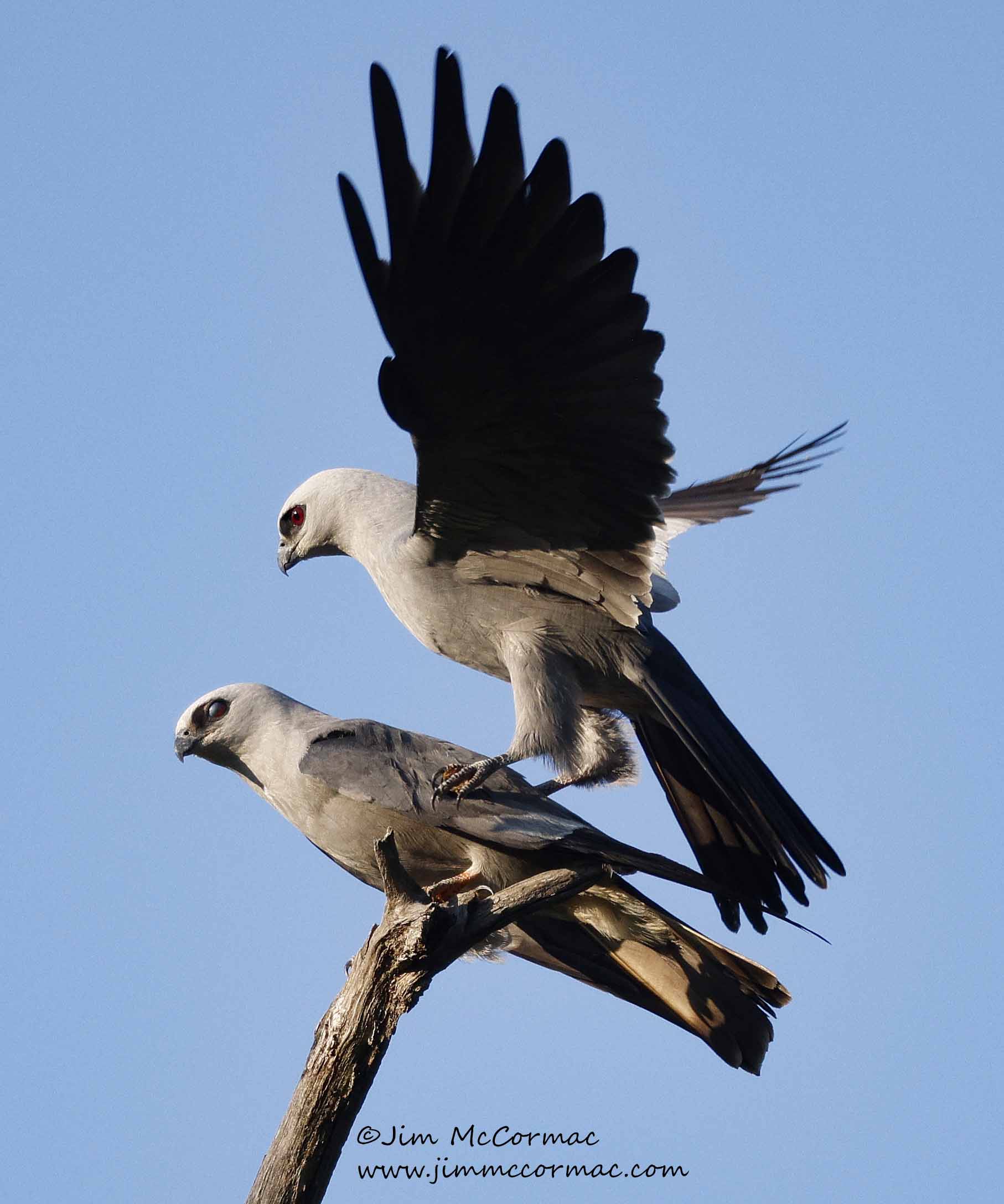
A male Mississippi Kite (Ictinia mississippiensis) lands atop his mate. Seconds later, he mounted her.

Last weekend the Midwest Native Plant Society hosted a wonderful conference at Shawnee State Park's lodge. Nearly 200 people were in attendance, and there was much to see: plants galore, snakes, lots of birds, amphibians, and more. The 1,100-acre park is nestled within the 70,000 acres of Shawnee State Forest and the biodiversity is extreme. But it was hard to beat this pair of kites.

While botanizing in the depths of the forest 6 or 7 years ago, in early summer, I heard the unmistakable calls of Mississippi Kites, but could not clap eyes on them. The following year park naturalist Jenny Richards located presumably the same birds near the nature center where they were a fixture much of that summer. A pair of kites has been present ever since.

This year the kites have shifted their base camp to the cabins at the lodge. There are a couple conspicuous dead snags between cabins 14 and 15, and when not out hunting one or both kites sit in those snags where they cannot be missed. There are even conveniently located benches with great views. It's kind of like going to the movies, except you're watching real live kites.

And the kites put on a show. It seemed that about every time the male would join the female at the snags, he would mount her in a hopefully successful effort to produce kitelets. Sometimes he would bring her a grasshopper. Occasionally one of the kites would perch atop an oak directly over the viewing area - they are hardly shrinking violets and paid people no mind. We were especially pleased to see them carrying sticks to a likely nest site somewhere in the nearby forest.

Kites are light and incredibly agile. Flyers extraordinaire, they deftly pluck insects such as cicadas (they'll emerge a bit later) dragonflies, and grasshoppers from the air. Small snakes and birds are also fair game.

The first Ohio record of Mississippi Kite (in modern times at least) was in 1978 in Franklin County. When Bruce Peterjohn published his 2nd edition of The Birds of Ohio in 2001, he only was aware of nine records. In the two decades since then, records have skyrocketed, and multiple birds are now documented annually. The first confirmed nesting was in 2008 in Hocking County and now there are probably at least a few nesting pairs in southern Ohio.

The Shawnee kites are easily observed and if you're in the area, it'd be worth stopping by for a look. If they aren't on the snags around cabin 15, just wait a bit and they'll likely appear. Nearly everyone who attended the recent conference got to see them, and often large throngs of people assembled to ooh and aah over the sporty kites.


Wednesday, May 18, 2022

Cave and Green salamanders

Cave Salamander, Eurycea lucifuga

At the recent New River Birding & Nature Festival, I was introduced to a sandstone cliff face with interesting inhabitants. Paul Shaw, Jodi French-Burr and I visited one wet night, and were treated to Cave Salamanders (top image) and Green Salamanders (photo follows text). During the day, they hole up in crevices. Commencing about 10 pm, out they come to hunt lesser creatures on the cliff face. Both species are listed as endangered in Ohio and are tough to find here. They become much more frequent to the south. Fayette County, West Virginia, May 6, 2022.

Green Salamander, Aneides aeneus

Monday, May 16, 2022

Nature: Tiny, endangered Walter's violet once found growing in Franklin County

A tiny Walter's violet grows in an Adams County woodland/Jim McCormac

Nature: Tiny, endangered Walter's violet once found growing in Franklin County

Columbus Dispatch
May 15, 2022

NATURE
Jim McCormac

Violets mean spring, at least for the botanically inclined. Chances are your yard is dotted with jots of purple. The color is courtesy of the common blue violet (Viola sororia). It’s a hardy native, capable of surviving turf grass deserts.

The common blue violet isn’t the only violet out there, although some of the others require much more searching. Give or take, there are about 26 native species in the genus Viola in Ohio. Give, mostly: Taxonomists have proposed a number of “new” species, these carved from established species. But skeptics remain and not all of the new splits have gained widespread acceptance.

Botanical simpletons might want to lump them all into three species: purple ones, white ones, and yellow ones.

On a trip to southern Ohio on April 22 (Earth Day), I encountered a booming population of one of our rarest violets. Walter’s violet (Viola walteri) is listed as state-threatened and is currently known only from Adams and Highland counties. These are the northernmost populations in its range.

Walter’s violet is also our smallest violet. The leaves are about the size of your pinky fingernail, and an entire plant could fit comfortably on a half-dollar coin. They require ground-level inspection to truly appreciate.

The scientific name Viola walteri recognizes botanist Thomas Walter, a complex and productive character. Born in Hampshire, England, in 1740, Walter came to America in the late 1760s. He settled in Charleston, South Carolina, and wasted no time making his mark.

At that time, the flora and fauna of the eastern U.S. was imperfectly known, and there was much to be found. Walter discovered a number of new plants, and eight of them were named in his honor.

In 1788, Walter published the results of his work in a book titled "Flora Caroliniana," an important milestone in early North American botany. He died the following year at age 48.

Between his botanizing, Walter married three times, produced five children, was a successful merchant, acquired 4,500 acres of land, and held political offices.

Including Walter’s violet, seven violet species are listed as imperiled by the Ohio Department of Natural Resources. Unlike the common blue violet in your yard, most violets are finicky specialists. Habitat loss is a major reason for their rarity.

Franklin County offers ideal habitat for Walter’s violet: thin soil over limestone in open woods or glades. Appropriate conditions formerly occurred along the Scioto River, especially in the Dublin area. And that’s where the only county record of Walter’s violet comes from. A specimen was collected near Hayden Falls on May 6, 1916, by botanist F.E. Leonard. This was the northernmost site ever recorded.

Large-scale changes in the intervening century have not been kind to plant conservation along the Scioto. Development and the rampant spread of invasive plants have hit native plant communities hard. The elfin Walter’s violet probably hasn’t survived the onslaught.

However, glimmers of hope often remain in the case of long-missing plants. And several other rare plants cling tenuously to Dublin’s rocky refuges. Perhaps little Walter’s violet will be rediscovered in Franklin County someday.

Naturalist Jim McCormac writes a column for The Dispatch on the first, third and fifth Sundays of the month. He also writes about nature at www.jimmccormac.blogspot.com.

Friday, May 13, 2022

A yellow Scarlet Tanager!


A yellow Scarlet Tanager! I saw this bird from afar, and my first impression was Baltimore Oriole. A quick glance through the bins proved that wrong. He allowed me to approach for shots, but never would move his head from behind that grapevine before flying into denser cover and vanishing. It's a male, and apparently he has some genetic anomaly that altered the process of changing the carotenoid-driven coloration from brilliant red to yellow. It surely was a striking bird. Magee Marsh, Lucas County, Ohio, May 10, 2022.

Wednesday, May 11, 2022

Eastern Fox Snake


An Eastern Fox Snake (Pantherophis gloydi) keeps an eye on your narrator. I had just set up my tripod near a ditch when I noticed the snake loafing near the water's edge. He was over four feet in length and quite well marked. I eased towards him to pick him up for a better look - they're gentle and I have never had one try to bite - but he quickly slid into the water. He didn't go far and watched me as I watched warblers. Keep an eye out for these handsome reptiles if you're at Magee Marsh, Ottawa National Wildlife Refuge, and vicinity. I encountered this one in that region yesterday.

Monday, May 9, 2022

A piebald robin


As always, click the photo to enlarge

A striking leucistic American Robin. The animal has a genetic condition that suppresses melanic pigments, creating a "piebald" effect. Karen and Don Stose, attendees at the New River Birding & Nature Festival, found this bird and tipped me to it. It was but ten minutes from where I'm staying, so off I went for a look. And I'm glad that I did, even though more exotic fare such as Swainson's Warbler was close at hand. Fayetteville, West Virginia, last Friday.