Friday, February 25, 2022

Waxwings feasting on sumac fruit

A gorgeous pre-dawn sunrise. Sunrises always look best before the sun crests the horizon. The colors are much more vivid. Back on February 15, I took a long overdue trip to the central basin region of Lake Erie. As I passed through Crawford County north of Bucyrus, the eastern skyline kept intensifying in color. Finally, I could no longer stand it and pulled onto a side road to make this shot. It was 7 F at the time and cold temperatures seem to bring out the best in sunrises.

After a highly productive day of finding and photographing a variety of birds, I stopped in at a prairie relict near Castalia, in Erie County. A Golden Eagle (Aquila chrysaetos) has been hanging in the vicinity, and I missed seeing the bird at the usual haunts - the only real miss that I had on this day. Anyway, I figured I'd get out on foot for a while, see what I could see, and hope that the big eagle might pass over. One usually sees far more on foot than in a vehicle.

At one point, a bunch of American Robins (Turdus migratorius) flew into a nearby Eastern Cottonwood (Populus deltoides). They were mostly quiet, only giving whisper calls amongst each other. I figured they had a target and a plan, and sure enough a little way over was a fine grove of Smooth Sumac (Rhus glabra) with plenty of fruit.

A stand of Smooth Sumac loaded with tasty fruit. There are four species of sumac in the genus Rhus in Ohio, and all produce fruit coveted by birds. One species, Fragrant Sumac (R. aromatica) is much shorter in stature than the others, and because it is somewhat easier to manage, it's probably the most frequently used in landscaping. However, the three bigger species produce more fruit, and put those colorful fruiting clusters high in the air where the birds can't miss them.

An American Robin feasts on sumac fruit. Many of his compadres joined him.

This situation was a photographic goldmine, especially to me because of my long-going effort to document animals feeding on or otherwise using native flora. The problem was that I was exactly on the wrong side of the light - looking straight into the late day sun. Fortunately, I had my lightweight Canon R5 and 400 DO II (with 1.4x extender) in hand. Eventually I was able to work around the sumac colony and get the light behind me, without spooking the birds. Moving through the prairie vegetation with a bigger rig and cumbersome tripod would have made it much harder to move stealthily and not spook the birds.

A gorgeous adult Cedar Waxwing (Bombycilla cedrorum) looks about from a bare shrub. As I got into good position, I heard the high-pitched wheezy trills of waxwings. Major bonus! Cedar Waxwings often occur with robins in winter, as they are after the same fruits. While I did have robin/sumac shots, I had never captured waxwings feeding on sumac fruit, so they quickly became my priority.

The waxwings - there were only a few - would stage on a bare shrub to look about before dropping into the sumac. I missed shooting the first few birds, but not this one. The animal posed stunningly for a second or two, glancing over its shoulder, crest erect, and wings and tail splayed slightly to reveal their colorful charms.

PHOTOGRAPHIC NOTE: When the light is abundant, as it was here, I prefer to stop down to f/8 or even f/11 if possible. I almost always shoot birds in manual mode, with the ISO on auto. I watch the ISO like a hawk, and it can largely drive what aperture and shutter speed that I use. In a perfect world (for me) the ISO is no higher than 500-800. Low ISOs mean less noisy images, especially if much cropping is necessary. Cameras are getting better at processing higher ISO settings, but I still do what I can to keep them as low as possible. Anyway, the settings for this shot were: f/8, 1/1000, ISO 320, with 0.3+ EV. In hindsight I probably would have stopped down to f/9 or f/10 and dropped the shutter speed to 1/640 or so but I'm nitpicking my efforts.

Caught in the act! An amazing array of songbirds feed on sumac. I've probably photographed 15 species on it and have seen a number of others eating it that I could not photograph. And I should say that it's not just songbirds. Woodpeckers, especially the Northern Flicker (Colaptes auratus), often visit sumac to plunder the berries.

If you are looking for good bird photography opportunities, stake out a sumac stand in winter. With some patience (and quietness) you'll almost certainly be rewarded with interesting opportunities of birds interacting with these showy native treelets.

Tuesday, February 22, 2022

On harriers, and shooting them (with a camera)

A Northern Harrier (Circus hudsonius) sits in a large field. There, see it? The lump in the center of the photograph. This species habitually roosts on the ground (and nests on the ground) and perched birds can blend well with the sere browned grasses of late fall and winter.

TAXONOMIC NOTE: The Northern Harrier was long considered to be conspecific with its Eurasian counterpart, the Hen Harrier. Plumage and morphology differences led to them being split into separate species recently. The Hen Harrier retains the scientific name Circus cyaneus, while the North American birds become C. hudsonius.

Harriers, from my experience, are generally not enamored with the presence of people. They typically remain well away from onlookers, although one might occasionally offer a brief flyby, usually while it's in transit to some other spot.

A female harrier harries voles. They're fun and interesting to watch, even from a distance. Northern Harriers on the hunt typically course low over the meadow, constantly watching the ground below. They're listening, too, for the sounds of rodents, even those concealed in their grassy raceways.

While even distant harriers are a visual treat, these are not the sorts of views that a photographer wants. In the case of the birds in the previous photos, even the largest lenses would not allow for the sort of cropping that would yield a tight high-quality image.

Over the years, I've had a few lucky encounters with Northern Harriers that resulted in decent photos. One of these experiences was remarkable. I was in my portable blind along the edge of a marsh, mostly angling for waterfowl. Suddenly a harrier appeared over a nearby ridge and headed my way. I got one or two shots off - one of which came out well - and the bird spotted me. I could not believe it. It's a camouflaged blind with a fairly narrow viewing port out the front with only the very end of the lens protruding. And the lens is also wrapped in camo. I'm back in the shadows of the interior, more or less invisible. Through the big lens I saw the bird make me, staring bullets right into my lens and immediately banking off and accelerating, not to be seen again.

My Jeep, parked on a beautiful but frigid morning at Killdeer Plains in north-central Ohio. Last Sunday, February 20, I resolved to spend a few hours really trying to work some harriers and make some good images. It was a beautiful morning with great light, and I arrived by dawn. The area that I went straight to must have a thriving Meadow Vole (Microtus pennsylvanicus) population this winter as numerous harriers and a few Rough-legged Hawks (Buteo lagopus) were in residence. The voles are their primary fodder.

But how to get near them? If I went out on foot, I knew what my odds of close encounters would be, and they wouldn't be good. Although it always makes me feel a bit lazy, vehicles can make great blinds and that's the tactic that I went with. This particular spot has a scruffy maple with some underbrush around it, and I wedged the Jeep up against that. The idea being that the vegetation would help make my vehicle less conspicuous and thus perhaps less worrisome, although I had no illusions about the birds not seeing it from a mile away.

At times, up to eight harriers were in view at once, although none immediately offered the sorts of close-range flybys I was hoping for. After the first hour I was getting a bit nippy. You don't want the engine running while doing this sort of thing as the raptors will hear it, and heat from the motor can distort images shot from the vehicle. Plus, the window is down.

Finally! A gorgeous female Northern Harrier winged by only a stone's throw away, allowing for superb frames without extreme cropping. Note how she carefully watches the ground, ever alert for mammalian opportunities. This was exactly the situation that I was hoping for. I think it just took an hour or so before the birds decided the vehicle wasn't a threat and began to ignore it.

As an aside, I got lucky in that only one other vehicle showed up during my time there and the occupant was also photographing birds. Whoever it was came my way at one point, but apparently realized that I was also shooting and quickly turned and went the other way. Great photographic manners by whoever that was, and I was most appreciative. Most people will just drive right up and want to chat or pull up 15 feet away and just sit there. This, needless to say, scuttles any hope of accomplishing an objective like shooting spooky harriers. Sometimes wildlife photography must be an anti-social activity :-) And the early bird gets the worm. Later in the day (when the light would not have been nearly as good) there would have been many more people and I probably could not have done this without interruption. As it was, I was done shooting by 10 am and headed for home.

Another female harrier soon made a close pass, allowing me another volley of photos. And then she detected a vole straight out from my position and made several pounces. In this shot she's just lifted from the ground, tail askew and legs dangling. Check out those formidable talons! What a shot this would have been if she had bagged the vole and it was clutched in her talons. That was probably too much to hope for but someday...

Photographic notes: These images were made with the Canon R5, their newest iteration of mirrorless camera. I cannot say enough good things about this unit. It bursts at 20 frames a second, which is fantastic for birds, especially birds in flight. I am always looking for subtleties of head angle and body posture, and these things happen so rapidly that there is no way you can wait and just shoot at the precise moment. High speed bursts greatly increase the odds of catching interesting postures. The image quality is also excellent. Perhaps best, at least for birds, is the remarkable intelligent autofocus tracking system. The camera recognizes eyes, and remains locked on them, even on a bird in flight. I had my first serious run with this camera last October in Cape May, New Jersey, and was stupefied how the camera could lock on the HEADS of flying Monarch butterflies in flight and stay locked on them as long as I did my job and kept the butterfly in the frame. As long as there is not lots of close background distractions, this system works superbly on flying birds - much easier than butterflies in flight! - and the photog's keeper rate should skyrocket. Ironically, I did not use intelligent autofocus for these harrier shots. Because the birds fly so low to the ground, the camera kept trying to grab grasses and other plants. I switched to center point focus with the adjacent focus points selected. This small focus block worked much better in this case and was quite good at grabbing the bird and staying locked on it. I also recently acquired the Canon 400 DO II lens and it in combination with this camera is an absolutely deadly combo for shooting birds. The lens has an f/4 maximum aperture, focuses with lightning speed, is ultra-light and easily hand-holdable, and the image quality is superb. More often than not, I use it with the Canon 1.4x III extender, which makes it a 560mm f/5.6 lens. I notice little or no deterioration of image quality, nor a slowing of focus speed.

As always, click the photo to enlarge

This is one shot that I really hoped to get, and why it's necessary to be close to the subject. Although a fair bit of cropping was required to create this perspective, the file size is still large enough (5 meg TIFF) that it is publishable. Enlarge the image to judge the sharpness for yourself (and as all images are on here, this is a greatly compressed jpeg).

Northern Harriers have distinctly owl-like facial disks, an adaptation to increase their hearing acuity. After much time spent watching them hunt, I believe they find prey as much if not more so by sound than sight. Meadow Voles - probably the main prey at this site and in many other areas - create grassy tunnels or "runways". Sort of like the subterranean tunnels made by moles, but above ground in the grasses. While the voles occasionally pop out, mostly they work from within the tunnels. Out of sight, perhaps, but not out of earshot to a bird that hears as well as a harrier.

Many times, including several times on this day, I have seen harriers pounce, pop back in the air, move slightly, and pounce again, sometimes over and over. Oftentimes they lift with grasses caught in their talons. I think they are tracking the vole totally by ear as it moves in the runway and pouncing on it sight unseen, trying to pluck the wee beast from its grassy tunnel. And oftentimes the harrier is successful. Someday, I will get that vole in talons harrier shot!

Sunday, February 20, 2022

Nature: The drum of the hairy woodpecker outpaces any rock 'n' roll star


The hairy woodpecker drums faster than the fastest human drummer/Jim McCormac

Nature: The drum of the hairy woodpecker outpaces any rock 'n' roll star

Columbus Dispatch
February 20, 2022

NATURE
Jim McCormac

There have been many astonishingly fast drummers. Legendary jazzman Buddy Rich comes to mind, as does Led Zeppelin’s John Bonham. Probably even faster is metal band Dream Theater’s drummer, Mike Mangini. He has been documented producing 20 beats a second!

Fast as he is, Mangini’s got nothing on a hairy woodpecker. A hairy at full speed hits the wood a mind-numbing 26 beats a second. Such a blistering rat-a-tat is far beyond what any human drummer can produce.

In the past few weeks, I’ve noticed the local woodpeckers drumming much more frequently. The neighborhood hairy woodpecker pair is at it, as are the red-bellied woodpeckers. The latter is a piker compared to the former, though: at full throttle, a red-bellied woodpecker cranks out 19 beats per second.

As winter wanes, woodpeckers step up their drumming. These rapid staccato bursts last for only a second or so and are not made as a byproduct of excavating grubs and other tasty wood-bound treats.

Fast drumming is how woodpeckers sing. It is the counterpart to songbirds’ songs; the brutish jackhammer operator to the cardinal’s sweet operatic aria. To the woodpecker, louder is better. A drummer commonly uses a hollowed-out tree snag. The substrate acts like an amplifier, increasing volume.

Especially ambitious woodpeckers sometimes use metal objects for drum skins, such as metal gutters or downspouts. I once watched a northern flicker demonstrate his prowess (25 beats per second!) in a northern Michigan campground. He used the numerous metal electrical boxes, there to service campsites, for drumming. All around the campground he flew, creating an ear-splitting cacophony on boxes throughout the site. Groggy early-morning campers were not amused, but I certainly was.

In our region, the most common woodpecker is the downy woodpecker. If you put out suet, they visit. Downy woodpeckers look like pint-sized hairy woodpeckers, but their small size doesn’t equate to greater speed. Although downys produce a comparatively anemic 17 beats a second, they still make a racket.

Although drumming is used to “sing” to prospective mates and current partners, it has other purposes. Woodpeckers work the perimeters of their territories, visiting established drumming trees. The routine pounding makes it clear to neighboring woodpeckers exactly where the invisible fence between turfs lies.

Drumming is also a way that mated pairs communicate with one another. Last summer, a friend, John Howard, and I got a dramatic example of this. While taking a rest in a large Highland County forest, we noticed a pair of crow-sized pileated woodpeckers vocalizing excitedly back and forth.

John and I were in between the birds, which were 100 yards or so apart and out of our sight. One was striking at wood, but not drumming. It was undoubtedly excavating for carpenter ants, beetle larvae or other insect fare.

Suddenly the pounding bird cackled maniacally, let out a rapid drum, and flew from the trees toward the other bird. Seconds later, a huge tree crashed to the ground right where the bird had flown from.

These giant birds regularly bring dead or dying trees down, as their massive excavations can greatly weaken the wood. It seemed clear the bird was telling his mate that something cool was about to happen.

These birds are well-designed for a life of hard knocks. Many strikes are given at 1,000 times or more the force of gravity. A blow less than a tenth that powerful would give a human a concussion if not instantly kill. Chisel-like bills that slice into wood rather than stop abruptly help dissipate shock. The bill design shunts energy away from the brain, further protecting it. And the brain is tightly packaged in a reinforced cranium, like a built-in helmet.

Because of their extraordinary ability to withstand high stresses, woodpeckers have long been studied by researchers. Technologies inspired by the birds’ physiology can lead to greater impact resistance in vehicles, aircraft and football helmets as well as other applications.

Naturalist Jim McCormac writes a column for The Dispatch on the first, third and fifth Sundays of the month. He also writes about nature at www.jimmccormac.blogspot.com.

Thursday, February 17, 2022

The Logan Oak on Jeopardy! Actual video clip


So, here's my few seconds of Jeopardy! fame (my oak photo), from last night's show. The contestant Megan answers correctly and went on to win the round. And apparently Loganites got wind that their famous tree made Jeopardy! and that caused some excitement down there. Thanks to Janet Riemenschneider Green for sharing this video with me!

Wednesday, February 16, 2022

Logan Oak to appear on Jeopardy!

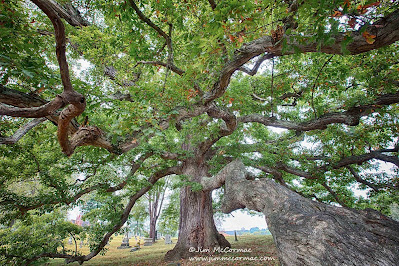
The centuries-old Logan Oak is an impressive White Oak (Quercus alba) indeed.

I made this photo of the fabled "Logan Oak" in September of 2019, never suspecting it might someday appear on the television show Jeopardy! I just wanted to see and try to photograph a cool tree. Yet, it will be on Jeopardy! tonight. Or so they tell me.  I was approached by an agent for the show last fall, which led to the deal to use the image. I don't know any details about how it'll be used, but as far as I know it's a green light.
 

Sunday, February 13, 2022

Skunk-cabbage: Hope to the winter-weary


Skunk-cabbage (Symplocarpus foetidus) in full flower this morning, February 13, 2022. This is a true harbinger of spring and the first of our native wildflowers to bloom. The fleshy liver-splotched spathe encloses a club-like spadix, visible through the opening. The little dots speckling the spadix are the flowers and their yellowish color is the pollen. It didn't feel much like spring when I made this image, though: 19 F and snowing. Franklin County, Ohio.

Friday, February 11, 2022

Loggerhead Shrike, AKA the "Butcherbird"


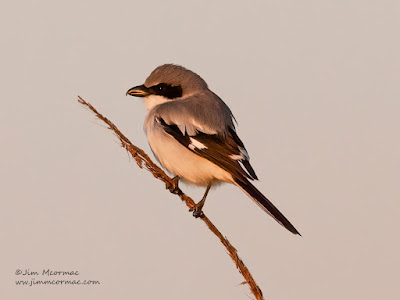
A Loggerhead Shrike (Lanius ludovicianus) tees up on flowering grass spike. This "butcherbird" was on the hunt.

I found the above bird near Jupiter, Florida, on January 14, 2022. Fortunately, shrikes are still somewhat common down there and not too tough to find. This bird was conspicuous as it teed up in prominent places, frequently calling. I watched it for some time, hoping to see it score a kill. It only made one attempt while I was there, chasing a Song Sparrow into the dense crown of a palm. The lucky sparrow escaped.

Potential prey that eludes a shrike are lucky indeed. They aren't nicknamed butcherbird for nothing. Probably due to their short legs and lack of talons, which makes it tough for the predatory songbirds to both hold victims and dismember them simultaneously, shrikes employ another tactic. They typically impale the victim on thorns, barbed wire, or other sharp objects. Once the prey item is so secured, they rip into it with a powerful raptorial bill. There was some barbed wire nearby, and I confess to having visions of the shrike using it to shish kabob that sparrow. On the other hand, I'm kind of glad the sparrow escaped. But I was a dispassionate observer, standing by to document whatever might happen without imposing my will.

Loggerhead Shrikes used to be uncommon but fairly widespread in Ohio. A number of times, in my younger days, I ran across them unexpectedly in rural areas. Always a great find, but certainly not an earth-shattering rarity. By 1980, their status had changed, much for the worse. By then, Loggerhead Shrike was a bonafide rarity, and it is even more so today. There may only be a few breeding pairs left in the state and the Ohio Division of Wildlife lists it as endangered.

The radical shift in agricultural practices undoubtedly played a big role in the shrike's demise. Mostly gone are the once common farms filled with meadows, shrubby fencerows, and other vestiges of non-crop habitat. Shrikes and many other bird species did well in the farm-scapes of yore. Today, it's mostly large industrial-scale agriculture with barely a trace of native flora and fauna.

The Loggerhead Shrike, in northerly latitudes such as Ohio, was a boom-and-bust species. It clearly colonized the state on the heels of deforestation and the opening up of the landscape. For several decades, the vegetation structure was conducive to shrikes and they peaked from around 1880 into the 1930's, but their heyday was short-lived in the big scheme. Loggerhead Shrike is not the only southern boom-and-bust species that has now vanished (or nearly so) from Ohio. Bachman's Sparrow and Bewick's Wren are two others that mirrored this pattern.

Fortunately, the fascinating and charismatic butcherbirds are still doing pretty well in the southern and westerly regions of their range. And if you're an Ohio birder, that's probably where you'll have to go to see them, at least in any numbers.