Sunday, February 6, 2022

Nature: Record highs and unusual sightings turn up in annual Christmas Bird Count

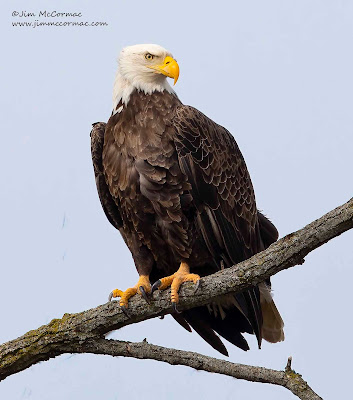
Fourteen bald eagles were tallied on the count, a record high/Jim McCormac

 Nature: Record highs and unusual sightings turn up in annual Christmas Bird Count

Columbus Dispatch
February 6, 2022

NATURE
Jim McCormac

The annual Christmas Bird Count (CBC), run under the auspices of the National Audubon Society, took place from Dec. 14 to Jan. 5. Well over 2,500 counts are conducted throughout the U.S., Canada and many other countries.

One of the oldest counts is the Columbus CBC. The inaugural count took place on Dec. 26, 1913, conducted by one observer. Fourteen species and 179 individuals were tallied. The count came nine months after the worst flood in Columbus history, which may have accounted for the low turnout of birds and birders.

The Columbus CBC was intermittent from 1913 to 1954. Since then, not a year has been missed and the last iteration took place on Dec. 19, 2021. Rob Thorn has served as compiler for over 20 years, and it’s a big job.

Thorn recently sent along a summary, and the 2021 count was one of the most productive ever. He marshalled the efforts of 88 observers. Only once has the count had more participants — in 2012, when 89 people helped.

The count area is a 15-mile diameter circle centered on Cassady and 5th avenues on the East Side, and that’s a lot of turf to cover.

Bernie Master, Tim Fitzpatrick and I covered a section of the South Side, including the sprawling Green Lawn Cemetery and the Columbus Impound Lot. We added a few goodies to the total, including merlin (a type of falcon) and fox sparrow.

A whopping 86 species were found, which has been eclipsed but once, also in 2012, when 89 species were counted. Many record high counts and unusual species turned up, and I’ll mention some below.

Seven trumpeter swans were found, a record high. This species was introduced (some say reintroduced) to Ohio in 1996 and is flourishing. Also in the fowl department, a blue-winged teal was exceptional. It is our least hardy duck and very rare in winter.

Red-shouldered hawks continue to expand, and a record count of 15 was made. Bald eagles also continue their meteoric increase. The 14 found was a record, but one that I predict is soon broken.

Eastern bluebirds, to the delight of many, also are doing well. A best ever 142 birds turned up. This gorgeous thrush has adapted well to suburbia. Less known is the elusive hermit thrush, but intrepid observers located nine of them. It might be a while before that total is bested.

Incredibly, four warbler species were documented. The only expected species is the rugged yellow-rumped warbler, and 49 were found. Completely unexpected was a black-throated green warbler, orange-crowned warbler, and two palm warblers. The latter three should be in the southern U.S. or even farther south.

A blue-gray gnatcatcher was a surprise. The spritely insectivore has been found on only six prior counts, the last in 2012.

Massive citizen science projects such as the Christmas Bird Count provide a wealth of data regarding avifauna. Some of the trends are negative, and some positive.

Up until 1970, double- or triple-digit numbers of northern bobwhite were found on every Columbus count. After that, few of the charismatic quail were located. Eight on the 1985 CBC were the last recorded. Bobwhite are victims of rampant development and wildlife-unfriendly agricultural practices.

On the other hand, opportunistic ring-billed gull numbers are soaring. Only single- or low double-digit numbers occurred in the count’s early years, if they were found at all. Gull numbers began to explode in the early 1990s, and counts have averaged 1,700 birds over the last 15 years. Our artificial lakes, reservoirs and prodigious human garbage have benefited the adaptable omnivores.

Thanks to Rob Thorn for his hard work and years of CBC stewardship, and to all of the count participants for their contributions.

Naturalist Jim McCormac writes a column for The Dispatch on the first, third and fifth Sundays of the month. He also writes about nature at www.jimmccormac.blogspot.com.

Wednesday, February 2, 2022

Winter warblers

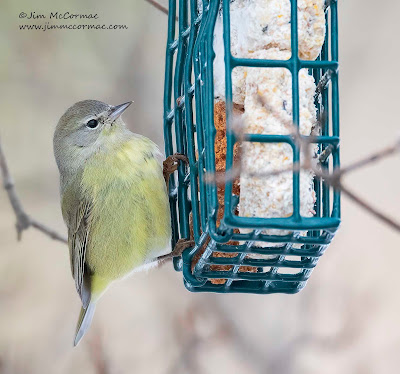
An Orange-crowned Warbler (Leiothlypis celata) clings to a suet feeder at Sharon Woods Metro Park in Columbus, Ohio. I made this photo on January 27, 2022 and the bird appeared there in January 15 - 12 days prior. The Orange-crowned Warbler is a hardy species and a late migrant, with tardy individuals still passing south through Ohio into November. However, mid-winter records like this seem to represent birds that are attempting to overwinter. And there is another Orange-crowned Warbler elsewhere in Columbus.

Large numbers of Orange-crowned Warblers winter in the U.S., from the lower Atlantic coastal plain states south through Florida and along the Gulf states through Texas. As warblers go, they do not range very far south, with the southern terminus of typical wintering grounds being northern Central America. So, an Orange-crowned Warbler attempting to ride out the cold season in Ohio doesn't seem like to much of a stretch.

But not so long ago, it apparently was. Excluding December records, which may represent very late migrants, Bruce Peterjohn in his scholarly work The Birds of Ohio lists only three verified January/February records of Orange-crowned Warblers. Bruce's revised edition appeared in 2001, so we're only talking two decades ago. A check of eBird records for January/February from 2001 to the present reveals about 20 records (and there are others). That's a huge increase in records. Either birders have become more adept at finding Orange-crowned Warblers or there are simply more of them to be found. I would lean towards the latter.

And it isn't just Orange-crowned Warblers attempting to ride out the snow and cold. This year's Columbus Christmas Bird Count documented three other warbler species in addition to one of the Orange-crowned Warblers, which was in the count circle. Yellow-rumped Warbler was predictable, as this is our hardiest warbler species and the only one that overwinters in numbers at this latitude. But Black-throated Green and Palm warblers (one of each) were decidedly unexpected. And possibly missed was Pine Warbler, one of which routinely overwinters at a local cemetery. However, the Pine Warbler is not a great surprise as it's our second hardiest warbler and probably routinely overwinters in Ohio, at least in forested southern regions.

While Orange-crowned Warblers have become nearly an annual wintertime phenomenon in Ohio, at least ten other species not mentioned above have been documented in January/February over the last decade. A number of them multiple times, too. They are Black-and-white Warbler, Black-throated Blue Warbler, Common Yellowthroat (another semi-hardy species and not completely unexpected), Magnolia Warbler, Nashville Warbler, Northern Waterthrush, Ovenbird, Tennessee Warbler, Wilson's Warbler, and Yellow-throated Warbler.

I'm sure other species will be added to the Ohio January/February list in coming years.

Monday, January 31, 2022

Nature: Once common red wolf now among rarest of the rare

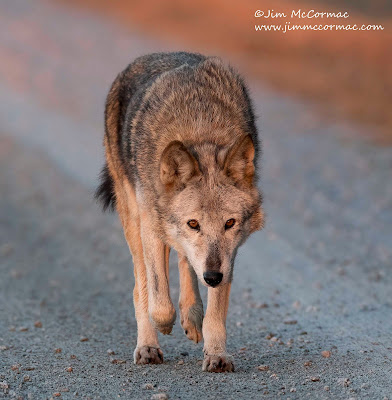
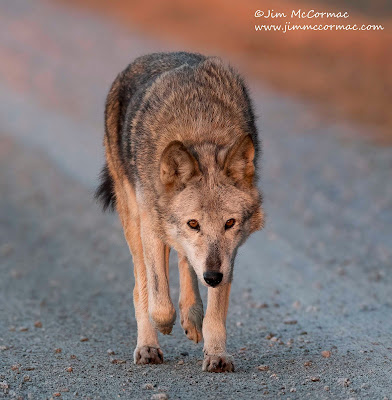
A female red wolf approaches Jim McCormac in the Alligator River National Wildlife Refuge in North Carolina/Jim McCormac
 

Nature: Once common red wolf now among rarest of the rare

Columbus Dispatch
January 30, 2022

NATURE
Jim McCormac

NOTE: See end of column for a link to an excellent film about red wolves.

January 11 was an unforgettable day. I was in the Alligator River National Wildlife Refuge in eastern North Carolina, a sprawling 152,000-acre mosaic of habitats. Mostly I was after waterfowl: thousands of northern pintail and tundra swans use the area, along with other species of fowl. My camera was my weapon.

Near day’s end, I was slowly cruising a seldom-used dirt track. I spotted an object nearly a half-mile down the lane and glassed it with 10-power binoculars. A canid! Either a coyote, or something much more special.

I pulled the Jeep off the track, exited with my big telephoto lens and hid behind the vehicle. Amazingly, the animal kept heading my way, periodically stopping to look about. Occasionally it would make brief forays into the vegetation but then return to the road.

As it got nearer, I saw it was an animal that I had no expectations of seeing – a red wolf! Luckily, I was downwind, and the wolf apparently was unaware of me. It surely saw the vehicle but apparently wasn’t put off by that. I kept clicking off shots, with the majestic mammal eventually approaching to about 75 feet.

At that point, the wolf fixed my lens with a glare (it still couldn’t see much of me), paused, then trotted into nearby woods and melted away. I suspect it had been hunting rabbits, which often come to road edges near dusk.

The federally endangered red wolf is among the rarest of the rare, with all remaining wild animals on the Alligator River refuge.

It wasn’t always so. Prior to European settlement, red wolves were common and ranged throughout the southeastern U.S., possibly including southern Ohio.

As settlers poured into the wilderness, wolf persecution began in earnest. Eventually, governments and farming coalitions offered bounties for their carcasses, and the massacres were successful. In 1978 the red wolf was declared extinct in the wild.

Wolves, possibly including both gray and red wolves, vanished from Ohio much earlier, by the mid-1800’s, victims of relentless persecution.

Fortunately, a number of red wolves had been live-trapped and these formed a captive colony housed at the Point Defiance Zoo & Aquarium in Washington State. In 1987, some of these animals were released into Alligator River.

The wolves flourished in their Carolinian refuge, peaking at perhaps 120 animals in the early 2010’s.

But lots of people still despise wolves, and many of the Carolina wolves have been shot or poisoned if they dared stray onto private lands. As of now, perhaps 17 wolves remain in the wild. The animal that I saw turned out to be a 12-year-old female, known to biologists as “1849”.

It is no longer possible for apex predators such as wolves to survive in vast swaths of the U.S. Human conflict and habitat loss are the primary reasons, and when human interests are at stake, we virtually always prevail.

If only present-day Americans had the deep connection to nature that the Cherokee people did, wolves would have far less to fear. Cherokees ranged over much of the southeast, knew the red wolf well, and held the mammal in reverence, seldom killing them.

Now, to protect the whole of our biodiversity necessitates protecting vast swaths of land, such as the Alligator River National Wildlife Refuge. But even that might not be enough for wide-ranging mammals like wolves. Time will tell how the red wolf saga plays out, and I’m rooting for the wily canines.

Naturalist Jim McCormac writes a column for The Dispatch on the first, third and fifth Sundays of the month. He also writes about nature at www.jimmccormac.blogspot.com.
Justin Grubb, creator of Running Wild Media and native of Worthington, Ohio, released a documentary film about red wolves in 2020. It features excellent footage of wolves and does an excellent job of telling their story. See it RIGHT HERE.

Saturday, January 29, 2022

Brown-headed Nuthatch, one cute elfin


A seldom traveled lane through the sprawling Alligator River National Wildlife Refuge in eastern North Carolina. I spent a few days a couple of weeks ago based in Manteo, NC, and made several trips into this refuge. My original primary objective was American Black Bears (Ursus americanus). As fate would have it, an unusually cold snap (9 F one morning!) apparently put the bears into a state of torpor, and I saw none. Nor did anyone else that I encountered. The bear density here is amazing, and as they usually do not truly hibernate, these bears grow to massive proportions. Apparently, one was documented at 850 lbs.! I'll be back to try for bears later.

There was an abundance of consolation prizes, and one of my favorites was a polar opposite of a giant bear on the size scale, the Brown-headed Nuthatch (Sitta pusilla). Along with the similar-sized western Pymy Nuthatch (Sitta pygmaea), this is the smallest North American nuthatch. A Brown-headed Nuthatch weighs 10 grams, and it would take nearly 39,000 of them to equal the weight of the aforementioned jumbo American Black Bear.

It didn't take long to find some of the bark-crawling sprites. Scattered older-growth pine groves produced them, and I found about three small bands of nuthatches in trees like this. Brown-headed Nuthatch is a social species, particularly in winter when small groups form.

I heard them first. Brown-headed Nuthatches deliver utterly delightful high-pitched calls suggestive of little squeak toys. Once one has pinpointed them by sound, it's an easy matter to clap eyes on the birds. They aren't shrinking violets but do tend to stay high in the canopy. Watch long enough though, and a bird or two will come lower. Hard workers, Brown-headed Nuthatches seem to work every inch, nook, and cranny of their host trees.
A Brown-headed Nuthatch dangles from a cone. No part of the pine goes uninspected, and this one spent a minute or few thoroughly probing this cone.

Most people, upon seeing one of these tiny nuthatches, would say or think something to the effect of "cute!" And cute they are. Unless you were a lacewing larva or some other small invertebrate attempting to hid in the bark. Then, the looming nuthatch would be Freddie Krueger incarnate. All things are relative.

The Brown-headed Nuthatch is nearing its northern range limits at Alligator River NWR. It is almost exclusively a bird of coastal plain states along the southern Atlantic, Florida, and Gulf states west to Texas. They are always tightly wedded to mature pines, of a number of species. Knowing its calls helps immensely in finding them.

FOOTNOTE: Like other southern pine specialty birds such as Bachman's Sparrow (Peucaea aestivalis) and Red-cockaded Woodpecker (Dryobates borealis), Brown-headed Nuthatches occasionally peregrinate well beyond their normal range. On November 21, 2001, one appeared at the Geauga County, Ohio feeders of Linda Gilbert. It remained until January 15, 2002. That bird represents Ohio's only record. I suspect that someday, one will appear here again and if it does, what a stir that little 10-gram ball of fluff will cause.

Sunday, January 23, 2022

Red Wolf


A Red Wolf (Canis rufus) ambles my way. I think this is just about the moment she realized someone/something was watching her.

The highlight of my recent trip through the Carolinas, Georgia, and the Atlantic Coast of Florida was a mammal. In spite of it being primarily a bird photography trip.

The Red Wolf is one of the rarest mammals, anywhere, with perhaps seventeen individuals in the wild. All of them occur in the Alligator River National Wildlife Refuge in North Carolina. I was fortunate to see one, and beyond fortunate to get the looks (and photographs) that I did.

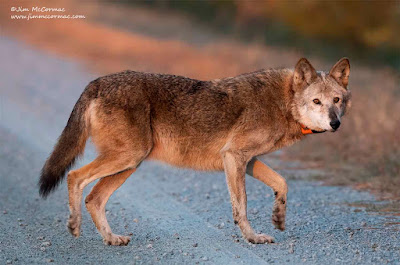
The wolf casts a last glance my way before trotting into nearby woods and melting away. She sports a radio collar - about seven of the wild wolves have these.

I'll tell the story of the Red Wolf in more detail here, soon, as it will be the subject of my next Columbus Dispatch newspaper column. Suffice to say it was an unexpected and thrilling experience. Fortune also literally shined on me as the light was beautiful and golden, and the sun was setting behind me.

A bit about how I came into such proximity to the beast. I had just turned onto a seldom-used gravel lane, headed towards a spot that American Black Bears frequent. Shortly after turning, I saw an object nearly a half-mile down the road, stopped, and glassed it with 10x binoculars. It was obviously a canid, although I could not tell if it was an Eastern Coyote or wolf from that range. But it seemed to be working my way.

I pulled the Jeep off the road, grabbed the 800mm lens/rig, eased out of the vehicle onto my knees, gently pushed the door shut (never slam doors!) and crawled around the back of the Jeep. It would have to serve as my blind, there was no time or opportunity to explore other options.

Amazingly, the animal kept ambling my way, stopping occasionally to look around and test the air. A few times it made brief forays into the vegetation. Perhaps it was hunting rabbits, which often come to roadsides around dusk. Fortunately for me, I was downwind so it couldn't get any scents, and the sidelined Jeep did not seem to interest it. As it drew nearer, I realized what I was looking at, crossed my fingers, and hoped it kept coming.

VEHICLE NOTE: My Jeep has auto headlights - they might have been deployed by this time. Fortunately, I had remembered to turn them off. When working from the vehicle in sparsely peopled areas, I usually keep the headlights off as long as possible. Had they been on when I turned onto the wolf road, the lights might have spooked the animal.

I've been forced to use the Jeep as a blind before, and when doing so rest the big lens butted up against part of the bumper, keep my body behind the vehicle, and thus offer the subject only a view of the lens' working end (the lens body is clad in camo) and a small part of my head and arm. It seems to break up my bipedal profile enough to sometimes keep warier animals from skedaddling.

Nearly everyone into natural history that visits this place knows about the wolves, me included. I just didn't expect to see one. Anyway, the animal eventually got to within 75-80 feet or so and was an easy mark for my big lens. The second shot above was my last, by which point she certainly realized that something was amiss. Her last pose was a beauty, though.

I probably could have just turned around and headed for home after this experience :-)

Thursday, January 20, 2022

Loggerhead Shrike


As always, click the photo to enlarge

A Loggerhead Shrike (Lanius ludovicianus) watches for victims from a wispy perch. These predatory songbirds are brutish hunters and are sometimes known as "butcher birds". I must admit, I watched this animal for some time hoping he might score a kill. It did chase a Song Sparrow into a palm, but the sparrow escaped. Shrikes often impale their victims on thorns, barbed wire, etc. As the shrike lacks large powerful talons, sharp objects serve to hold their meal in place while the bird rips it apart. Pine Glades Natural Area, Jupiter, Florida, January 15, 2022.

Sunday, January 16, 2022

Florida Scrub Jay, and Florida


A Florida Scrub Jay (Amphelocoma coerulescens), one of a clan of five birds that I encountered this morning near Hobe Sound, Florida. This rare jay, which is endemic to Florida, is but one of numerous interesting sightings on this expedition.

I left last Sunday, spent time in North Carolina then worked south into Florida. Working my way back to wintry Ohio now. When I return, I'll share more.