A stately Sycamore, Platanus occidentalis, rises from rich alluvial soils along a stream. White and brown barked Sycamore trees are easily recognized, and are the most conspicuous tree that defines the channels of creeks and rivers. They also play host to a variety of wildlife, some of which are Sycamore specialists, such as the beautiful Yellow-throated Warbler (at least in this part of the world).
While far less obvious than the aforementioned warbler and much better at hiding, this furry caterpillar is even more of a Sycamore associate than the warbler. It is a Sycamore Tussock Moth caterpillar, Halysidota harrisii. Insofar as I know, Sycamore is its only host plant.
I got an email a week or so back from a work colleague, Katie Thierolf, letting me know that she had seen numerous of these caterpillars at the state fairgrounds. Being unable to make a trip down there, I implored her to wrangle some of the cats into a jar, and bring the captured livestock back to the office so I could make some images. She did so - thank you Katie! - and some of the images and a story follow.
Sycamore Tussocks might be mistaken for the far more wide-ranging Banded Tussock Moth caterpillar, Halysidota tessellaris (above), which feeds on a great variety of plants. However, the caterpillars are easily distinguished by the color of their lashes - whitish to cinnamon-brown in the Sycamore; black in the Banded. Sycamores also have a denser furrier appearance to me, perhaps because their clumps of setae (hairs) are more tightly spaced. So the two species of caterpillars are easily separated. Not so the adult moths, as we shall see.
Sycamore Tussocks are interesting in that they have great color variation - one might think these were two separate species. A crop of eggs can produce caterpillars that range from lemon-yellow to gray to white.
It took a bit of wrestling around with these guys, and a lot of wasted shots, but we eventually managed some nice side by sides. These are handsome beasts by any standard of furry tubular beauty.
As an aside, this is what the underside of a Sycamore Tussock Moth caterpillar looks like. There are eight pairs of legs, as we can clearly see. The orange head of the animal is at the left and there are three pairs of thoracic legs just to the rear. The four pairs of legs in the center of the body are known as anterior prolegs, and the pair at the back of the cat are the anal prolegs.
In tight on the anterior prolegs, which are extremely grippy. These powerhouse gams do the bulk of the work when it comes to securing the caterpillar to twigs or foliage, and their sticking power is astonishingly strong. Just think about a brutal thunderstorm with attendant gale force winds. The caterpillar must do its best to ride out such storms and remain in the tree, and these legs are how they do it.
Katie brought me the caterpillars towards the end of the day, and their photo shoot had to wait until the next day. The three cats were secured in a large jar and well provisioned with fresh Sycamore foliage. Caterpillars essentially do two things - eat, and poop. In Lepidopteran parlance, caterpillar poo is known as frass, and the pile of frass above was generated overnight by the trio.
We go in tight on the frass, just because we can. It looks like tiny rabbit pellets. Believe it or not, there are small animals that mimic the look of frass pellets to perfection, and I just happen to have some good photos of one of these beasts, made last weekend. If not preempted by something cooler, I'll share that critter in the next post. But then, what could possibly be cooler than an animal that is the mirror image of a frass pellet?
I mentioned earlier that Banded and Sycamore Tussock Moth caterpillars are easily told apart, but the moths that they morph into are not. If the moth above came to the attention of most moth enthusiasts, I suspect that they would call it a Banded Tussock Moth, in part because that is the species included in field guides. But the Sycamore Tussock Moth is identical in appearance. Insofar as I know, no one knows how to tell the two apart except by a minute examination of the genitalia, even though it is easy to differentiate the caterpillars. So to be technically accurate, one must pronounce such a moth a "Banded/Sycamore".
Rachel Shoop, a biology student at Marietta College, is studying the DNA variation in these species. Perhaps, as part of her work, she will also unearth morphological characters that will enable us to visually separate the two. Such knowledge will make life more satisfying for moth-ers at the mothing sheets.
Oh, the caterpillars used in this shoot were released into a Sycamore tree at our office complex. Hopefully they will establish a local colony of Sycamore Tussock Moths.
A romp through the diverse flora and fauna of Ohio. From Timber Rattlesnakes to Prairie Warblers to Lakeside Daisies to Woodchucks, you'll eventually see it here, if it isn't already.
Thursday, August 14, 2014
Piping Plover braves Conneaut!
A typical scene at the "sand spit" at Conneaut Harbor, Ohio. Conneaut is wedged into the extreme northeastern corner of Ohio, on the shore of Lake Erie. It is a legendary birding locale, and in this photo birders mingle with legions of typically much more intrusive users of the harbor. John Pogacnik and I had led this trip to Conneaut last fall, and we saw lots of interesting birds. But both birds and birders must dodge numerous cars and other vehicles on the sands, wind-surfers soaring over the waters, bird-chasing dogs roaring about, and a host of other people-related disturbances.
In spite of its activity, the sheltered sandy flats in the Conneaut Harbor manage to serve as refugia for migrant shorebirds. Many of these sandpipers and plovers are making long-distance hauls from the highest regions of the Arctic tundra, where they breed, to places as distant as South America. Small birds that engage in annual journeys that span great distances need places to stop, rest, and refuel, and Conneaut provides such a way station. At least intermittently, as the birds are frequently disturbed by the seemingly ever-present people and their attendant hijinks.
Photo: Dane Adams
On July 31 of this year, Dane Adams found the bird above at Conneaut, an absolutely stunning juvenile Piping Plover, Charadrius melodus. He graciously allowed me to share his beautiful image. Note all of the multicolored bands festooning the bird's legs. The colors and combinations of those bands allow the bird to be specifically identified, thus enabling researchers to track its movements.
Piping Plovers have not fared well against the onslaught of Homo sapiens. There are three core breeding areas for the tiny plovers: the Great Plains states and adjacent Canadian prairie provinces; the Atlantic coast; and sandy shores of the Great Lakes. Collectively, probably fewer than 6,000 birds still exist. People love beaches, and human excesses have driven obligate beach-nesting bird species such as the Piping Plover away from numerous historical nesting grounds.
All populations have declined considerably, but the Great Lakes Piping Plovers have really taken it on the chin. In 2013, only 66 pairs were documented as nesting, and they fledged a grand total of 124 chicks. That was actually a good year, for recent times. The vast majority of these nesters were on Michigan beaches, with the largest aggregation in the vicinity of Sleeping Bear Dunes on Lake Michigan (23 pairs in 2013). In fact, eight days prior to Dane's find, another Piping Plover stopped in at Conneaut and it proved to have come from a Sleeping Bear Dunes nest.
Thanks to the work of Bob Lane, who tracked down the specifics of Dane's bird using the band combination, we know that the bird was born this summer on beaches near Wasaga Beach, Ontario, Canada. That's on the southern lobe of Lake Huron's Georgian Bay, and about 175 miles due north of Conneaut. As only a few pairs of the Great Lakes Piping Plover population nest in Canada, this little bird is a rarity indeed.
Here's hoping the charismatic, diminutive plover (one weighs about the same as a plump strawberry) makes it safely to its winter destination - beaches of the southern Atlantic or Gulf Coast. And then returns to the Great Lakes to successfully nest, and produce more charming little plovers.
Monday, August 11, 2014
Carolina Wolf Spider rediscovered!
Your narrator wrestles with two savages that collectively outweigh him, and that's saying something! This pair of St. Bernards are named Chloe and Lula, and they're a barrel of laughs. Nothing like a 130 lb. dog that thinks she's a puppy and deserves to jump in your lap. And two of them means double the fun!
The dogs belong to John Howard, a familiar name to regular readers of this blog and students of the natural sciences statewide and beyond. John lives in Adams County, smack in the middle of some of the richest biodiversity east of the Mississippi River. There is nowhere in this great state that I'd rather go, partly because the prospects of incredible new finds, whether they be plant or animal, always loom large. And on this trip, we scored big.
I'm bookended by two of the best, most well-rounded naturalists that I know, David and Laura Hughes. The three of us joined with John last Saturday to investigate some interesting Adams County habitats. First, we had to get out of John's "yard" and that took a while. We found lots of cool stuff there, and Laura and David brought some very interesting animals that required lots of photographing. I'll hope to share some of that stuff in the future.
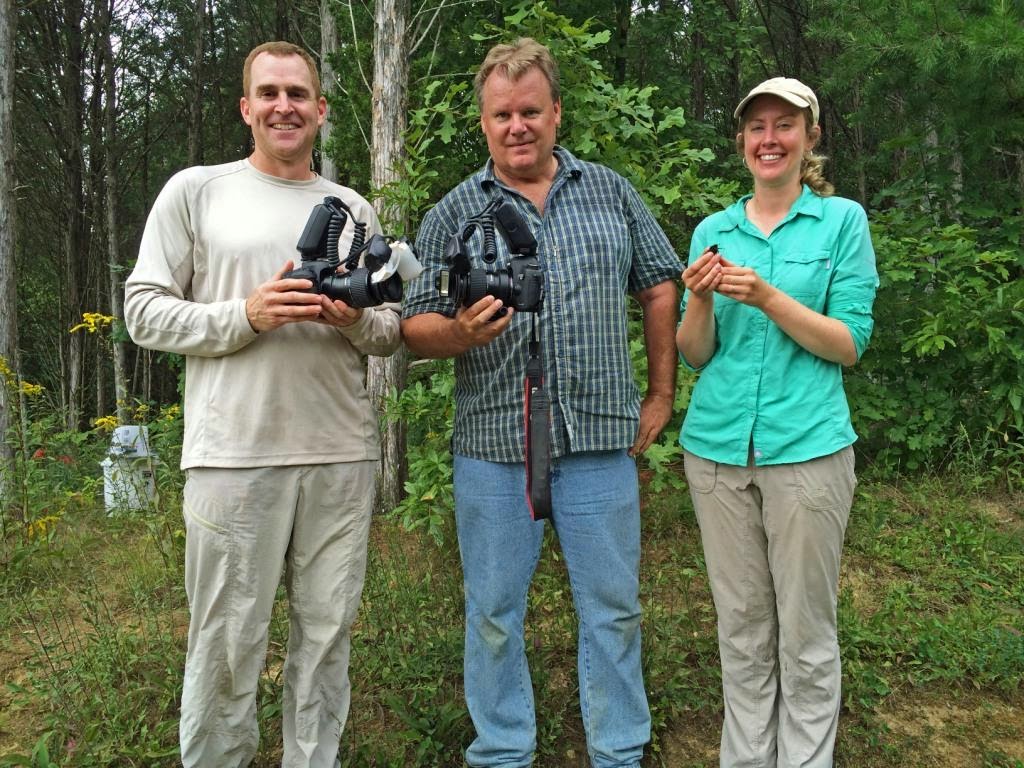
David served as my counselor/therapist when I was trying to decide whether to acquire Canon's remarkable (and costly) MP-E 65 macro lens. It's a very niche lens, but if you're into macro and shoot Canon, it'll eventually be a must-have piece of hardware. Dave already had one, and after a lengthy talk with him I pulled the trigger and got one. We're holding our macro rigs in this shot, and made good use of them on this day. Laura, by the way, is holding a spectacular female Hercules Beetle, Dynastes tityus.
Our destination was a prairie barrens not dissimilar to the one in this photo. Such habitats are full of biodiversity, often including many rare (sometimes VERY rare) species.
David and Laura work a borescope, while John kneels at the ready with his camera. A borescope is a highly specialized instrument that sports a long flexible tube with an amazingly good camera at the tip. One can thread the tube into nearly any nook or cranny, and built-in lights illuminate whatever lurks within. The operator controls the camera - which shoots stills or video - from the box that Laura is holding. Only the most serious of explorers of the natural world have such a tool, but that's Dave and Laura.
We'll stick the borescope in anything that looks interesting, but in this prairie we had a specific target in mind. Missouri Wolf Spiders, Geolycosa missouriensis.These big spiders create round burrows in the ground, and hole up in the depths during the day. At night, they come to the entrance and dash out to kill any unfortunate victim that bumbles too close. Most of the burrows that we inspected had a spider in residence, and it is really cool to see them come into view as the camera snakes its way into the inky depths of the burrow.
After a bit, we came across a burrow that was HUGE - three times the diameter of those of the Missouri Wolf Spiders. Excitement reigned, as we had some idea as to what the occupant might be. The camera was quickly readied and plumbed down the hole, and you can see the result on the borescope's screen.
Yes! We knew we weren't looking at a Missouri Wolf Spider; this thing was significantly larger and quite grayish. Laura popped off many photos and a lot of video of the animal as it glared at the camera. By now, we were relatively certain that we had made an exceptional find.
Eventually the jumbo spider got ticked off by the intrusive tube, and began to lunge at it. Laura played it like a cat lured by a string, and slowly teased the spider to the burrow entrance. This photo shows the spider at the burrow's mouth. Note its impressive orange chelicerae, or fangs. The tube is the borescope, and that burrow is big enough to stick your thumb in and not touch the sides. A penny provides scale.
We had rediscovered the Carolina Wolf Spider, Hogna carolinensis, which had not been seen in Ohio for over 60 years. At one time, going back nearly a century, this was considered a common wolf spider in Ohio. Spider expert Richard Bradley (CLICK HERE to see his excellent new book) believes that it could not cope with intensive agriculture and other habitat alterations, and thus disappeared from much of its former range.
The spider eventually came completely out of the hole and allowed us to view it in all of its gigantic splendor. According to Rich Bradley, this is a male, and possibly not a fully mature individual. Carolina Wolf Spiders can live for several years. Just imagine, the females are significantly larger!
We called Richard Bradley that night, and quickly sent him photos for confirmation. We're grateful for his comments about this species, and for confirming the identification. Our find was made at the end of the day, and thus we ran out of daylight before we could scour the prairie for additional spider burrows. There must be others, and you can believe searches will be organized before long.
Chance favors the prepared mind, and even though rediscovering this spider was not even on our minds, all of the necessary ingredients were present. Rich had educated us all in year's past about the Carolina Wolf Spider, and what its burrows looked like. John and I had sought it before in places that we thought looked good, but obviously with no luck. However, as soon as we saw the burrow we thought about this spider. Without the Hughes' borescope, it wouldn't have been possible to confirm the spider without a serious intrusion on the animal that involved shovels, and we wouldn't have wanted to do that.
Many of you who read this - if you made it this far! - will wonder why it isn't a GOOD thing that this spider went missing. To me it is fantastic to know that the largest wolf spider in North America lives on in Ohio. It is a high-end predator and such animals often serve as excellent early warning systems when things go awry with the environment. This Carolina Wolf Spider, and I suspect any others that we discover, live in some of the rarest and most interesting habitats in the Midwest. Within feet of the spider's burrow were several state-listed rare plants, and the general area is loaded with rare species. The spider is one of them, and an integral part of the relict prairie in which it occurs. I'm very glad that this site is owned and protected as a preserve by the Cincinnati Museum and The Nature Conservancy. Most of our prairies were not protected, and that's why many cool animals such as the Carolina Wolf Spider have become critically endangered in Ohio, along with a raft of plants.
Click on the video to see actual footage shot through the borescope before we teased the spider out. Ignore our excited chatter. We were already discussing how to get our evidence to Rich for confirmation.
The dogs belong to John Howard, a familiar name to regular readers of this blog and students of the natural sciences statewide and beyond. John lives in Adams County, smack in the middle of some of the richest biodiversity east of the Mississippi River. There is nowhere in this great state that I'd rather go, partly because the prospects of incredible new finds, whether they be plant or animal, always loom large. And on this trip, we scored big.
I'm bookended by two of the best, most well-rounded naturalists that I know, David and Laura Hughes. The three of us joined with John last Saturday to investigate some interesting Adams County habitats. First, we had to get out of John's "yard" and that took a while. We found lots of cool stuff there, and Laura and David brought some very interesting animals that required lots of photographing. I'll hope to share some of that stuff in the future.
David served as my counselor/therapist when I was trying to decide whether to acquire Canon's remarkable (and costly) MP-E 65 macro lens. It's a very niche lens, but if you're into macro and shoot Canon, it'll eventually be a must-have piece of hardware. Dave already had one, and after a lengthy talk with him I pulled the trigger and got one. We're holding our macro rigs in this shot, and made good use of them on this day. Laura, by the way, is holding a spectacular female Hercules Beetle, Dynastes tityus.
Our destination was a prairie barrens not dissimilar to the one in this photo. Such habitats are full of biodiversity, often including many rare (sometimes VERY rare) species.
David and Laura work a borescope, while John kneels at the ready with his camera. A borescope is a highly specialized instrument that sports a long flexible tube with an amazingly good camera at the tip. One can thread the tube into nearly any nook or cranny, and built-in lights illuminate whatever lurks within. The operator controls the camera - which shoots stills or video - from the box that Laura is holding. Only the most serious of explorers of the natural world have such a tool, but that's Dave and Laura.
We'll stick the borescope in anything that looks interesting, but in this prairie we had a specific target in mind. Missouri Wolf Spiders, Geolycosa missouriensis.These big spiders create round burrows in the ground, and hole up in the depths during the day. At night, they come to the entrance and dash out to kill any unfortunate victim that bumbles too close. Most of the burrows that we inspected had a spider in residence, and it is really cool to see them come into view as the camera snakes its way into the inky depths of the burrow.
After a bit, we came across a burrow that was HUGE - three times the diameter of those of the Missouri Wolf Spiders. Excitement reigned, as we had some idea as to what the occupant might be. The camera was quickly readied and plumbed down the hole, and you can see the result on the borescope's screen.
Yes! We knew we weren't looking at a Missouri Wolf Spider; this thing was significantly larger and quite grayish. Laura popped off many photos and a lot of video of the animal as it glared at the camera. By now, we were relatively certain that we had made an exceptional find.
Eventually the jumbo spider got ticked off by the intrusive tube, and began to lunge at it. Laura played it like a cat lured by a string, and slowly teased the spider to the burrow entrance. This photo shows the spider at the burrow's mouth. Note its impressive orange chelicerae, or fangs. The tube is the borescope, and that burrow is big enough to stick your thumb in and not touch the sides. A penny provides scale.
We had rediscovered the Carolina Wolf Spider, Hogna carolinensis, which had not been seen in Ohio for over 60 years. At one time, going back nearly a century, this was considered a common wolf spider in Ohio. Spider expert Richard Bradley (CLICK HERE to see his excellent new book) believes that it could not cope with intensive agriculture and other habitat alterations, and thus disappeared from much of its former range.
The spider eventually came completely out of the hole and allowed us to view it in all of its gigantic splendor. According to Rich Bradley, this is a male, and possibly not a fully mature individual. Carolina Wolf Spiders can live for several years. Just imagine, the females are significantly larger!
We called Richard Bradley that night, and quickly sent him photos for confirmation. We're grateful for his comments about this species, and for confirming the identification. Our find was made at the end of the day, and thus we ran out of daylight before we could scour the prairie for additional spider burrows. There must be others, and you can believe searches will be organized before long.
Chance favors the prepared mind, and even though rediscovering this spider was not even on our minds, all of the necessary ingredients were present. Rich had educated us all in year's past about the Carolina Wolf Spider, and what its burrows looked like. John and I had sought it before in places that we thought looked good, but obviously with no luck. However, as soon as we saw the burrow we thought about this spider. Without the Hughes' borescope, it wouldn't have been possible to confirm the spider without a serious intrusion on the animal that involved shovels, and we wouldn't have wanted to do that.
Many of you who read this - if you made it this far! - will wonder why it isn't a GOOD thing that this spider went missing. To me it is fantastic to know that the largest wolf spider in North America lives on in Ohio. It is a high-end predator and such animals often serve as excellent early warning systems when things go awry with the environment. This Carolina Wolf Spider, and I suspect any others that we discover, live in some of the rarest and most interesting habitats in the Midwest. Within feet of the spider's burrow were several state-listed rare plants, and the general area is loaded with rare species. The spider is one of them, and an integral part of the relict prairie in which it occurs. I'm very glad that this site is owned and protected as a preserve by the Cincinnati Museum and The Nature Conservancy. Most of our prairies were not protected, and that's why many cool animals such as the Carolina Wolf Spider have become critically endangered in Ohio, along with a raft of plants.
Video by David and Laura Hughes
Click on the video to see actual footage shot through the borescope before we teased the spider out. Ignore our excited chatter. We were already discussing how to get our evidence to Rich for confirmation.
Thursday, August 7, 2014
Ohio Sustainable Landscapes Symposium
Swamp Milkweed, Asclepias incarnata, a beacon for pollinating insects and a big producer of Monarch butterflies.
Mark your calendars for Saturday, September 13. That's the date of the annual Ohio Sustainable Landscapes Conference, hosted by Dawes Arboretum in partnership with the Licking County Master Gardeners. All of the details and registration information ARE HERE.
Dawes Arboretum, for those of you who have not been, is an 1,800 acre paradise. Located just south of Newark, it is easy to reach from everywhere, and once on the grounds there is plenty to do. The arboretum strikes an excellent balance between formal gardens and wild natural areas, and as a result teems with biodiversity.
Eastern Tiger Swallowtail caterpillars, Papilio glaucus, require native trees as host plants, including ash and tuliptree.
The symposium features a fine lineup of speakers (present company possibly excluded), including horticulturist Solomon Gamboa. He'll be talking about his efforts to work with the citizenry of Cincinnati to come together to forest the Queen City.
Megan Palomo is coming all the way from the fabulous Phipps Conservatory in Pittsburgh. She'll be discussing the creation of backyard ecosystems, and how that benefits not only the homeowner but the world beyond.
If all goes well for the aforementioned swallowtail caterpillar, it'll morph into one of these beauties. Tiger Swallowtails are addicted to Joe-pye-weed, and if you've got it in your garden, you're sure to attract any local tigers.
Dawes also managed to wrangle Bill Dawson, of Columbus's own Franklin Park Conservatory. Bill will present a program on community gardens, their exponential growth in Ohio's capital city, and the good that they do.
Scaly Blazing-star, Liatris squarrosa, is botanical candy for butterflies and moths. Any blazing-star will greatly enrich a yardscape.
Finally, your narrator will be on hand and prepared to wax eloquent (to the extent possible) about the wonderful world of moths and butterflies. One could reasonably state that no group of insects has the impact of this bunch. Their caterpillars are intimately tied to vegetation, and with a bit of knowledge a person can essential garden for a crop of favored butterflies - or moths.
Possessed of an almost otherworldly appearance, this freshly emerged Pandorus Sphinx, Eumorpha pandorus, would catch and hold any eye. Its host plants? Good old wild grapes, and Virginia Creeper. Grapes and their kin are super natives that produce an extraordinary array of moths. Grape specialists will factor into my story, in which I will explore the amazing world of moths and butterflies, their enormous ecological roles, often breathtaking beauty, mind-blowing adaptations, and how we can help them out.
I think you'll really enjoy this conference, and the opportunity to spend time at Dawes Arboretum. Space is most definitely limited, so you'll probably want to sign on soon. Again, all symposium details are RIGHT HERE.
Monday, August 4, 2014
Bands pinpoint oldest of birds
An "ancient" female Ruby-throated Hummingbird, caught and banded by Allen Chartier, proved to be eight years, one month of age. Photo courtesy Allen Chartier.
BANDS PINPOINT OLDEST OF BIRDS
Columbus Dispatch
Sunday, August 3, 2014
NATURE
Jim McCormac
I recently received an email from Allen Chartier, a hummingbird expert who lives in Michigan, bearing news of an old bird. He had captured a ruby-throated hummingbird in his home state that proved to be 9 years, 1 month old — the oldest ruby-throat on record.
Chartier had caught the bird in 2006 — it was already an adult — and placed a tiny metal band with unique coding on its leg.
Hummingbirds typically burn up quickly. Most chicks don’t survive their first year, and of those that do, a life span of a few years is probably the norm.
Chartier’s bird was a Methuselah among hummingbirds and has made many journeys to Central America, where ruby-throated hummingbirds spend winter. Chartier estimates that the nickel-weight bird has traveled more than 36,000 miles, and she isn’t done yet.
Two days after capturing the bird, Chartier caught another female that was 8 years, 1 month old.
The science of bird banding — placing metal rings on the banded bird’s leg — provides much of the data regarding bird longevity. The U.S. Geological Survey’s Bird Banding Laboratory oversees bird banders and keeps records. Thanks to its workers, we have a much better idea of how long wild birds live.
Most songbirds don’t survive their first year. Only about 25 percent of American robin fledglings survive until November the year they hatch. Those that live longer can expect to last about 1.7 years. Thus, a robin in California that lived to be 13 years, 11 months, defied all odds.
One of the oldest birds ever documented was a Canada goose right here in Ohio. It lived to be
33 years, 3 months.
That pales in comparison with the true ancients of the bird world: the albatrosses. A female Laysan albatross dubbed Wisdom was first banded as an adult on Midway Atoll in the Pacific Ocean in 1956. She still returns to nest and successfully fledge chicks. Wisdom is at least 63 years old.
Wild birds face a life fraught with peril: predators galore, brutal weather, diseases, parasites, and man-made threats including tall buildings and vehicles.
The oldest known wild orchard oriole lived to be 10 years, 11 months. A female of the same species, found injured as a fledgling, was kept captive and free from the usual threats by Ohio artist Julie Zickefoose. It survived to 17 years of age.
Many longevity records derive from birds that were banded or recovered in Ohio, including the following:
• Great horned owl: 28 years
• Tundra swan: 25 years, 3 months
• Great egret: 22 years, 10 months
• Blue jay: 17 years, 6 months
• Turkey vulture: 16 years, 10 months
• Barn owl: 15 years, 5 months
• Chimney swift: 14 years
• Indigo bunting: 13 years, 3 months
• Common nighthawk: 9 years
• Cape May warbler: 4 years, 3 months
Naturalist Jim McCormac writes a column for The Dispatch on the first and third Sundays of the month. He also writes about nature at www.jimmccormac.blogspot.com
Sunday, August 3, 2014
Midwest Native Plant Conference recap
The 6th annual Midwest Native Plant Conference took place this weekend, and what a great time it was. For the fifth year in a row, we centered the event at Bergamo Center on the sprawling grounds of Mount St. John, just outside of Dayton. CLICK HERE for the conference website and all of the details.
As has been the case every year, the conference filled to capacity, which is about 170 people. I think we could make it larger, but bigger is not always better and none of us involved in its planning wishes to move it. The venue is perfect. A big thanks to everyone who works hard, and more or less all year, to make this thing come together. Keynote speakers, numerous concurrent breakout sessions, field trips, multiple vendors of native plants, numerous other exhibitors, meals - all of the things that make for LOTS of work and planning.
As is often the case at these conferences, I get so busy with this, that, and the other thing that I never pull out the camera to photo-document the event. So all I come away with, photo-wise, are some images from field trips that I was on. At least I can share some of those.
We always do night trips on Friday and Saturday night. Thanks to Don Geiger's efforts, the grounds of Mount St. John (150 acres!) are rich in native plants, and we always find lots of interesting things. The last several years, I have been fortunate to co-lead these forays with Lisa Rainsong, Wendy Partridge, and at least one of the two trips, Judy Semroc. Little escapes their notice. Following are some photos from our two evening trips.
This is a subadult Wheelbug, Arilus cristatus - death in the flowers. These assassin bugs are always crowd-pleasers; all the more so when people learn of their gruesome killing tactics. Wheelbugs stalk their victims - usually lesser insects - pounce, and stab the prey with that powerful hypodermic needle of a proboscis that is folded beneath its head. Chemicals are injected which liquefy the prey's innards, which are then sucked back out through the same proboscis.
Caution is required when alighting on a flower, if you are a small pollinating insect. These are the disk flowers of a False Sunflower, Heliopsis helianthoides, and a small ambush bug in the genus Phymata awaits a victim. Its orange eyes lend a rather ominous appearance to the animal, as do those powerful Popeye forelegs. When a moth or some other insect lands, the ambush bug will lunge, and dispatch it in much the same way as described above under the Wheelbug.
Lisa Rainsong is one of the foremost experts on "singing insects" - the Orthopterans. It is always a delight, and a robust learning experience, to spend time afield with her. Visit her blog, RIGHT HERE.
The conference grounds are rich in singing insects, and we always focus on them on our nighttime trips. We want to help people tune in to the sounds of the night and the insects that create the symphony. The conehead katydids are always popular, and I suspect that some of the uninitiated think that we are pulling their legs when we talk about them. So, we always do our best to go into the meadows and capture one, and that's what we've done here. This is a Sword-bearing Conehead, Neoconocephalus ensiger.
Last evening, as we investigated a night light, lo and behold, there sat a huge and very fresh Polyphemus Moth, Antheraea polyphemus.These giant silk moths are stunning, and so large that they can be mistaken for bats when they fly. Some sort of millipede has photo-bombed the picture - far right side.
The Polyphemus was a male, and here is a close-up of one of its antenna. A majestic work of art and much resembling a fern, this sensory organ can detect the female's pheromones from perhaps a half-mile, maybe farther.
As I was leaving the conference this morning to head to Cedar Bog to lead a post-conference field trip, someone tipped me to these moths. I was delighted to see that they were Honey Locust Moths, Sphingicampa bicolor. Not only that, it was a mating pair, and the female was somehow already dumping eggs. Perhaps one of my moth ranching friends can explain this.
There are numerous Honey Locust trees close at hand; in fact, some of them were overshadowing the native plant vendors where the moths appeared. It's in those trees where the caterpillars were probably feeding. The moths were found on one of the plants that was for sale at a vendor's booth.
When our group arrived at Cedar Bog, we were shown this beautiful chrysalis. I think it was found by Jill Michaels at her property, but I'm not sure. Anyway, it is that of a Question Mark butterfly, Polygonia interrogationis.Note the beautiful silvery splashes on the side, as if a welder slopped some molten silver onto the structure.
We soon headed into the bog via its boardwalk, where we spent an all too quick four hours finding scores of interesting plants and animals. This Tawny Emperor, Asterocampa clyton, was exceptionally cooperative.
I suspect that one could easily heap 100 or more of these flowers on a quarter. It is the bloom of the Virginia Stickseed, Hackelia virginiana, and the blossom is so tiny that it would go unnoticed by the vast majority of passersby. When seen well, it proves to be an interesting and ornate flower worthy of our inspection.
The Ground-nut, Apios americana, was in full flower and this one bowled people over. The strange pinkish flowers are fascinating in shape and color. It's worth a visit to Cedar Bog in the next few weeks just to see them, but if you go you will see scads of other stuff.
Thanks again to all of the speakers, organizers, field trips leaders, and attendees who made for another great Midwest Native Plant Conference. And big thanks, as always, to everyone at Bergamo Center for the great hospitality and flawless service.
Planning has already begun for the 2015 conference, and I hope that you can make it.
As has been the case every year, the conference filled to capacity, which is about 170 people. I think we could make it larger, but bigger is not always better and none of us involved in its planning wishes to move it. The venue is perfect. A big thanks to everyone who works hard, and more or less all year, to make this thing come together. Keynote speakers, numerous concurrent breakout sessions, field trips, multiple vendors of native plants, numerous other exhibitors, meals - all of the things that make for LOTS of work and planning.
As is often the case at these conferences, I get so busy with this, that, and the other thing that I never pull out the camera to photo-document the event. So all I come away with, photo-wise, are some images from field trips that I was on. At least I can share some of those.
We always do night trips on Friday and Saturday night. Thanks to Don Geiger's efforts, the grounds of Mount St. John (150 acres!) are rich in native plants, and we always find lots of interesting things. The last several years, I have been fortunate to co-lead these forays with Lisa Rainsong, Wendy Partridge, and at least one of the two trips, Judy Semroc. Little escapes their notice. Following are some photos from our two evening trips.
This is a subadult Wheelbug, Arilus cristatus - death in the flowers. These assassin bugs are always crowd-pleasers; all the more so when people learn of their gruesome killing tactics. Wheelbugs stalk their victims - usually lesser insects - pounce, and stab the prey with that powerful hypodermic needle of a proboscis that is folded beneath its head. Chemicals are injected which liquefy the prey's innards, which are then sucked back out through the same proboscis.
Caution is required when alighting on a flower, if you are a small pollinating insect. These are the disk flowers of a False Sunflower, Heliopsis helianthoides, and a small ambush bug in the genus Phymata awaits a victim. Its orange eyes lend a rather ominous appearance to the animal, as do those powerful Popeye forelegs. When a moth or some other insect lands, the ambush bug will lunge, and dispatch it in much the same way as described above under the Wheelbug.
Lisa Rainsong is one of the foremost experts on "singing insects" - the Orthopterans. It is always a delight, and a robust learning experience, to spend time afield with her. Visit her blog, RIGHT HERE.
The conference grounds are rich in singing insects, and we always focus on them on our nighttime trips. We want to help people tune in to the sounds of the night and the insects that create the symphony. The conehead katydids are always popular, and I suspect that some of the uninitiated think that we are pulling their legs when we talk about them. So, we always do our best to go into the meadows and capture one, and that's what we've done here. This is a Sword-bearing Conehead, Neoconocephalus ensiger.
Last evening, as we investigated a night light, lo and behold, there sat a huge and very fresh Polyphemus Moth, Antheraea polyphemus.These giant silk moths are stunning, and so large that they can be mistaken for bats when they fly. Some sort of millipede has photo-bombed the picture - far right side.
The Polyphemus was a male, and here is a close-up of one of its antenna. A majestic work of art and much resembling a fern, this sensory organ can detect the female's pheromones from perhaps a half-mile, maybe farther.
As I was leaving the conference this morning to head to Cedar Bog to lead a post-conference field trip, someone tipped me to these moths. I was delighted to see that they were Honey Locust Moths, Sphingicampa bicolor. Not only that, it was a mating pair, and the female was somehow already dumping eggs. Perhaps one of my moth ranching friends can explain this.
There are numerous Honey Locust trees close at hand; in fact, some of them were overshadowing the native plant vendors where the moths appeared. It's in those trees where the caterpillars were probably feeding. The moths were found on one of the plants that was for sale at a vendor's booth.
When our group arrived at Cedar Bog, we were shown this beautiful chrysalis. I think it was found by Jill Michaels at her property, but I'm not sure. Anyway, it is that of a Question Mark butterfly, Polygonia interrogationis.Note the beautiful silvery splashes on the side, as if a welder slopped some molten silver onto the structure.
We soon headed into the bog via its boardwalk, where we spent an all too quick four hours finding scores of interesting plants and animals. This Tawny Emperor, Asterocampa clyton, was exceptionally cooperative.
I suspect that one could easily heap 100 or more of these flowers on a quarter. It is the bloom of the Virginia Stickseed, Hackelia virginiana, and the blossom is so tiny that it would go unnoticed by the vast majority of passersby. When seen well, it proves to be an interesting and ornate flower worthy of our inspection.
The Ground-nut, Apios americana, was in full flower and this one bowled people over. The strange pinkish flowers are fascinating in shape and color. It's worth a visit to Cedar Bog in the next few weeks just to see them, but if you go you will see scads of other stuff.
Thanks again to all of the speakers, organizers, field trips leaders, and attendees who made for another great Midwest Native Plant Conference. And big thanks, as always, to everyone at Bergamo Center for the great hospitality and flawless service.
Planning has already begun for the 2015 conference, and I hope that you can make it.
Friday, August 1, 2014
Passenger Pigeon Symposium: August 29-30
A quartet of extinct birds (L to R): Passenger Pigeon, Carolina Parakeet, Ivory-billed Woodpecker, Eskimo Curlew. You, I, nor anyone else will ever get to see one of these species - they're gone, for good.
The pigeon was once an overwhelmingly abundant bird in Ohio, and elsewhere in its range. The Carolina Parakeet was at least locally common in Ohio; the last wild flock here was seen in 1862 in Columbus. The last living specimen died in the Cincinnati Zoo in 1918. Ivory-billed Woodpeckers probably did not occur as far north as Ohio (even though it is on most checklists for the state, based on archaeological evidence); it probably blinked out in the mid 1900's. Evidence suggests that Eskimo Curlews regularly migrated through Ohio, at least in small numbers. Market hunting did this species in, and there have been only few and scattered reports since the 1960's. Hope still flickers, very faintly, that the curlew may still survive.
This is Martha, the last surviving Passenger Pigeon. She died on September 1, 1914, in the same Cincinnati Zoo that housed the last Carolina Parakeet. This year is the centennial of her passing, and the extinction of a species that once numbered in the billions. Some believe that the Passenger Pigeon population outnumbered all other bird species in North America, combined. Had you witnessed the flocks of two hundred years ago, neither you nor any of your comrades would have ever predicted the pigeon's extinction.
On August 29-30, the Ohio Ornithological Society and the Cincinnati Zoo are hosting a Passenger Pigeon Symposium at the zoo. The keynote speaker is Joel Greenberg, whose excellent book A Feathered River Across the Sky came out earlier this year. This book is the best work on the story of the pigeon ever done. Other speakers include legendary wildlife artist John Ruthven, the Cincinnati Zoo's Dan Marsh and Brian Jorg, and I will give a program about the possible relationships that existed between the Passenger Pigeon and Cerulean Warbler.
There will be birding trips to nearby Fernald Nature Preserve, nocturnal forays including mothing, and the Friday night shindig will even include music by the Rain Crows!
You won't want to miss it. All of the details, including registration information, are RIGHT HERE.
The pigeon was once an overwhelmingly abundant bird in Ohio, and elsewhere in its range. The Carolina Parakeet was at least locally common in Ohio; the last wild flock here was seen in 1862 in Columbus. The last living specimen died in the Cincinnati Zoo in 1918. Ivory-billed Woodpeckers probably did not occur as far north as Ohio (even though it is on most checklists for the state, based on archaeological evidence); it probably blinked out in the mid 1900's. Evidence suggests that Eskimo Curlews regularly migrated through Ohio, at least in small numbers. Market hunting did this species in, and there have been only few and scattered reports since the 1960's. Hope still flickers, very faintly, that the curlew may still survive.
Photo: Wikipedia
This is Martha, the last surviving Passenger Pigeon. She died on September 1, 1914, in the same Cincinnati Zoo that housed the last Carolina Parakeet. This year is the centennial of her passing, and the extinction of a species that once numbered in the billions. Some believe that the Passenger Pigeon population outnumbered all other bird species in North America, combined. Had you witnessed the flocks of two hundred years ago, neither you nor any of your comrades would have ever predicted the pigeon's extinction.
On August 29-30, the Ohio Ornithological Society and the Cincinnati Zoo are hosting a Passenger Pigeon Symposium at the zoo. The keynote speaker is Joel Greenberg, whose excellent book A Feathered River Across the Sky came out earlier this year. This book is the best work on the story of the pigeon ever done. Other speakers include legendary wildlife artist John Ruthven, the Cincinnati Zoo's Dan Marsh and Brian Jorg, and I will give a program about the possible relationships that existed between the Passenger Pigeon and Cerulean Warbler.
There will be birding trips to nearby Fernald Nature Preserve, nocturnal forays including mothing, and the Friday night shindig will even include music by the Rain Crows!
You won't want to miss it. All of the details, including registration information, are RIGHT HERE.
Subscribe to:
Posts (Atom)
.jpg)


.jpg)