Daughmer Savanna in Crawford County, one of Ohio's newest state nature preserves. The Ohio Division of Natural Areas and Preserves (DNAP) was instrumental in assuring the long-term protection of this stunning site, along with the Crawford County Park District.
DNAP, along with the Cleveland Museum of Natural History and other partners, hosts the Ohio Botanical Symposium, which will be held on Friday, April 5th. This is the 13th year for the symposium, which began with about 35 people in a classroom at Ohio State University. From humble beginnings it has mushroomed into a can't-miss 400+ person botanical extravaganza. It's held at the Villa Milano in Columbus, and does fill up, so get your tickets soon. Organizers have put together another excellent agenda, as can be seen HERE, along with registration information. Don't dawdle; the symposium is an outstanding way to start the spring.
A snippet of the 65,000 acre Shawnee State Forest in southern Ohio. Hard to believe this is the Buckeye State, eh? If you've read this blog with any regularity you've probably seen some of the scores of posts that I've made about Shawnee and its flora and fauna over the years. This is one of the best wilderness areas in the Midwest, and coupled with the (nearly) adjacent Edge of Appalachia Preserve, there is some 80,000 acres to roam.
The area teems with rare flora, and a staggering abundance of more common plants. A visit to Shawnee and vicinity is always rewarding, and once you've been once, you're almost certain to visit again. The best indoctrination into Shawnee and its multitude of nooks and crannies is with experts who know it well: enter Flora-Quest. This field trip focused botanical event will soon host its 7th consecutive conference the weekend of May 3-5. Early May is the peak of spring wildflowers, and by the end of F-Q your mind will be spinning at all of the magnificent plants that you'll have encountered. If you've got a camera, your cards will be stuffed with megabytes of digitized botanical beauties.
Space is rather limited at F-Q, and it does fill up, so this is another event to sign onto soon. All of the details are RIGHT HERE.
Although it is 20 degrees as I write this, the signs of spring are everywhere and the days quickly grow longer. By the time the two events plugged above roll around, flowering plants will be in evidence everywhere. Following is a pictorial taste of what's to come...
Cross-vine, Bignonia capreolata, Adams County, Ohio, April 7th, 2012. The other, better looking Trumpet-creeper!
Striped Maple, Acer pensylvanicum, April 15, 2012, Shenandoah National Park, Virginia. An endangered species in Ohio.
Birdfoot Violet, Viola pedata, April 25, 2012, Shawnee State Forest, Ohio. Flora-questers will get to see this beauty, which is arguably the showiest violet in North America.
Painted Trillium, Trillium undulatum, May 1, 2012, Monongehala National Forest, West Virginia. Another Ohio endangered species.
Pink Lady's-slipper, Cypripedium acaule, May 1, 2012, Babcock State Park, West Virginia. This stunning orchid is locally common in Shawnee State Forest and if you're at Flora-Quest you'll see 'em.
Dwarf Iris, Iris verna, May 3, 2008, Shawnee State Forest, Ohio. A roadside bank just a stone's throw from the state park lodge is blanketed with this Ohio threatened species, which is our only upland species of Iris.
Carolina Catchfly, Silene caroliniana, May 5, 2007, Shawnee State Forest, Ohio. These botanical stunners grow on nearly barren shaley hillsides and their brilliant flowers are jarring against the stark backdrop.
Spider Milkweed, Asclepias viridis, May 25, 2009, Edge of Appalachia Preserve, Adams County, Ohio. This large-flowered milkweed grows in prairie barrens and is sometimes known by the whimsical name "Green Antelopehorn".
Green Cottongrass, Eriophorum viridicarinatum, June 8, 2005, Cedar Bog, Urbana, Ohio. This rarity is confined to fens in Ohio, and is not a grass, but a sedge.
Crested Coralroot, Hexalectris spicata, July 14, 2012, prairie in Adams County, Ohio. One of forty-six native orchid species in Ohio (there is one well established nonnative species).
Obedient Plant, Physostegia virginiana, August 19, 2011, Willow Point Wildlife Area, Ohio. The curious common name stems from the flowers, which can be twisted around the stem as if on an axle, and will remain where placed.
Cardinal Flower, Lobelia cardinalis, August 31, 2011, Crane Hollow State Nature Preserve, Ohio. Easily in the top tier of our most striking wildflowers, the specimen in this photo was particularly engaging - it stood about seven feet tall!
Climbing Fern, Lygodium palmatum, September 15, 2007, Shawnee State Forest, Ohio. This strange fern is rare and local in southeastern Ohio. The broader leaves are sterile; the tiny lacy leaves are the fertile spore-bearing leaves.
Fringed Gentian, Gentianopsis virgata, October 6, 2012, Betsch Fen, Ohio. A fitting grand finale to Ohio's botanical season, but there is much to see between now and the gentian's closure to the season.
A romp through the diverse flora and fauna of Ohio. From Timber Rattlesnakes to Prairie Warblers to Lakeside Daisies to Woodchucks, you'll eventually see it here, if it isn't already.
Sunday, February 17, 2013
Tuesday, February 12, 2013
Ohio Natural History Conference!
The annual Ohio Natural History Conference rapidly approaches! Mark your calendars for Saturday, February 23, and plan a visit to the Ohio Historical Society's intriguing building in Columbus. This event, as always, is sponsored and orchestrated by the Ohio Biological Survey, which is celebrating its 100th anniversary.
This year's engaging crop of speakers includes Andy Jones of the Cleveland Museum of Natural History, Kathy Smith of the OSU Extension Service, Herman Mays of the Cincinnati Museum Center, August Froehlich with The Nature Conservancy, Katrina Schultes with the U.S. forest Service, and keynote speaker Scott Loarie of Stanford University, creator of iNaturalist.
Technology is revolutionizing the way that we learn about and even interact with nature, and we'll learn a lot about the interplay between humans, the natural world, and technological gizmos. These conferences are always rewarding, and a good opportunity to meet many of your peers.
For the complete lowdown, and to register, GO HERE. And, walk-ins are always welcome so feel free to show up that morning and join the festivities.
This year's engaging crop of speakers includes Andy Jones of the Cleveland Museum of Natural History, Kathy Smith of the OSU Extension Service, Herman Mays of the Cincinnati Museum Center, August Froehlich with The Nature Conservancy, Katrina Schultes with the U.S. forest Service, and keynote speaker Scott Loarie of Stanford University, creator of iNaturalist.
Technology is revolutionizing the way that we learn about and even interact with nature, and we'll learn a lot about the interplay between humans, the natural world, and technological gizmos. These conferences are always rewarding, and a good opportunity to meet many of your peers.
For the complete lowdown, and to register, GO HERE. And, walk-ins are always welcome so feel free to show up that morning and join the festivities.
Sunday, February 10, 2013
Red Fox, lazing in the sun
Yesterday, I had the pleasure of heading NNE to the wildlands of the Mohican region with Bruce Miller and Peter King. We had a few objectives in mind: investigating a report of a Barn Owl that had just come to light, seeing the now famous Evening Grosbeak flock, and searching for a Northern Shrike that has occasionally been seen along the route that we would be taking.
We scored on the owl and grosbeaks - more, perhaps, to follow on those. But as is often the case when spending time afield, something cool and totally unexpected pops into view. This is such a story; a tale of a foxily serendipitous find.
The boys and I had made our rounds, relishing the spectacle of a ghostly Barn Owl in its dimly lit haunts, and marveling over a flock of noisy and gluttonous Evening Grosbeaks. We had just circled about the area where the aforementioned Northern Shrike had been seen, but no luck on the butcherbird, although a consolatory Rough-legged Hawk put on a show. Well, two out of three ain't bad.
We were on our way to the Mohican State Park lodge for lunch, and the driver - me - had just hung a left into the lodge's long entrance road, when STOP - BACK, BACK, BACK!!! roared Peter, blustering and choking out his words. I knew some new game was afoot, although I wasn't sure what. A quick jab of the transmission into reverse and a stab of the throttle, and I saw what had caught his eye. A gorgeous Red Fox, lazing right out in the open, on the edge of the lawn!
Dopey with the warmth of the sun's rays and the promise of a soon to arrive spring, the fox barely regarded his new-found admirers. In short order, big telephoto lenses were bristling from the car's windows, and scads of images were fired off, burst-mode style.
As sharp of ear as they are of eye, the distant clicks of cameras finally made the fox beam on on us, wondering no doubt as to who the fools were that were interrupting its sleepy reverie. We certainly did not want to bother this glorious animal, but a stunning photo-op with a wild Red Fox is as rare as hen's teeth, and we couldn't help ourselves.
Finally the animal stood, shook off the dust, and turned to give us a baleful glare. It still sports the full luxuriance of its thick winter pelage - just have a look at that magnificent tail!
The fox slowly sauntered into the adjacent woods, turning to take another look at the paparazzi. My hunch is that it has a den very nearby, and when the weather is sunny regularly loafs on the grassy bank. Even though the temperature was decidedly cool, we had not a half-hour before commented on how nice the sun's warm rays felt. Apparently this fox felt the same, prompting his bask.
Sure enough, when we departed the lodge an hour or so later and motored back by this spot, our foxy friend was back, sprawled out on the lawn as before. Should you find yourself entering the lodge at Mohican, and it is a bright day, check the lawn behind the entrance sign and perhaps you'll also see this handsome beast.
If you would like to read more about Red Foxes, HERE IS an article that I wrote about them a while back.
Friday, February 8, 2013
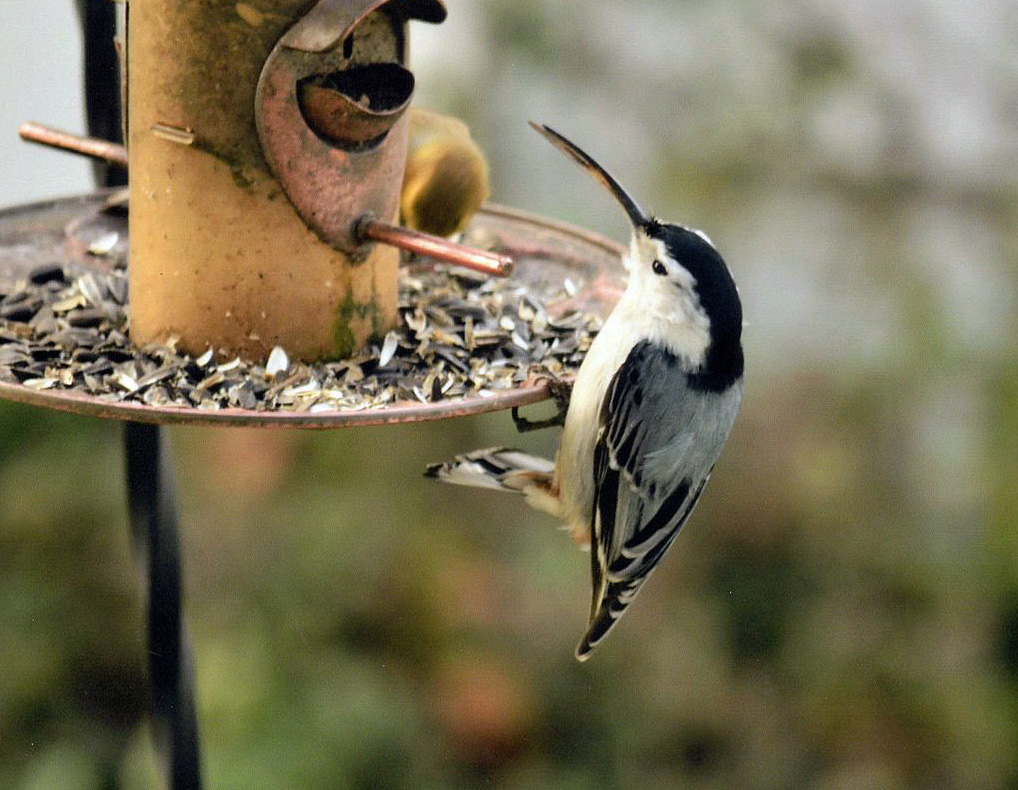
A "Long-billed" Nuthatch [updated]
Photo: Jeannine Snow
This is certainly NOT your typical White-breasted Nuthatch, and the bird is quite an eye-catcher! Gina Buckey tipped me to the oddball bird, and shared a few images made by her friend Jeannine Snow. I appreciate the info, and the use of the photos.
Our long-billed nuthatch is visiting a Newark, Ohio area feeder, and in spite of its amazing Pinocchioesque bill, has managed to survive for a while. The bird is an adult male, and presumably a hatch-year bird, so it's been poking around with that whopper of a bill for probably eight months or so.
Photo: Jeannine Snow
The obvious question: what happened? Bill deformities - and it is an abnormal bill to be sure - are actually well documented and occur routinely enough that such deformities have been the subject of much study. Perhaps the leaders in bill deformity research are scholars at the U.S. Geological Survey's Alaska Science Center. Their pages on this subject ARE HERE. Be prepared to see some bizarre and rather distressing bill deformities.
The upshot of all the research to date is that no one is yet quite sure of the cause or causes that trigger bill aberrations. A whopping 30 species, and not just passerines such as this nuthatch, have been documented with bill deformities in Alaska alone. Obviously, other species elsewhere can develop bill abnormalities.
The Alaskan researchers have focused most intensely on studying weird-billed Black-capped Chickadees. In spite of failing to pinpoint the exact cause or causes, they have identified several likely factors: genetics, environmental contaminants, disease and/or parasites, and nutritional disorders.
Such highly elongated and often grossly distorted bills cannot be good for the affected bird. Alarmingly, birds with bad bills seem to be on the increase, and one hopes that someone runs down the cause sooner than later.
The aforementioned Alaska USGS page has a place to report birds with bill deformities, HERE. I'm not clear on whether they want info on Alaska birds only, though, but if so perhaps they can direct reporters elsewhere. If I learn of a better site to report to, I'll pass it along. Wil Hershberger let me know that the Cornell Lab of Ornithology's Project FeederWatch website has more info on this phenomenon, and offers a reporting venue: RIGHT HERE.
Tuesday, February 5, 2013
Herring Gull: that name covers a lot of stuff
A flotilla of Herring Gulls (mostly) floats in Lake Erie near downtown Cleveland. Quite a diverse crew, eh? Someone new to gulling could be excused for thinking them all to be different species.
It takes a Herring Gull about four years to achieve its adult plumage, and every age class floats in the scene above. The dark brown birds are first and second-cycle gulls; they'll become cleaner, neater, and grayer and whiter with age.
A young (second-cycle [I think]) Herring Gull protects its bloody shad by loudly bugling at some interloper.
Leg color can be an important identification characteristic; generally speaking, Herring Gulls have pink legs. I believe this is a first-cycle bird, with neatly patterned wing coverts and mostly dark bill.
On the day that I was at East 72nd Street - other posts from that trip HERE, and HERE - the bird in the center left of the photo grabbed everyone's eye. For one, it is already in its breeding finery, with gleaming white head and neck, none of the dirty brown mottling that winter-plumaged Herring Gulls should still be retaining.
There was much debate about its identity, and we'll come back to that momentarily.
This fellow sticks out like a sore thumb - an adult Lesser Black-backed Gull, with its charcoal-gray mantle. The only likely source of confusion on Lake Erie, barring oddball hybrids, is Great Black-backed Gull. But adult Great Black-backeds are nearly black above, significantly larger, and do not develop the copious brown mottling on the head and neck.
Lesser Black-backed Gull is essentially part of the Herring Gull complex, and this closely allied species regularly hybridizes with Herring Gulls. Ohio did not record its first Lesser Black-backed until 1977, but the numbers of this European species have skyrocketed since. Along with them have come more records of apparent hybrids.
Back to the weirdo bird of two photos ago. Here we have the Lesser Black-backed Gull bookended by two Herring Gulls, and Mystery Gull is in the backdrop. This juxtaposition of these animals allows us to carefully compare mantle color. The Herrings are the palest gray, the Lesser Black-backed is jarringly dark in comparison, and Mystery Gull is somewhat in between.
At the time, in the field, we felt that it must be a hybrid, possibly between Lesser Black-backed and Herring. Later, I saw a note posted to the Ohio Birds Listserv by John Pogacnik, who was there later and saw the bird. John put forth the theory that it might be a Vega Gull, which is a largely Asian subspecies of the Herring Gull, and is treated as its own species elsewhere in the world.
I delved into the literature, and agreed that John might be onto something. The Kodak Gray Scale is used as a gauge for determining mantle color in gulls to a somewhat exacting degree, and according to Steve Howell in his book Gulls of the Americas, Vega Gull should read a 7-8 on the Kodak scale, versus a 4-5 for (American) Herring Gull. That seemed to match our bird.
However, there seemed to be problems with pigeonholing this animal as a Vega Gull. For one, it appears to have a mostly pale eye - Vega should be mostly dark - and the mantle is probably a bit on the dark side. What to do?
Find an expert. A major shortcoming for us who spend most of our time in the midwestern U.S. is that we just don't see or gain familiarity with Vega Gull. John pointed me to an excellent article detailing the Vega Gull, HERE, by Chris Gibbins. Dr. Gibbins spent time looking at scores of Vega Gulls in Japan, where they are common, and exhaustively documented and described what he saw.
I sent Chris a series of images of our mystery bird, and received a reply in short order. In a nutshell, he did not think it to be Vega, due to the darker mantle, pale eye, and wing pattern. He also noted that, if it were a Vega, it should still have a dirty brown head and neck as the bird still should be in winter plumage. Perhaps most importantly, his overall initial impression was not of a Vega Gull, and that means something coming from someone who has taken the time and effort to carefully study the species in the field.
So, to us at least, the gull remains a mystery. Here it is again, sandwiched between an adult Herring Gull, and an adult Great Black-backed Gull. I find the mystery bird to be very bull-necked in appearance and fairly stout overall - could one of its parents be a Great Black-backed Gull, if not a generation or two removed?
Sometimes, and this is very dissatisfying to some of us birders, a label just cannot confidently be placed on certain birds. But perhaps you know what this Mystery Gull is. If so, please do tell.
When stumped by oddball Herring Gulls and their ilk, I can take solace in this quote from Steve Howell's Gulls of the Americas: "The Herring Gull complex... constitutes one of the most problematic issues in contemporary avian taxonomy". Couple that statement with the large white-headed gulls' penchant for mating with other species, and we sometimes end up with weirdo birds that'll drive you up the wall.
I promise to steer clear of gulls for a while.
It takes a Herring Gull about four years to achieve its adult plumage, and every age class floats in the scene above. The dark brown birds are first and second-cycle gulls; they'll become cleaner, neater, and grayer and whiter with age.
A young (second-cycle [I think]) Herring Gull protects its bloody shad by loudly bugling at some interloper.
Leg color can be an important identification characteristic; generally speaking, Herring Gulls have pink legs. I believe this is a first-cycle bird, with neatly patterned wing coverts and mostly dark bill.
On the day that I was at East 72nd Street - other posts from that trip HERE, and HERE - the bird in the center left of the photo grabbed everyone's eye. For one, it is already in its breeding finery, with gleaming white head and neck, none of the dirty brown mottling that winter-plumaged Herring Gulls should still be retaining.
There was much debate about its identity, and we'll come back to that momentarily.
This fellow sticks out like a sore thumb - an adult Lesser Black-backed Gull, with its charcoal-gray mantle. The only likely source of confusion on Lake Erie, barring oddball hybrids, is Great Black-backed Gull. But adult Great Black-backeds are nearly black above, significantly larger, and do not develop the copious brown mottling on the head and neck.
Lesser Black-backed Gull is essentially part of the Herring Gull complex, and this closely allied species regularly hybridizes with Herring Gulls. Ohio did not record its first Lesser Black-backed until 1977, but the numbers of this European species have skyrocketed since. Along with them have come more records of apparent hybrids.
Back to the weirdo bird of two photos ago. Here we have the Lesser Black-backed Gull bookended by two Herring Gulls, and Mystery Gull is in the backdrop. This juxtaposition of these animals allows us to carefully compare mantle color. The Herrings are the palest gray, the Lesser Black-backed is jarringly dark in comparison, and Mystery Gull is somewhat in between.
At the time, in the field, we felt that it must be a hybrid, possibly between Lesser Black-backed and Herring. Later, I saw a note posted to the Ohio Birds Listserv by John Pogacnik, who was there later and saw the bird. John put forth the theory that it might be a Vega Gull, which is a largely Asian subspecies of the Herring Gull, and is treated as its own species elsewhere in the world.
I delved into the literature, and agreed that John might be onto something. The Kodak Gray Scale is used as a gauge for determining mantle color in gulls to a somewhat exacting degree, and according to Steve Howell in his book Gulls of the Americas, Vega Gull should read a 7-8 on the Kodak scale, versus a 4-5 for (American) Herring Gull. That seemed to match our bird.
However, there seemed to be problems with pigeonholing this animal as a Vega Gull. For one, it appears to have a mostly pale eye - Vega should be mostly dark - and the mantle is probably a bit on the dark side. What to do?
Find an expert. A major shortcoming for us who spend most of our time in the midwestern U.S. is that we just don't see or gain familiarity with Vega Gull. John pointed me to an excellent article detailing the Vega Gull, HERE, by Chris Gibbins. Dr. Gibbins spent time looking at scores of Vega Gulls in Japan, where they are common, and exhaustively documented and described what he saw.
I sent Chris a series of images of our mystery bird, and received a reply in short order. In a nutshell, he did not think it to be Vega, due to the darker mantle, pale eye, and wing pattern. He also noted that, if it were a Vega, it should still have a dirty brown head and neck as the bird still should be in winter plumage. Perhaps most importantly, his overall initial impression was not of a Vega Gull, and that means something coming from someone who has taken the time and effort to carefully study the species in the field.
So, to us at least, the gull remains a mystery. Here it is again, sandwiched between an adult Herring Gull, and an adult Great Black-backed Gull. I find the mystery bird to be very bull-necked in appearance and fairly stout overall - could one of its parents be a Great Black-backed Gull, if not a generation or two removed?
Sometimes, and this is very dissatisfying to some of us birders, a label just cannot confidently be placed on certain birds. But perhaps you know what this Mystery Gull is. If so, please do tell.
When stumped by oddball Herring Gulls and their ilk, I can take solace in this quote from Steve Howell's Gulls of the Americas: "The Herring Gull complex... constitutes one of the most problematic issues in contemporary avian taxonomy". Couple that statement with the large white-headed gulls' penchant for mating with other species, and we sometimes end up with weirdo birds that'll drive you up the wall.
I promise to steer clear of gulls for a while.
Kirtland Bird Club - Wednesday night
A late fall storm clears out of Lake Erie at Fairport Harbor, Ohio. The five Great Lakes are among the most dynamic and diverse freshwater aquatic systems on the globe, and support a staggering amount of biodiversity. Collectively, lakes Erie, Huron, Michigan, Ontario, and Superior harbor 20% of the world's fresh water, and it takes a drop of water entering the system at Superior's upper end 320 years to travel through the system.
I get to travel to the Cleveland Museum of Natural History this Wednesday evening, and present a program on the Great Lakes to the Kirtland Bird Club. We'll take a virtual trip through the Great Lakes, and circle back to the most diverse lake of them all, Erie, which sits but a few miles to the north of where we'll be gathering.
Should you find yourself in Cleveland or vicinity this Wednesday, feel free to stop by. The meeting commences at 7:30, and the Kirtland Bird Club welcomes guests. If you're around earlier, be sure and explore the Cleveland Museum of Natural History, which is full of fascinating exhibits and is a true state and national treasure.
I get to travel to the Cleveland Museum of Natural History this Wednesday evening, and present a program on the Great Lakes to the Kirtland Bird Club. We'll take a virtual trip through the Great Lakes, and circle back to the most diverse lake of them all, Erie, which sits but a few miles to the north of where we'll be gathering.
Should you find yourself in Cleveland or vicinity this Wednesday, feel free to stop by. The meeting commences at 7:30, and the Kirtland Bird Club welcomes guests. If you're around earlier, be sure and explore the Cleveland Museum of Natural History, which is full of fascinating exhibits and is a true state and national treasure.
Thursday, January 31, 2013
Some more gulls, and beautiful creatures they are
An adult Ring-billed Gull with gizzard shad. Like a kid in a candy shop. This and the following photos were made last Saturday at Cleveland's East 72nd Street park on Lake Erie. There, the shad pile up in the wake of a power plant's warm water effluvia like scaley locusts in an aquatic wheat field. Unfortunately for the nonnative shad, most die and are consigned to be expelled as gull guano.
At most seasons and in most areas in Ohio, the Ring-billed Gull is, if not the default gull, certainly the most common. This adult in flight shows its clean white tail, and mostly black outer primaries. Of course, that black ring around the bill is a pretty good clue to its identity. The bird is in winter plumage, as indicated by the light brown flecking on the head and neck. As it enters breeding condition in spring, those areas will become bright white.
This is a "second cycle" Ring-billed Gull. When "cycle" is applied to a gull, it indicates a distinct plumage sequence within a series of molts. All gulls take multiple years to attain full adult plumage, which is one of the reasons that they're confusing to identify. Different ages of the same species can look like completely different species.
Ring-billed gulls require about three years to achieve fully adult plumage, as in the birds in the previous two photos. This second cycle animal differs from an adult in its almost entirely black wingtips, and the prominent black terminal tail band.
This is the largest gull that you'll see on Lake Erie, or anywhere in the world. It is a Great Black-backed Gull, and one of these bruisers weighs three times as much as a Ring-billed Gull. The "GBBG" in the photo is a first cycle bird - mostly brown but showing the semblance of a dark mantle on the back. The head and neck are suffused with a dirty brown wash. Note the gargantuan bill.
I suspect that this Great Black-backed Gull is a second cycle bird. Its mantle is darkening up, and shows less of he checkerboard pattern caused by the copious white flecking of a younger bird.
No problem telling an adult Great Black-backed Gull, with its sooty-black upperparts and giant size. These birds are so large that nonbirders sometimes mistake them for Bald Eagles. The individual in this photo would be at least four years old - it takes that many years to achieve fully adult plumage. If it makes it to this stage, it could live for a long time. The oldest known wild bird lived for nearly three decades, and some of the large gull species probably manage to survive for far longer than that.
Big, pale, and ghostly, a Glaucous Gull sticks out like a sore thumb. This is another big boy, second in size and scale only to the Great Black-backed Gull. The Glaucous dwarfs the adult Ring-billed Gull directly behind it. Most of the other birds in the shot are Herring Gulls of various ages. The Herring Gull complex is an interesting group, and we found a real oddball Herringwhatever in this crowd. More on that later.
This is a first cycle Glaucous Gull, with dingy white plumage throughout, no obvious gray mantle differentiation, and a dark eye. Glaucous are among the "white-winged gulls", which includes the Iceland Gull. These Arctic-breeding birds of the far north lack, or mostly lack, dark pigment in the wingtips as can be seen on this bird.
They don't call 'em white-winged gulls for nothing. Glaucous Gulls are always a treat to find. While they are regular along Lake Erie in winter, we don't get very many. They're big, fierce animals capable of domineering the lesser gulls. This is another "four-year" gull - like the Great Black-backed Gull, it takes a Glaucous that long to reach maturity. This was the only of its kind at East 72nd on this day, so I was unable to make images of other age classes. But they look large, white, and cool no matter their age.
At most seasons and in most areas in Ohio, the Ring-billed Gull is, if not the default gull, certainly the most common. This adult in flight shows its clean white tail, and mostly black outer primaries. Of course, that black ring around the bill is a pretty good clue to its identity. The bird is in winter plumage, as indicated by the light brown flecking on the head and neck. As it enters breeding condition in spring, those areas will become bright white.
This is a "second cycle" Ring-billed Gull. When "cycle" is applied to a gull, it indicates a distinct plumage sequence within a series of molts. All gulls take multiple years to attain full adult plumage, which is one of the reasons that they're confusing to identify. Different ages of the same species can look like completely different species.
Ring-billed gulls require about three years to achieve fully adult plumage, as in the birds in the previous two photos. This second cycle animal differs from an adult in its almost entirely black wingtips, and the prominent black terminal tail band.
This is the largest gull that you'll see on Lake Erie, or anywhere in the world. It is a Great Black-backed Gull, and one of these bruisers weighs three times as much as a Ring-billed Gull. The "GBBG" in the photo is a first cycle bird - mostly brown but showing the semblance of a dark mantle on the back. The head and neck are suffused with a dirty brown wash. Note the gargantuan bill.
I suspect that this Great Black-backed Gull is a second cycle bird. Its mantle is darkening up, and shows less of he checkerboard pattern caused by the copious white flecking of a younger bird.
No problem telling an adult Great Black-backed Gull, with its sooty-black upperparts and giant size. These birds are so large that nonbirders sometimes mistake them for Bald Eagles. The individual in this photo would be at least four years old - it takes that many years to achieve fully adult plumage. If it makes it to this stage, it could live for a long time. The oldest known wild bird lived for nearly three decades, and some of the large gull species probably manage to survive for far longer than that.
Big, pale, and ghostly, a Glaucous Gull sticks out like a sore thumb. This is another big boy, second in size and scale only to the Great Black-backed Gull. The Glaucous dwarfs the adult Ring-billed Gull directly behind it. Most of the other birds in the shot are Herring Gulls of various ages. The Herring Gull complex is an interesting group, and we found a real oddball Herringwhatever in this crowd. More on that later.
This is a first cycle Glaucous Gull, with dingy white plumage throughout, no obvious gray mantle differentiation, and a dark eye. Glaucous are among the "white-winged gulls", which includes the Iceland Gull. These Arctic-breeding birds of the far north lack, or mostly lack, dark pigment in the wingtips as can be seen on this bird.
They don't call 'em white-winged gulls for nothing. Glaucous Gulls are always a treat to find. While they are regular along Lake Erie in winter, we don't get very many. They're big, fierce animals capable of domineering the lesser gulls. This is another "four-year" gull - like the Great Black-backed Gull, it takes a Glaucous that long to reach maturity. This was the only of its kind at East 72nd on this day, so I was unable to make images of other age classes. But they look large, white, and cool no matter their age.
Subscribe to:
Posts (Atom)
.jpg)