Saturday, December 8, 2012

Coyotes caught on camera!

Once again, the amazing trail camsmanship of Laura and David Hughes is on display here. This time, they've bagged a pair of Coyotes, Canis latrans, at their traditional Monroe County game trail hotspot.


Coyotes, while very common in most areas, can be quite furtive and are prone to doing most of their wandering at night. Thus, we don't often get to see how they operate, especially when the "dogs" are unaware of our presence.

Thanks again to David and Laura for another awesome peek into the secret lives of Ohio's mammals!

Friday, December 7, 2012

Caterpillars are fascinating - really!

A pair of jumbo Cecropia Moth caterpillars, Hyalaphora cecropia, make mincemeat of a black cherry sapling. This spectacular "cat" is but one of about 3,000 species of moth larvae eating their way through our woods and fields.

I'm giving a program entitled "Growing Caterpillars: A Tale of Birds, Plants, and Conservation" at the Columbus Natural History Society next Monday evening, December 10th. The price of admission is just right - free! The Society meets at the Ohio State University's Museum of Biological Diversity at 1315 Kinnear Rd., Columbus, Ohio 43210. Doors open at 7 pm; the show gets under way at 7:30 pm. All are welcome.

A Checker-fringe Prominent caterpillar, Schizura ipomoea, does its best to become one with a black maple leaf, and it's doing a pretty darn good job if you ask me.

I've had a casual interest in caterpillars for a long time, but really started becoming passionate about studying them in the last five years. Why? I began to realize just how important these tubular eating machines are to our environment. It's hardly an understatement to say that caterpillars make the world go 'round.

A tiny work of art, painted and shellacked, a gorgeous caterpillar known as The Asteroid, Cucullia asteroides, chows on flat-topped goldenrod. All caterpillars are intriguing on some front, whether it is beauty, camouflage, toxicity, bizarre defense systems, ecological value, or any combination of the above.

If you were able to toss all of Ohio's caterpillars into a pile, and a honking big pile it would be, their collective biomass would exceed that of a more conspicuous herbivore, the White-tailed Deer. If it were not for all of these caterpillars, many songbirds would go extinct, forests would largely fall silent, plant diversity would plummet, and our humanoid world would suffer greatly.

Sporting bright coloration warning would-be predators that it is poisonous and unpalatable, a Black Swallowtail butterfly, Papilio polyxenes, caterpillar noshes on cowbane, Oxypolis rigidior, one of our native parsleys. Even though butterflies garner the lion's share of attention, they are outnumbered by moth species by a factor of 20 in these parts. Even though they may be underappreciated, it is moths that do the heavy ecological lifting, especially stage II of their four-part life cycle, the caterpillars.

If you're in the Columbus area next Monday and want to learn more about a strange and mysterious world with far-reaching impacts, come on down to the Columbus Natural History Society's get-together. Directions are RIGHT HERE.

Tuesday, December 4, 2012

Bohemian Waxwing!


A trio of Cedar Waxwings, Bombycilla cedrorum, silky and dapper, pauses from plundering an ornamental crabapple. I made this image almost exactly four years ago in Wyandot County. Then, as would be the case now, I was excited to see these animals and lingered to admire them. To me at least, just about all birds are worthy of admiration, but waxwings require an extra glance. They are avian Clark Gables: sophisticated, impeccably tailored, unflappable and refined. A waxwing is the model sashaying down the runway; chickadees, robins, and jays are merely coarse and ill-mannered louts shouting and gawking from the seats below.


The family Bombycillidae is a small one:  it represents just .0003 of the world’s birds. Pictured above, courtesy WikiCommons, is the Japanese Waxwing, Bombycilla japonicum, one of only three waxwing species on the globe and the one least familiar to North American birders. This eastern Asian species gives up nothing in the looks department to its American counterparts.

Photo: Dane Adams

And finally, the third species in the waxwing trio, the robust and showy Bohemian Waxwing, Bombycilla garrulus.
Bohemian: “An itinerant person; a vagabond”

In this part of the world, the appearance of Bohemian Waxwings always causes a stir. They’re rare – quite rare – here, and their appearances are utterly unpredictable in any given locale. Thus it was a momentous occasion last Saturday when a group of Columbus birders stumbled into a flock of eleven BoWax pilfering fruit from a crabapple tree at Maumee Bay State Park. Word soon spread and before long many other birders were basking in the presence of the regal waxwings. Dane Adams, who has kindly shared many of his excellent photos with this blog, made the scene and provided this beautiful image.

A Bohemian Waxwing is like a majorly gussied up Cedar Waxwing. If your firsthand familiarity of the waxwing tribe extends only to the latter, get ready to pick your jaw up off the sod when you first encounter a BoWax in living color. They’re jumbos; a classic example of Bergmann’s Rule. A plump Cedar X-wing might tip the scales at 32 grams; BoWax are honking big in comparison, like nearly 60 grams big. That’s like comparing Richard Simmons to Arnold Schwarzenegger. The artists also worked overtime when painting the Bohemians. True, Cedar Waxwings have those cool little red waxy nubs on their wing feathers. So do the BoWax, but their wing adornments also include bold white and yellow brushstrokes. The undertail coverts are a luscious shade of cinnamon-brown, and the forehead and cheeks are tinted in the same reddish-brown hue, making the bird look as if it is blushing. The bird in Dane’s photo is an adult; the extent of yellow on the tail and coloration in the wings increases with age.


This map, via the Cornell Lab of Ornithology, helps to explain why Bohemian Waxwings are a BIG DEAL in Ohio and adjacent necks of the woods. They breed about 1,500 miles away, throughout the northern and western reaches of the great boreal forest. While the short northern summers bring a bounty of insects, and the waxwings certainly hawk for those, these birds are primarily frugivorous (fruit-eating). But not just any fruit – waxwings specialize on soft sugar-laden fruits such as those of mountain-ash, grapes, various members of the rose family, etc. Such fare tends to be ephemeral, not lasting long on the vine, so to speak. Thus, the waxwings must adopt a nomadic, or Bohemian, lifestyle in their constant quest for berries. Occasionally large-scale food shortages drive large numbers out of the core range and far to the south and east. And it is during such irruptions that we hope to find BoWax here in Ohio.
On average, one or a few Bohemian Waxwings turn up in Ohio every three or four winters, if that. We used to see more of them. At the time of earliest ornithological records, in the early to mid 1800’s, Kirtland and others mentioned BoWax flocks as a seemingly fairly regular occurrence. Even by the early 1900’s flocks were reported with some regularity, such as 75 in Lake County in January of 1920, which must have been a stunning sight.


This winter is shaping up to be a good one for Bohemian Waxwings in this region, or at least good for birders who are seeking them. This eBird map shows, in purple, the extent of their eastward sweep. Keep a close eye out for waxwings and scrutinize flocks when you find them. Sometimes Bohemians get in with the Cedars and can be easy to overlook. Waxwings, of either species, are often drawn to ornamental fruit-bearing trees such as crabapples, hawthorns, and the like and thus the birds can appear even in very urban areas.


Ace photographer Brian Zwiebel, who lives but a stone’s throw from Maumee Bay State Park, got to the waxwings in time to snap this stellar image, and I appreciate his allowing me to share it. Be sure to check out more of Brian’s work RIGHT HERE.
Congrats to Andy Sewell, who was with the group of birders that first stumbled into the Maumee Bay waxwings and recognized them for what they were. He quickly got word out and as a result many a person added Bohemian Waxwing to their state and/or life lists.

Sunday, December 2, 2012

A Merlin in the prairie

An immature male Merlin, Falco columbarius, surveys his domain. This is the third winter in a row that I've found a Merlin in this massive restored prairie, and in every case I've found the birds sitting on this very fence post.

I stopped in this Pickaway Plains prairie last Friday after work, stopping along the way to pick up a fellow raptor enthusiast, Deb Bradley, who doesn't live too far from the site. Our primary mission: Short-eared Owls. It seems to be shaping up to be a decent flight of these floppy-flying grassland hooters, so I wanted to check this locale for them. We weren't disappointed; at least four short-ears emerged from the tall Indian Grass at dusk, and began hunting. There were also about five Northern Harriers working the grasslands.

I took this shot several years ago, and it shows the Merlin's favorite fence posts. If you visit, you'll have a darn good chance of seeing the speedy little falcon atop one of these posts. Just slow down and check them from afar before moving in too closely. Part of the massive grassland disappears in the distance behind the posts.

If you want to visit this spot, this map may help you. The yellow north-south road is U.S. Route 23, and Circleville, Ohio is just a few miles to the north. Turn west on the upper road traced in blue - Radcliff Road, and then just follow the roads that I've outlined. This route makes a big rectangle and dumps you back out on 23. The red arrow points to the exact spot where the aforementioned posts are located. The best birding, where the roads bisect the grasslands, is shown in red.

This is a spectacular site. Located along the Scioto River (seen on the far left of the photo), this land is smack in the middle of the former Pickaway Plains prairie, a long linear swath of prairie that roughly followed Rte. 23 from present-day Circleville and extended perhaps seven miles to the south. About six years ago, one of the landowners put over 1,000 acres into the Conservation Reserve Program, and the land is now an ocean of prairie grasses. Birds have responded accordingly, and now the "Charlie's Pond" prairie is a fabulous birding locale.

If you're a songbird, this is the last thing you want to see staring needles at you. And it probably will be the last thing you see. Merlins are consummate bird-hawks, deftly flying down and snatching up lesser birds, ripping them up, and eating them.

I admire the Merlin's sheer insolence. They think very little of our species, and it shows. Had I not been as near as I was, with a long 500 mm lens bristling out the open car window, the bird probably would have paid me no mind. In general, we are not worthy in the world of the Merlin. One time, a bunch of us were at Green Lawn Cemetery, admiring a big female Merlin perched high atop a dead Sycamore snag. A woman, who had never before seen one of these falcons, finally burst out in semi-exasperation, "why won't it even look at us!". I had to break the news that, to the bird, she was a lesser species, not suitable for food or any other purpose, and therefore was not worthy of the bird's attention.

Note the acute wing tips, a characteristic of falcons. Merlins put those powerful wings to good use, and are feathered bullets capable of astonishing bursts of speed and remarkable veers and jags. They're very clever animals, too. Merlins have been documented following much larger Northern Harriers as the "Marsh Hawks" course low over grasslands, hoping to surprise voles. As a byproduct of their hunting, the harrier sometimes flushes songbirds, which are typically of little interest to the raptor. But songbirds are of great interest to Merlins, and when the harrier spooks one the Merlin is there to pounce.

An even better Merlin hunting story was published in an ornithological journal and described Merlins that flew in tandem with a speeding locomotive, up near the front of the train. When the train kicked up birds as it sped along, the Merlins were there to grab them.

In recent years, Merlins have become much more common in Ohio and many other parts of their range. We've even had two breeding records in the past few years, and I will guarantee that there will be more nestings. It's great to see these exciting and charismatic little raptors rebounding, even if they don't like us very much.

Thursday, November 29, 2012

Ring-necked Snake, a harmless charmer

In a recent post, I included this photo and made mention of a cool reptile that was on that flat rock and that had captured the attention of the assembled throng. I also said that I'd be back later to highlight the animal, and give it some air time on the vast World Wide Web. So here we go...

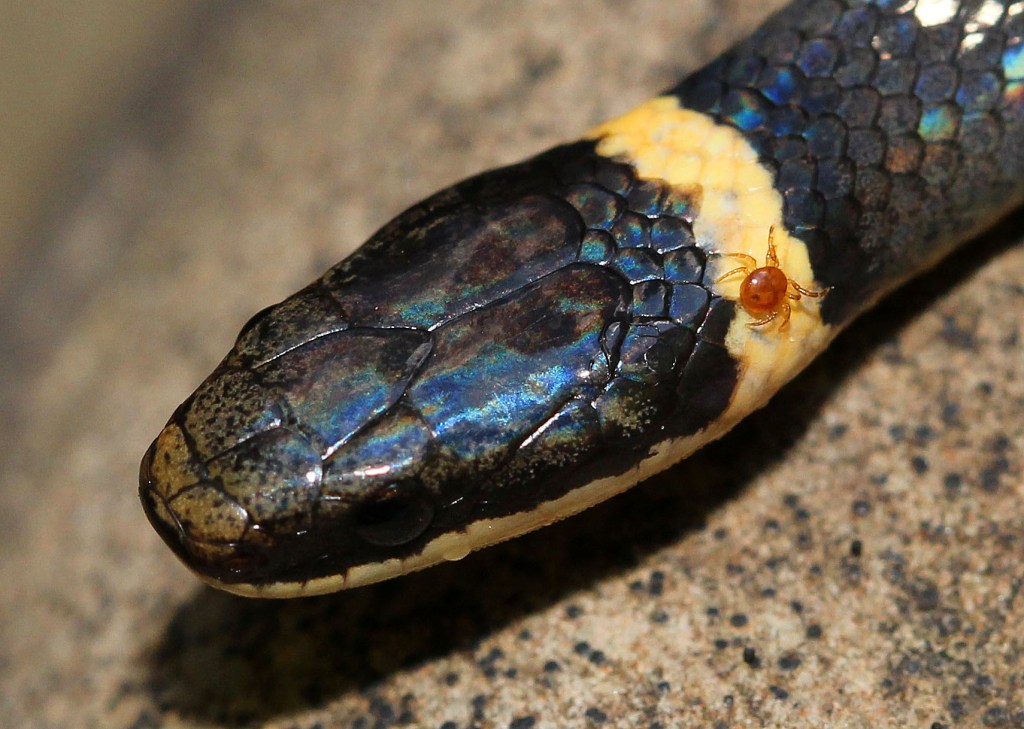
A gorgeous animal by any possible criteria, this Northern Ring-necked Snake, Diadophis punctatus edwardsii, is what had us so enthralled. From the outset of this August 18 trip to the wilds of southern Ohio, I had been exhorting my expedition comrades to "find a ring-neck, find a ring-neck, find a ring-neck". We had three topnotch snakers along: John and Vince Howard, and David Hughes. I am NOT much of a snake-finder. I really like them, but get too fixated on other pursuits while afield to devote much time or energy to turning rocks and logs, and doing what is required to produce snakes.

Anyway, the three aforementioned snakists spent a fair bit of time flipping objects, and one of them (can't remember who) eventually produced this beauty, which was carefully placed on this rocky runway for a modeling/photography session.

If I had to pick a favorite snake, it would be the Ring-necked Snake. What's not to like here? Ring-necks are stunning little animals, and a wonderful entree into the world of snakes. They are small - a whopper only reaches a bit more than a foot in length - and exceedingly gentle. I've never had one attempt to bite, nor have I heard of that happening. Even if a ring-neck snapped someone's finger, its mouth is so small it couldn't do anything. Thus, the ring-neck is a wonderful animal to introduce to someone with a fear of reptiles, or who has had little experience with snakes.

The colors and patterning of the Ring-necked Snake are striking indeed. The dorsal, or upper, surface is plated in a dark steely blue-black, and the ventral (lower) side of the animal is a beautifully contrasting golden-orange. The effect is quite striking - no pun intended - and is augmented by the pale yellow neck collar.

Ring-necked Snakes are common in parts of southern and eastern Ohio, where they inhabit rocky streams such as where this one was found, moist forested slopes, regenerating clearcuts and other such wooded habitats. They're a bit of work to find, though. Occasionally I just stumble into one that is out and about, but apparently ring-necks are primarily nocturnal. Hence the need to go poking under hiding spots in good habitat to find one.

We noticed that this specimen had a hitchhiker. The orangish object on the snake's neck collar is a mite. Snakes can become afflicted with parasitic mites, which apparently can become a real problem with captive animals. In the wild, mites are probably not so much of an issue for the animals. I know very little about mites, especially those that parasitize snakes, but I don't think this mite is the same species that plagues captive animals. For all I know, it is just using the snake to ride to a new locale - mites often hitchhike on animal taxicabs. Anyway, it made this snake experience all the more interesting. Perhaps one of the herpetologists out there can shed some light on this.

I'm sure that I'm preaching to the choir here, but I want to reinforce that snakes are beneficial and should be protected at all costs, whether relatively "cute" species such as this Ring-necked Snake, or less enchanting behemoths such as Black Rat Snakes. If you don't like them, let them be and they'll do the same. If a snake is somewhere you'd rather it wasn't, such as an Eastern Garter Snake in the garden or an Eastern Milk Snake in the shed, please just relocate it to somewhere else. Or have someone move it for you. I get a disconcerting number of photos sent to me each year from people wanting to know the identification of a snake, often thinking it might be a venomous species. They're invariably harmless species, but what bothers me is how many of the snakes in these photos are dead - slaughtered by the blade of a shovel. The ignorant killing of snakes absolutely disgusts me, and it is almost never, if ever, neccesary to slay them.

If everyone had firsthand exposure to a gentle Ring-necked Snake, and could see up close and personal just how cool snakes are, I'm sure our tubular reptiles would have many more fans.

Wednesday, November 28, 2012

Barn Owl and cat hit it off, big time!

I'm on a bit of an owl jag, but one can never get enough of owls! A friend shared the following video with me, and it is amazing. It features a Barn Owl, Tyto alba, that was raised from a chick and trained for falconry, of all things. The owl is named Gebra, and her most unlikely buddy is a black housecat dubbed Fum. These animals live in Spain, and were born in early spring of 2010. They were introduced when only a month old, and as you'll see, hit it off rather grandly.

Sorry, for some reason YouTube won't allow me to embed this video, so just click on the following link to view it: http://youtu.be/mWhD5bc6Fmg

Tuesday, November 27, 2012

Eastern Screech-Owl becomes one with the tree

This stretch of bike trail along Alum Creek in Westerville gets lots of traffic - runners, walkers, bikers - just not at the moment that I made this photo. The trail has of late seen an uptick in a new element of user - birders. For some time, there has been an especially cooperative Eastern Screech-Owl, Megascops asio, roosting in a tree in the swatch of scruffy riparian woodland shown in this image. As this locale is only 12 minutes from my office, I've been wanting to pay a visit, camera in tow, for some time. Finally, after seeing another post to the Ohio Birds Listserv about the owl from Ira Shulgin, I had to trot up there yesterday over the lunch hour. Ira was good enough to give me precise directions to the roosting tree, which enabled me to quickly locate the little hooter.

Young riparian, or streamside, woods are often scruffy places, in part due to a proliferation of Box-elder trees, Acer negundo. These gnarled and scraggly maples are often a dominant tree in early successional habitats, and what they lack in aesthetics they more than make up for in wildlife value.

This is the owl's home turf, as seen from the edge of the bike path. The spot that is circled in red marks the owl cavity about 20 feet up in a Box-elder, and it would be extremely easy to walk right by and never notice. Scores of people do just that every day.

However, a close look at the Y-fork in the tree reveals a sleepy little owl, soaking up early afternoon rays. Eastern Screech-Owls are consummate bark mimics, and their plumage can match the bark of trees to a remarkable degree. Such camouflage serves to hide them well from potential predators, and the owls tend to hole up tight in spots such as this during the daylight hours.

That doesn't mean that they'll be missed by everyone. Tree-gleaners such as chickadees, nuthatches, and titmice often stumble into roosting screech-owls as they go about their business of inspecting tree trunks. When this happens, quite the hue and cry will be made and before long an entire gang of noisy chickadees and other songbirds will form a conspicuous twittering crowd around the hapless owl. Many a birder has discovered a roosting owl with the assistance of mobbing tree-gleaners.

Eastern Screech-Owls come in two classic color morphs: red, and gray. This individual is a gray, and this color form really blends well with bark. For the 20 minutes or so that I admired the bird, it never bothered to open its eyes and give me a glance, near as I could tell. Such slothfulness is typical daylight behavior for a screech-owl.

These owls are very common throughout Ohio - easily our most common owl species. They have a strong affinity for streamside habitats, and places such as the site depicted in this post almost always have them. This is in part due to the Box-elder trees, which often form good roosting cavities. It's a great irony that tree species that are typically derided as worthless by loggers, foresters and the lumber industry are often of the greatest value to wildlife.

If you are interested in owls - and who isn't! - mark your calendar for the weekend of February 15-17, 2013. That's when the Ohio Ornithological Society and Greater Mohican Audubon Society will be holding its Owls of North America Symposium at beautiful Mohican State Park. The event is headlined by the incomparable Denver Holt of the Owl Research Institute, and what a speaker he is! In addition to talks, there'll be field trips, owl-banding for Northern Saw-whet Owls, and much more. GO HERE to register.