Enjoy, and thanks for sharing these, John.
A romp through the diverse flora and fauna of Ohio. From Timber Rattlesnakes to Prairie Warblers to Lakeside Daisies to Woodchucks, you'll eventually see it here, if it isn't already.
Friday, March 11, 2011
Some very foxy photos
John Howard sent along some excellent photos of a Red Fox that he happened across a while back down in Adams County. He had the camera at hand and was quick on the trigger, and did a marvelous job of capturing the clever little beast as it made its prowls.
Enjoy, and thanks for sharing these, John.

Enjoy, and thanks for sharing these, John.
Wednesday, March 9, 2011
Red Fox
An alert Red Fox, Vulpes vulpes, warily eyes the camera man. Photo courtesy Tim Daniel/Ohio Division of WildlifeI recently wrote a piece about one of our handsomest mammals, the Red Fox, which appeared in last Sunday's Columbus Dispatch. At the end of the column, I asked readers to let me know of any foxes that they had seen within the limits of Interstate 270 - Columbus' outerbelt , which largely defines the city and its suburbs. And only sightings from within the last year, so as to get an up-to-date snapshot of their frequency in our city.
Well, I received 53 e-mails from area residents, and two things became obvious. One, Red Foxes are thriving within the city, and two, people really like these animals. Their larger brethren, the Coyote, tends to provoke a much more negative and often semi-fearful response; not so with the fox. People often spoke quite fondly of their encounters and made mention of the pleasure they got from having the opportunity to observe and admire these clever little animals.
Following is my Dispatch column in case you would like to read it, and after that is a map that I made that shows the approximate locations of the fox reports that I received.
Columbus Dispatch
NATURE
Cute, clever foxes are all around us
Sunday, March 6, 2011
Jim McCormac
“If the lion was advised by the fox, he would be cunning.” — William Blake
Sly, svelte and good- looking, the red fox is your neighbor — although you might not know it.
One of our most interesting mammals, foxes are adaptive and faring well, even in suburbia. These clever beasts recognize us as one of their few enemies, and that, coupled with their mostly nocturnal habits, keep the fox largely out of sight and mind.
A red fox is worth a gander, if chance permits.
It’s testimony to the fox’s good looks that especially pretty women are called “foxes.” Bright-eyed and bushy-tailed, the fox is endowed with a gorgeous coat of burnt orange. A white breast and dark legs give the impression that it wears black stockings and a bib. The incredible white-tipped tail can be well over half the animal’s length. It serves as a rudder on aerial leaps and helps balance the animal when in full gallop.
Foxes are canids, the same family that your dog belongs to. They do look doglike, albeit small: A 15-pound fox would be hefty, and they’re only 31/2 feet long. Were it not for the thick coat, a fox would be but a wisp of itself.
Foxes act catlike in spite of their canine lineage, as anyone who has watched them hunting mice knows. They’ll furtively stalk prey, then pounce in a stiff-legged leap, deftly seizing the victim.
Red foxes pair up in winter to breed. Their dens are usually modified woodchuck burrows, but they’ll use rock piles, hollow logs or other suitable crevices. The babies — kits — are born in early spring. Watching an active den is a treat. The kits, which usually number a half-dozen or so, cavort and tussle near the entrance like kittens. The parents bring wounded chipmunks and other small prey so that the youngsters can practice the craft of killing.
Foxes aren’t strict meat-eaters, though. They’re omnivorous: They eat a variety of foods. During summer and fall, berries and other vegetable matter become dietary staples.
I once drove by a rural farmhouse with scads of chickens in the yard when something caught my eye. It was a red fox, frozen stiff as a statue, paw in the air and poultry on its mind, looking straight at me. Busted, the fox scampered off.
The clever creatures aren’t usually chicken thieves, though, and are far more beneficial than detrimental. They’re inveterate mousers and partial to the rabbits that plunder your garden. Fluffy should be safe, too: Cats are usually too much for a fox to handle.
In 1962, 70 of Ohio’s 88 counties offered bounties on foxes. People didn’t understand the importance of predators, and foxes were vilified as killers of “good” animals. In 1975, the archaic bounty practice was banned.
Today, red foxes are common in every Ohio county and plentiful in urban areas such as Columbus.
Naturalist Jim McCormac writes a column for The Dispatch the first and third Sundays of the month. He also writes about nature at jim.mccormac.blogspot.com.
Further afield
• Let me know whether you’ve seen any red foxes during the past year within the bounds of I-270. Drop an e-mail to ambrosia@columbus.rr.com.
• One of spring’s great natural phenomenons is the running of the salamanders. Naturalist Chrissy Pheifer will present a program titled “Salamanders: The Mystery and Journey” at the Columbus Natural History Society meeting at 7:30 p.m. March 14 in the Museum of Biological Diversity, 1315 Kinnear Rd.
Locations of red fox sightings in Columbus, Ohio, over the past year. A few of these foxes are local celebrities and were reported by multiple observers. And I'm sure there are plenty of others going unreported. Thanks to all who shared their sightings!Monday, March 7, 2011
Royal Tern - in Ohio!
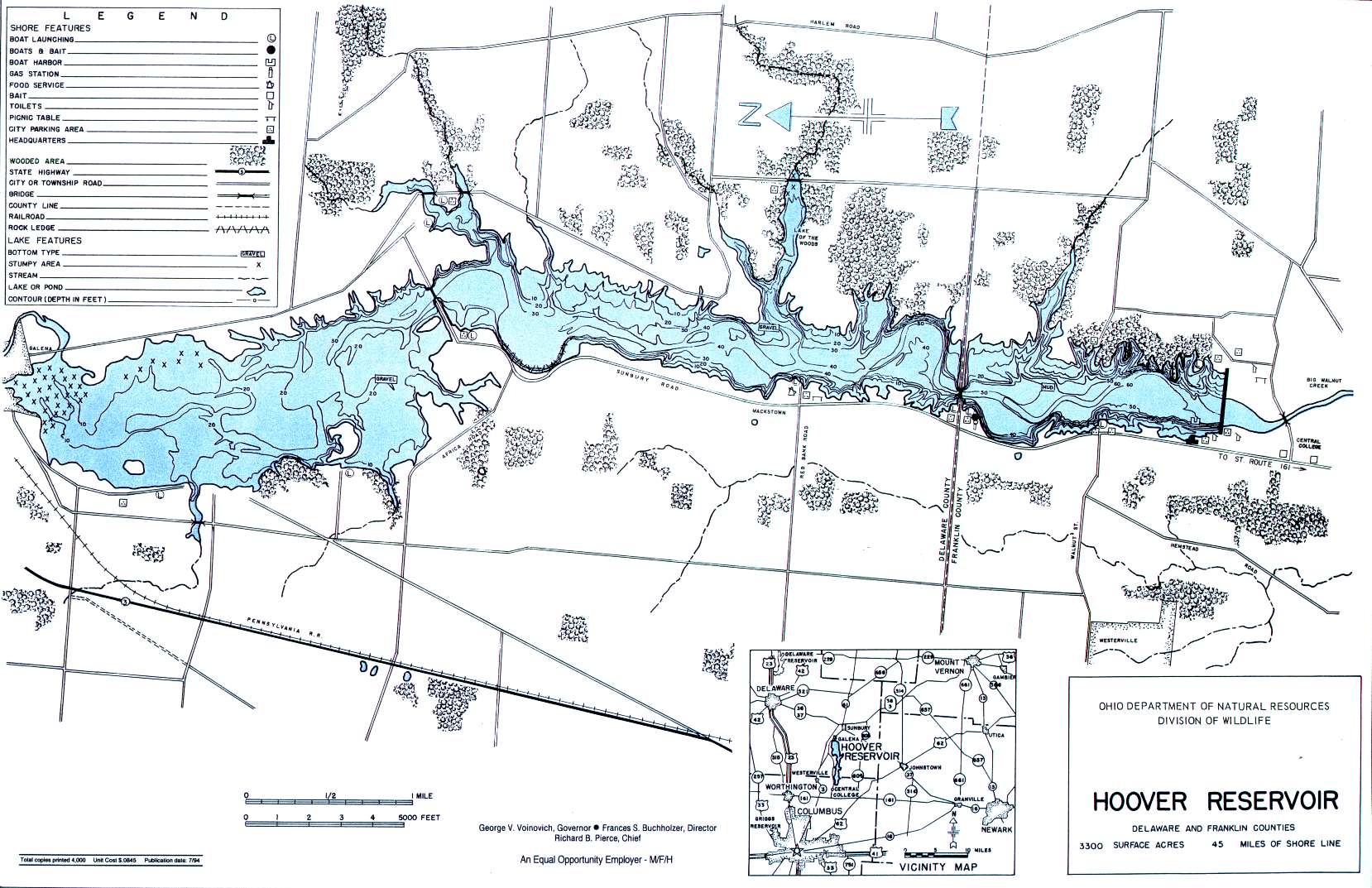
But let's tern the conversation to the bird at hand. I was able to run up to Hoover today during lunch - I have the great fortune of only working about 15 minutes away - and quickly found the bird, along with a number of other birders.
While Royal Terns rarely leave their coastal haunts, wayward individuals do turn up far from home. These vagrants have been seen in the Great Lakes region before. Michigan just had their first record last year, for instance. Ohio had but one prior record - a bird that spent part of July and August of 1995 wandering our Lake Erie coastline. I never did catch up with that one, so it was certainly a pleasure to see this wanderer, and so close to home.
The photos above were mine, taken with my dinky 300mm lens. Now comes the real treat. I ran into Dane Adams at Hoover, and he had his big gun along - an 800mm cannon. If you've read this blog much, you've probably seen some of Dane's outstanding work, as he's good enough to share his photos with me from time to time. And he's done so once again... read on.
Thanks to Dane's photo, it's as if we've got the bird in hand. There are only two likely issues of identification, with the two other jumbo North American terns. Caspian Tern, which is seasonally common in Ohio and a regular migrant at Hoover Reservoir, is a very understandable source of confusion. It is the only regularly occurring big tern in the state, and without benefit of a good look, that's what one would be left thinking.
But with a look like this, the distinctive yellowish-orange bill can be discerned - in Caspian the bill is a honking big reddish thing. Also, the undersides of the primary feathers are pale dusky gray, other than the V of darker pigment that outlines these feathers. In Caspian Tern, the lower primaries are much darker and form a conspicuous blackish blotch.
Trickier perhaps is separating Royal Tern from its congeners in the genus Thalasseus. In North America, that means the Elegant Tern, found on the West Coast but with a few vagrant East Coast records. That species would be even more exciting here in Ohio, but it can be ruled out by the bill, which is long, slender and somewhat downcurved in Elegant. Among other differences.
But, as Kenn Kaufman noted in a an Ohio Birds listserv post, there are other terns in the world that resemble Royal, notably another Thalasseus, the Lesser Crested Tern. I have no direct experience with that species, but it seems to have a distinctly different wing pattern, such as bolder, wider stroke of black on the trailing edge of the underside of the primaries. But with photos like Dane's now out there, if some expert thinks otherwise they have excellent photographic resources to work with.
Thanks much to Kenny Davis, who first sounded the alert that a big tern was flying about Hoover, and to Vic Fazio for his detective work that led to the identification. This Royal Tern was #364 on my Ohio life list - the only bird list that I keep.
Sunday, March 6, 2011
Snow Trillium erupts
On my way back from yesterday's Amish Bird Symposium in southernmost Ohio's Adams County, I stopped off to have a look at our largest population of Snow Trillium, Trillium nivale. Don't know that I would have, ordinarily, but John Howard tipped me that he'd seen a few plants in bloom there the preceding Wednesday.
Snow Trillium is one of nearly 100 species of vascular plants that was discovered and described to science from Ohio. The type locality - the place of the original discovery and collection - was along the banks of the Scioto River near Columbus, in 1834. John Riddell was the collector and his type specimen still exists, safeguarded in the New York Botanical Garden. If you want to see it, click HERE.
Every week will bring new plants pushing forth and spreading their petals. March is a welcome time of year after these cold and snowy past few months.
Friday, March 4, 2011
Shreve Migration Sensation
If you are looking for a good time on the cheap, come on up to the little town of Shreve in Wayne County, Ohio on Saturday, March 26th. That's the date of the now legendary Shreve Migration Sensation. For the admission price of $10.00, you'll get more bang for the buck than any other event.
Shreve is a beautiful community nestled in the gently rolling hills buffering the Killbuck Valley. Good thing we aren't holding this event about 11,000 years ago, when a ferocious torrent of water burst through the retreating Wisconsin glacier and carved out the valley and shaped those rolling hills. We would have been flooded out, big time.
Your narrator leans against a post in downtown Shreve. Note the sign, and the flags flying from the streetlights. This town of about 1,600 people really gets into the act; it's impossible not to when your town swells by about 1,000 new people for a day. This is Ohio's largest one-day birding festival, and is probably one of the largest such single day events anywhere.
Keen observer that you no doubt are, you may have noticed that I was holding a bag in the shot above. Yes, indeedy-do, it was a bag full of Amish-made cookies from this restaurant, the Des Dutch Essenhaus. It goes without saying that the cookies are magnificent, or so say all of the people that I give them away to. Yeah, right, whatever - I can vouch for their tastiness and it's worth a trip to Shreve just to bag some.
The hub of Migration Sensation activities is this bulding, the local school. That's the original structure on the right; a newer addition on the left. The Sensation always features a half-dozen presentations on various topics, and the programs take place in the gymnasium of the older building.
Believe it or not, Shreve is my mother's hometown. She attended this school. And when I give my program on Ruby-throated Hummingbirds there this year, it'll about the sixth or seventh year in a row that I've given talks in this building. I find this very cool, nearly surreal, especially since my mom - and dad - have sat in the audience and heard their son speak, such as last year. I would bet you $58.00 bucks that my mom, when but a tiny tot racing about in that gymnasium some years back, would never have envisioned that one day she would have a boy who would grow up to like birds and would be speaking about them as an adult in the very gymnasium that she frisked about as an elementary school child. And she would be there to listen.
The newer wing of the school also sports a gymnasium, and it is packed to the gills with vendors, exhibitors and various displays. Come on up, and I'll guarantee that you'll see some of your friends in there. And likely meet some new ones.
A troop of birders marches into the swamps of the Killbuck Wildlife Area. A month or so later the monotone swee-swee-swee's of Prothonotary Warblers will fill these woods, but for now we'll have to make due with the grating churrs of Red-headed Woodpeckers. And plenty of other birds, including all of the other regularly occurring Ohio woodpeckers.
One of the ponds that dot the local landscape. I took this shot at a past Sensation, and this water body, small that it is, had at least the following floating about: Mallard, American Black Duck, American Wigeon, Ring-necked Duck, Redhead, Canvasback, Lesser Scaup, Ruddy Duck, and Common Merganser.
Waterfowl are the centerpiece of Migration Sensation field experiences. The largest wetland complexes in the state away from Lake Erie are found in the broad Killbuck Valley, and the sheer numbers and diversity of fowl is typically staggering. Expert birders are stationed at all of the hotspots to help, and you'll have the company of numerous other birders of all stripes. This is a great chance to learn more about birds from lots of friendly and helpful people.
A shot across the wetland-filled Kiillbuck Valley, just a stone's throw north of Shreve. Those are Tundra Swans, the big ivory lumps. Tons of other stuff, too, and those toughest of swallows, the Tree Swallow, should be back in numbers by the time of the Sensation. Sometimes a noteworthy rarity pops up, such as Eurasian Wigeon or White-winged Scoter, sending ripples of excitement through the crowd and causing a migration of birders to the hotspot.
Two years ago, some sharp-eyed birder spotted this dozing Barred Owl taking siesta in a gnarly swamp white oak. The brown-eyed hooter had kindly positioned himself right by a road, and of course word spread. By day's end, more people had fawned over this owl than had seen any of us speakers. We, in essence, were trumped by a chubby bag of feathers who had not even bothered to assemble a PowerPoint.
But that's as it should be at the Shreve Migration Sensation: Birds First.
Come on up, you can pay your ten bucks at the door. All of the details can be found RIGHT HERE.
Shreve is a beautiful community nestled in the gently rolling hills buffering the Killbuck Valley. Good thing we aren't holding this event about 11,000 years ago, when a ferocious torrent of water burst through the retreating Wisconsin glacier and carved out the valley and shaped those rolling hills. We would have been flooded out, big time.Believe it or not, Shreve is my mother's hometown. She attended this school. And when I give my program on Ruby-throated Hummingbirds there this year, it'll about the sixth or seventh year in a row that I've given talks in this building. I find this very cool, nearly surreal, especially since my mom - and dad - have sat in the audience and heard their son speak, such as last year. I would bet you $58.00 bucks that my mom, when but a tiny tot racing about in that gymnasium some years back, would never have envisioned that one day she would have a boy who would grow up to like birds and would be speaking about them as an adult in the very gymnasium that she frisked about as an elementary school child. And she would be there to listen.
Waterfowl are the centerpiece of Migration Sensation field experiences. The largest wetland complexes in the state away from Lake Erie are found in the broad Killbuck Valley, and the sheer numbers and diversity of fowl is typically staggering. Expert birders are stationed at all of the hotspots to help, and you'll have the company of numerous other birders of all stripes. This is a great chance to learn more about birds from lots of friendly and helpful people.
But that's as it should be at the Shreve Migration Sensation: Birds First.
Come on up, you can pay your ten bucks at the door. All of the details can be found RIGHT HERE.
Thursday, March 3, 2011
Deciphering the language of chipmunks
Eastern Chipmunk, Tamias striatus. The little beasts certainly deserve our thanks and appreciation. Vital cogs of the eastern deciduous forest ecosystem, "chippies" serve valuable roles in seed dispersal and as food for things with a taste for meat.But chipmunks don't like to be eaten. And they express their displeasure with organisms who might pose them a threat loudly, and with gusto. We've all heard their scolding chitters, and most of these calls - two out of three, it turns out - are pretty intuitive. But their other oft-given sound has always puzzled me, as it is quite different than other chipmunk sounds.
Well, I learned a great thing today, courtesy of Lang Elliott and his excellent blog. It's Lang's incredible recording of Hermit Thrushes and companions that was the subject of the previous blog.
It turns out that Lang did extensive field studies on Eastern Chipmunks as part of his research for his masters degree. He tracked the behavior of an upstate New York population, and was able to place their vocalizations into three major categories: high-pitched chips; chip-trills; and clucks. The first two types are pretty intuitive if you've spent much time watching chipmunks. If they see a threat, such as us, they offer up a series of loud chips. Ditto the "chip-trill" calls, although Lang was able to show that one is invariably given as the animal races into a subterranean hiding spot, and now that I know that, that's been my experience, too.It was the third call type, the "cluck", that always puzzled me. It's a conspicuous forest sound, and I've found that a surprising number of people don't associate the call with a chipmunk. With good reason - it is quite unlike their other sounds. The cluck call sounds like a drumstick being rapped against a hollow log - a deep TOCK, TOCK sound, at rather well spaced intervals.
Well, Lang's known about this since the 1970's and his field studies, and perhaps you did, too, but it's new knowledge to me. The cluck notes are the chipmunk's warning calls for AERIAL THREATS! How cool is that?! Say a Red-shouldered Hawk is perched close at hand. The observant little chippies go on high alert and start issuing hollow TOCK notes to their buddies while the raptor or owl is in the area and of potential danger.
There are three reasons that I am greatly pleased by this knowledge: One, I don't like it when I encounter something frequently and don't understand it; two, I can now share this very cool factoid when CLUCKING chipmunks are encountered; and three, we can use the chipmunks' alerts as a cue to look for nearby raptors!
Thanks, Lang, and be sure and visit his blog RIGHT HERE and listen to chipmunk calls for yourself.
Wednesday, March 2, 2011
This, you must hear
Lang Elliott is one of the most accomplished recordists of the natural world, of all time. His skills are all the more amazing considering he was partially deafened by an errant firecracker in his youth. If you like birds and nature and have made much effort to learn about it, you've heard Lang's work somewhere along the way.
The following recording should strike most people dumb, at least for a few minutes. Lang made it some time back, in upstate New York along the margins of a peat bog. Taped at that transitional time when darkness gives way to light, it captures the dawn songsters heralding a new day, while creatures of the night sing their final night songs.
Hermit Thrushes are the indisputable stars of the show. Their haunting, ethereal melodies create a rich tapestry of sound so melodic it is hard to believe mere feathered creatures could create it. A pack of coyotes in the distance add eerie but somehow fitting ambience, as do the raucous hoots of a Barred Owl. Lesser songsters punctuate the sound track: soft chew-beks of a Yellow-bellied Flycatcher, the ornately jumbled complexities of an Ovenbird singing its dusk/dawn song, the nasal banjo-twangs of green frogs.
There's more, too. Have a good listen to one of the finest symphonies on earth, RIGHT HERE
Subscribe to:
Posts (Atom)